

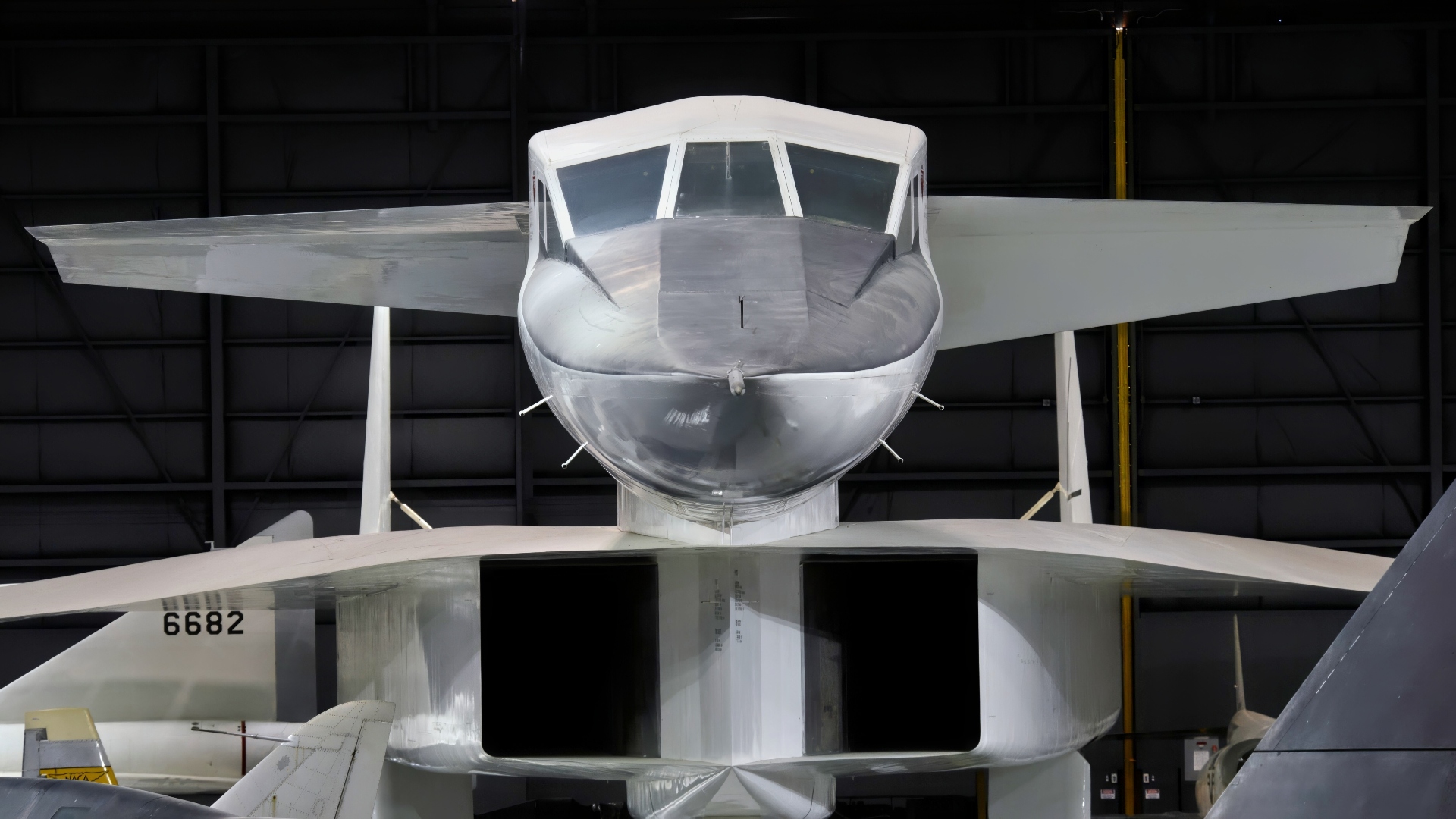
Key Points and Summary – The North American XB-70 Valkyrie was a “technical marvel” of the 1950s—a Mach 3, 70,000-foot nuclear bomber designed to replace the B-52.
-It used a “revolutionary” principle called “compression lift” to ride its own shockwave.
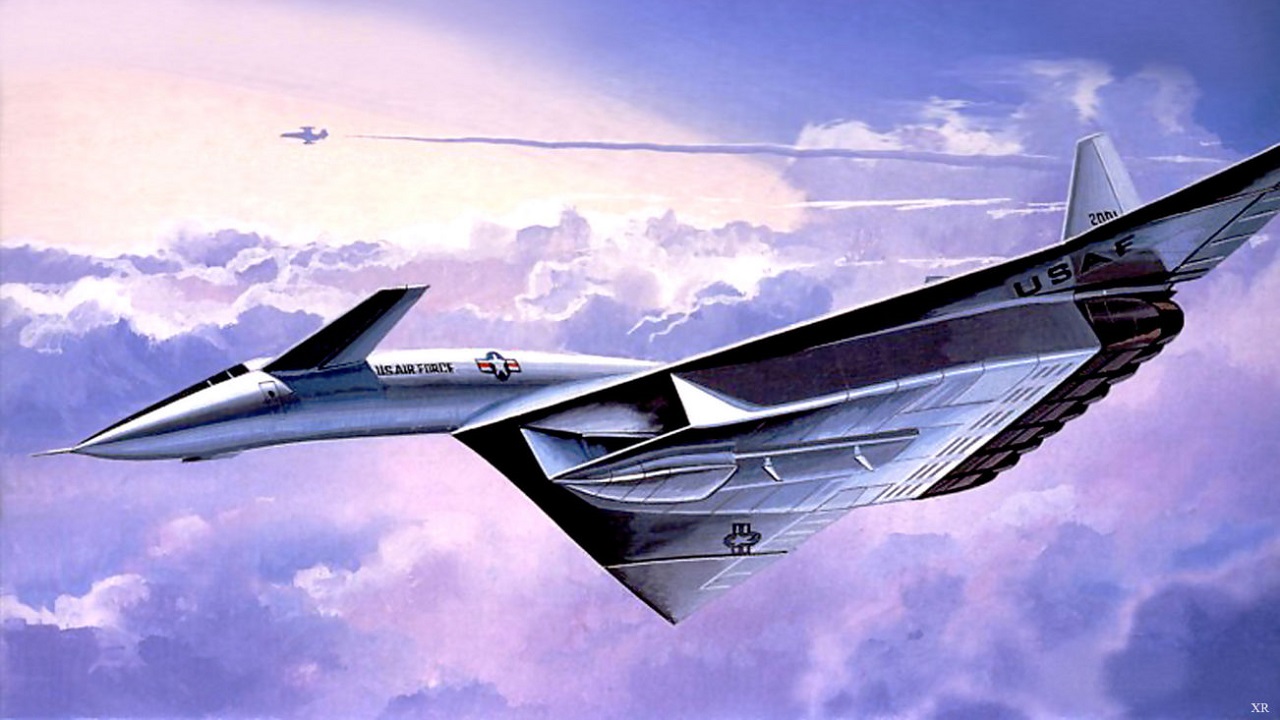
XB-70. Image Credit: Creative Commons.

XB-70. Image Credit: Creative Commons
-However, the program was canceled by the Kennedy-Johnson administration in 1961 due to its “very expensive” cost, its new vulnerability to Soviet SAMs, and the rise of “cheaper” ICBMs.
-The Valkyrie’s fate was sealed in a “deadly accident” in 1966, when an F-104 chase plane got caught in its wingtip vortex during a photoshoot and collided with the bomber, killing two pilots.
Should The Air Force Have Built The Mach 3 XB-70 Valkyrie?
The North American XB-70 Valkyrie was a Cold War bomber that could outrun Soviet defenses at Mach 3 and at an altitude of 70,000 feet. Unlike the SR-71, which embodied those same attributes, the Valkyrie would be armed with nuclear weapons. It was a technical marvel of its time.
Initially conceived as a replacement for the B-52, the Valkyrie boasted sharp angular design features, including six afterburning engines and a shockwave-riding airframe.
The XB-70 carried the same combat load as a B-52 but had triple the speed.
However, the Air Force decided against the massive bomber, as improvements in Surface-to-Air Missiles (SAMs) made it vulnerable, and instead chose ICBMs as they developed. The Air Force then transitioned to low-level penetration missions using the B-1 bomber and later employed stealth technology.
Was it a mistake?
The Chooser Of The Slain
The name “Valkyrie” itself means “chooser of the slain” in Old Norse. The Valkyries were tasked with selecting the most heroic warriors who died in battle to join Odin in Valhalla. They were seen as symbols of both valor and honor, representing the glory and potential afterlife of warriors who died in battle.
The Air Force initiated the XB-70 bomber program in 1955, aiming to develop a Mach 3 bomber capable of flying at 70,000 feet. In September 1957, the Air Force issued a new set of requirements that called for a bomber with a cruising speed of Mach 3.0 to 3.2, an over-target altitude of 70,000 to 75,000 feet, a range of up to 10,500 miles, and a gross weight not to exceed 490,000 pounds.
The XB-70 Had Fuel Tanks The Size of a Bomber
The XB-70 was initially designed to operate under the “brute force concept,” which called for carrying a massive amount of fuel for a long-duration subsonic flight into Soviet territory and an aerodynamic design that was optimized for high performance during a relatively “short” sprint through enemy airspace.
This approach led to massive concepts that leveraged external fuel tanks that could be jettisoned once depleted. These “tip tanks” may have been disposable, but they were neither small nor cheap.
As a 1960 Congressional report pointed out, each 191,000-pound tip-tank was approximately the same size as America’s existing B-47 Stratojet long-range nuclear bomber.
General Curtis LeMay, a legend of World War II’s European and Pacific air campaigns, was not impressed.
“This isn’t an airplane,” LeMay reportedly said, “this is a three-ship formation.”
The XB-70 Takes Shape
North American Aviation engineers revisited the redesign of the aircraft. They utilized a document, “Aircraft Configurations Developing High Lift-drag Ratios at High Supersonic Speeds,” to explain that aircraft designed from nose to tail for a single flight condition could dramatically outperform those designed to compromise between high- and low-speed flight.
Engineers at North American Aviation used a principle called ‘ compression lift ‘ to build a bomber that could fly at Mach 3 for 7,500 miles. This had initially been researched by the National Advisory Committee for Aeronautics (NACA, which today is NASA).
Compression lift occurs when a conical body underneath the center of a wing pushes the air to the sides, increasing pressure under the wing section and thus dramatically increasing lift. This eliminates the need for a large wing, which creates considerable drag.
The XB-70 was designed to utilize the compression lift principle by riding its shock wave, generated by supersonic flight, and using the lift thus created, much like a surfer rides a wave. The conical body underneath the wing’s center evolved into a giant pod, slightly triangular when viewed from below, which housed six engines, a bomb bay, and landing gear.
The Valkyrie was powered by six General Electric J93-GE 3 turbojet engines, each delivering around 30,000 lb of thrust in the afterburner. Due to the installation design, an engine can be removed and replaced in just a couple of hours.
The engines were mounted side by side at the rear of the underwing pod. Two large rectangular inlet ducts provided two-dimensional airflow. A series of variable ramps inside the intakes, called the Air Induction Control System (AICS), would expand and contract to manipulate airflow to the engines and protect them from the powerful shock of supersonic air.
The system detected small changes in pressure during flight and reduced supersonic air to subsonic speeds at the engine faces.
The XB-70 was operated by a four-person crew, comprising a pilot (and aircraft commander), co-pilot, bomb and navigation officer, and defensive systems officer.
The cabin was designed to provide each crew member with an “encapsulated ejection seat” that would enclose them, providing pressurized oxygen for the descent from 70,000 feet. This had already been designed for the B-58.
The Valkyrie’s large delta-wing was paired with forward canards, also known as horizontal stabilizers, which provided lift ahead of the aircraft’s center of gravity and allowed for better trim control and a reduction in trim drag at high supersonic speeds.
The canards themselves had flaps, which, coupled with using the aircraft’s elevons as flaps and the large delta wing, allowed for lower speeds on takeoff and landing than would otherwise be possible with such a design.
The outer wing panels were hinged to allow for improved subsonic and supersonic flight. The panels were flat during takeoff and low-speed flight, effectively extending the wing surface and improving the aircraft’s lift-to-drag ratio.
Once the Valkyrie reached supersonic speeds, the wingtips would angle down to reduce the wing area behind the bomber’s center of gravity (reducing trim drag) and increase directional stability at high speeds.
The Valkyrie Was the Answer to the B-52s’ Obsolescence
In early 1960, then-Senators John F. Kennedy and Lyndon Johnson made public statements in favor of the Valkyrie program before winning the 1960 Presidential election over Richard Nixon.
In a humorous quip, Johnson cited the B-52’s “obsolescence” as a reason for continuing the Valkyrie program. Now, some 65 years later, the B-52’s service life shows no signs of ending.

A B-52 Stratofortress assigned to the 2nd Bomb Wing at Barksdale Air Force Base, Louisiana, takes off to return home from a Bomber Task Force deployment at Navy Support Facility, Diego Garcia, April 3, 2024. The U.S. routinely and visibly demonstrates commitment to our Allies and partners through the global employment of our military forces.(U.S. Air Force photo by Master Sgt. Staci Kasischke)

A U.S. Airman guides a B-52 Stratofortress into to its parking position at Morón Air Base, Spain, May 20, 2025. The 496th Air Base Squadron provided coordinated support across airfield operations, refueling, lodging, and security to ensure mission readiness. (U.S. Air Force photo by Cristina Oliveira)
However, by the early 1960s, new Surface-to-Air Missiles (SAMs) threatened the survivability of high-speed, high-altitude bombers. Less costly, nuclear-armed ICBMs (Intercontinental Ballistic Missiles) were also entering service. They were improved in their guidance systems and command and control, which were much better than those of the earlier models.
But a year later, the Kennedy-Johnson administration would axe the XB-70 program. The aircraft would be used for testing purposes at NASA.
A Deadly Accident Seals The Valkyries’ Fate
During a photoshoot opportunity, disaster struck. Al White and Maj piloted the Valkyrie. Carl S. Cross.
An F-104N, flown by Joe Walker, began to move in close to the XB-70’s right wingtip, too close for safety. The Valkyrie’s angled-down wingtips generated strong vortices, and these caught the F-104N and flipped it over onto the Valkyrie’s back.
The upside-down Starfighter smashed across the Valkyrie’s tail surfaces, tearing most of them away and damaging the left wing. Joe Walker was killed instantly upon impact, and his F-104N fell to the floor of the Mojave Desert in a ball of flames.
For 16 seconds, the Valkyrie continued in straight and level flight, but then went into two slow rolls and broke into an unrecoverable flat spin. White managed to eject, but Cross was killed when the aircraft hit the ground in an upright and level configuration. White received serious injuries during ejection, but later returned to flight status. He never flew the remaining XB-70 again.
Should The USAF Have Built The Valkyrie?
The XB-70 wasn’t suited to the low-level bombing strategy that the Pentagon adopted. And they were convinced that the Valkyries could survive the SAM belts that the Soviets were building, although the Mach 3 SR-71 Blackbird spy plane was never shot down, despite having 4,000 missiles launched at it.

SR-71. Image Credit: Creative Commons.
But the Valkyrie was very expensive.
With the improvements made to ICBMs, which were based both on land and at sea on submarines, they became much cheaper and easier to protect. The bomber worked perfectly fine in an environment that changed quickly all around it.
It was the right decision, but it was still disappointing not to see it fly.
The remaining Valkyrie flew to Wright-Patterson Air Force Base in Ohio, where it was displayed at the Air Force Museum. It resides there today.
About the Author: Steve Balestrieri
Steve Balestrieri is a National Security Columnist. He served as a US Army Special Forces NCO and Warrant Officer. In addition to writing on defense, he covers the NFL for PatsFans.com and is a member of the Pro Football Writers of America (PFWA). His work was regularly featured in many military publications.
More Military
Russia’s Mach 2 Su-30SM Fighter Has A Message for Any Air Force on Earth
The Mach 2.2 B-1A Bomber Has A Message for the U.S. Air Force
The Mach 2.35 ‘Super’ Eurofighter Typhoon Fighter Has a Message for Any Air Force On Earth
Canada’s CF-18 Hornet Fighter Crisis
Forget NGAD or the J-20: A 7th Generation Fighter Could Hit Mach 5


