

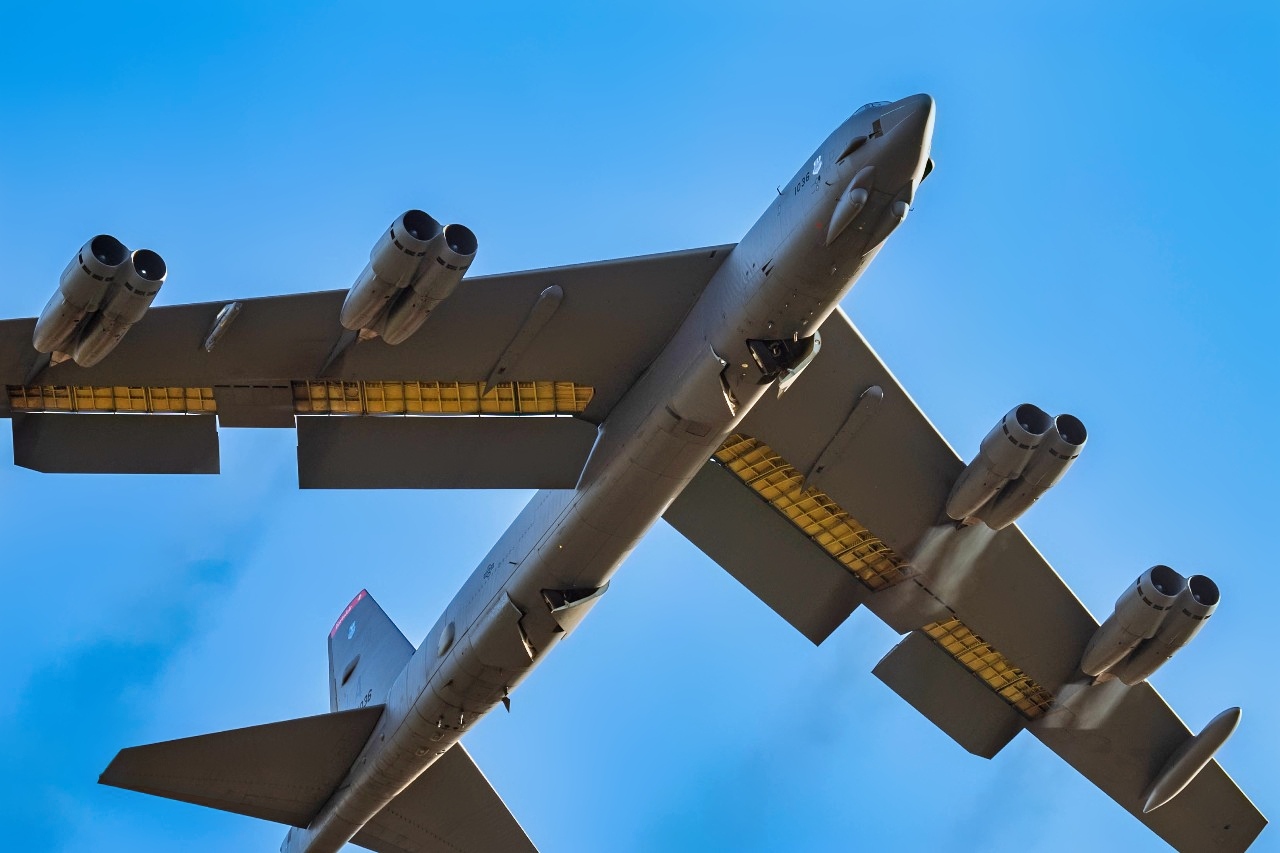
Key Points and Summary on the B-52H – The Boeing B-52H Stratofortress, a cornerstone of American air power since the 1950s, is set to fly for over a century thanks to significant modernization.
-Originally designed as a Cold War nuclear deterrent, the “BUFF” has proven its versatility in numerous conflicts, from Vietnam to the Global War on Terror, carrying massive conventional payloads.
-Now, with major upgrades including new Rolls-Royce engines and an advanced AESA radar system, the B-52 will continue to serve as a formidable long-range strike platform alongside the B-21 Raider, ensuring its relevance for decades to come.
The B-52H Bomber Explained
The Boeing B-52H Stratofortress is one of the most iconic and enduring aircraft in the history of military aviation. Developed during the early years of the Cold War, the B-52 was designed to serve as a long-range strategic bomber capable of delivering nuclear weapons deep into enemy territory.
Over the decades, it has evolved into a versatile platform capable of performing a wide range of missions, from nuclear deterrence to conventional bombing and close air support.
The B-52H, the final and most advanced variant of the aircraft, remains in active service today and is expected to continue flying well into the 2050s, making it the first aircraft in history to serve for over a century.
Design and Development of the Stratofortress
The origins of the B-52 date back to 1946, when the U.S. Army Air Forces issued a requirement for a new strategic bomber to replace the B-36 Peacemaker. Boeing won the contract and began developing what would become the B-52. The first prototype flew in 1952, and the aircraft entered service in 1955.
The B-52H variant was introduced in 1961 and featured significant improvements over earlier models, including more efficient turbofan engines, upgraded avionics, and enhanced weapons capabilities.
A total of 102 B-52H aircraft were built, and all were delivered to the Strategic Air Command, which later became part of the Air Force Global Strike Command.
The B-52H is a large, subsonic, long-range bomber with a high-wing design and eight engines mounted in four twin pods beneath the wings. Its airframe is robust and spacious, allowing it to carry a massive payload over intercontinental distances without the need for aerial refueling.
The aircraft measures approximately 159 feet in length, with a wingspan of 185 feet and a height of over 40 feet. It has a maximum takeoff weight of nearly 488,000 pounds and can fly at speeds of up to 650 miles per hour.
Its unrefueled range exceeds 8,800 miles, and it can operate at altitudes of up to 50,000 feet. The standard crew consists of five members: a pilot, co-pilot, radar navigator, navigator, and electronic warfare officer.
America’s Longest Serving Bomber
One of the defining features of the B-52H is its extraordinary payload capacity. The aircraft can carry up to 70,000 pounds of mixed ordnance, including nuclear and conventional bombs, cruise missiles, and precision-guided munitions. It was originally designed to deliver nuclear weapons as part of the United States’ strategic deterrent force, but its role has expanded significantly over the years.
The B-52H can now carry a wide variety of conventional weapons, including unguided bombs, laser-guided bombs, Joint Direct Attack Munitions (JDAMs), and standoff weapons such as the AGM-158 Joint Air-to-Surface Standoff Missile (JASSM). It is also capable of launching air-launched cruise missiles (ALCMs), including nuclear-capable variants.
The aircraft’s electronic warfare and radar systems have been continuously upgraded to keep pace with contemporary threats. While earlier versions of the B-52 were equipped with a tail gun for self-defense, this feature was removed from the B-52H in the early 1990s as air combat tactics and technologies changed.
Today, the B-52H relies on advanced electronic countermeasures and support from other aircraft for protection in contested environments.
Throughout its long service life, the B-52H has participated in numerous military operations around the world. During the Vietnam War, B-52s conducted extensive bombing campaigns, including Operation Rolling Thunder and the infamous Operation Linebacker II, which delivered massive payloads over North Vietnam. In the 1991 Gulf War, B-52s flew long-range missions from bases in the United States and Diego Garcia to strike Iraqi targets with both conventional and precision-guided munitions.
The aircraft also played a key role in the wars in Afghanistan and Iraq, providing close air support and strategic bombing capabilities during Operation Enduring Freedom and Operation Iraqi Freedom. More recently, B-52Hs have been used in operations against the Houthi’s and continue to conduct strategic deterrence patrols in regions such as the Indo-Pacific and Europe.
The B-52H Bomber in 4 Words: The Upgrades Really Matter
Despite its age, the B-52H remains a vital component of the U.S. Air Force’s bomber fleet thanks to its robust design and ongoing modernization efforts. One of the most significant upgrades is the Radar Modernization Program, which replaces the aging radar system with a modern active electronically scanned array (AESA) radar derived from the F/A-18 Super Hornet.
This new radar will significantly improve the aircraft’s targeting, navigation, and situational awareness capabilities. Another major initiative is the re-engining program, which will replace the original Pratt & Whitney TF33 engines with new Rolls-Royce F130 engines.
These modern engines will enhance fuel efficiency, reduce maintenance requirements, and extend the aircraft’s range and loiter time.
Even today, the B-52H continues to play a central role in the United States’ nuclear triad, alongside land-based intercontinental ballistic missiles (ICBMs) and submarine-launched ballistic missiles (SLBMs).
Its ability to deliver nuclear weapons from airbases around the world provides a flexible and visible deterrent that complements the other legs of the triad. At the same time, its conventional capabilities make it a valuable asset for power projection, precision strike, and close air support missions.
The B-52H’s longevity is a testament to its robust design, adaptability, and the foresight of its engineers. Few aircraft in history have demonstrated such enduring relevance across multiple generations.
The Air Force plans to keep the B-52H in service through at least 2050, and possibly beyond, making it the longest-serving combat aircraft in history. It will eventually operate alongside the B-21 Raider, a next-generation stealth bomber currently under development, but the B-52H will continue to perform missions that do not require stealth, such as launching standoff weapons and conducting maritime patrols.
About the Author:
Isaac Seitz, a Defense Columnist, graduated from Patrick Henry College’s Strategic Intelligence and National Security program. He has also studied Russian at Middlebury Language Schools and has worked as an intelligence Analyst in the private sector.
Iran War
30,000 Pound Bunker-Buster Bombs Might Not Be Able to Destroy Fordow


