


China is now building something far more dangerous than a stealth fighter—a complete network-centric air combat ecosystem designed specifically to dominate the First Island Chain and break American air superiority in the Pacific.
Beijing is integrating the J-20, J-35, J-50, and sixth-generation J-36 fighters with the KJ-3000 airborne battle manager, WJ-700 reconnaissance drones, AI-assisted targeting, and persistent ISR into a single distributed combat architecture.
China Has Big Plans in the First Island Chain
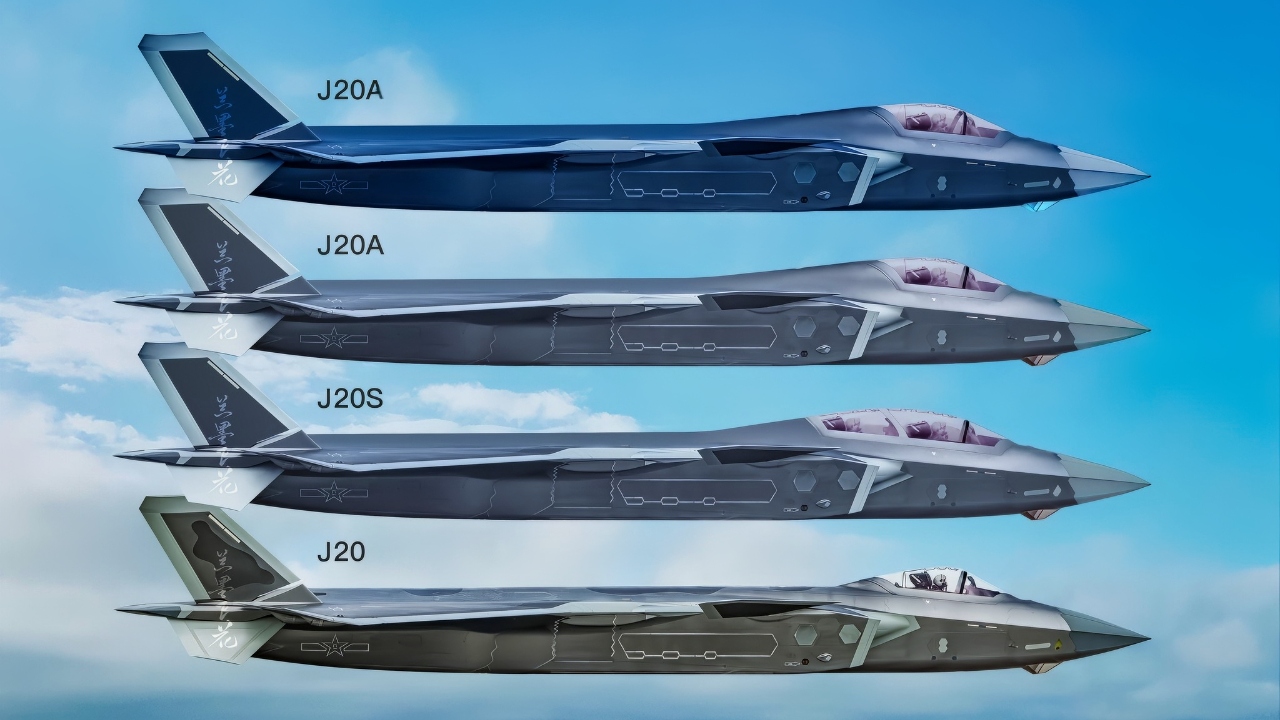
China J-20 Fighter X Screenshot.
China’s rise has reached a new level of sophistication, as the country is now fully committing its impressive industrial base and civilian economy to modernizing and expanding its military. Having spent decades essentially imitating–copying–Western, notably American, aerospace concepts, Beijing is now building its own version of network-centric air combat architecture.
And this architecture is geared toward contesting control over the First Island Chain (the territories stretching from the Kamchatka Peninsula through Japan, Taiwan, and the Philippines).
Scaling the End of US Dominance
Most Western analyses miss the larger story here, instead getting caught up in the technical arguments between Fifth- and Sixth-Generation warplanes. The real story, though, is how China is integrating stealth fighters, airborne command-and-control aircraft, loyal-wingman-style drones, long-range sensors, artificial-intelligence-assisted targeting, maritime strike capabilities, persistent ISR (intelligence, surveillance, reconnaissance) capabilities, and distributed kill chains into a single giant combat network.
In this context, then, the aircraft themselves matter less than the technological ecosystem they enable. Individually, the J-20 “Mighty Dragon” fifth-generation air superiority warplane or the KJ-3000 are insignificant. Taken together, however, these birds–and many others–form a lethal, distributed, advanced combat architecture that is likely capable of dominating that First Island Chain, irrespective of whatever systems and strategies the Americans deploy against this Chinese air war ecosystem.
Take the Shenyang J-35, China’s answer to America’s F-35 Lightning II fifth-generation multirole warplane.
China built the J-35 for scale. Unlike the United States, which has struggled to reach its full potential (and has chronically operated at 50 percent readiness), the J-35 is likely to achieve rapid scale. In the course of that scaling, too, there will be evolutions at each iteration in short order. Indeed, the Chinese are developing aircraft carrier variants of the J-35, meaning that this bird will become China’s primary warplane.
That navalized J-35 variant highlights a larger trend underway. It’s a doctrinal shift indicating that China is positioning its growing carrier fleet as nodes within the larger anti-access/area-denial (A2/AD) framework Beijing has constructed around the First Island Chain since 2009.
KJ-3000
Then there’s the KJ-3000, which is essentially an airborne radar node. The plane serves as a battle manager and employs long-range sensors to perform that role. What’s more, the KJ-3000 serves as an advanced communications relay in combat for other platforms and units. This asset is a key element in China’s growing integrated warfare strategy in the air and at sea.
The KJ-3000 helps Chinese forces extend their radar horizon far beyond coastal radar sites and enables distributed targeting across huge maritime areas. This system becomes essential because China must coordinate among fighters, missile forces, naval aviation, surface ships, drones, and air defenses simultaneously. It’s similar to how the United States utilizes its Boeing E-3 Sentry and Northrop Grumman E-2 Hawkeye platforms.

Pilots with the 131st Bomb Wing conduct pre-flight checks in a B-2 Spirit stealth bomber at Whiteman Air Force Base, Missouri, June 6, 2024. The B-2 is a multi-role bomber capable of delivering both conventional and nuclear munitions anywhere on the globe through previously impenetrable defenses. (U.S. Air National Guard photo by Master Sgt. John E. Hillier)
The KJ-3000 further illustrates how China has rapidly evolved in modern warfare.
J-50 Shenyang: China’s Possible Air Dominance Fighter
The J-50 remains a mystery to outsiders. Yet several characteristics of this new bird stand out: a large internal weapons bay, stealth-optimized shaping, possible thrust vectoring, an emphasis on long-range design, and a potential bomber-escort role. The J-50 signals that China is thinking beyond regional tactical aviation toward real long-range air dominance operations.
Already, we’ve seen the Chinese infiltrating the Second Island Chain, indicating that Beijing has long-term designs to go beyond the First Island Chain. Systems like the J-50 will give Beijing options to accomplish that task.
J-36: China’s Attempt at a Sixth-Generation Combat System
Undoubtedly, the most fascinating plane in China’s long lineup of air warfare is the sixth-generation J-36. This bird breaks from fighter orthodoxy in several ways. There are three engines on this plane, all supporting a larger airframe. There’s a side-by-side cockpit arrangement, too. J-36 has a large internal volume and can fight at long ranges.
It is clearly an answer to America’s sixth-generation F-47 warplane. Yet that side-by-side cockpit arrangement implies a high crew workload for controlling drones, running sensor sweeps, managing electronic warfare (EW) systems, and coordinating long-range strikes. Again, this system, like the other Chinese planes listed, is just another node.
WJ-700: Persistent Eyes Over the Battlefield
Think of this uncrewed aerial vehicle (UAV) as being akin to the American MQ-9 Reaper or MQ-1 Predator drones, but the WJ-700 is for Indo-Pacific reconnaissance and maritime targeting mission sets. The W-700 provides persistent eyes and situational awareness for Chinese forces in the critical strategic regions of the Taiwan Strait, South China Sea, and Philippine Sea, as well as during engagements with the United States Navy.
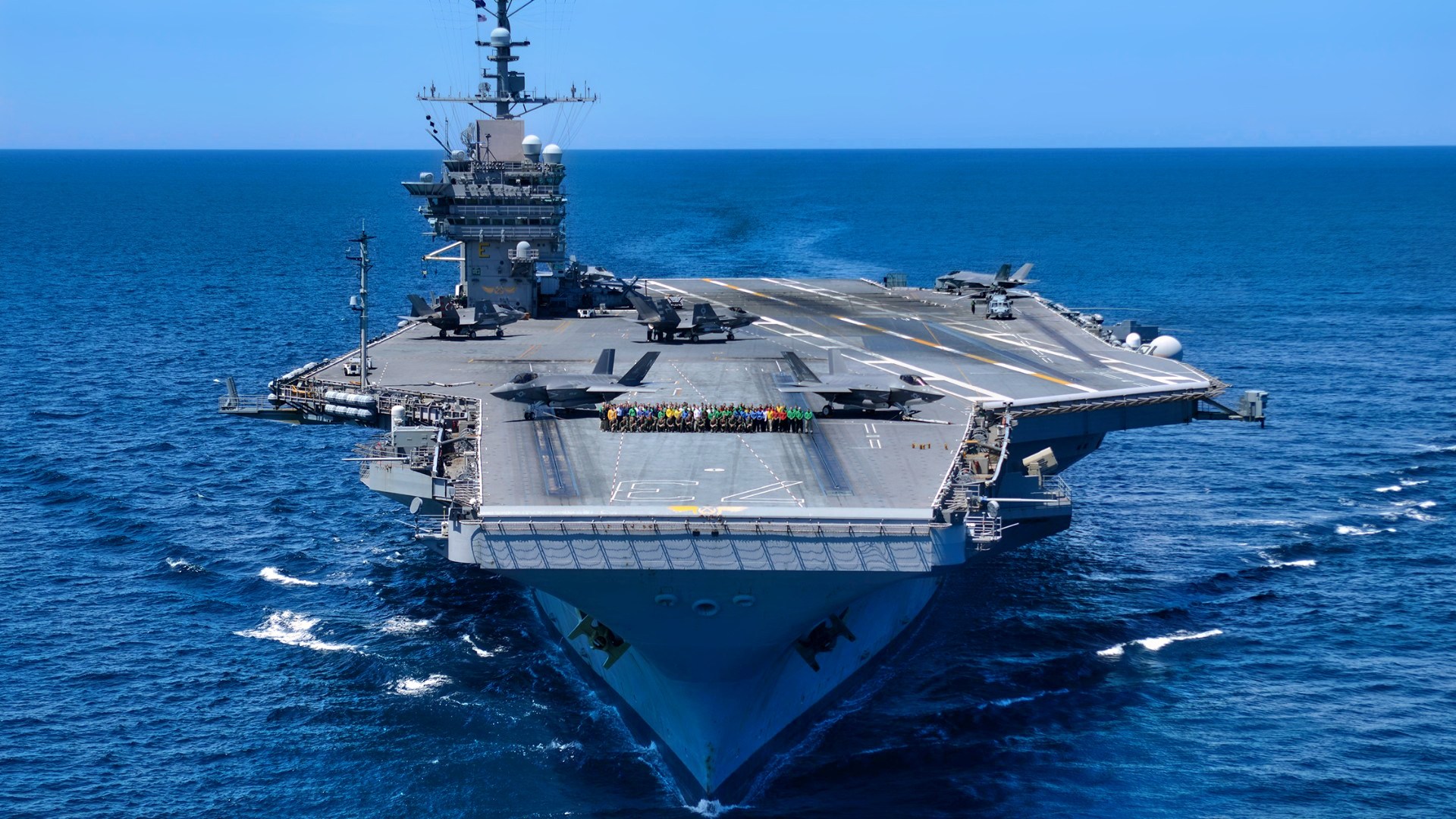
ATLANTIC OCEAN (Aug. 16, 2016) Sailors assigned to the Grim Reapers of Strike Fighter Squadron (VFA) 101, the Navy’s F-35C Fleet replacement squadron, pose on the flight deck of the aircraft carrier USS George Washington (CVN 73) during an aerial photo exercise. VFA-101 aircraft and pilots are conducting initial qualifications aboard George Washington in the Atlantic Ocean. The F-35C is expected to be Fleet operational in 2018. (U.S. Navy photo by Mass Communication Specialist Seaman Apprentice Krystofer Belknap)
This persistent ISR capability is foundational for China’s A2/AD warfare in the First Island Chain.
What Happens Next?
China’s trajectory as an airpower is becoming clearer. China’s air force and naval air force are becoming stealthier, more networked, longer-ranged, more drone-integrated, and more production-scaled. And that last part is the key to all this. America likely still retains qualitative advantages over China in combat experience, engine technology, pilot training, sensor integration maturity, global logistics, and operational doctrine, but China is set to offset some or all of those American qualitative advantages through sheer industrial scale.
If Beijing truly pursues the projection of more than 1,000 fifth-generation fighters by the 2030s, as it will, then the strategic balance in the Indo-Pacific will change significantly in its favor. After all, the United States built its post-Cold War military posture on the assumption of uncontested air dominance. China is building an air force specifically designed to break that assumption.
When China finally brings all these pieces together, its air warfare umbrella will be so powerful that the US simply cannot challenge China in its part of the world the way it used to. At that point, it’s an entirely new strategic paradigm–one that favors China in the Indo-Pacific.
About the Author: Brandon J. Weichert
Brandon J. Weichert is a Senior National Security Editor. Recently, Weichert became the editor of the “NatSec Guy” section at Emerald. TV. He was previously the senior national security editor at The National Interest. Weichert hosts The National Security Hour on iHeartRadio, where he discusses national security policy every Wednesday at 8 p.m. Eastern. He hosts a companion show on Rumble entitled “National Security Talk.” Weichert consults regularly with various government institutions and private organizations on geopolitical issues. His writings have appeared in numerous publications, among them Popular Mechanics, National Review, MSN, and The American Spectator. His books include Winning Space: How America Remains a Superpower, Biohacked: China’s Race to Control Life, and The Shadow War: Iran’s Quest for Supremacy. Weichert’s newest book, A Disaster of Our Own Making: How the West Lost Ukraine, is available for purchase at any bookstore. Follow him via Twitter/X @WeTheBrandon.


yeye
May 6, 2026 at 6:42 pm
Given uncle sam’s performance in the 2026 epstein fury war against iran, things are truly looking up for the china air power. In the western pacific.
Their second line of air defense fighters, consisting of the j-16 fighter and the j-10, is good enough to make uncle sam sweat, today.
That’s because all those fighters are supported by a vast missile arsenal that can easily neutralize uncle sam’s airbases, airfields and air decks in and across the pacific.
For those few US jets that can still claw their way into the air, the china air defense has many, or numerous jilin, gaofen, ludi and other space satellites tracking their flight. None of those US jets can hide from these satellites. Hovering above.
So, conclusion is That the air battle over the western pacific will fare worse for US jets than the battle over iran.