

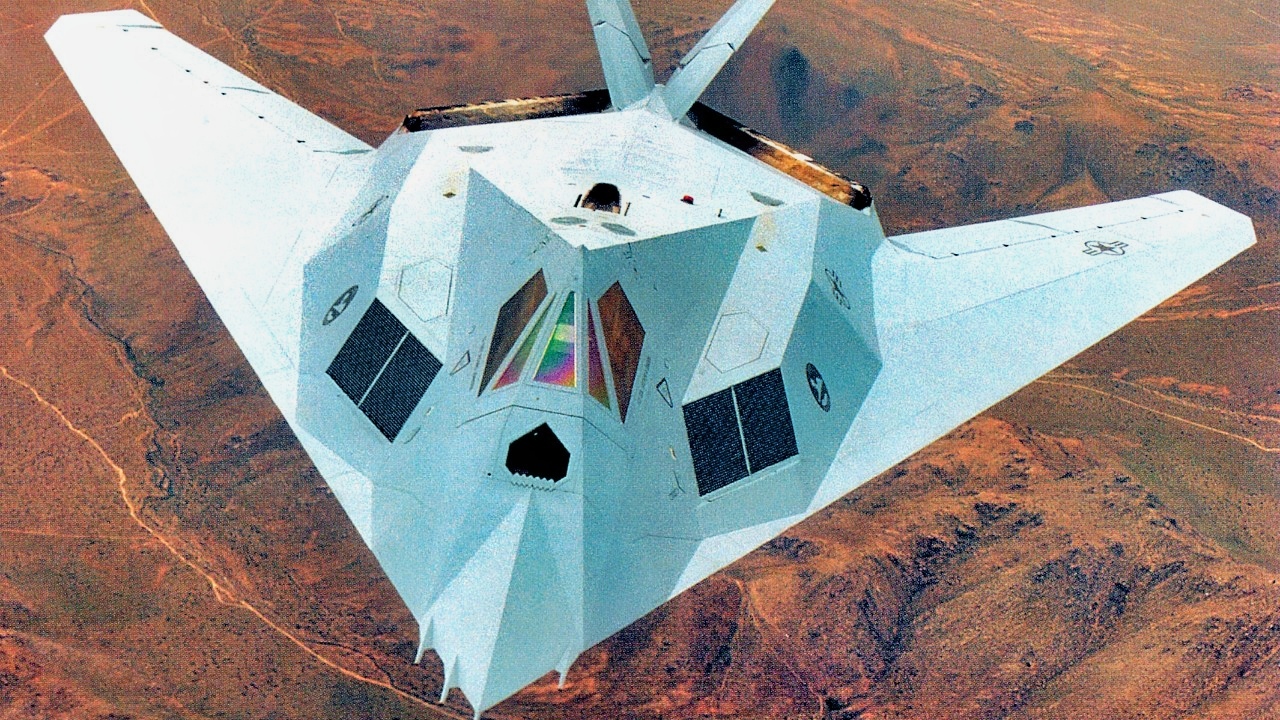
Key Points and Summary – The F-117 Nighthawk, America’s first stealth aircraft, was a ground-attack bomber, so why was it designated as an “F” for “fighter”?
-Air Force brass wanted the best-of-the-best for the top-secret program, and elite fighter pilots wouldn’t fly a “bomber.”
-This article explores the quirky history of the “Wobblin’ Goblin,” from its classified origins and humorous nicknames to its starring role in Operation Desert Storm, where it became an overnight superstar by dropping the very first bombs of the war with impunity.
The F-117 Was Truly a Showstopper
The F-22 and F-35 were the first two 5th-generation stealth fighters to attain operational status, doing so in December 2005 and July 2015, respectively.
This achievement gave the United States not only bragging rights but also to the two planes’ manufacturer, Lockheed Martin’s legendary Skunk Works division.
If you mentally time-warp back to the 4th Generation of fighter planes, more specifically the 1980s, those double bragging rights become *triple* bragging rights, as that’s when the US and Skunk Works fielded the very first so-called “Stealth Fighter.”
Ironically, this first warplane to receive that label functioned in practice not as a true fighter but rather as a bomber ground-attack aircraft: the Lockheed F-117 Nighthawk.
Or, at least if you are a child of the 1990s, the F-117 Stealth Fighter.
F-117 Stealth Fighter Origins and Initial History
The F-117 traces its roots back to DARPA’s Have Blue program of the 1970s. It made its maiden flight on June 18, 1981, and attained official operational status with the United States Air Force in October 1983.
However, for the next half-decade, the plane was officially shrouded in secrecy, even though the general concept of stealth technology was already known to the public, and much speculation abounded about the mysterious “Stealth Fighter” (as embodied in Testor’s so-called “F-19 Stealth Fighter” 1:48 scale plastic model kit in 1987).
The speculation gained additional momentum after one of the then-still-secret planes crashed near Bakersfield, California, in July 1986.
When the Pentagon finally officially acknowledged the existence of the warbird back in November 1988, it not only ended speculation but also inspired the proclamation that the F-117A was “The U.S. Air Force’s Best Kept Secret.”
The Nighthawk also inspired humorous nicknames amongst the pilots who flew it.
Among these unofficial monikers were “Wobblin’ Goblin” (due to its alleged instability at low speed, though some pilots dispute this allegation), “Hopeless Diamond,” “Roach,” and “Stinkbug.”
A total of 64 airframes were built.
F-117 Specifications and Vital Stats
Crew: 1 (pilot)
Fuselage Length: 65 ft 11 in (20.09 m)
Wingspan: 43 ft 4 in (13.21 m)
Height: 12 ft 5 in (3.78 m)
Empty Weight: 29,500 lb. (13,381 kg)
Maximum Takeoff Weight: 52,500 lb. (23,814 kg)
Powerplant: 2 × General Electric F404-F1D2 turbofan engines generating 9,040 pounds-force (40.2 kilonewtons) thrust each
Range: 930 nautical miles (1,070 statute miles, 1,720 kilometers)
Service Ceiling: 45,000 ft (14,000 m)
Max Airspeed: 684 mph (Mach 0.92 1,100 kph/ 594 knots)
Armament:
2,000 pounds (910 kilograms) worth of laser-guided “smart”, OR
Conspicuous by their absence from the Nighthawk’s armament roster are any sort of air-to-air missiles or guns. Such loadings would’ve increased the size of the radar signature and thus compromised the warbird’s stealth “invisibility”
So, Why Was It Called a Fighter?
It was a clever (or some might prefer to say “silly”) bait-and-switch semantics.
As aviation writer Maciej Karol elaborates in a 3 November 2016 article for World War Wings appropriately titled “The Ridiculous Reason The Nighthawk Is Designated ‘F-117’”:
“The letter “B” in B-17, B-52 and B-2 for example stands for ‘bomber.’ The letter ‘F’ in F-15s, F-22s and so on stands for ‘fighter.’ Pretty simple right?…Long story short, the brass wanted their top pilots to fly the Nighthawks. With millions of dollars invested, they didn’t want to lose one in inexperienced hands (no offense bomber pilots.) They wanted their best fighter pilots to fly them, but there was no way a fighter jock would fly a bomber so…..they changed the name from B-117 to F-117…The fighter pilots started lining up.”
Hypothetically, the F-117 could also just as easily have been designated the “A-117,” with the “A” standing for “Attack,” a la the A-10 Warthog or the AC-130 gunship.
Regarding the reference to “the brass,” the specific individual member of the brass who came up with the semantic reason for the Nighthawk’s “stealth fighter” label was Gen. Robert J. Dixon, then-head honcho at Tactical Air Command (TAC; now known as Air Combat Command [ACC]).
Operational History/Combat Performance
Silly labels aside, the F-117 Nighthawk ended up distinguishing itself in air-to-ground combat.
The warbird’s first official “blooding” in combat—in the skies over Panama during Operation Just Cause in December 1989—was somewhat underwhelming.
However, a mere 14 months later, the plane would more than redeem itself for that lackluster first performance and become an overnight superstar in the eyes of the military aviation community and general public alike.
This was during the 1991 Persian Gulf War AKA Operation Desert Storm, wherein the F-117 attacked the airfields and command-and-control facilities of then-Iraqi strongman Saddam Hussein in Baghdad with pinpoint accuracy and virtual impunity.
Regarding the use of the word “overnight” in the previous paragraph, we use that word quite literally:
-It was an F-117A that dropped the very first bomb of the war, striking a telecommunications center in Baghdad.
-The “Stinkbugs” attacked 31 percent of all targets struck during the first 24 hours of the war, and were the only aircraft involved in attacks on heavily defended targets in and around Baghdad on that first night.
Reportedly, the F-117 ended up attacking 1,600 high-value Iraqi targets during Desert Storm. From there, the plane continued to serve with distinction during Operation Allied Force (the 1999 Kosovo air campaign; alas, it was herein that the “Roach” suffered its first combat loss, thus demonstrating that stealth technology was neither wholly invisible nor infallible), Operation Enduring Freedom, and Operation Iraqi Freedom.
The F-117 was officially retired in 2008.
In 2 Words: Made History
As of the last count, 16 F-117 Steat specimens survive as static displays or restoration works-in-progress at military bases and museums across the United States.
Among these are:
-“Unexpected Guest” (Tail No. 82-0803), displayed outside the Ronald Reagan Presidential Library in Simi Valley, California
-“Lone Wolf” (85-0816) at the Evergreen Aviation & Space Museum, McMinnville, Oregon; this one is particularly significant, as she’s the aforementioned first Wobblin’ Goblin to drop a bomb during Desert Storm
About the Author: Christian D. Orr, Defense Expert
Christian D. Orr is a Senior Defense Editor. He is a former Air Force Security Forces officer, Federal law enforcement officer, and private military contractor (with assignments worked in Iraq, the United Arab Emirates, Kosovo, Japan, Germany, and the Pentagon). Chris holds a B.A. in International Relations from the University of Southern California (USC) and an M.A. in Intelligence Studies (concentration in Terrorism Studies) from American Military University (AMU).
More Military
The U.S. Navy’s Submarine Crisis Is Real


Les Hubbard
July 21, 2025 at 10:35 am
I was with the program at both sites between 1982 and 1986, and my understanding of “fighter” designation vs “bomber” had more to do with funds allocation(fighters got more money than bombers) than attracting top pilots. Don’t know how “black money” availability worked into the calculation.
Kevin K.
July 21, 2025 at 12:19 pm
The “F” designation had more to do with the numbering system used at the time for all aircraft once they had to start documenting it for procurement, budgets, later on for pilots to log time, etc. When they needed to designate the proposed aircraft very early on as the program began, they used the next number, F-117. No one who created these numbers knew what it was actually and no one in the know was about to correct it. A bit of subterfuge never hurts…
The F-117 doesn’t fly like a fighter and frankly, any competent pilots were welcome to the program. Why anyone feels that fighter pilots wouldn’t be attracted to the F-117 makes no sense. When a pilot was clued into just what this plane was, they were interested. It was leading edge stuff back then, why wouldn’t a good pilots want to be involved? I’ve spoken to F-117 pilots, they were totally eager to fly the plane no mater what their background was.
By the way, I’ve never had an F-117 pilots tell me it flew poorly or worse at low speeds. They all say it flew very well. The flight control system did a great job in the F-17.
Horsemen
July 21, 2025 at 2:53 pm
The F one-seventeen is a piece of aerospace frankened flying abberation, or ffa, that first attacked panama (the prelude to iraq), baghdad and the yugoslavia, where it finally got shot down by an aging AA missile system.
Anyway, the idea for the f-117 was developed in great massive secrecy in the 1970s, and around 1981, lockheed won the competition.
By 1989, it was fully ready for combat duty.
But just ten years later, in 1999, like the dark angel asmodeus, it fell straight down to Earth, thanks to colonel zoltan.
C4kami
July 23, 2025 at 3:00 pm
What were the four words? Your article title doesn’t fit.
co4awhile
July 24, 2025 at 7:42 pm
The great book skunk works by Ben. Rich is a great read for in-depth history on the nighthawk. The best part is how the nighthawk can’t glide in any way shape or form and the natural behavior is for it to swap ends (ie. Tail first). It’s only the avionics and fight control systems that The tail aft…