


Key Points and Summary – The A-6 Intruder gave the Navy and Marines something they lacked in the early jet age: a long-range, all-weather attack aircraft that could hit hard at night and in bad weather.
-Grumman’s side-by-side, twin-engine design entered service in the 1960s with DIANE navigation/attack avionics, then matured into the A-6E TRAM with a stabilized FLIR/laser turret and precision weapons.

A-6 Intruder National Security Journal Photo. Image By Jack Buckby Taken on September 18, 2025.
-From Vietnam through Libya, Praying Mantis, and Desert Storm, Intruders flew the ugly missions—low, long, and often alone—while KA-6D variants kept the air wing gassed.
-Fatigue issues, canceled replacements, and budget shifts ended the type in the 1990s, but its doctrine and tech live on across naval aviation.
-BONUS – National Security Journal visited the A-6 Intruder on display at the USS Intrepid museum in New York harbor. All of the photos you see here are from that visit.
A-6 Intruder: The Night-and-Weather Hammer of Naval Aviation
By the late 1950s, carrier air wings boasted fast fighters and nuclear-capable strike aircraft—but little that could reliably deliver conventional firepower at night or in foul weather at serious range. The Navy and Marine Corps needed an aircraft that could navigate through cloud and terrain, find targets in the dark, and put iron—and eventually precision weapons—exactly where a landing force or fleet commander needed them. The requirement was not glamour; it was assured strike on the worst day, when the deck is pitching, the weather is closing, and the target can’t wait.
Grumman’s answer became the A-6 Intruder: a compact, side-by-side two-seat attack jet that traded top-end speed for payload, persistence, and sensors, optimized for low-altitude penetration in any weather.
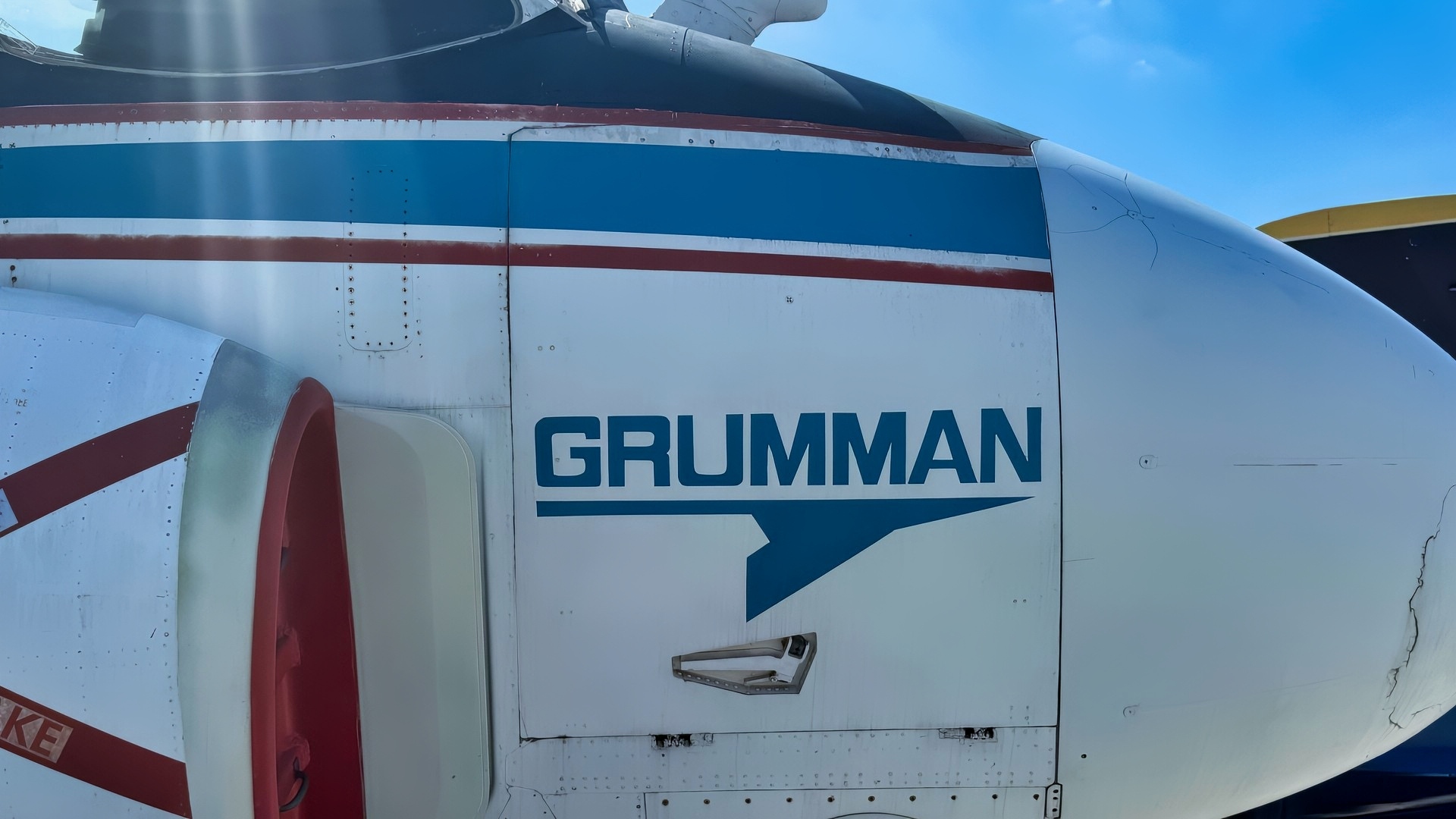
Side of A-6 Intruder. Image Credit: National Security Journal.
Designing a Purpose-Built All-Weather Striker
The Intruder’s platform looks modest next to sleek fighters, but every line serves the mission:
Side-by-Side Crew: Pilot and bombardier/navigator (BN) sat shoulder-to-shoulder beneath a generous canopy. That arrangement simplified communication during high-workload penetrations and let the BN run the sensors, plot the route, and manage weapons without shouting over a console.
Twin Engines, Twin Margin: Two reliable turbojets offered reassurance over cold water and enemy terrain; neither engine had to be exotic to deliver the range and lift the jet needed.
Rugged Structure: Grumman built “forgiving” airplanes. The Intruder’s strong landing gear and airframe tolerated heavy bring-backs and the brutal cadence of carrier operations.
DIANE Avionics: The heart of the early A-6A was Digital Integrated Attack/Navigation Equipment—radar, inertial navigation, and computing to guide the jet through the weather to a release point. DIANE was ambitious for its time and gave the Intruder its all-weather bite.
The prototype first flew at the dawn of the 1960s. Fleet squadrons received A-6A models soon after, with the Marines embracing the design for its close air support and deep-strike flexibility from austere bases or deck.
Development: From DIANE to TRAM (and Tanking Along the Way)
No attack aircraft stands still, and the Intruder matured quickly:
A-6A: Baseline with DIANE. Crews learned to wring capability from early-generation sensors—powerful in concept, temperamental in practice.
A-6B: A specialized SEAD variant that traded some bombing gear for sensors to hunt enemy radars, firing anti-radiation missiles to suppress surface-to-air defenses.
A-6C: Trialed enhanced night sensors for reconnaissance and target identification on the Ho Chi Minh Trail and similar environments.
KA-6D: The tanker Intruder. Fitted with a hose-and-drogue pod and extra fuel plumbing, it became the air wing’s indispensable gas station, launching early and orbiting as a lifeline for strike packages and recovery tanking.
A-6E: The definitive strike model, culminating in TRAM—Target Recognition and Attack Multi-sensor, a stabilized turret under the nose blending FLIR and a laser designator/tracker. With TRAM, the Intruder pivoted from “can hit in weather” to “can precisely hit in weather.” This is the version of the plane that is presented in the photos of this article from our visit.
SWIP and Weapons Integration: The Systems/Weapons Improvement Program folded in new nav-attack computers, better jammers and receivers, and the ability to launch a wider portfolio of precision munitions and standoff anti-ship/land-attack missiles. Late-life A-6Es could carry laser-guided bombs, Walleye, AGM-84 Harpoon/SLAM in maritime and strike roles, and a full kit of conventional ordnance.
There were also projected upgrades—A-6F/G with new engines and radar—that would have extended the Intruder’s life, but those paths were canceled as budgets and priorities shifted.
Operational Rollout: Learning the Rhythm
On the boat, the Intruder earned a reputation as the crew-dog workhorse. It wasn’t the flashiest cat shot, but it brought back big loads, trapped in weather, and turned quickly on the flight deck. The KA-6D began most cycles, topping off fighters and strikes at launch and again before recovery. Strike Intruders taxied with a zoo of loads—clusters, slicks, mines, and later, precision munitions—tuned to the day’s target set.
For Marine squadrons, the airplane’s short-field handling, rugged gear, and all-weather sensors made it a favorite from expeditionary strips, delivering deliberate fire support in conditions that grounded lighter jets.
Combat: The Intruder’s Real Résumé
Vietnam defined the A-6’s early combat identity. Intruders flew low-level, all-weather attacks against rail yards, bridges, airfields, and supply lines in North Vietnam—often at night, often alone or in small sections, often under concentrated AAA and SAM coverage.
The airplane’s strength—hitting through weather—also meant crews frequently pressed in when others could not, which is why A-6 squadrons absorbed hard losses and earned a reputation for grim professionalism.
Post-Vietnam, the Intruder kept finding new fights and new roles:
Libya, 1986 (El Dorado Canyon): A-6Es struck air defenses and military infrastructure, showcasing TRAM’s precision and the platform’s stand-up to dense SAM belts.
Persian Gulf, 1987–1988 (Earnest Will / Praying Mantis): Intruders hunted Iranian fast-attack craft, minelayers, and even engaged surface combatants. In Operation Praying Mantis, they teamed standoff missiles and guided bombs to disable or sink Iranian navy units—an advertisement for carrier air’s maritime strike reach.
Desert Shield/Storm, 1990–1991: A-6Es were everywhere—mine warfare, bridge and airfield attacks, maritime strikes on Iraqi naval units, and precision work against hardened sites. The jet’s range and payload let carriers mass effects deep inland while KA-6Ds kept the deck cycle flowing. SLAM and laser weapons gave the Intruder a starring role in televised precision, but crews knew the core value was unchanged: night, weather, and reliability.
Between headline operations, Intruders flew the daily grind—presence patrols, exercises with allies, and cruise after cruise where their very availability shaped the air wing’s options.
Accidents and Problems: The Price of Low and Long
Every community carries scars, and A-6 squadrons are candid about theirs:
Early Avionics Reliability: DIANE’s first iterations were maintenance-intensive. As parts and procedures improved, so did uptime, but the airplane demanded a serious avionics culture on the line.
Low-Level Risk: The jet was built for terrain-hugging flight. In bad weather and at night, add heavy loads and enemy fire and you get a naturally high-risk envelope. Mishaps in training and combat led to continual improvements in tactics, crew coordination, and simulators.
Wing Fatigue: Late in life the fleet faced wing-box fatigue. A composite re-wing effort began but collided with budget realities and changing plans for the A-6’s replacement. Restrictions, inspections, and phased retirements followed—an engineering truth of hard-worked airframes rather than a slight on the design.
None of these issues made the Intruder unsafe when flown by the book; they underscored that the airplane did the hard missions, and hard missions accumulate risk and wear at a faster clip.
Retirement: Program Cancellations and a Changing Air Wing
The Intruder’s sunset was shaped as much by what didn’t arrive as by what did. The Navy’s planned replacement, the A-12 Avenger II, was canceled in the early 1990s. Without that stealth follow-on, the service bridged the gap by pushing more strike work to the F/A-18C/D and later folding deep-strike and tanking into F/A-18E/F operations. The KA-6D’s refueling role migrated to S-3 Vikings for a time, then to Super Hornets with buddy stores.

(Dec. 7, 2024) LT Steven Holcomb, attached to the Gunslingers of Strike Fighter Squadron (VFA) 105, operates a F/A-18E Super Hornet on the flight deck during flight operations, Dec. 7, 2024. USS George H.W. Bush is in the basic phase of the Optimized Fleet Response Plan conducting flight deck certification.(U.S. Navy photo by Mass Communication Specialist Seaman Jayden Brown)
Marine A-6 squadrons went first, retiring in the early 1990s as the Corps standardized on F/A-18 for fast jet work and AV-8B for expeditionary attack. Navy A-6Es flew on a bit longer, with the last squadrons standing down in the mid-1990s. By decade’s end the Intruder had made its final trap.
What the Intruder Changed
It normalized all-weather precision from the sea. Before LANTIRN and advanced AESA radars, a carrier could already promise a commander night-and-weather attack because A-6 squadrons existed. That shaped strategy: amphibious assaults, coercive signaling, and crisis response assumed that weather wouldn’t cancel the strike.
It made the tanker organic to the air wing. The KA-6D taught generations of deck crews and strike leaders how to design fuel into tactics, not bolt it on. That thinking lives today in the way air wings plan long-range packages.
It elevated human-machine teamwork. The Intruder’s side-by-side cockpit showed the value of dedicated mission management by the BN while the pilot flew. Today’s single-seat jets rely on sensor fusion to accomplish something similar, but the concept—divide the cognitive load—was operationalized in thousands of A-6 sorties.
It refined maritime strike with carriers. Praying Mantis and Gulf operations wrote playbooks for anti-ship targeting, standoff weapon pairing, and battle-damage assessment from a carrier deck—doctrine that later aircraft expanded.
The Intruder’s Place in Naval Aviation History
The A-6 will never be a museum darling for air-show crowds; it looks workmanlike because it was. But in the ledger of what wins wars—a platform that shows up, in any weather, with serious payload—the Intruder sits near the top. It carried carrier air wings across a technological bridge from dumb bombs to precision strike, from clear-sky raids to 24/7, all-weather coercion, and from episodic tanking to continuous fuel planning.
Visit a preserved Intruder and you’ll notice two things. First, the cockpit: close, talkative, businesslike, a reminder that combat power can be as much about people as silicon. Second, the bomb racks and pylons: a statement that the ship mattered because the airplane could routinely deliver effects, not just promise them.
When today’s air wings brief long-range, adverse-weather strikes with multiple moving parts—tanker tracks, shooters, jammers, and recovery in a tight window—they are executing a choreography the A-6 community spent three decades perfecting.
That is a legacy measured not in paint schemes but in confidence: the confidence that a carrier strike group can hit what it aims at, whenever it must.
About the Author: Harry J. Kazianis
Harry J. Kazianis (@Grecianformula) is Editor-In-Chief and President of National Security Journal. He was the former Senior Director of National Security Affairs at the Center for the National Interest (CFTNI), a foreign policy think tank founded by Richard Nixon based in Washington, DC. Harry has over a decade of experience in think tanks and national security publishing. His ideas have been published in the NY Times, The Washington Post, The Wall Street Journal, CNN, and many other outlets worldwide. He has held positions at CSIS, the Heritage Foundation, the University of Nottingham, and several other institutions related to national security research and studies. He is the former Executive Editor of the National Interest and the Diplomat. He holds a Master’s degree focusing on international affairs from Harvard University.
More Military
USS Intrepid (CV-11) Has a Message for the U.S. Navy
F-16XL Was the Plane the Air Force Wouldn’t Fly
NATO-Russia War of 2025: It Won’t Be Pretty
K3: The ‘Stealth’ Tank That Looks Like a B-21 Raider and Runs on Hydrogen
The U.S. Navy’s Ohio-Class SSGN Submarines Summed Up in 1 Word


Paul
September 23, 2025 at 12:11 pm
My father and I worked at Hughes Aircraft on the A6E Tram for years. Great program and a fun time in Aerospace. My dad helped design the Trams telescope Assy. Thanks for the memories
Roger Wilco
September 24, 2025 at 4:37 pm
So what, exactly, is the message the A6 has for the US Navy, as posited in your headline? I skimmed the article and failed to fine the answer the author posed; just a history of the aircraft probably gleaned from Wikipedia. I’m blocking. Goodbye charlatan.