


Key Points and Summary – ‘First shot–first kill’ defines the F-22 Raptor’s mission: stealth, speed, vectoring and upgraded sensors/weapons (3.2B, AIM-9X/120, AESA, new comms/computing) to seize air dominance and suppress enemy air defenses.
-In One Word: The problem is size.
-Only 186 were built and ~150 or fewer are truly available, forcing dispersal via Rapid Raptor to put jets forward fast but limiting large-formation presence in a great-power fight.
-Restarting production died years ago, so the Air Force leans on networking—two-way F-35/F-22 links and the Raptor’s ‘quarterback’ role with 4th-gen jets—while eyeing sixth-gen relief.
-Bottom line: close the numbers gap with F-47/NGAD and Navy F/A-XX, or accept risk.
F-22 Raptor Still Rules—But Can 150 Jets Win a Great-Power Air War?
“First Shot-First Kill” is the key operational concept behind the high-speed, stealthy 5th-generation F-22 Raptor, a famous air supremacy fighter argued by many to be the world’s best. Its performance parameters are wide-ranging as the F-22 has among the world’s best thrust-to-weight ratios, Mach 2.25 speed, and advanced air-to-air combat vectoring capability.
The Raptor is also well known for its weapons and extensive upgrades over the years, factors that have inspired the Pentagon and Air Force to plan to fly the F-22 until 2060 and beyond. A fleet-wide F-22 software upgrade, referred to as 3.2b, has vastly improved the performance of the aircraft’s AIM-9X and AIM-120 air-to-air and air-to-ground weapons.
The platform has also received new antennas, communications technology, computing, and AESA Radar in recent years. Therefore, while the Raptor may have first entered operational service in 2005, the aircraft remains relevant, effective, potentially superior, and in high demand from Combatant Commanders more than 20 years later.
F-22 & Air Dominance
The Concept of Operation for the F-22 can be described as intended “air dominance,” meaning the aircraft is built to use stealth, speed, and air-to-air combat capability to destroy rival stealth aircraft and counter air defenses.
Suppression of Enemy Air Defenses is the Air Force’s formal term for one of the Raptor’s key missions, as the aircraft is designed to use advanced sensing, stealth, and precision weaponry to locate, evade, and potentially destroy an enemy’s ground-based surface-to-air missile systems.
The operational concept is to create a survivable “air corridor” for less stealthy but critical 4th-generation aircraft, bombers, and drones to operate in and travel through for attacks over enemy territory.

F-22 Raptor Sitting in AF Museum National Security Journal Photo. Image Credit: Harry J. Kazianis
Despite these attributes and a successful combat debut against ISIS in 2014, the F-22 suffers from a concerning deficit: fleet size. In total, the Air Force has received 186 F-22s; however, numerous public reports estimate that the actual operational available fleet of F-22 is roughly 150 or fewer aircraft. Therefore, a numbers deficit certainly creates an F-22 “mass” problem in the event that the Air Force is called upon to perform major combat operations.
Rapid Raptor Program
To address this problem and ensure the successful positioning of F-22s for rapid deployment anywhere in the world, the Air Force created a program known as Rapid Raptor. This initiative involves forward positioning F-22s in critical locations across the globe to ensure that the aircraft can strike anywhere in the world within 24hours.
While the Rapid Raptor program remains effective as a way to ensure an F-22 “first-kill” attack, it does not enable the Air Force to “mass” F-22 formations across a wide theater of operations, something that would, of course, prove vital in the event of a great power conflict.
This dispersal of the fleet is a primary reason why many historians, observers, wargamers, Pentagon weapons developers, and decision makers have come to greatly lament the decision to stop F-22 production years ago.

F-22 Fighter. Image Credit: National Security Journal.
While there are likely many factors that influenced this decision, such as budget considerations or the arrival of the F-35, it appears the decision to prematurely “end” F-22 production may have suffered from short-term thinking.
The F-22 came of age during the height of the Global War on Terror and the Iraq and Afghanistan wars, so weapons developers may have lacked a “longer term” view of the global threat environment, which could have correctly anticipated the rise of great power, near-peer rivals such as Russia and China.
Solving the F-22 Problem?
Recognizing all of this, some might be inclined to wonder if this F-22 fleet size problem was in any way “solvable,” given that there simply are not enough Raptors to meet current and potential future demand. Years ago, the Air Force considered restarting production of the F-22 line, but plans were cancelled ostensibly for budget reasons.
One thing the Air Force has done is focus heavily on compatibility, networking, interoperability, and information exchange across otherwise incompatible platforms.
In recent years, the US Air Force has upgraded LINK 16 F-35-to-F-22 two-way communications technology to ensure high-speed Raptors can instantly coordinate with F-35s in an air combat scenario.
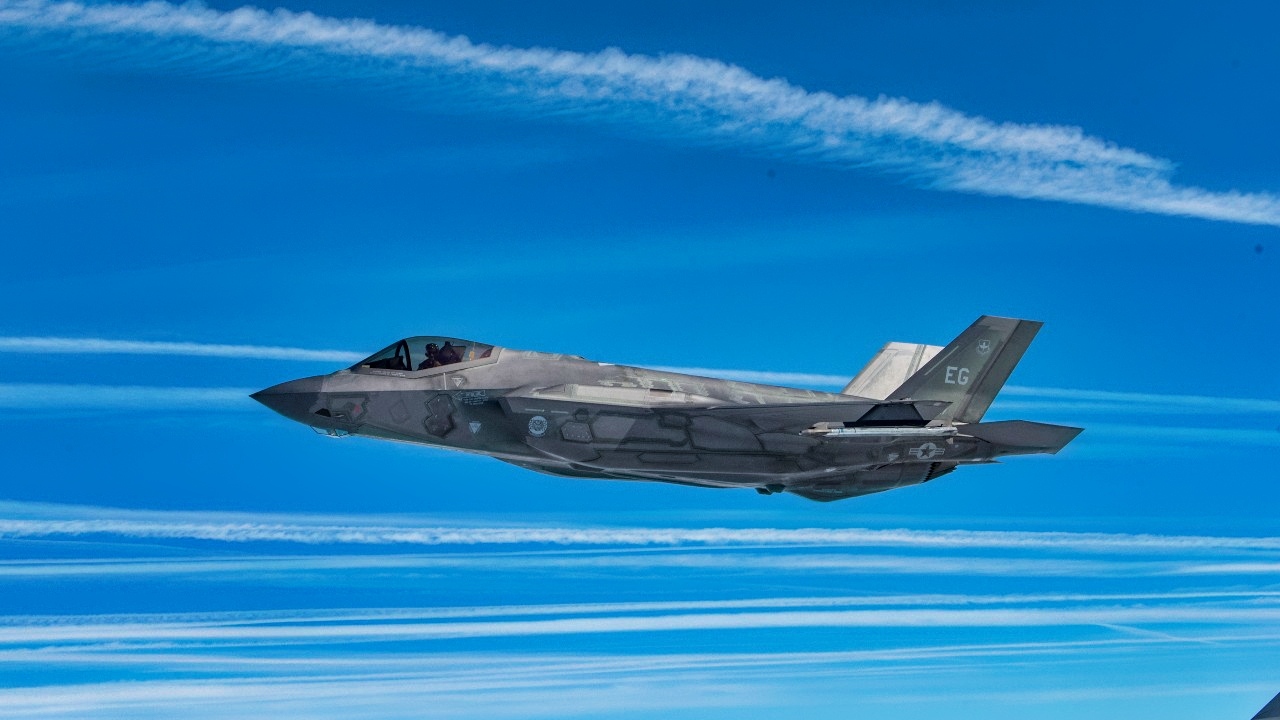
U.S. Air Force F-35 Lightening II with Eglin Air Force Base, Florida flies off the wing of a KC-135 Stratotanker with MacDill Air Force Base, Florida on December 16, 2021. The F-35 is the U.S. Air Force’s fifth-generation fighter and will replace the F-16 Fighting Falcon and the A-10 Thunderbolt II. (U.S. Air Force photo by Staff Sgt. Tiffany A. Emery)
This makes great tactical sense given that the US Air Force, Navy, and Marines now operate hundreds of F-35s in position to support F-22s with multirole sensing, computing, surveillance, data-exchange, and targeting.
Additionally, the F-22 has become known as an “aerial quarterback” given its commensurate ability to share information with and direct 4th-generation aircraft.
F-47 & F/A-XX
Still another possible remedy for an F-22 shortage would, quite simply, be to build hundreds of F-47s and F/A-XX planes capable of operating in a large-scale air combat contingency.
About the Author: Kris Osborn
Kris Osborn is the President of Warrior Maven – Center for Military Modernization. Osborn previously served at the Pentagon as a highly qualified expert in the Office of the Assistant Secretary of the Army—Acquisition, Logistics & Technology. Osborn has also worked as an anchor and on-air military specialist at national TV networks. He has appeared as a guest military expert on Fox News, MSNBC, The Military Channel, and The History Channel. He also has a Masters Degree in Comparative Literature from Columbia University.
More Military
SR-72 Mach 6 Mistake the Air Force Needs to End
The U.S. Navy’s Ohio-Class Missile Submarine Nightmare
America Has Mini-Aircraft Carriers
Russia’s Su-57 Felon Stealth Fighter: Made in India?
F-22 Raptor vs. J-20 Stealth Fighter: Hope This Never Happens


Doyle
September 19, 2025 at 9:09 am
Yes they can win a great power war….unless they run out of missiles first.
JDDrouin
September 19, 2025 at 1:00 pm
The F-22 story is a perfect example of the buffoons and clowns posing as 1-, 2-, 3-, & 4-Star Generals who run the USAF. To wit:
There are 32 F-22s that were built to Block 20 standards and are not rated at “combat capable”. Those buffoons and clowns posing as 1-, 2-, 3-, & 4-Star Generals who run the USAF decided that the estimated upgrade to Block 30/35 standard (the latest and greatest) of $50 million per aircraft is “too much”.
Now even the rankest, literally the brand-new, first-day-in-the-USAF Airman Basic, understands that $50 million for a “best-combat-aircraft-in-the-sky-by-any-definition” is far, far, far beyond a good bargain.
But those buffoons and clowns posing as 1-, 2-, 3-, & 4-Star Generals who run the USAF … ‘nooooo, that’s too much’.