

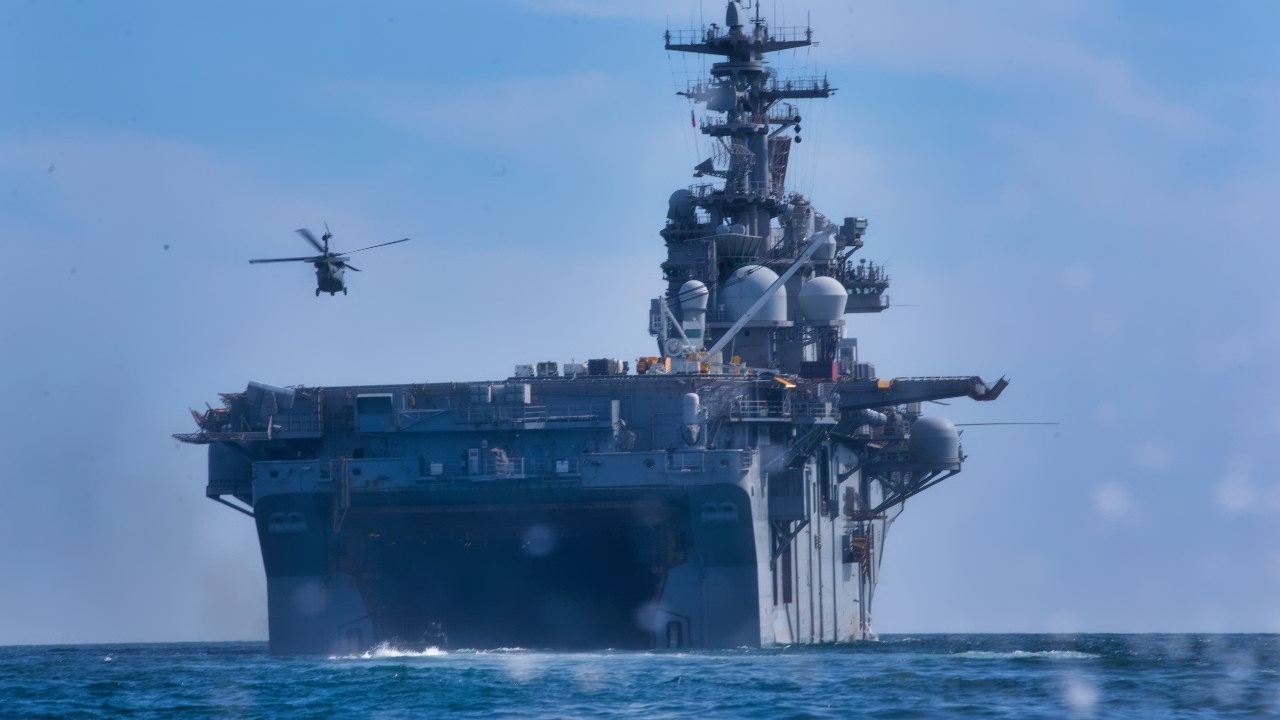
Key Points and Summary (Published On 9/19/2025 10:59 AM) – The eight-ship Wasp-class landing helicopter dock (LHD) succeeded Tarawa as the Navy–Marine Corps sea base for amphibious assault, crisis response, and disaster relief.
-At 40,500 tons and 843 ft, Wasps embark F-35B/Harrier jets, MV-22 Ospreys, CH-53E heavylift, AH-1Z/UH-1Y, plus landing craft—delivering “mini-carrier” punch.
-LHD-1–7 use steam turbines; LHD-8 adds a gas-turbine hybrid drive. Wasps launched strikes in Afghanistan and Iraq, served as Harrier carriers, and led relief from the 2004 tsunami to Hurricane Katrina. USS Bonhomme Richard was lost to fire in 2020; seven ships remain active as America-class successors enter service.
USS Wasp-Class Assault Ship Explainer (Or Mini-Aircraft Carrier?)
In the realm of Mother Nature, wasps are insects in the narrow-waisted suborder apocrita of the order Hymenoptera. They are quite deadly to other insects, as well as spiders. In some cases, they can also be deadly to humans who are susceptible to anaphylactic shock.
In the realm of maritime warfare, the USS Wasp brings a sting of its own. It is a proud name in the annals of the U.S. Navy. A total of ten Navy vessels past and present have borne the moniker, including the sloop-of-war that bagged a reindeer (as in HMS Reindeer) during the War of 1812; and two World War II aircraft carriers: CV-7 was the lead ship of the Wasp-class flattops. Later came her Essex-class successor, CV/CVA/CVS-18.
Now the insect’s naval namesake is being proudly carried on by the Wasp class of landing helicopter dock (LHD) amphibious assault ships. National Security Journal now takes a closer look at this new generation of Wasps.
Wasp-Class Amphibious Assault Ship Initial History and Concept
The Wasp class of LHDs was the designated successor to the Tarawa class of landing Helicopter Assault (LHA)-type amphibious assault ships. LHDs and LHAs provide the U.S. Marine Corps with a means of ship-to-shore movement by helicopter, in addition to movement by landing craft.
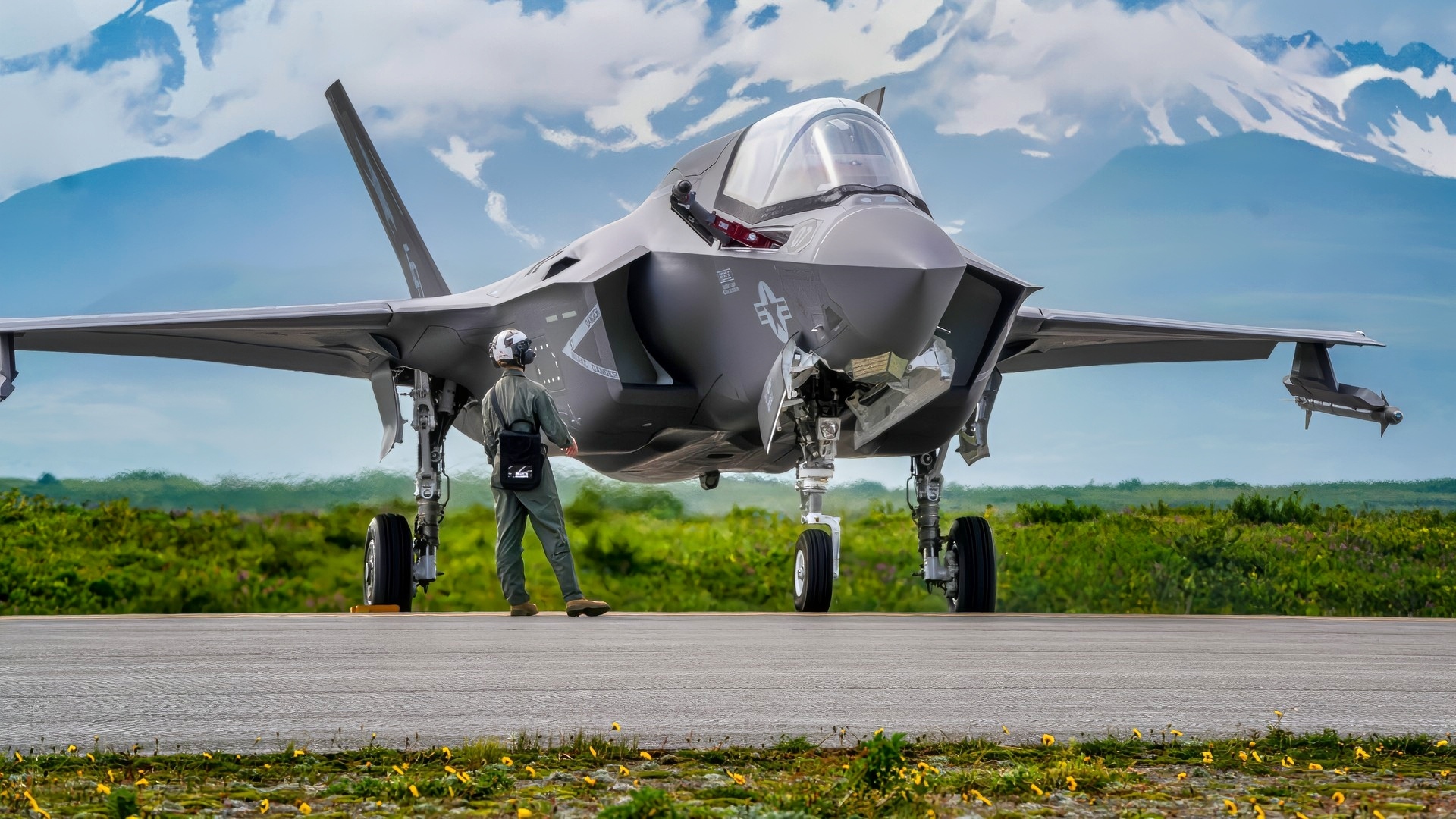
A U.S. Marine Corps F-35B Lightning II Joint Strike Fighter assigned to Marine Corps Air Station Beaufort, parks on a runway for a forward armed and refueling point (FARP) for ARCTIC EDGE 2025, August 18, 2025, at Cold Bay Airfield, Alaska. AE25 provided Special Operations Command North the opportunity to test a range of capabilities and response options to deter, disrupt, degrade, and deny competitor activity in the Arctic in support of globally integrated layered defense of the homeland. AE25 is a NORAD and U.S. Northern Command-led homeland defense exercise designed to improve readiness, demonstrate capabilities, and enhance Joint and Allied Force interoperability in the Arctic. (U.S. Air Force photo by Airman 1st Class Gracelyn Hess)
The Wasp-class ships were built by Huntington Ingalls Industries (HII) at the Ingalls Shipbuilding facility in Pascagoula, Mississippi. Appropriately enough, the USS Wasp (LHD-1) is the lead ship of the class. She was laid down on Feb. 28, 1984, launched on May 30, 1985, christened on Sept. 19, 1987, and commissioned on July 6, 1989. Her motto is “Honor – Tradition – Excellence.”
Seven sister ships were subsequently built. The newest of the bunch is the USS Makin Island (LHD-8), laid down on Feb. 14, 2009, launched on September 22, 2006, and commissioned on Oct. 24, 2009. Her motto is “Gung Ho! (Work together!)”
Wasp-Class Amphibious Assault Ship Specifications
Displacement: 40500 long tons / 41,150 short tons fully laden
Hull length: 257 meters (843 feet)
Beam Width: 31.8 meters (104 feet)
Draft: 8.1 meters (27 feet)
Propulsion:
LHD-1 through LHD-7: 2 x boilers / 2 x geared steam turbines (70000 shp / 52000 kW total); 2 shafts, 2 propellers, 2 rudders
LHD-8: 2 x GE LM2500 gas turbines (70000 bhp / 52000 kW total); 6 x Fairbanks Morse diesel generators (6 x 4000 kW); 2 x electric motors (2 x 5000 shp/3700 kW); 2 shafts, 2 propellers, 2 rudders
Max Speed: 22 knots (41 km/h)
Range: 9500 nautical miles (17600 kilometers) at 18 knots (33 km/h)
Crew Complement: 66 commissioned officers, 1,004 enlisted seamen, embarked landing forces of 1,687 Marines (+ 187 surge)
Armament:
2 x Mk.29 launcher for 8 x RIM-7 Sea Sparrow Missile
2 x Mk.49 launchers for RIM-116 Rolling Airframe Missiles (RAM)
2-3 x Mk.15 Phalanx Close-in Weapon System (CIWS)
3-4 x Mk.38 Mod.2 25mm Machine Gun System (MGS)
Aircraft Carrying Capacity (Standard Complement):
6 x AV-8B Harrier II attack aircraft OR 6 F-35B Lightning II stealth strike-fighters
4 x AH-1W/Z Super Cobra/Viper attack helicopter
12 x MV-22B Osprey assault support tiltrotor
4 x CH-53E Super Stallion heavy-lift helicopters
3-4 x UH-1Y Venom utility helicopters
Operational History of the Wasps
As noted by the official U.S. Navy informational page, “LHAs (and later LHDs) have been participants in major humanitarian-assistance, occupation and combat operations in which the United States has been involved. Such operations have included participating as launch platforms for Marine Corps expeditionary forces into Afghanistan during Operation Enduring Freedom in 2001 and 2002, Iraq in Operation Iraqi Freedom in 2003 and humanitarian support after the catastrophic Tsunami in 2004. During Operation Iraqi Freedom, two LHDs served as ‘Harrier carriers,’ launching an air group of AV-8B attack aircraft against targets inside Iraq.
USS Boxer (LHD 4) Wasp-class amphibious assault ship coming into San Diego – September 18, 2025
SRC: YT- SanDiegoWebCam pic.twitter.com/PYjRZHpcuU
— WarshipCam (@WarshipCam) September 18, 2025
“In 2004, LHDs were used to transport thousands of Marines and their equipment to Iraq and Afghanistan for combat operations. Post Hurricane Katrina support was provided in New Orleans by LHD 7 (Iwo Jima) where thousands of police, fire and rescue personnel were hosted onboard during recovery operations and Iwo Jima operated as the central command and control hub.”
Sadly, one of the Wasps, the USS Bonhomme Richard (LHD-6) – another proud name in U.S. Navy history because of its association with John Paul Jones – was severely damaged in July 2020 by a fire that injured at least 57 sailors and civilians. She was decommissioned and towed away for scrapping in April 2021.
Where Are They Now? The Way Ahead for the Wasps
In theory, the Wasp-class vessels are being succeeded by the America-class LHAs, which are a variant of the Wasp-class.
In reality, the seven surviving Wasps still remain in service, and this reporter is unaware of any plans to retire any of them. The USS Wasp, USS Kearsarge (LHD-3), USS Bataan (LHD-5), and USS Iwo Jima (KHD-7) are homeported in Norfolk, Virginia. Meanwhile, the USS Essex (LHD-2), USS Boxer (LHD-4), and USS Makin Island (LHD-8) are homeported in San Diego, California.
USS Boxer (LHD 4) Wasp-class amphibious assault ship off of Oceanside, California – September 10, 2025
SRC: YT- SanDiegoWebCam pic.twitter.com/dT4FqBDLu0
— WarshipCam (@WarshipCam) September 10, 2025
In 2014, Japan’s then-Defense Minister Itsunori Onodera suggested that Japan purchase at least one Wasp-class ship to provide robust defensive amphibious capability for Japanese outer islands in the face of Chinese threats.
About the Author: Christian D. Orr, Defense Expert
Christian D. Orr is a Senior Defense Editor. He is a former Air Force Security Forces officer, Federal law enforcement officer, and private military contractor (with assignments worked in Iraq, the United Arab Emirates, Kosovo, Japan, Germany, and the Pentagon). Chris holds a B.A. in International Relations from the University of Southern California (USC) and an M.A. in Intelligence Studies (concentration in Terrorism Studies) from American Military University (AMU). He is also the author of the newly published book “Five Decades of a Fabulous Firearm: Celebrating the 50th Anniversary of the Beretta 92 Pistol Series.”
More Military
Russia’s Su-57 Felon Stealth Fighter: Made in India?
F-22 Raptor vs. J-20 Stealth Fighter: Hope This Never Happens
China’s New H-20 Stealth Bomber Is Coming


