
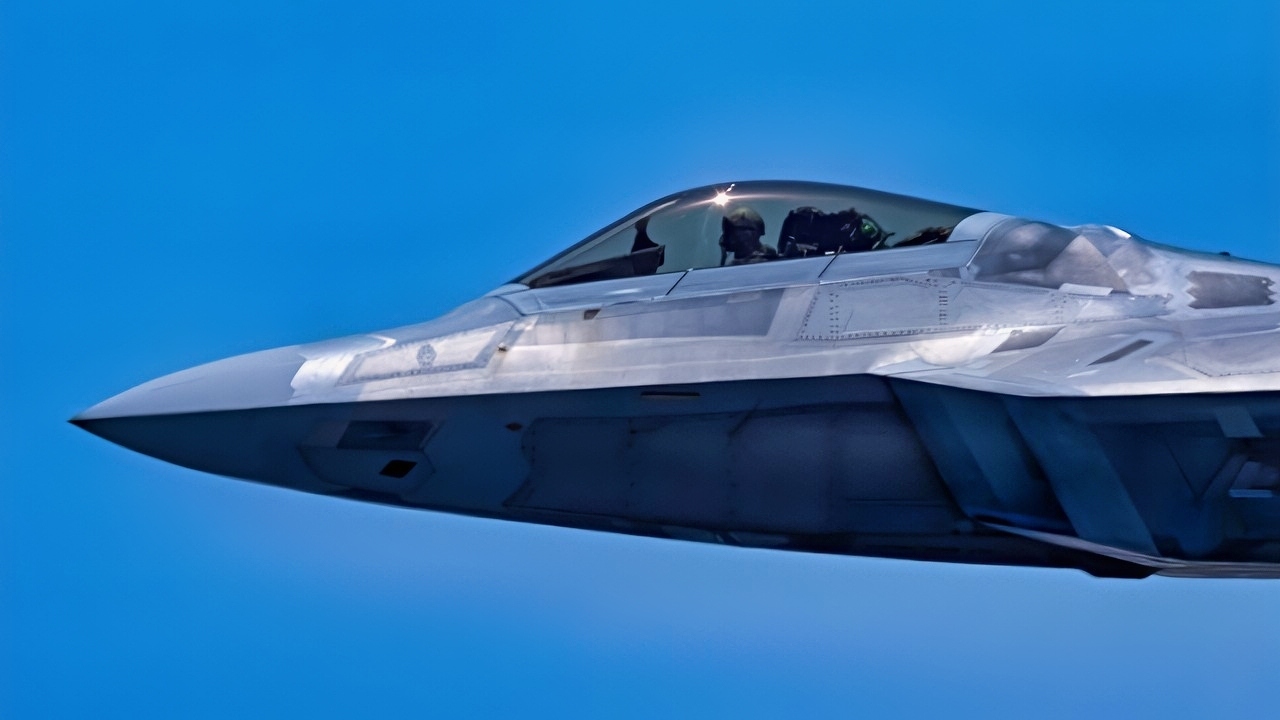
Lockheed Martin unveiled an F-22 Raptor 2.0 configuration at the Air & Space Forces Association’s Warfare Symposium in Denver this February, featuring a new Low Drag Tank and Pylon system designed to extend the fighter’s combat range by roughly 850 nautical miles without breaking its stealth profile. The standard F-22 has a combat radius of about 590 nautical miles — a serious problem in any conflict with China across the vast distances of the Pacific, where KC-135 and KC-46 tankers are easy targets. Lockheed Martin says the new tanks remain attached during combat and stay survivable, rather than being dropped before contested airspace.
The F-22’s Biggest Weakness Is Being Addressed
Follow us on YouTube.
Lockheed Martin this year publicly unveiled a new “Raptor 2.0” configuration for the F-22 that features stealth-compatible external fuel tanks intended to dramatically extend the fighter’s operational range without completely sacrificing survivability.
The upgraded version of the aircraft was shown during the Air & Space Forces Association’s Warfare Symposium in Denver in February. It included a new “Low Drag Tank and Pylon” system, or LDTP, designed specifically for long-range operations in high-threat environments like the Indo-Pacific.
It’s a fix for a long-recognized problem with the F-22: its short combat radius, which could become a particular problem in a potential conflict involving China across the vast distances of the Pacific.
Unlike the F-22’s current 600-gallon external drop tanks, which significantly increase radar signature and are normally discarded before combat, the new tanks are designed to remain attached during operational missions.
Lockheed Martin says the tanks can provide roughly 850 nautical miles of additional range while maintaining low observability and minimizing aerodynamic penalties.

U.S. AIR FORCE ACADEMY, Colo. – Two F-22 Raptors perform a flyover and air demonstration during noon meal formation at the U.S. Air Force Academy in Colorado Springs, Colo., April 12, 2023. Events such as these aim to cultivate warrior ethos, a future-focused mindset, and supplement existing character, leadership, and officer development efforts with the cadets. (U.S Air Force Photo by Trevor Cokley)
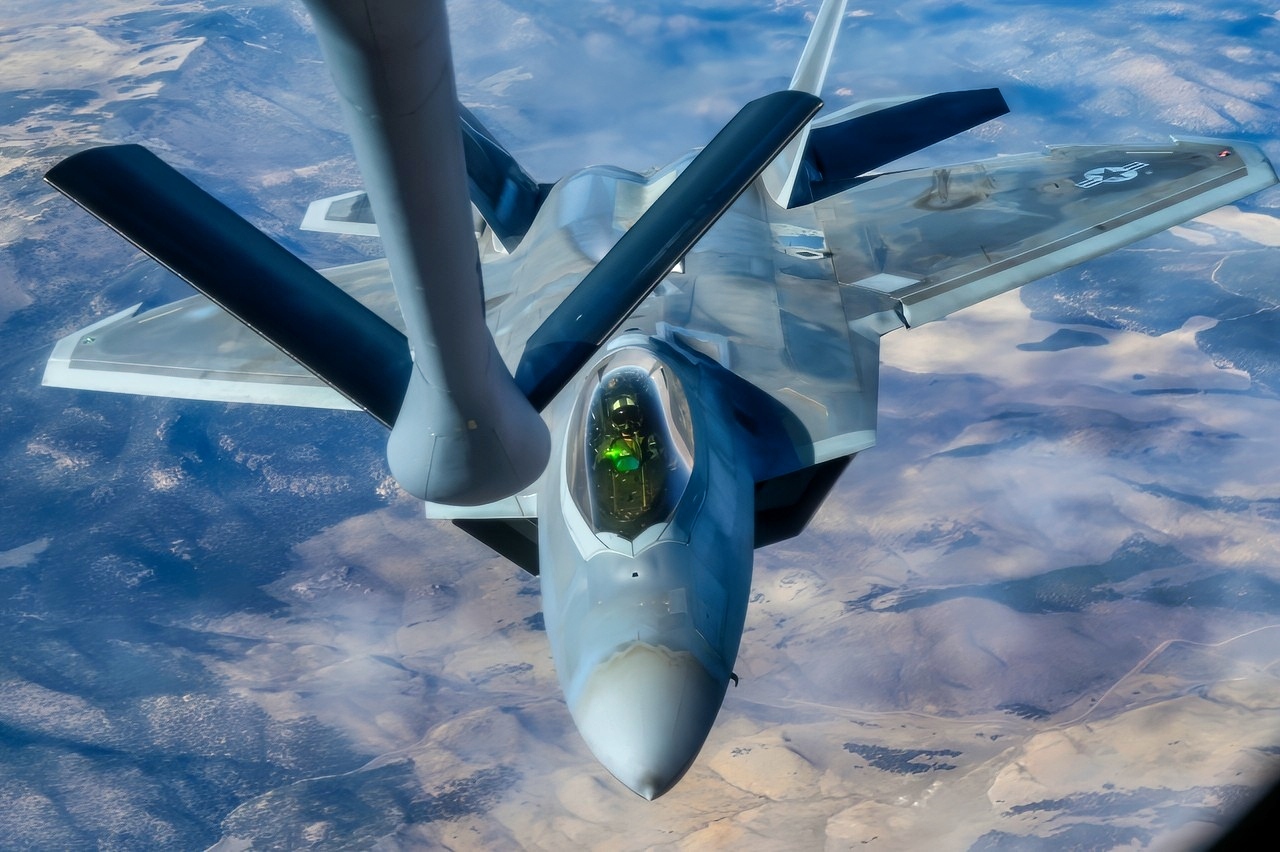
An F-22 Raptor approaches to receive fuel from a KC-135 Stratotanker assigned to the 92nd Air Refueling Wing during the Weapons Integration course over the Nevada Test and Training Range, Dec. 12, 2023. Air refueling crews assigned to the 92nd, 93rd and 97th Air Refueling Squadrons at Fairchild Air Force Base, Washington, participated in the WSINT course to enhance interoperability with a variety of aircraft and demonstrate how Air Mobility Command’s air refueling capabilities enhance global reach for all Department of Defense air operations. WSINT is a series of complex, large-force employment missions that serve as the capstone portion of Weapons School classes, which take place twice a year at Nellis Air Force Base, Nevada. WSINT students plan and execute every aspect of air, space and cyber combat operations, with joint force components converging over the Nevada Test and Training Range. (U.S. Air Force photo by Senior Airman Haiden Morris)
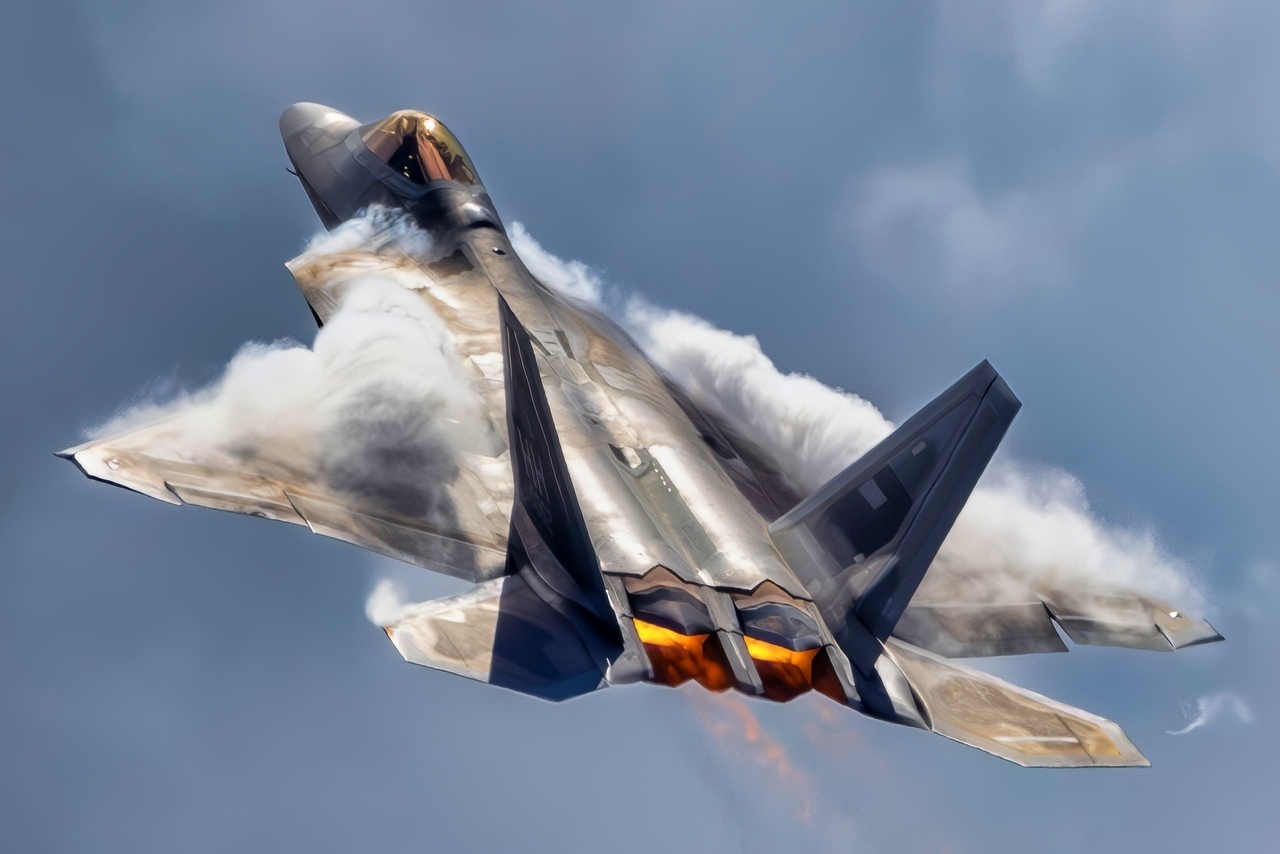
An F-22 Raptor performs an aerial demonstration at Marine Corps Air Station Kaneohe Bay, Hawaii, Aug. 8, 2025. The rapid change in angle of attack causes visible vapor to form around the aircraft, giving spectators a clear view of the jet’s aerodynamic performance. This demonstration highlights the unique thrust-vectoring capabilities of the F-22, allowing it to achieve extreme agility unmatched by other fighter aircraft. (U.S. Air Force photo by Staff Sgt. Lauren Cobin).
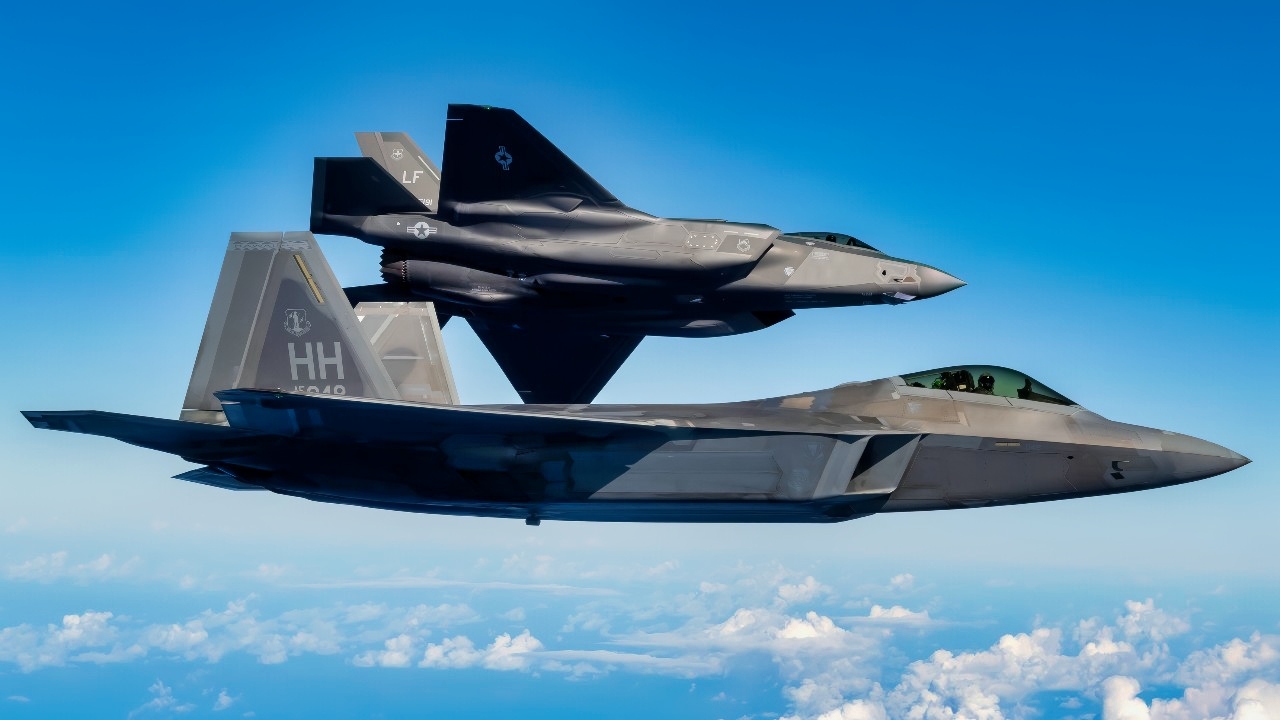
An F-35A Lightning II banks away from an F-22 Raptor Feb. 6, 2020, near the Hawaiian Islands. F-35 Airmen from Luke Air Force Base, Ariz., temporarily relocated to Joint Base Pearl Harbor-Hickam, Hawaii, to join other flying squadrons in exercise Pacific Raptor. Every training mission of the exercise was carried out by total-force teams from the Air Force’s Active, Reserve and Air National Guard components. (courtesy photo)
The change may seem relatively minor compared to the introduction of entirely new weapons or sensors.
Still, it addresses one of the central realities of modern air warfare: even advanced stealth fighters are constrained by geography, tanker availability, and fuel consumption.
The F-22’s Range Problem Has Always Existed
While the F-22 remains one of the most capable air superiority fighters ever built, it does have drawbacks.
It was built to combine stealth, supercruise capability, high maneuverability, and advanced sensors into a single platform that remains unmatched in many air-to-air scenarios.
Range, however, has always been a problem, with most estimates placing its unrefueled combat radius at roughly 590 nautical miles.
That limitation is manageable in scenarios where refueling is possible, but in the Pacific, where distances between bases can stretch thousands of miles and tankers are vulnerable, it’s different.
Dispersed island airfields create major logistical challenges even before accounting for combat operations themselves. The problem stems from the F-22’s design priorities.
The aircraft was developed during the 1990s primarily for high-end air superiority missions against Soviet or post-Soviet threats, where the Air Force expected to operate from relatively secure forward bases in Europe or nearby regions.
The fighter was optimized around stealth, acceleration, supercruise, and maneuverability rather than extreme endurance.
As with other stealth aircraft, the F-22 is deliberately designed to carry most of its fuel internally to preserve low observability.
External fuel tanks compromise the low-observable design of stealth aircraft, while internal fuel tanks improve survivability but limit fuel volume compared to non-stealth aircraft.
The F-22’s powerful Pratt & Whitney F119 engines consume fuel rapidly during high-performance operations.
Supercruise itself (sustained supersonic flight without afterburners) offers major tactical advantages but still imposes significant fuel demands during long-range missions.
What the New Tanks Actually Change
The new Low Drag Tank and Pylon system aims to address part of that problem without compromising the aircraft’s stealth profile.
Current F-22 drop tanks are primarily useful for ferry flights and long-range transit, as they substantially increase radar visibility while degrading aerodynamic performance.
Pilots generally discard them before entering contested airspace. The new tanks were designed specifically to avoid that tradeoff.
The tanks use faceted stealth shaping and low-drag geometry intended to reduce radar reflections while preserving much more of the aircraft’s aerodynamic performance.
Lockheed Martin representatives have said that the tanks are designed to remain attached during combat operations rather than being treated as expendable external stores. Vice president of Lockheed Martin’s F-22 program, Katie Ciccarino, said that the tanks “can go into combat” but that they are “droppable” if needed.
“But the idea would be not to drop them, and to retain them throughout whatever the pilot is doing and then coming home and being able to use them again,” she also said.
This is a significant operational change.
Traditional external tanks are essentially disposable range extenders, but the new system instead attempts to integrate additional fuel capacity directly into the aircraft’s survivable (stealth) configuration.
The tanks are part of an ongoing modernization effort known as “Raptor 2.0,” which also includes new stealthy underwing infrared search-and-track pods designed to improve detection of enemy stealth aircraft.
The Indo-Pacific Changed Everything
The Air Force’s growing focus on Pacific operations is the primary driver of these recent decisions.
It’s hard to ignore the aircraft’s range limitations, because any future conflict with China, which appears to be increasingly likely or, at least, possible, would involve enormous operational distances and the use of dispersed basing.
Refueling tankers would be extremely vulnerable, and defending them would involve the use of other high-value air assets.
That last point is particularly important: modern U.S. airpower depends heavily on tanker aircraft like the KC-135 and KC-46 to sustain long-range fighter operations.
But those tankers themselves are large, slow, and expensive, making them easy and likely targets for long-range missiles and enemy fighters.

Aircraft from the 1st Fighter Wing conducted an Elephant Walk at Langley Air Force Base, Jan. 31, 2025, showcasing the wing’s readiness and operational agility. This demonstration highlighted the wing’s capability to mobilize forces rapidly in high-stress scenarios. The wing’s fleet includes F-22 Raptors and T-38 Talons. As Air Combat Command’s lead wing, the 1 FW maintains unparalleled combat readiness to ensure national defense at a moment’s notice. (U.S. Air Force photo by SrA Ian Sullens)
Reducing dependence on aerial refueling has therefore become increasingly important for stealth aircraft expected to operate in contested airspace.
The longer an aircraft can operate without risking other assets, the better.
The F-22’s current drop tanks already help extend range during long-distance deployments. Raptors operating from Alaska, for example, frequently carry external tanks during intercept missions covering vast stretches of airspace.
But those traditional tanks become far less practical once survivability against modern air defenses becomes a factor.
The new stealth-compatible tanks, therefore, are effectively an acknowledgment that future air wars will require fighters to travel much farther while relying less on vulnerable tanker support.
About the Author: Jack Buckby
Jack Buckby is a British researcher and analyst specializing in defense and national security, based in New York. His work focuses on military capability, procurement, and strategic competition, producing and editing analysis for policy and defense audiences. He brings extensive editorial experience, with a career output spanning over 1,000 articles at 19FortyFive and National Security Journal, and has previously authored books and papers on extremism and deradicalization.


