

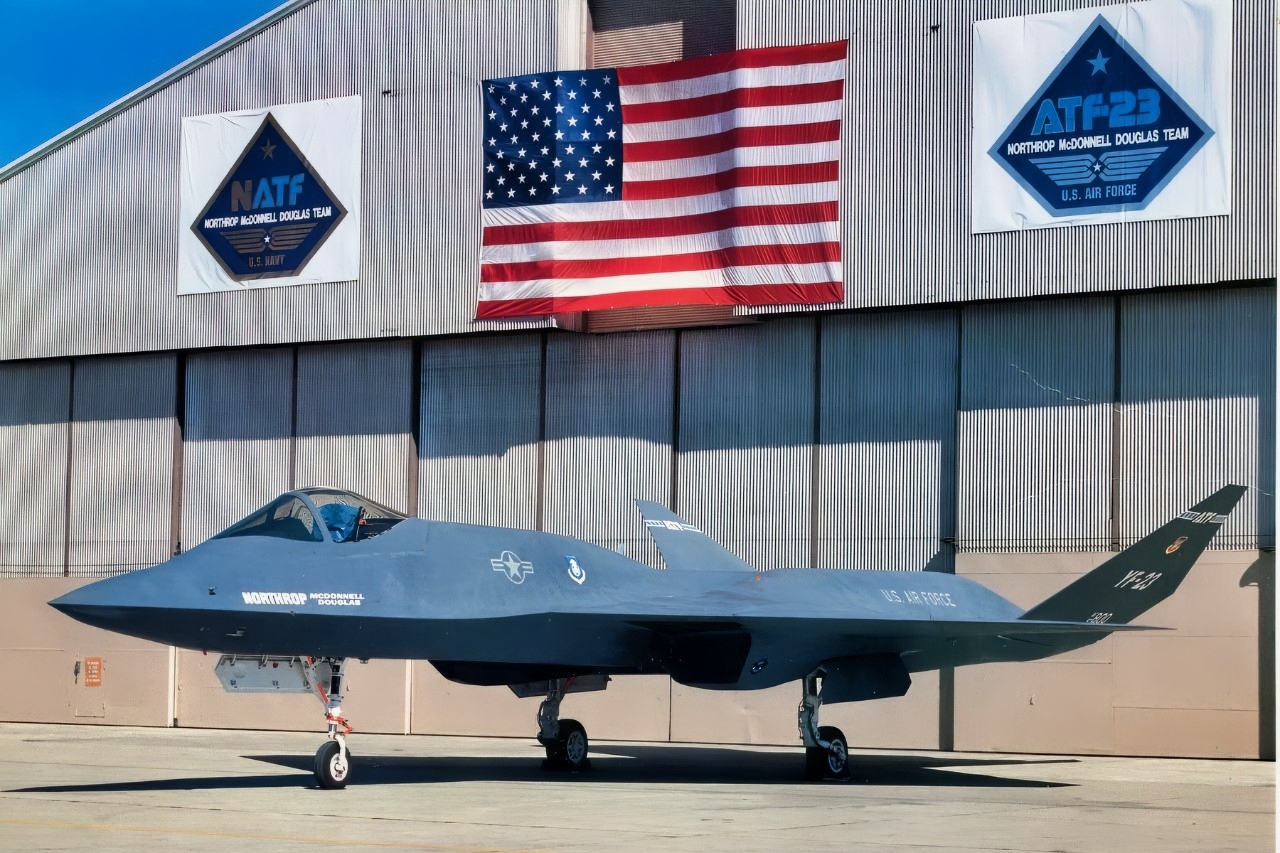
Key Points and Summary – Northrop’s YF-23 Black Widow II lost the Advanced Tactical Fighter competition to the YF-22, but many analysts still argue it was the more advanced design.
-With its blended wing-body, canted tails, and supercruise engines, the YF-23 pushed stealth and range even further than its rival.

YF-23. Image Credit: Creative Commons
-Drawing on original blueprints, aerospace artist Adam Burch and The War Zone reconstructed how a production F-23 might have evolved: cleaner intakes, refined exhausts, expanded internal weapons bays, and a reshaped nose for a full AESA radar.
-The result is a convincing glimpse of the stealth fighter America almost built—and what airpower might have looked like if it had.
What If the YF-23 Had Won? Inside America’s ‘Lost’ Stealth Fighter
The YF-23 was a prototype stealth fighter developed by Northrop and McDonnell Douglas. Known as the Black Widow II, the jet competed to win the U.S. Air Force’s Advanced Tactical Fighter program in the late 1980s and early 1990s.
And, as you likely know, we have spent a lot of time and money visiting the only two YF-23 fighters in existence today. We have taken way too many vidoes and photos of these fighters than we can count at this point.
Although it lost the competition to the YF-22, which became the F-22 Raptor, the YF-23’s advanced stealth technology left a lasting impression. So, especially, did its unique design, which featured a blended wing-body configuration and canted vertical tails.
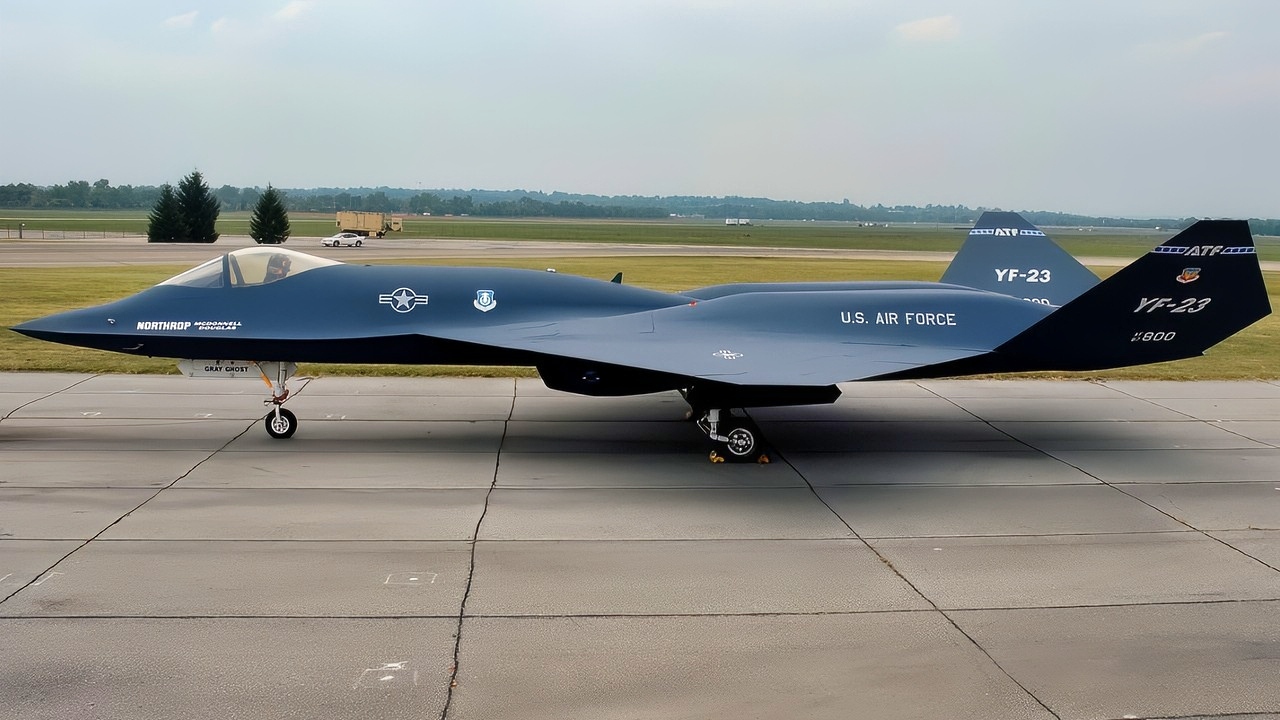
DAYTON, Ohio — Northrop-McDonnell Douglas YF-23 at the National Museum of the United States Air Force. (U.S. Air Force photo)

YF-23 on Taxiway USAF. Image Credit: Creative Commons.
The YF-23 was an outstanding aircraft, but it suffered from poor presentation by program leaders. History could have turned out quite differently otherwise.
It is hard to argue against the F-22, which remains the world’s best stealth aircraft, but sometimes it is fun to play the “what if” game, especially when many analysts are still convinced the YF-23 was the better aircraft.
The War Zone took the alternate scenario to the next level; they put together a fascinating piece on what the F-23 would have looked like.
Let’s start by taking another look at the YF-23.
Meet The YF-23 Stealth Fighter
The Black Widow II featured a sleek, stealthy design and incorporated a number of innovative technologies, including advanced radar-absorbing materials, a revolutionary diamond-shaped wing, and an emphasis on reducing infrared signatures.
Designers used a blended wing-body and S-duct engine intakes to reduce the jet’s radar cross-section.
The aircraft was powered by two Pratt & Whitney YF119 or General Electric YF120 engines, enabling supercruise – this meant the YF-23 could maintain supersonic speeds without using fuel-guzzling afterburners, giving it advantages in range and fuel efficiency.
The YF-23 could reach speeds of up to Mach 2.2 at high altitudes, flying over distances of 2,424 nautical miles, according to Aerotime Hub. Its combination of speed, agility, and stealth made it a fierce competitor.
While Lockheed’s YF-22 had a visually impressive design, the YF-23 went a step further with an extraordinary appearance. Its diamond-shaped wings weren’t a mere visual feature – they helped to lower the aircraft’s radar visibility – and its slim side profile resembled that of the SR-71 Blackbird spy plane.

SR-71. Image Credit: Creative Commons.
Imagining the F-23 In Its Final Form:
In his piece, TWZ’s Tyler Rogoway correctly points out that the prototype YF-22 looked quite different in many aspects from the F-22 Raptor in its finished form. The same would have been true for our fictional F-23.
Rogoway worked with well-known aerospace artist Adam Burch of Hangar-B Productions. Using various sources, including the actual blueprints for the F-23A, Burch created a series of awesome artist renderings to show what this aircraft could have been.
As pointed out in the TWZ piece, this wasn’t just a fan art/science fiction rendering. It was as real as it could be, recreating the aircraft from its blueprints to resemble the planned production form.
The F-23 would have been longer and more smoothly molded, with the YF-23’s large trapezoidal engine nacelles blended more seamlessly into the fuselage.
In the artist’s rendering, the engines were placed closer together and angled slightly inward. Without thrust reversers, a more efficient, low-observable flap nozzle could have been installed, and the flat exhaust troughs would have received updated heat-resistant coverings.
The F-23’s nose shape would be changed to accommodate a more powerful active electronically scanned array radar, and its intakes would be drastically changed, replacing the innovative “gauzing panels” that remove turbulent air from the intakes.
The F-23 would have had diverterless supersonic intakes, similar to what is seen today on the F-35 and J-20. The intake leading edges would be serrated, giving them a menacing look and enhancing their low-observable properties.
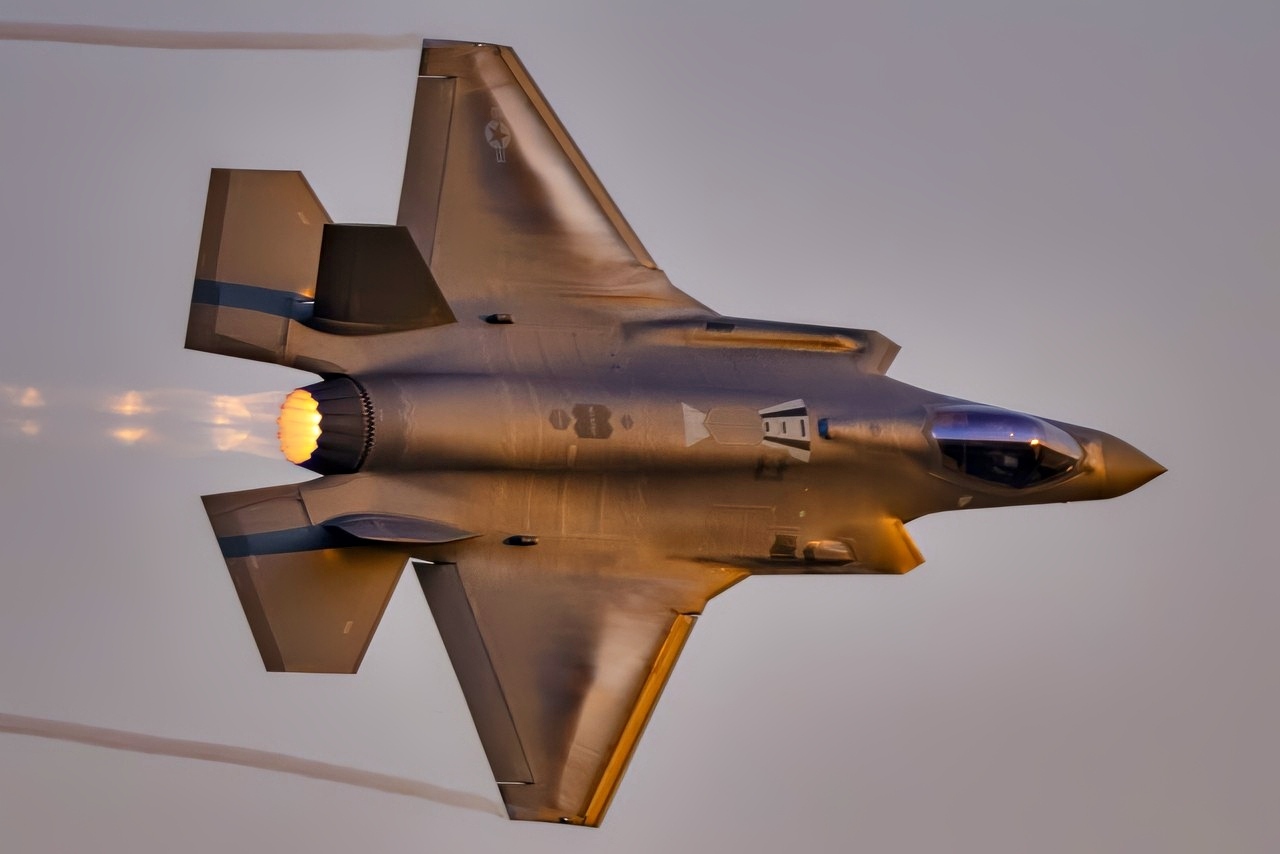
A U.S. Air Force F-35A Lightning II assigned to the F-35A Lightning II Demonstration Team performs at the Capitol Air Show over Sacramento, California, July 15, 2024. Innovations such as the F135 Smart Stacking Tooling Enhancement developed by the OC-ALC mechanics and engineers have significantly improved the rotor assembly process, increasing precision and enhancing the depot’s ability to produce the engine that powers the F-35 Lightning II. (U.S. Air Force photo by Staff Sgt. Zachary Rufus)
Weapons Bays and Capacity Expanded:
The fictional F-23’s weapons capacity was expanded, improving storage over the single bay found on the YF-23. The internal weapon bays were arranged to carry a pair of AIM-9 Sidewinders in the front bay and four to five AIM-120s in the rear bay.
Air-to-ground munitions could also be carried. With its rear weapons bay, it could carry much larger weapons than what the F-22 is capable of carrying today.
Burch has a ton of experience in the realm of aviation, and it is worth repeating his comments about what it took to complete the rendering of this aircraft.
“The F-23A model was the result of long hours of research, supposition, dead ends, frustration, fits, starts, and restarts. Above all else, in bringing the ‘Black Widow II’ to life, I drew on my own experience as a professional aerospace engineer, amateur historian, middling pilot, and terrible meteorologist to produce something I hope will do her designers, engineers, maintainers, and pilots proud.
“I attempted to remain faithful to the reference material wherever possible before succumbing to creativity and shamelessly lifting design cues from production aircraft, such as the F-22A. As with all ‘what if’ projects, there are many questions regarding small details about the final design that may never be answered and that is just fine with this artist!”
The renderings in the article are numerous and just fantastic. They bring the F-23 to life. The artist shows the scope and the size of the F-23. It would absolutely dwarf its namesake, the P-61 Black Widow of World War II fame – one of my favorite aircraft from that era.
Northrop has released an artist’s rendering of its F/A-XX concept sixth-generation stealth fighter. One wonders whether the F/A-XX will resemble Northrop’s YF-23, which remains a fantastic prototype, and if so, how close will it resemble Burch’s rendering?

F/A-XX Handout Photo from Northrop Grumman.
About the Author: Steve Balestrieri
Steve Balestrieri is a National Security Columnist. He served as a US Army Special Forces NCO and Warrant Officer. In addition to writing on defense, he covers the NFL for PatsFans.com and is a member of the Pro Football Writers of America (PFWA). His work was regularly featured in many military publications
More Military
The YF-23 Black Widow II Stealth Fighter Almost Made the Ultimate Comeback
The New Leopard 2A8 Tank Has a Message for the Russian Army
The F-22J Raptor Stealth Fighter Will Never Fly For Japan (China Is Smiling)


V. Kerrigan
October 5, 2025 at 10:07 pm
You’re blaming poor presentation for the 23 not being selected? How about the USAF not prioritizing the assets of the design and what would be needed in today’s environment.
T Mccauley
October 5, 2025 at 11:46 pm
I worked on the f22 during the competition with Northrop. During the testing one of the f22s was lost in a low altitude crash . If you see the video of the crash you notice the aircraft start to pitch up and down violently. This was later determined to be pilot induces oscillation.
We were told that the f23 was grounded and eventually lost the competition because it developed structural failure and was no longer flyable .
Joe
October 6, 2025 at 2:19 am
the f22 is and probably always will be the best dogfighting aircraft in existence. the modern strategies are moving away from “building the best dogfighter” to “building stealthy weapons platforms”, with a focus on having longer range missiles and radar than the other side. the f23 might be stealthier but I doubt it would perform to the f22s specs
bret
October 6, 2025 at 3:31 pm
Seeing the recent Phoenix patch of the new F47…I wouldn’t be surprised if it was an updated and altered version of the same basic YF23 Black Widow platform.
Jeff
October 7, 2025 at 9:31 pm
I read another article about a year ago about Japan wanting a 5th gen fighter. Rather than start from scratch, they reached out to Northrop about the F23. The Biden admin. was saying no. But it sounded like the incoming Trump team was more open to the idea. So maybe there is a new chance at life for the f23.