
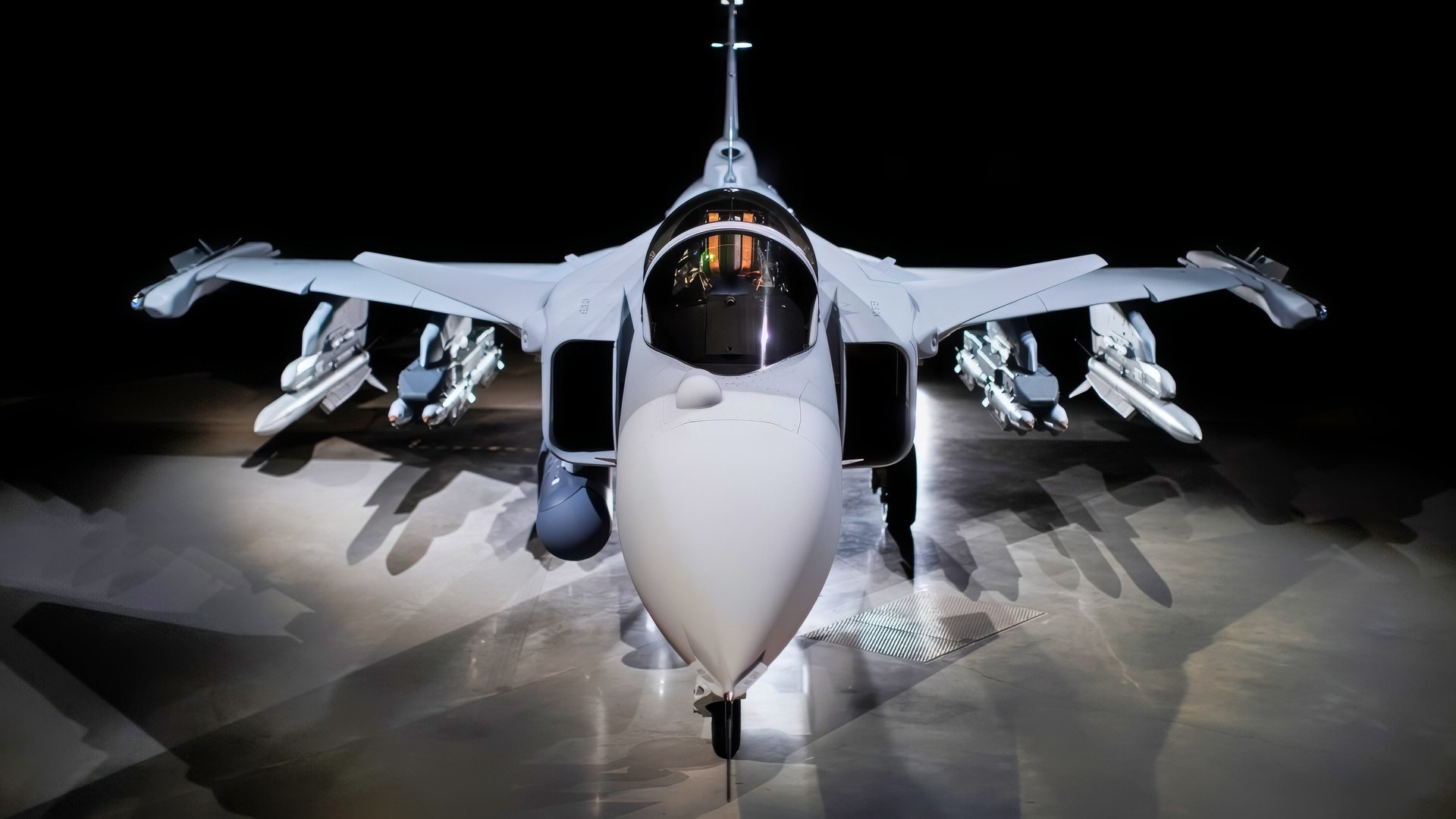
Key Points and Summary – Sweden is backing financing talks that could send up to 150 JAS 39 Gripen E fighters to Ukraine—potentially with part-production on Ukrainian soil.
-The E model upgrades the lightweight multirole Gripen with a GE F414 engine, more fuel, added hardpoints, AESA radar, IRST, and fused avionics, while keeping 10–20 minute turnarounds and dispersed-basing ops that thrive on minimal infrastructure.
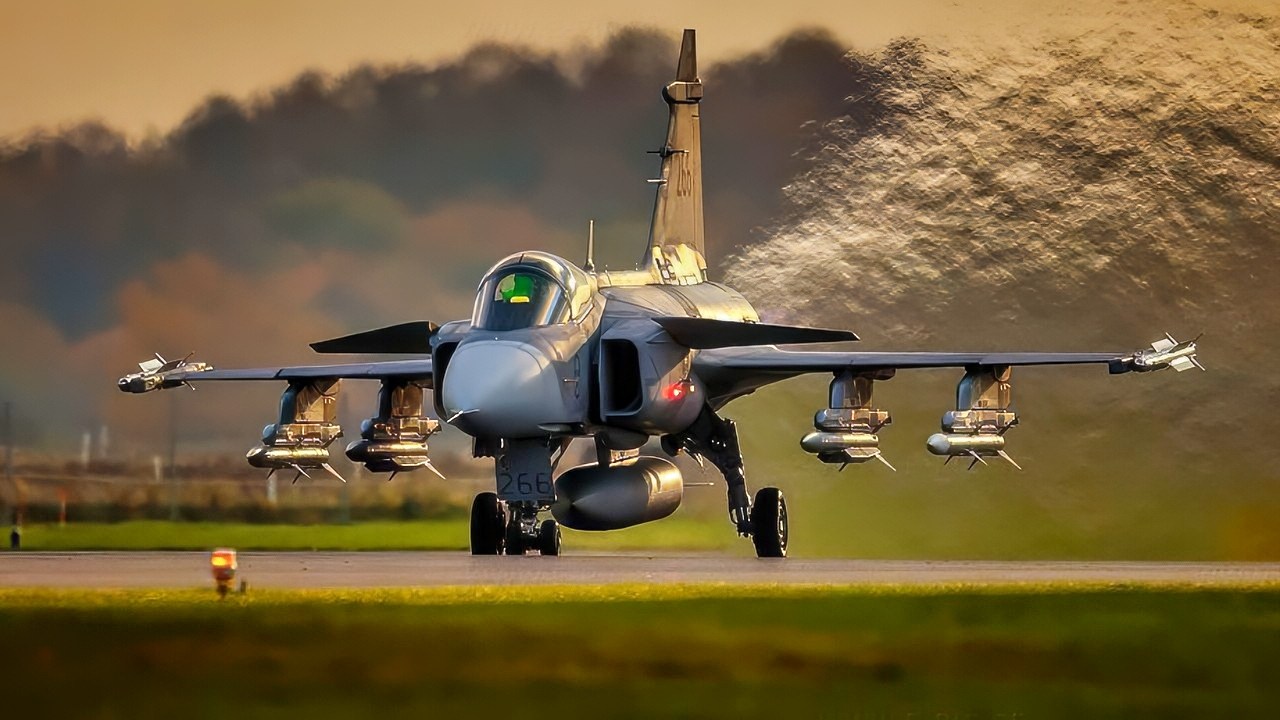
JAS 39 Gripen SAAB Image Handout

JAS 39 Gripen Flying in Formation.
-It isn’t stealth, but survivability leans on powerful EW, decoys, standoff weapons, and robust datalinks.
-For a country replacing Soviet-standard fleets under fire, the draw is scale, speed, and sustainment—high-end effects without boutique stealth baggage. If it works for Kyiv, Canada’s watching.
Here’s Why Ukraine Is Eyeing A JAS 39 Gripen E Deal
In November 2025, Sweden’s Defense Minister Pal Johnson confirmed that Stockholm is actively supporting financing talks with Kyiv for a potential deal under which Ukraine could acquire up to 150 JAS 39 Gripen E fighters.
It could become Sweden’s most significant aircraft export order to date.
The program is aimed not just at delivering the aircraft, but also at opening the door to part-production in Ukraine itself—a deal that Saab frequently offers potential customers like Canada.
But this sudden surge of interest in the JAS 39 Gripen E is interesting.
It reflects how the platform is increasingly viewed as a viable successor for Warsaw-compatible fleets—meaning the air forces in Central and Eastern Europe that used to operate Soviet-standard aircraft.
At the same time, the contract proves that the JAS 39 Gripen E, despite being a 4.5-generation design that isn’t stealthy, could still provide years of valuable service.
But can the Gripen E really remain strategically relevant in current and future high-threat air-defense environments without stealth?
Where the Gripen E Excels
The Gripen E is a substantial redesign of the earlier C/D series, offering enhanced performance and modern systems while retaining much of its original purpose and design features.
It still features a single engine and is a lightweight multirole fighter. According to the manufacturer, Saab, it features a maximum take-off weight of 16.5 tonnes, 10 weapon hardpoints, aerial refueling capability, and a combat turnaround time of just 10-20 minutes.
The Gripen E uses the GE F414-G engine, which offers significant thrust improvements over earlier versions, and has a fuselage approximately 1 meter longer.
It also has an increased internal fuel capacity and two additional hardpoints, raising payload capacity to around 7,200 kg. Its avionics suite has also been thoroughly modernized with AESA radar, passive IRST sensors, a wide-area cockpit display, advanced sensor-fusion capabilities, and updated datalinks.
Equally important is the aircraft’s entire operational concept. It is designed to support dispersed basing—a military strategy that involves spreading aircraft and support operations across multiple small airfields. It’s also designed for fast turnarounds and minimal ground infrastructure, which, in turn, keeps costs low.
Hence, its popularity among small-nation air forces that primarily operate in contested but not peer-adversary environments. All of these features make the Gripen E attractive for export.
In Ukraine’s case, the letter of intent (LOI) is for up to 150 airframes. Sweden has already ordered approximately 60 for its own air force.
Why No Stealth?
Despite the upgrades, the Gripen E remains non-stealthy in its airframe design. It lacks internal weapons bays and has not adopted extreme low-observable shaping.
It also does not claim a radar-cross-section (RCS) comparable in any way to fifth-generation jets.
Stealth wasn’t a priority when engineers designed this airframe, nor when they upgraded it. The lack of stealth is therefore a feature, not a bug.
It’s a design trade-off to keep costs down, with stealth materials not only costing more to use but also requiring a lot of maintenance over the years. The airframe’s shaping would also need to be dramatically designed so extensively that making the Gripen E a stealth jet would require making it into an entirely different aircraft.
And while stealth is increasingly valuable in an environment, there is more to survivability than simply evading detection. Sometimes, delaying detection can be nearly as useful, or even dominating, in network-enabled operations.
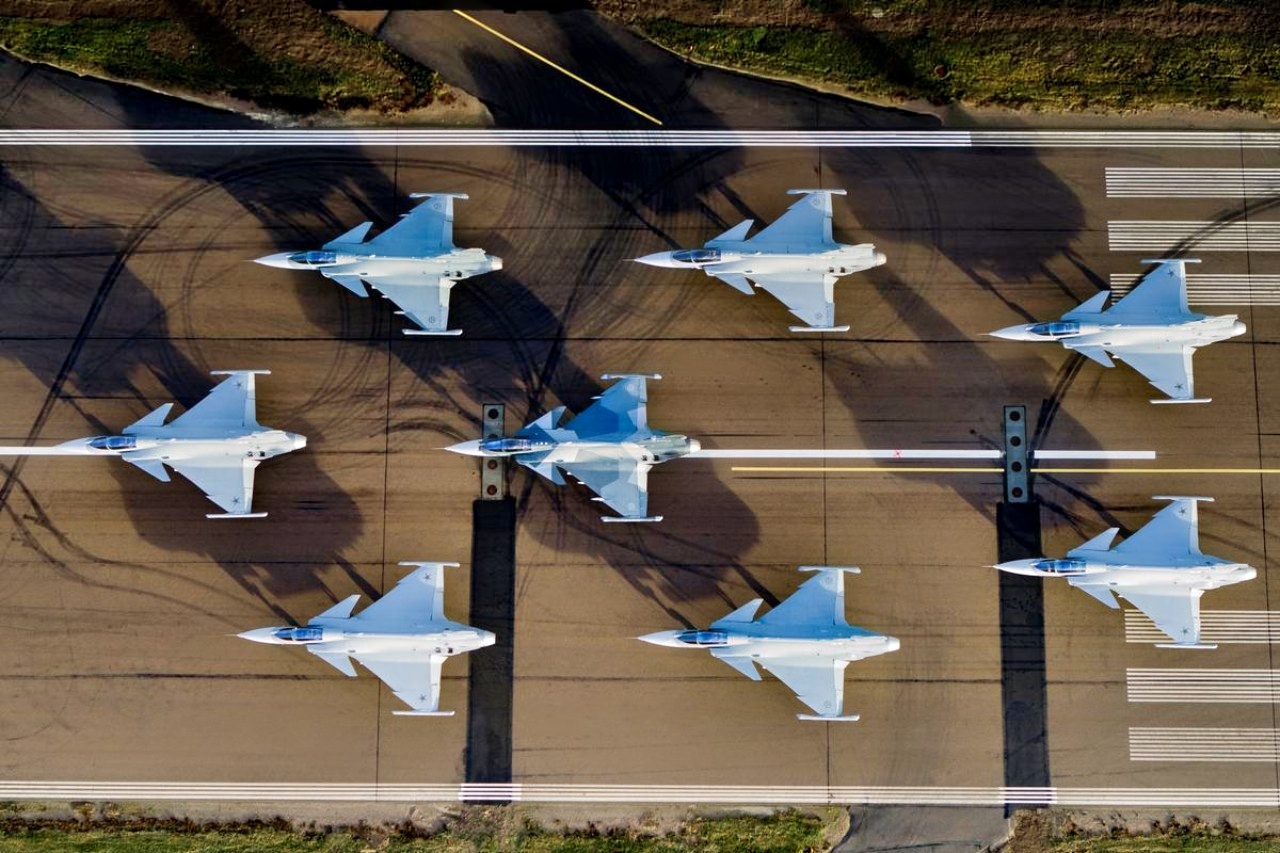
JAS 39 Gripen E Fighters. Image Credit: Creative Commons.
The JAS 39 Gripen E doubles down on its strengths rather than competing with more advanced, expensive platforms designed explicitly for stealth.
From this perspective, the Gripen E is a hugely valuable asset that delivers high-end performance on a budget, without the logistics chain that comes with full-stealth platforms.
Sure, in a high-threat environment, with dense SAM belts and stealth fighter threats, the lack of stealth could still limit the Gripen’s penetration ability. But that simply means the Gripen can instead lean on its networked operations, electronic warfare capabilities, and allied supporting assets to succeed.
A Future for Gripen
In the end, the Gripen E’s success will depend less on what it lacks and more on what it does well. It was never designed to slip through, completely unseen, in hostile radar networks.
Instead, this piece of Swedish engineering was intended to completely out-think and out-maneuver them, without lumping the aircraft with all the baggage that comes with stealth.
The JAS 39 Gripen E uses advanced jamming, data fusion, and networked targeting to survive where stealth platforms cannot—and for countries like Ukraine or smaller NATO allies, that distinction really matters.
Ukraine and others need aircraft that can be built, maintained, and deployed quickly and at scale. Boutique stealth fleets would be great, sure, but they often spend more time in hangars than on patrol – and that’s costly.
About the Author:
Jack Buckby is a British author, counter-extremism researcher, and journalist based in New York. Reporting on the U.K., Europe, and the U.S., he works to analyze and understand left-wing and right-wing radicalization, and reports on Western governments’ approaches to the pressing issues of today. His books and research papers explore these themes and propose pragmatic solutions to our increasingly polarized society. His latest book is The Truth Teller: RFK Jr. and the Case for a Post-Partisan Presidency.
More Military
The ‘Super’ B-52H Stratofortress Bomber Is Already Flying
‘Go Home’: Stealth F-22 Raptor Flew Right Under Iranian F-4 Phantom Undetected
Russia’s ‘New’ PAK DA Stealth Bomber Has a Message for Every Military On Earth
China’s New H-20 Stealth Bomber Has a Message for Any Military on Earth
Mach 2 F-4 Phantom II Fighter Has a Message for Every Air Force on Earth


Forward Thinker
November 14, 2025 at 12:34 am
The Gripen seems to be a better idea for Canada given that it is less costly and we do not really need stealth in our defensive role. In addition, if Saab is willing to transfer technology and build not only ours but some for export in Canada means getting parts for repair and upgrading will be easier. The question might be interoperability with US planes but I am sure that can be overcome. In this trade climate with the us, we should not be making ourselves vulnerable to the USA should Trump want to make withholding supplies and upgrades as negotiating leverage. Buy the 16 we have committed to if we cannot get out of that but fill out our needs with zgripens from a freindly nation.
Erik Brickman
November 14, 2025 at 2:14 pm
It’s nice for me, a Swede interested in smart defense deals, to see that Canada also recognizes the usefulness of the Gripen E. It goes to show that Canadians don’t need to think like their American counterparts.
Stephan Larose
November 14, 2025 at 4:42 pm
Who is paying for Ukraine to buy 150 of these? Is Sweden paying? Because it isn’t Ukraine, they are beyond broke. Russia will blow all of these up on the tarmac, there is nowhere in Ukrathey can’t strike with impunity. Sweden better demand payment upfront. Zelensky is corrupt, everyone around him is corrupt, and when this war the US foisted on Ukraine ends, it’ll be a dysfunctional rump state, likely signing away its rights to an air force as part of the peace deal.