

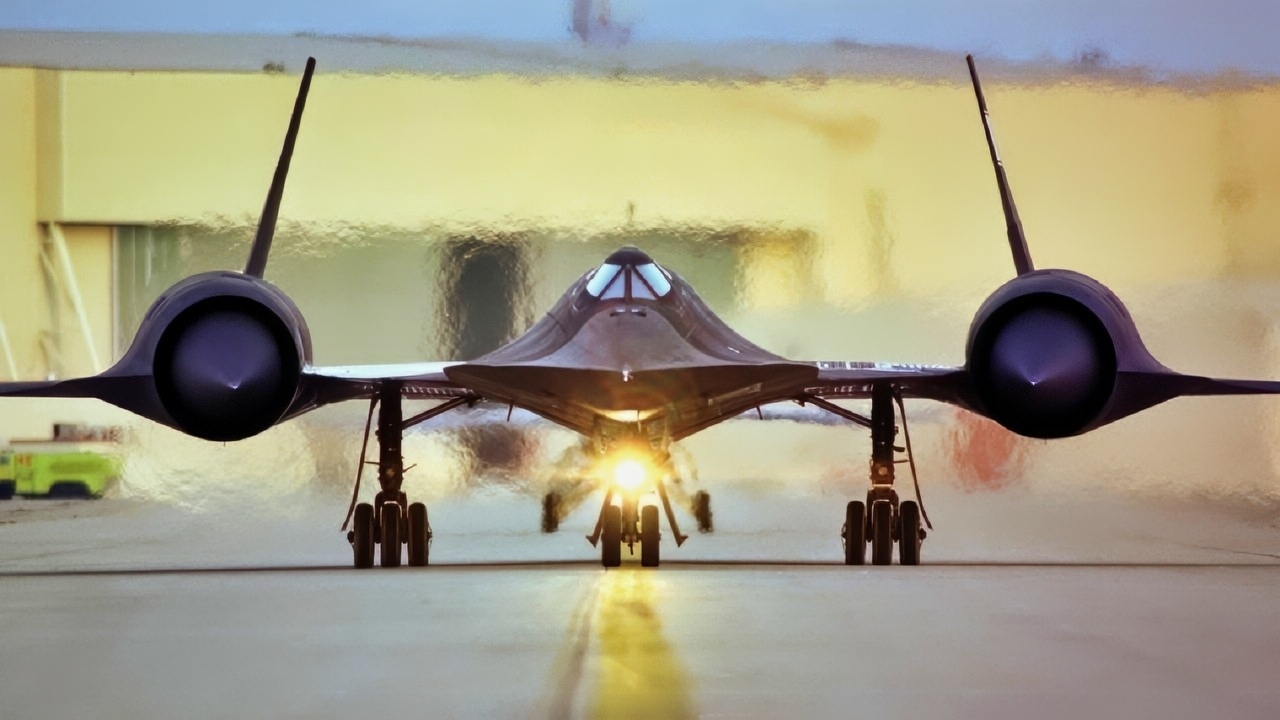
Key Points and Summary – Despite the legendary success of the Mach 3 SR-71 Blackbird, the Soviet Union never developed a direct equivalent, for several key reasons.
-Moscow prioritized its burgeoning spy satellite program and focused its airpower doctrine on defensive interceptors like the MiG-25, rather than offensive deep-penetration reconnaissance.
-Technologically, the Soviets lacked the advanced manufacturing capability to work with titanium, the crucial material for a high-speed airframe.
-Ironically, the CIA secretly sourced much of the titanium needed for the SR-71 from the Soviet Union itself, using a network of front companies.
Why Didn’t the Soviet Union Build Its Own SR-71 Blackbird Reconnaissance Plane?
A variety of factors, including different reconnaissance platforms and defense doctrines, meant that a Soviet answer to the United States’ fastest manned aircraft never materialized.
It is one of the most unique aerospace projects of the Cold War era: able to fly over three times the speed of sound, snap clandestine photographs of targets across the Soviet Union, and never suffer a single loss due to enemy action—despite being targeted by over 4,000 missiles fired at it in anger. The SR-71 Blackbird, the brainchild of Lockheed’s secretive Skunk Works division, is an incredible jet that has been the subject of interviews, documentaries, and newspaper articles.
But despite the jet’s incredible success as an advanced, top-secret reconnaissance platform, why did the Soviet Union never develop an analogue to the SR-71?
Part of the reason no SR-71-esque jet ever flew was that the Soviet Air Forces’ red star roundel? Differing strategic doctrines. The United States developed the SR-71 to fill a specific role, as a deep-penetration reconnaissance aircraft that would fly—unarmed—over enemy territory, preserved only by the incredible altitudes at which it flew as well as its speed, unmatched by any other manned, air-breathing aircraft.
In contrast, the Soviets placed higher value on spy satellites, which offered a more persistent observation capability, particularly as their space program began to mature. Though easy to forget now, the Soviet Union held a healthy lead in the space race for many years, notching such firsts as the first artificial satellite, the first animal in space, the first man in space, and several notable other firsts.
Given the progress the Soviet space program had been making, it is perhaps understandable that future visions of persistent space-based surveillance allowed the Americans to rapidly progress beyond what the USSR could achieve through manned flights.
However, Soviet doctrine differed significantly from that of the United States. Hard-pressed to match every American capability, particularly one as challenging as the SR-71 project, Soviet doctrine emphasized airspace denial and leaned heavily on surface-to-air missiles and fast interceptor aircraft to offset their more limited capabilities.
One of the significant barriers to the SR-71 program was the titanium that the program relied on. Much of the SR-71 aircraft was built of the strong, lightweight metal. Ironically, most of the titanium used in the SR-71 program was imported from the Soviet Union using CIA-created front companies to disguise the purpose of their purchases.
However, the metal was challenging to refine and manipulate using the technology of the era, as it is highly sensitive to contamination from trace elements that come into contact with the metal during smelting and welding.
MiG-25 Fighter vs. SR-71 Blackbird
The closest rival to the SR-71 in terms of raw speed was the Mikoyan-Gurevich MiG-25, a Mach 2.8+ interceptor that was eventually adapted to perform some reconnaissance as well. In terms of sensors and survivability, that jet was less sophisticated than its American rival, and simply not as fast.
Instead, other platforms in Soviet service, like the Tu-22R or the MiG-25, performed tactical reconnaissance. Being less technically challenging to build, they could be used in high-risk scenarios.
The Soviet Union also faced a much different operating environment than the United States and Western Europe. While SR-71s based in Europe, Asia, or the Middle East could potentially overfly the Soviet Union, much of which was remote and empty, largely devoid of important military or political targets.
However, the jet’s operational range, which is less than 3,000 miles, could be significantly increased with the use of in-flight refueling from tanker aircraft, thereby dramatically extending the jet’s range.
Soviet pilots, in contrast, would first have to overfly the Atlantic or Pacific Oceans before overflying the United States, or contend with NORAD radars over the Arctic and Canada. Flying that distance, peering down at a target, and making the trip back to base would have been a tall order.
About the Author: Caleb Larson
Caleb Larson is an American multiformat journalist based in Berlin, Germany. His work covers the intersection of conflict and society, focusing on American foreign policy and European security. He has reported from Germany, Russia, and the United States. Most recently, he covered the war in Ukraine, reporting extensively on the war’s shifting battle lines from Donbas and writing on the war’s civilian and humanitarian toll. Previously, he worked as a Defense Reporter for POLITICO Europe. You can follow his latest work on X.
Hypersonic Weapons In-Depth
Russia’s Hypersonic Missiles Summed Up in 4 Words


