

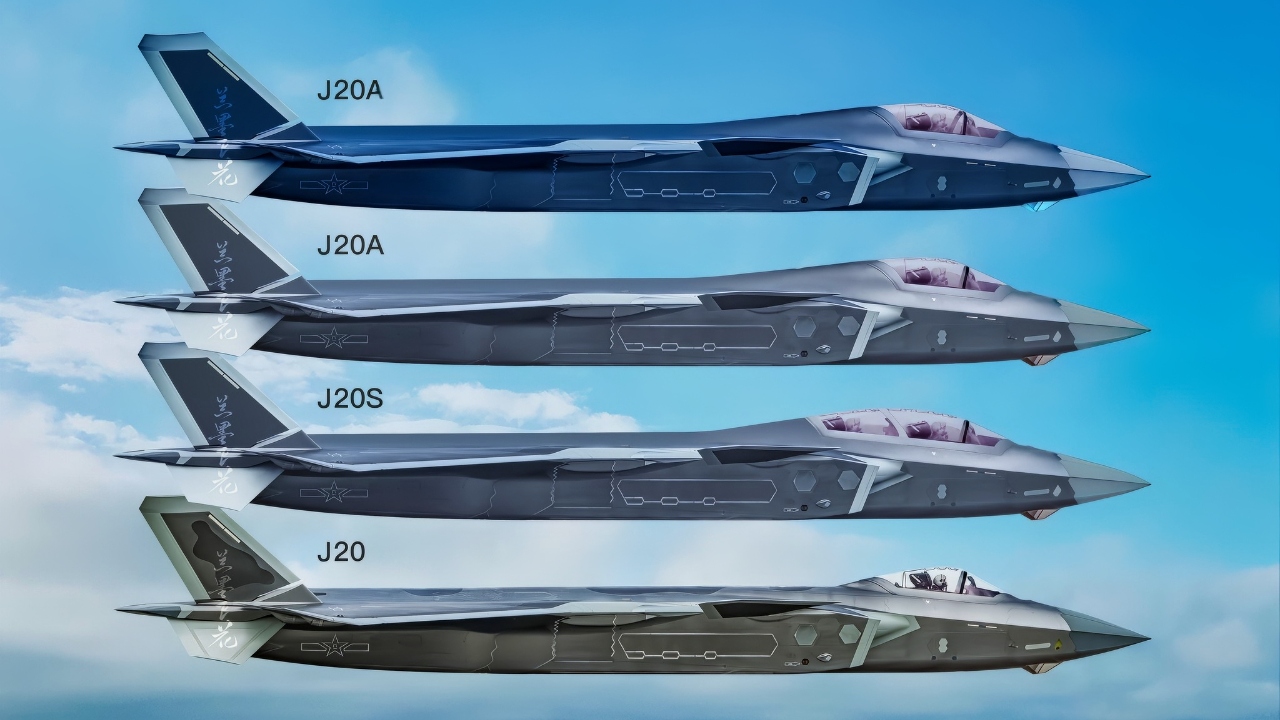
Key Points and Summary – Russia’s Su-35 is a non-stealth supermaneuverable evolution of the Su-27, packing powerful sensors (Irbis-E PESA, IRST), thrust-vectoring and long legs. China’s J-20 is a true fifth-gen design built around low observability, internal bays, AESA radar, sensor fusion and long-range weapons.
-In beyond-visual-range fights, the J-20’s stealth and networking likely let it detect, target and shoot first.
-If the Su-35 survives to merge, its thrust-vectoring agility and high off-boresight missiles tilt a close-in dogfight its way.
-Outcome hinges on context: J-20 advantages at range; Su-35 dangers up close—assuming it gets there.
Su-35 vs J-20: Who Wins If They Meet in Combat?
The Sukhoi Su-35 “Flanker-D” is one of the most advanced fighter jets in the Russian Aerospace Forces. It builds upon the legacy Su-27 with advanced avionics and thrust vectoring engines inherited from the Su-57 Felon.
The Chengdu J-20, on the other hand, is China’s first fifth-generation fighter jet. It utilizes advanced stealth technology and advanced electronics, making it a fearsome air superiority fighter. The J-20 has also received a fair number of upgrades throughout the years, further increasing its lethality and effectiveness.
While it is unlikely that Russia and China will go to war in the near future, if the J-20 and the Su-35 were to ever meet in combat, which fighter is most likely to win?
The Su-35 vs. the Mighty Dragon
The Su-35 is an evolution of the Su-27 Flanker, retaining the large airframe but incorporating advanced avionics, radar systems, and thrust-vectoring engines. It is not a stealth aircraft, but it does feature some radar cross-section reduction measures such as radar-absorbent materials and a cleaner airframe.
The aircraft is designed for supermaneuverability, with thrust-vectoring nozzles and a highly redundant fly-by-wire system that allows it to perform extreme aerial maneuvers. It has a large internal fuel capacity and can carry external drop tanks, giving it impressive range and endurance.
In contrast, the J-20 was designed from the ground up as a stealth fighter. It features a blended fuselage, diverterless supersonic inlets, canted vertical stabilizers, and internal weapon bays, all optimized for low observability.
Its canard-delta configuration provides lift and maneuverability, though the canards may compromise stealth in certain radar bands. The J-20 is built to engage targets at long range while remaining undetected, and it incorporates advanced sensor fusion and electronic warfare capabilities to support that mission.
Avionics
Avionics and sensors are another area where the two aircraft diverge significantly. The Su-35 is equipped with the Irbis-E radar, a powerful passive electronically scanned array (PESA) system capable of detecting large targets at ranges up to 400 kilometers.
It also features an infrared search and track (IRST) system for passive detection, an electronic warfare suite for jamming and countermeasures, and a helmet-mounted display that allows the pilot to target enemies with high off-boresight missiles like the R-73.
The J-20, on the other hand, is believed to use an active electronically scanned array (AESA) radar, likely the KLJ-5 or a similar system. AESA radars offer superior tracking capabilities and are harder to detect due to their low probability of intercept.
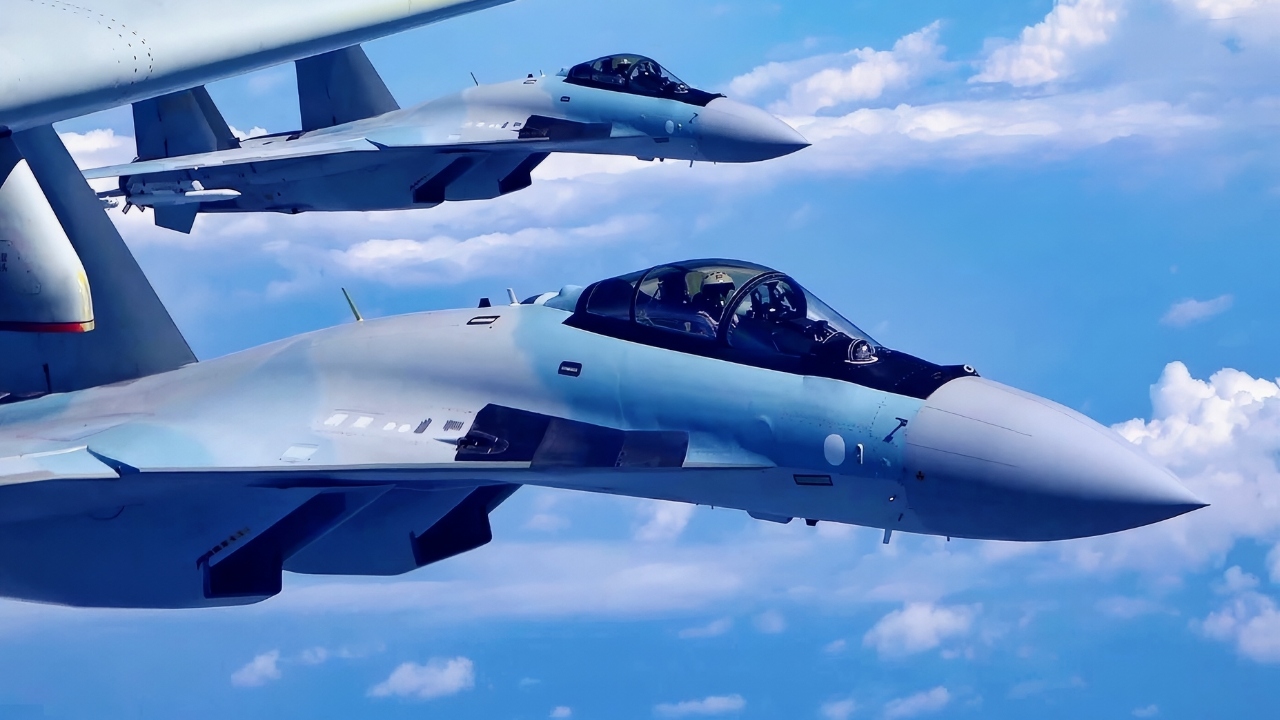
Su-35 from China. Image Credit: Chinese Air Force PLAAF.
The J-20 also integrates multiple sensors through a fusion system that combines radar, IRST, and electronic surveillance data. It may feature a distributed aperture system similar to that of the F-35, providing the pilot with 360-degree situational awareness.
Additionally, the J-20 is designed to work with artificial intelligence systems to support manned-unmanned teaming and advanced data processing.
Engine Performance
In terms of propulsion and performance, the Su-35 is powered by two Saturn AL-41F1S turbofan engines, each producing 142 kilonewtons of thrust with afterburner. This gives the aircraft a top speed of Mach 2.25 and a combat radius of approximately 1,600 kilometers.
Its rate of climb is an impressive 280 meters per second, and its thrust-vectoring capability allows it to perform maneuvers that few other aircraft can match.
The J-20 currently uses WS-10C engines, though it is expected to transition to the more powerful WS-15 engines. The WS-15 is projected to produce over 180 kilonewtons of thrust, enabling the J-20 to achieve supersonic cruise. Its top speed is estimated at Mach 2.0, and its combat radius is around 2,000 kilometers.
The aircraft’s stealth optimization includes serrated engine nozzles and internal weapons bays, which help maintain a low radar cross-section.
Stealth Capabilities
Stealth is the great divider in this discussion. Despite efforts to reduce its visibility, the Su-35 has an estimated radar cross-section of 1 to 3 square meters from the front, which makes it relatively easy to detect with modern radar systems.

J-20 Mighty Dragon in Camo Back in 2018. Image Credit: Chinese Air Force.
However, it compensates with a strong electronic countermeasures suite and IRST, allowing it to detect and engage targets passively. Its survivability relies on agility, electronic warfare, and pilot skill.
The J-20, by contrast, is designed to avoid detection altogether. It benefits from sophisticated stealth shaping and radar-absorbent materials. Its radar cross-section is estimated to be less than 0.1 square meters from the front, making it extremely difficult for most systems to track and engage.
While its stealth systems are not quite on par with Western stealth fighters, it is significantly harder to spot than the Su-35. It also features advanced jamming systems, sensor fusion, and passive detection capabilities. Its survivability is based on staying hidden and striking from long range.
Who Wins in 4 Words: J-20 Has the Advantage
So, who would win in a one-on-one fight? The answer depends heavily on the context of the engagement. In a beyond-visual-range scenario, the J-20 is much better equipped than its Russian adversary.
Its stealth design allows it to detect and engage the Su-35 before being seen, and its PL-15 missiles are highly capable. The Su-35, with its larger radar cross-section, would likely be targeted first and would have to rely on electronic countermeasures and evasive maneuvers to survive.
In a within-visual-range dogfight, the situation changes dramatically in the Su-35’s favor. Its supermaneuverability and thrust-vectoring engines give it a significant edge. The J-20, while agile, is not optimized for close-range combat and may struggle against the Su-35’s light capabilities.
This, however, assumes that the Su-35 can get close enough to the J-20 to engage it in a close-range battle, which is unlikely but not impossible.
About the Author: Isaac Seitz
Isaac Seitz, a Defense Columnist, graduated from Patrick Henry College’s Strategic Intelligence and National Security program. He has also studied Russian at Middlebury Language Schools and has worked as an intelligence Analyst in the private sector.
More Military
The X-44 Manta Has a Message for the U.S. Air Force
French-Built Super Étendard Fighter Sunk a British Destroyer
Russia Now Has a Death Star Battlecruiser
France’s Charles de Gaulle Aircraft Carrier Has a Message for Any Navy on Earth
Russia’s Last Aircraft Carrier Might Soon Be Headed to the Grave


