


Summary and Key Points: Naval leadership research consistently shows aircraft carrier captains report higher levels of anxiety than their nuclear submarine counterparts — despite submarines operating in a more physically dangerous environment.
-A U.S. Navy aircraft carrier holds approximately 5,000 sailors, including the air wing; a nuclear submarine holds 130 to 150 highly screened specialists.
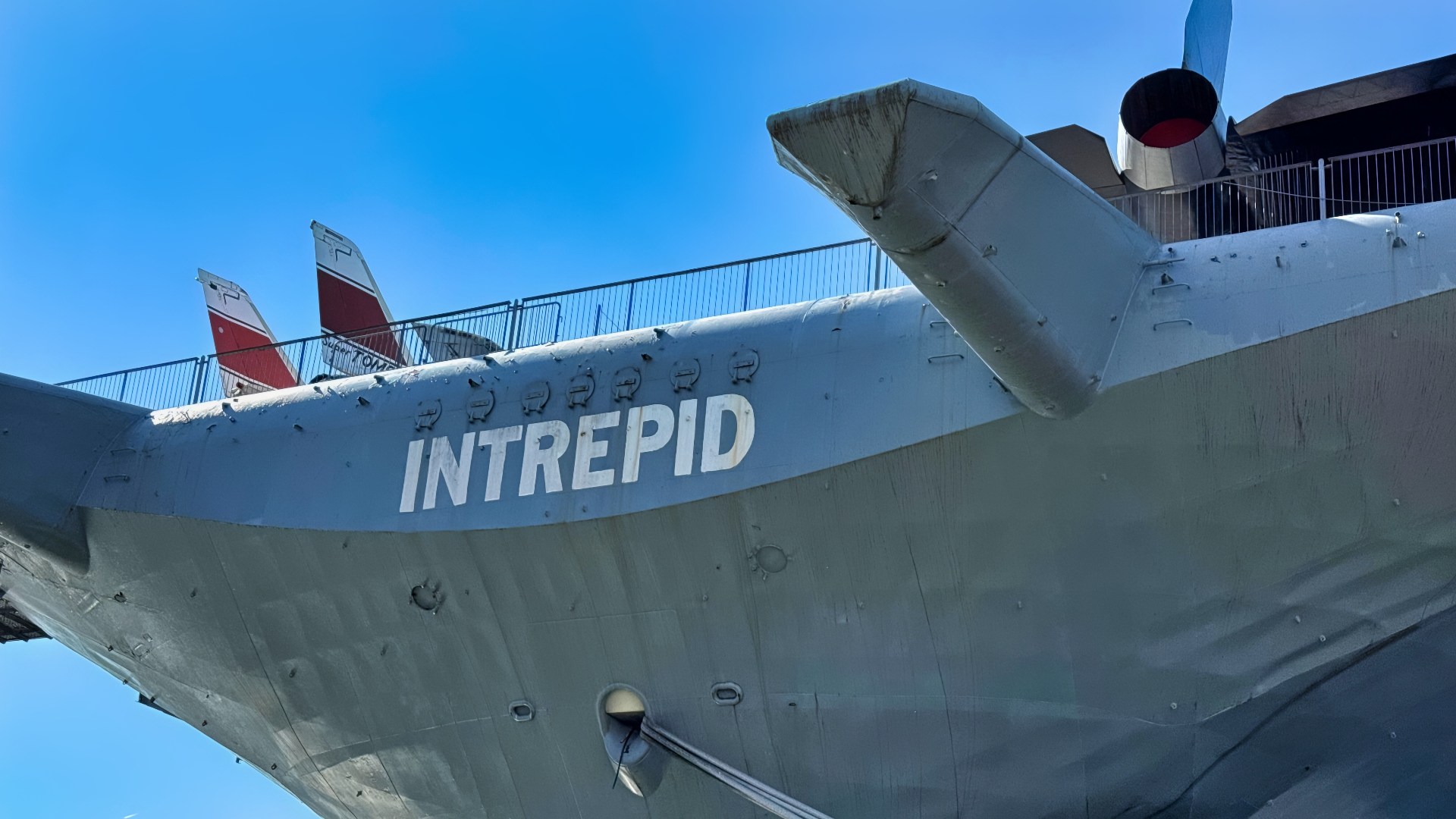
Essex-Class Carrier USS Intrepid NSJ Photo.
-Submarine danger is static — governed by physics, engineering, and procedures.
-Carrier danger is dynamic — governed by human behavior, timing, and complex coordination, with 30-ton aircraft landing at 150 miles per hour on a pitching deck.
Being an Aircraft Carrier Captain Is Hard Work
The conventional assumption, perhaps Hollywood-driven, is that nuclear submarine command is the most stressful leadership post in the Navy—nuclear reactors, confined spaces, ocean depths, and high-consequence failures. But the reality, as documented in naval leadership research, is that aircraft carrier captains often report higher levels of anxiety than their submarine counterparts. This may seem counterintuitive, as submarines operate in a more dangerous environment. But aircraft carriers do show to be the more stressful command position—underscoring the difference between physical danger and psychological stress.
Aircraft Carrier vs. Nuclear Submarine: Two Types of Danger
Submarine danger is “static,” referring to environmental factors such as pressure, the nuclear reactor, and confined spaces—things governed by physics, engineering, and procedures.
Carrier danger, meanwhile, is “dynamic,” relating to flight deck operations and thousands of personnel—things governed by human behavior, timing, and complex coordination. And humans handle predictable danger better than unpredictable human systems.

(Aug. 8, 2017) The Nimitz-class aircraft carrier USS George H. W. Bush (CVN 77) at sea during exercise Saxon Warrior 2017, Aug. 8. Saxon Warrior is a United States and United Kingdom co-hosted carrier strike group exercise that demonstrates allied interoperability and capability to respond to crises and deter potential threats. (U.S. Navy photo by Mass Communication Specialist 1st Class Theron J. Godbold /Released)
The Panopticon Effect
Visibility and surveillance compound the stress of carrier command. The environment is constantly observed, with an admiral often on board and a strike group commander nearby, leaving the carrier captain under the watch of superiors.
Operational visibility is high; every landing is recorded; every mistake is reviewable in real time. On a carrier, errors are immediately escalated, and command relief can happen quickly.
The submarine, meanwhile, operates in complete isolation; the CO has time to resolve issues without an admiral over the shoulder.
Management Scale
The carrier crew consists of 5,000 sailors, including the ship’s company and an air wing.
With so many souls aboard, there is a constant probability of accidents, disciplinary issues, and medical events. When 5,000 people are confined aboard a ship for months at a time, you can roughly guarantee that problems will arise. The submarine, meanwhile, holds just 130-150 sailors, who are highly screened and highly specialized.Fewer people typically means less unpredictability. And the statistical inevitability of problems on a carrier, relative to the high predictability on a submarine, often makes the carrier far more stressful.
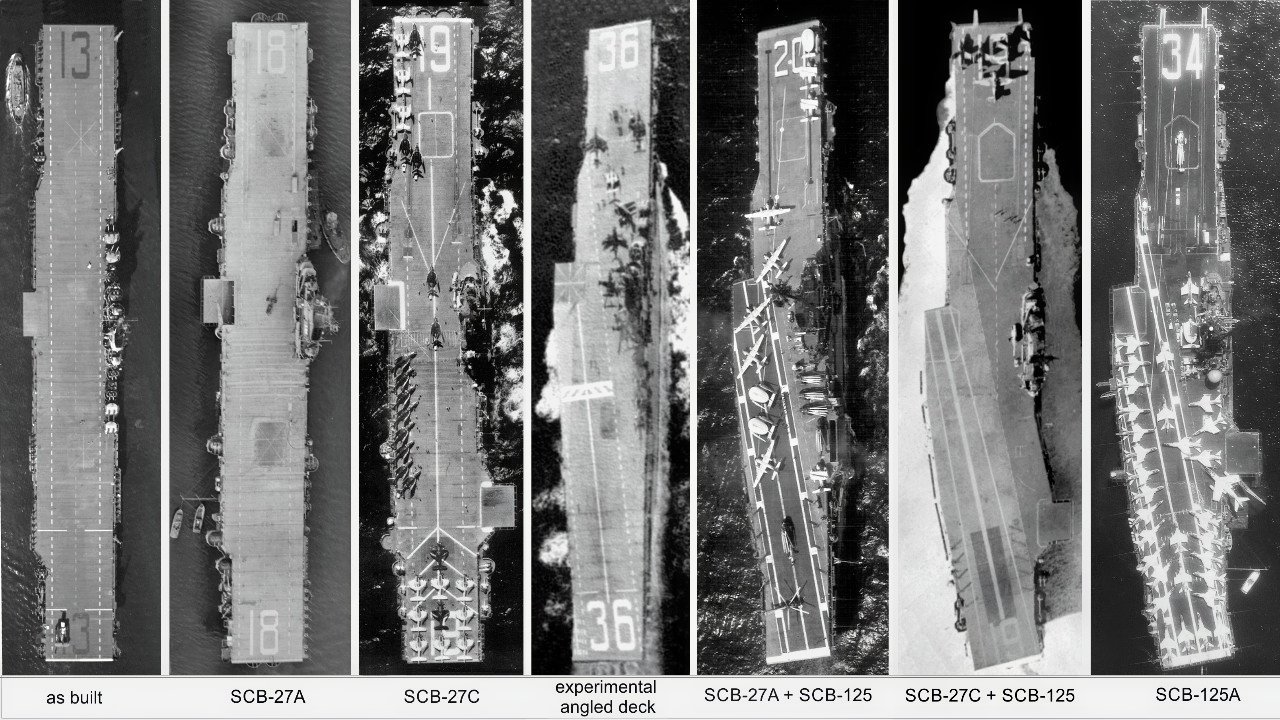
Essex-Class. Image Credit: Creative Commons.
Split Command Structure
On a carrier, the CO is responsible for the ship. But the air wing falls under a separate chain of command.
The result is coordination friction and overlapping authority—an inherently stressful structure. The submarine is less inherently stressful—with a unified command, a single mission, and total authority. Again, less stressful. The carrier CO is placed in the unfortunate position of having to manage systems beyond its control.
The Flight Deck
The submarine commander does not have to deal with a flight deck, which is generally considered one of the most dangerous spaces in the world. The operating conditions are insane: 30-ton jets landing at 150 miles per hour—often at night, often in poor weather.
The pitching deck, human timing, and mechanical failure points all contribute to flight deck unpredictability. A single mistake or a single mechanical failure can be catastrophic. Even perfectly refined procedures cannot eliminate the inevitability of human error.

Amphibious assault ship USS Makin Island (LHD 8) and aircraft carrier USS Nimitz (CVN 68) perform expeditionary strike force (ESF) operations, Feb. 15, 2023 in the South China Sea. Nimitz Carrier Strike Group (NIMCSG) and amphibious assault ship USS Makin Island (LHD 8) with embarked 13th Marine Expeditionary Unit are conducting joint ESF operations, representing unique high-end war fighting capabilities, maritime superiority, and power projection, demonstrating the U.S. commitment to our allies and partners in the Indo-Pacific region. (U.S. Navy photo by Mass Communication Specialist 3rd Class Kendra Helmbrecht)
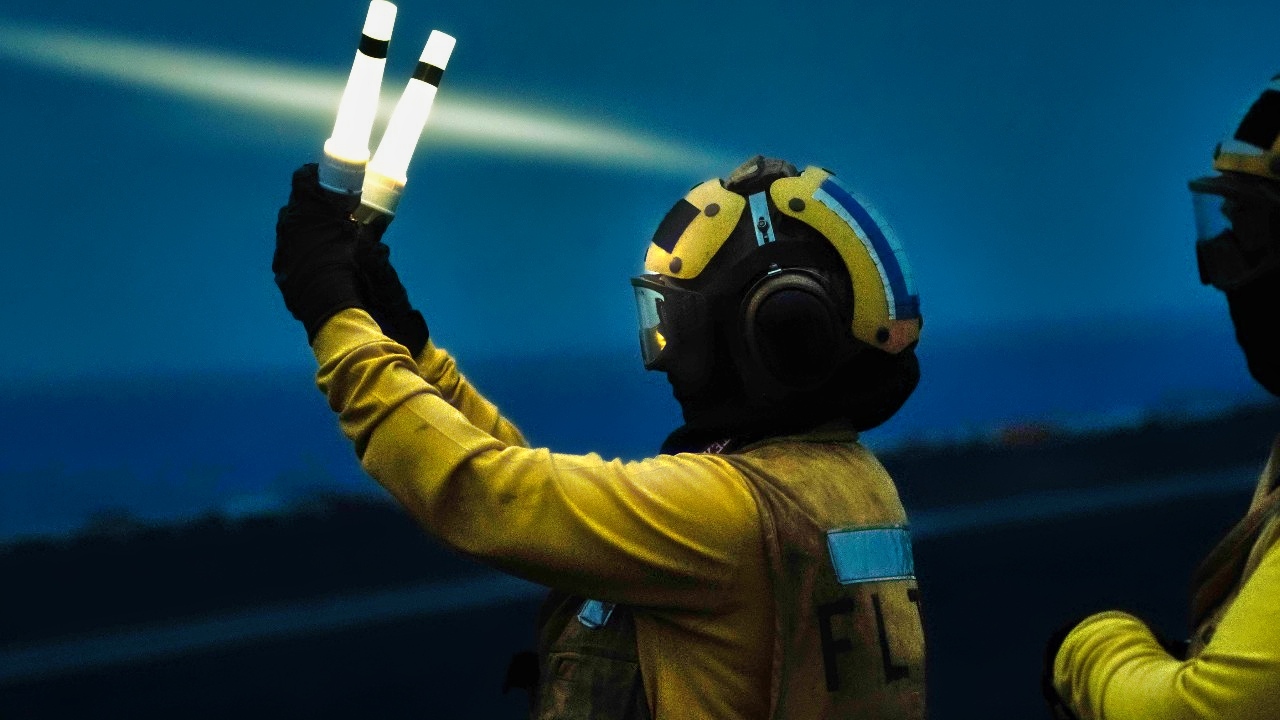
U.S. 5TH FLEET AREA OF OPERATIONS (Aug. 6, 2024) An Aviation Boatswain’s Mate (Handling) signals aircraft on the flight deck of the Nimitz-class aircraft carrier USS Theodore Roosevelt (CVN 71), Aug. 6. Theodore Roosevelt is deployed to the U.S. 5th Fleet area of operations to support maritime security and stability in the U.S. Central Command area of responsibility. (Official U.S. Navy photo)
Submarine Command
The submarine is a highly engineered, closed system. Operations are checklist-driven. Processes are highly repetitive. The commander has total control over this repetitive process.
The stress is constant, yes, but more predictable because the environment is more structured and less chaotic than the aircraft carrier.
Technology Differences
The carrier features advanced systems. But the systems depend on human execution. The submarine is highly automated, with tightly integrated systems that depend less on human interaction.
The difference between human-dominant carrier systems and automated submarine systems has a significant impact on stress levels. Human systems introduce variability that technology cannot fully control. Commanders must account for this, essentially expecting the worst, at all times.
Accountability Structures
The carrier’s CO is responsible for thousands of people and multiple mission areas. The visibility of failure is public within the chain of command. The submarine CO is accountable, of course, but with less immediate scrutiny.
This has a different psychological impact. The carrier CO is being constantly evaluated; the submarine CO is evaluated episodically. And continuous scrutiny amplifies stress beyond the immediate physical risks of submarine command.

The F-14 Tomcat, famed for its role in “Top Gun” and its mission to protect U.S. carrier groups, underwent a significant transformation in its later years.
Dubbed the “Bombcat,” the F-14B variant was repurposed with advanced systems like the LANTIRN pod, enabling precision-guided munitions delivery from high altitudes.
Fatigue and Tempo
Carrier operations feature continuous flight operations and long working hours. Crew fatigue is often high, which impacts safety. The aircraft carrier CO is responsible for fatigue management; failure to manage fatigue can lead to catastrophe.
The submarine features a structured watch rotation, with a more predictable rhythm. So the intensive operational tempo of the carrier, relative to the submarine, compounds human risk, makes the environment more dangerous, and makes management of that environment more stressful.
Different Leadership Styles
Carrier COs require a different skillset. Leadership aboard a carrier is often coordination-heavy. Submarine leadership is control-heavy. Aboard a carrier, risk management relates to human error more than anything else; on a submarine, risk management relates to system failures above all else. And as modern warfare becomes increasingly complex, data accumulates, requiring more coordination.
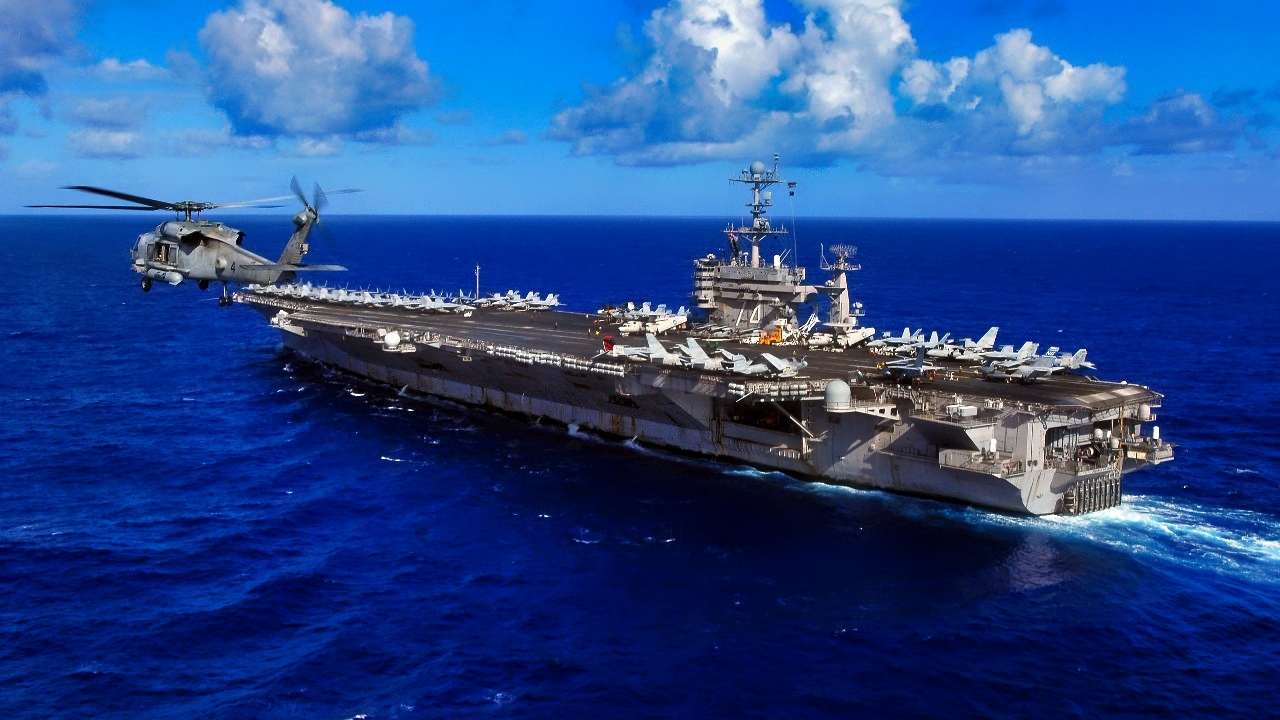
An HH-60H Seahawk, from the “Eightballers” of Helicopter Anti-Submarine Squadron (HS) 8, flies past Nimitz-class aircraft carrier USS John C. Stennis (CVN 74) during flight operations. Stennis is on a scheduled deployment to promote peace, regional cooperation and stability.
So other command environments are catching up to the carrier command environment in terms of complexity and requisite coordination, meaning that the carrier command, and all related stressors, may be a preview of what stress levels look like for commanders across military domains in the future.
The Core Takeaways
The submarine is a physically dangerous place. Confined spaces, submerged beneath the ocean, with a nuclear reactor and various warheads aboard—the danger is real, and the stress of command corresponds.
But carrier command is psychologically relentless. The visibility, scale, and human unpredictability of carrier leadership exacerbate the stress, making for an environment that naval leadership research shows is deeply stressful.
So it may seem counterintuitive that submarine command does not edge out carrier command in terms of stress, given the inherent dangers of submarine operations. But a closer look reveals that carrier operations are the more acute stress-driver. Because the number of things that can go wrong is remarkable. And because someone is always watching closely, any mistake is scrutinized in real-time.
About the Author: Harrison Kass
Harrison Kass is a writer and attorney focused on national security, technology, and political culture. His work has appeared in City Journal, The Hill, Quillette, The Spectator, and The Cipher Brief. He holds a JD from the University of Oregon and a master’s in Global & Joint Program Studies from NYU. More at harrisonkass.com.


