

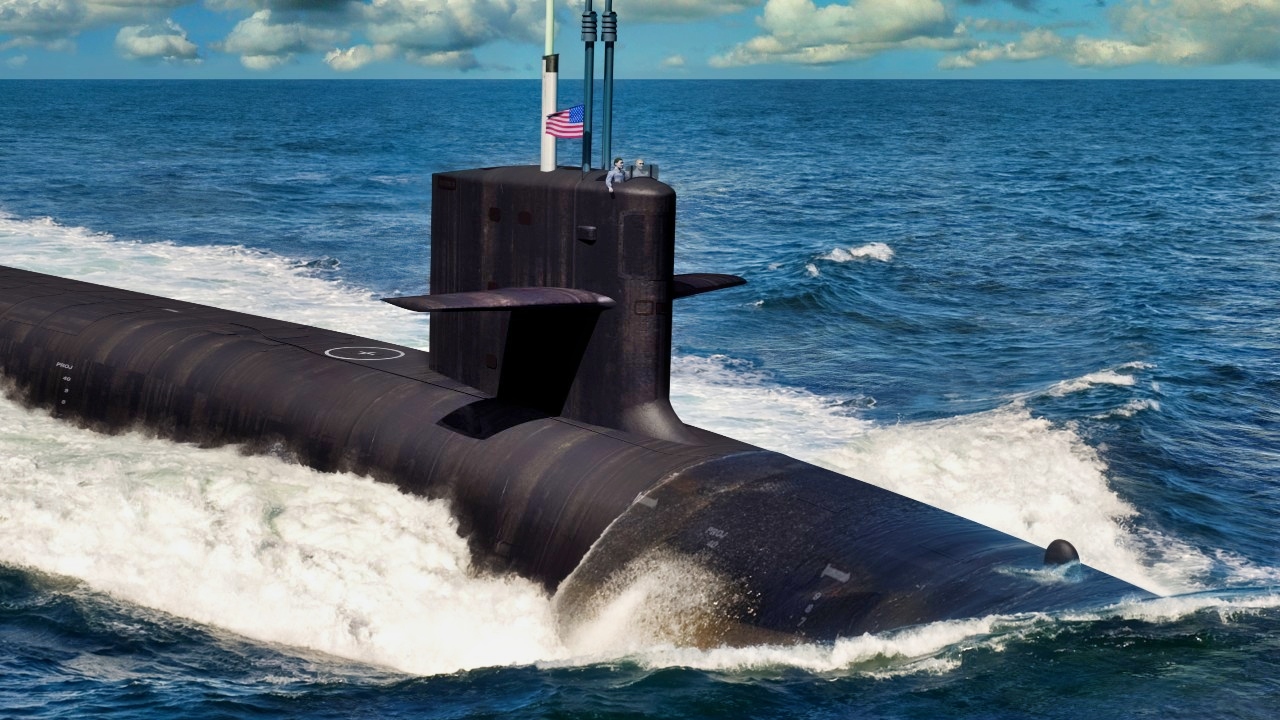
Key Points and Summary – The U.S. Navy’s top-priority program, the Columbia-class ballistic missile submarine, is in deep trouble.
-The lead vessel, the future USS District of Columbia, is facing a new $1.7 billion cost increase, pushing its total price to over $16.1 billion.
-The Navy blames the hike on both inflation and poor “shipbuilder performance.”
-This massive cost overrun comes on top of the program already being 17 months behind schedule.
-The failure to deliver this critical leg of the nuclear triad on time and on budget is especially alarming as China continues to outpace the U.S. in naval shipbuilding.
The US Navy’s Columbia-Class Submarines Are Now Facing a $1.7 Billion Cost Hike
For all its proud, illustrious history and all the underwater technological marvels that it has produced, the US Navy’s submarine program, AKA the “Silent Service,” just can’t seem to get out of its own way lately, monetarily and logistically speaking.
For starters, there is the plight of the USN’s nuclear-powered general-purpose attack submarines (SSNs [Submersible Ship Nuclear] AKA “fast attack” boats). The next-generation SSN(X) program is already enduring a “nightmare” of delays and soaring costs.
Only 24 out of the 66 planned Virginia-class SSNs have been completed so far (with twenty-three in active service), at a unit cost of $2.8 billion. The Seawolf-class SSNs could probably qualify for the Endangered Species list, as only three out of the originally planned 29 ships of the class were built. And now doubts are being cast on the viability of the AUKUS program.
But it’s not just the fast-attacks that are running afoul of funding and logistical issues. The next generation of nuclear-powered ballistic missile submarines (SSBNs), the Columbia-class subs, are supposed to replace the reliable but aging Ohio-class SSBNs (which were built between 1976 and 1997). However, the Columbia program has just seen its financial woes escalate from bad to worse.
Bottom Line Up Front (BLUF)
The latest and not-so-greatest news comes to us from Bloomberg reporter Anthony Capaccio, in a July 22, 2025, article titled “Next-Gen US Missile Submarine Sees a $1.7 Billion Cost Hike.” To wit: “[A]nother black eye for a program that’s the centerpiece of the service’s modernization plans…The USS District of Columbia is now expected to cost at least $16.1 billion, 12% more than forecast when Congress first authorized construction funds in 2021, the Naval Sea Systems Command said in a statement…Sixty percent of the cost growth is driven by inflation in materials and labor costs, with the rest attributed to ‘shipbuilder performance’ by General Dynamics Corp. and HII, the service said.”
This just adds insult to injury (or perhaps more accurately, a new injury piled on top of an already existing one), as the Columbia program is already 17 months behind schedule from its contracted October 2027 date.
Columbia-Class Premise and Promise
On paper, the Columbia-class boats hold considerable promise. It’s supposed to represent the up-and-coming sea leg of America’s nuclear strategic triad, along with the land-based Sentinel ICBM and the Northrop Grumman B-21 Raider strategic bomber.
A total of 12 ships are planned, with the USS District of Columbia (SSBN-826) slated as the lead vessel of the class. (On a semantic note, as an individual warship, the District of Columbia is so named to avoid confusion with a pre-existing fast-attack sub, the USS Columbia [SSN-771]. However, the Navy still refers to the class as a whole as simply the Columbia class.)
The proverbial new kids on the block will have a hull length of 560 feet (170.7 m) and a beam width of 43 feet (13.1 m), making them equally as long and 1 foot (30 cm) wider than their Ohio-class predecessors.
They will wield 16 missile tubes, each capable of carrying one UGM-133 Trident II D5LE ballistic missile.
The Way Forward?
This past April, U.S. Secretary of Defense (SECDEF) Pete Hegseth, in a speech to students at the US Army War College, announced the launch of a review of “all 72 active major defense acquisitions programs” in accordance with President Donald Trump’s executive order that that aims to transform how the US government purchases equipment and services for military and Department of Defense (DOD) civilian personnel alike.
One would logically presume that the Columbias will face additional scrutiny under the SECDEF’s review initiative due to this latest cost overrun. One also cannot help but wonder if the Columbia’s ever-spiraling price tag is running the risk of triggering a Nunn-McCurdy breach.
Hopefully, the combined brain trust of the USN, General Dynamics Electric Boat, and Huntington Ingalls Industries, Inc. (HII) will figure out something sooner rather than later. To give our readers a greater appreciation for the sense of urgency on this matter, consider that back on May 2, 2025, Indo-Pacific (INDOPACOM)
Commander Admiral Samuel Paparo told the McCain Institute’s annual Sedona Forum that the China’s People’s Liberation Army Navy (PLAN) churns out six combat naval ships annually, compared with the 1.8 hulls produced in the US. Diving deeper into those sobering stats, the Admiral noted that Beijing builds two submarines a year for every 1.4 made in America.
Time will tell.
About the Author: Christian D. Orr, Defense Expert
Christian D. Orr is a Senior Defense Editor. He is a former Air Force Security Forces officer, Federal law enforcement officer, and private military contractor (with assignments worked in Iraq, the United Arab Emirates, Kosovo, Japan, Germany, and the Pentagon). Chris holds a B.A. in International Relations from the University of Southern California (USC) and an M.A. in Intelligence Studies (concentration in Terrorism Studies) from American Military University (AMU).
More Military
We Almost Touched the F-117 Stealth Fighter


