


Key Points and Summary – USS Halibut began life as a Regulus cruise-missile submarine, but its real legacy came after a radical refit turned it into a one-of-a-kind spy boat.
-The Navy ripped out its obsolete missiles, added diver lock-out chambers, powerful thrusters, a darkroom, computers, and “Fish” underwater drones launched from a converted missile bay.

Sturgeon-class. Image Credit: Creative Commons.
-Halibut used those tools to locate the sunken Soviet K-129 and later support Operation Ivy Bells, tapping secret Soviet undersea communication cables.
-So sensitive were its missions that the sub carried a self-destruct system.
-Retired in 1975, Halibut quietly shaped some of the Cold War’s most audacious intelligence coups.
The Fascinating Story Behind the USS Halibut Spy Submarine
One primarily associates submarines with destroying enemy shipping with torpedoes or launching land attack cruise missiles and nuclear weapons.
This Cold War submarine started that way, but later became dedicated to spying on the Soviets. Named the USS Halibut, it was a sneaky boat that could even launch remotely piloted sea drones to search the depths of the ocean.
The Halibut also had a self-destruct feature, which showed you just how much the Navy was worried about its potential discovery and capture.
Cold War Hero
The USS Halibut undertook several famous missions. It was instrumental in discovering the Russian submarine K-129 after it wrecked.

Victor III-Class Submarine. Image Credit: Creative Commons.
The Halibut was also an essential part of Operation Ivy Bells – the effort to spy on Soviet naval underwater communication lines. This was one boat that could take on significant patrols, which even had a positive effect on the United States’ victory in the Cold War.
The Halibut had an interesting shape, making it able to float at the bottom of the sea out of range of enemy depth charges and incessant sonar location attempts by Soviet anti-submarine warfare activity.
Its First Mission Was to Launch Nuclear Missiles
The spy submarine was initially meant as an SSGN to launch the Regulus II missile, which was a powerful turbojet-propelled cruise missile.
This missile was behind the times, as it was carried and launched from the submarine’s deck, but it featured an inertial guidance system and a range of 1,000 miles.
The Regulus II was quickly outdated by the time the Halibut was built, and was replaced by the Polaris submarine-launched ballistic missile on the modern George Washington-class “boomer” SSBNs.
Since the Regulus II was also stored below decks on the Halibut, the submarine had a curious bulbous shape. There were torpedoes on board, but these were to be used as a last resort for defensive reasons instead of offensive purposes. The Halibut’s job was to float undiscovered and hidden in the depths for the collection of reconnaissance and intelligence data.
Let’s Change the Mission and Purpose Of This Submarine
The Halibut was 350 feet long. The extra missiles made it displace a hefty 5,000 tons.
The S3W submarine fleet reactor enabled a speed of 20 knots underwater. Since the Regulus II missiles were discontinued, it wasn’t clear what the mission for the boat was going to be.
The Navy decided to allow for patrolling with the outdated Regulus II missiles. But then the silent service had an idea. The Halibut had an ample payload.
Why not transform it for a new mission?
Time for a Unique ‘Glow Up’
It was sent to dry dock in Pearl Harbor with a new $70 million makeover. “She received a photographic darkroom, hatches for divers to enter and exit the sub while submerged, and thrusters to help her maintain a stationary position,” according to the National Interest.
But it was the unmanned submerged vessels that were really interesting.
Nicknamed the “Fish,” these underwater drones could take photos and had their own sonar.
They were configured to reach depths of 2,500 feet. And that old bay for the Regulus II missiles?
That was turned into a “bat cave” for the Fish’s undersea remotely controlled vessels. There was even a modern computer to analyze the data that the Fish collected.
Press This Button to Self-Destruct
Plus, the Navy installed a self-destruct mechanism on the Halibut in case it was discovered and forced to surface. This made the crew understand just how dangerous the spying missions were going to be.
The Halibut was redesignated from an SSBN to a fast attack sub and sent to the “Deep Submergence Group.” It would be able to dive deep and find ships that had sunk to the bottom.

The Ohio-class ballistic-missile submarine USS Maine (SSBN 741) begins a dive into the Strait of Juan de Fuca off the Washington Coast, March 18, 2025, during routine operations. Special units within the Coast Guard are tasked with the protection of U.S. Naval submarines while surfaced and transiting U.S. territorial waters to and from their patrol stations. (U.S. Coast Guard photo by Petty Officer 1st Class Steve Strohmaier)
In 1968, that ability came in handy to locate the wreck of the Soviet submarine K-129, a Gulf II-class SSBN boomer that sank in the Pacific 1,600 nautical miles from Hawaii.
There was a heightened sense of urgency for recovering the K-129. It carried R-21 nuclear missiles. The Navy wanted to get a peek at these projectiles for research purposes.
As National Interest’s Kyle Mizokami wrote, “Halibut was the perfect ship for the task. Once on station, it deployed the Fish ROVs and began an acoustic search of the ocean floor. After a painstaking search and more than twenty thousand photos, Halibut’s crew discovered the ill-fated Soviet sub’s wreckage. As a result Halibut and her crew were awarded a Presidential Unit Citation, for ‘several missions of significant scientific value to the Government of the United States.’ Halibut’s contribution to efforts to recover K-129 would remain secret for decades.”
That was not the end of the watch for the Halibut. U.S. intelligence agencies came up with a bold idea.
There could be a way to tap into Russian undersea communications cables.
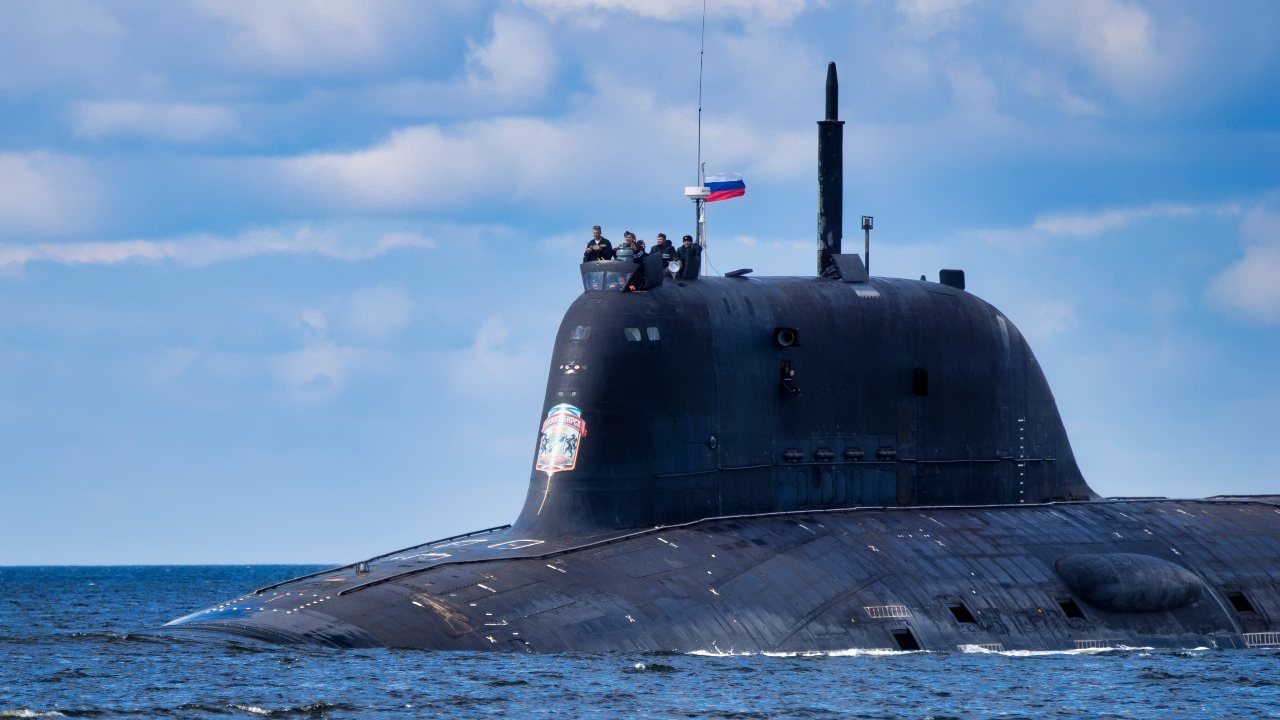
Yasen-Class Submarine Russian Navy. Image Credit: Creative Commons.
Operation Ivy Bells was the name of the mission.
There was a connection from the naval base at Petropavlovsk on the Kamchatka Peninsula with the Soviet Pacific Fleet headquarters at Vladivostok, Mizokami explained.
And sensitive information about the activity of Soviet subs was discovered.
This was ripe for spying, and the information stolen would be invaluable. The Ivy Bells’ missions granted the Halibut a Navy Unit Citation.
It was finally retired in 1975 after 1,232 dives.
About the Author: Brent M. Eastwood
Author of now over 3,000 articles on defense issues, Brent M. Eastwood, PhD is the author of Don’t Turn Your Back On the World: a Conservative Foreign Policy and Humans, Machines, and Data: Future Trends in Warfare plus two other books. Brent was the founder and CEO of a tech firm that predicted world events using artificial intelligence. He served as a legislative fellow for US Senator Tim Scott and advised the senator on defense and foreign policy issues. He has taught at American University, George Washington University, and George Mason University. Brent is a former US Army Infantry officer. He can be followed on X @BMEastwood.


