

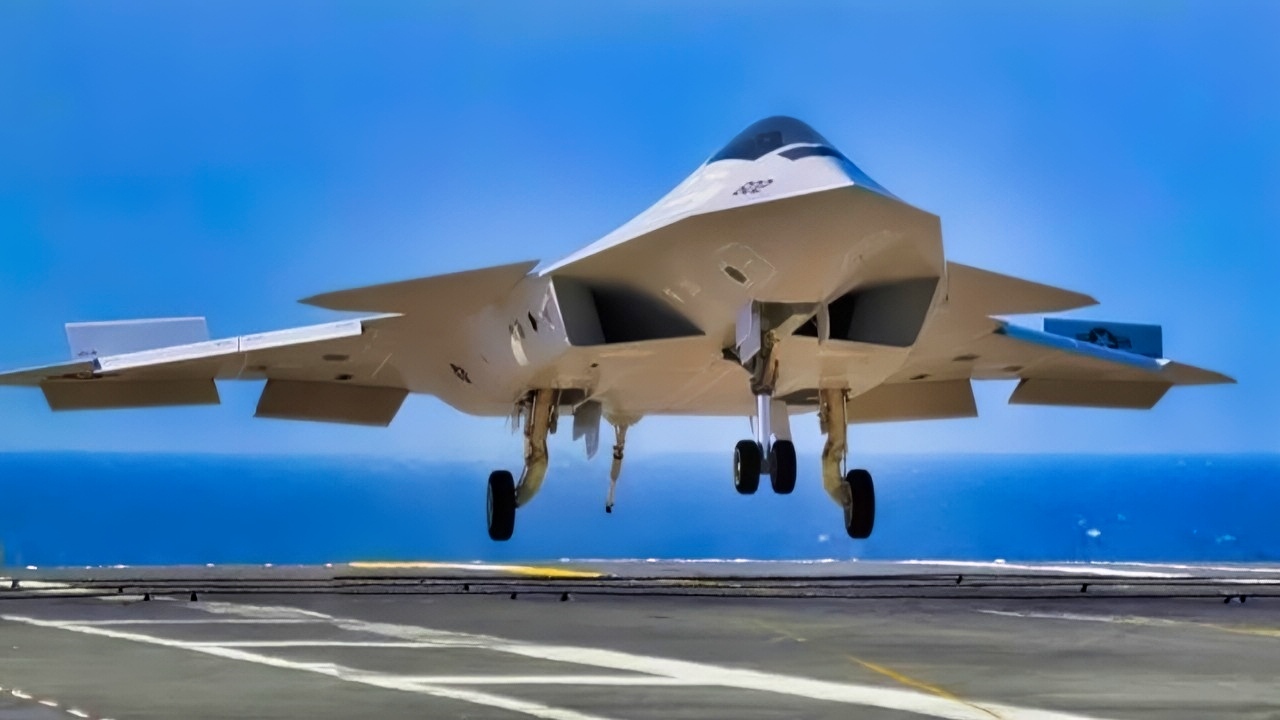
3 Key Points on F/A-XX Fighter Crisis – The U.S. Navy’s F/A-XX next-generation fighter program is facing severe delays and massive budget cuts, a crisis that the nominee for Chief of Naval Operations warns will put America’s “air superiority at risk.”
-The program’s budget for FY26 has been slashed by over 90% of what was planned, as the Pentagon prioritizes the Air Force’s competing NGAD program.

F/A-XX U.S. Navy Fighter. Image Credit: Creative Commons.
-This major setback comes as China is reportedly already flying two different 6th-generation fighter prototypes, creating a dangerous capability gap for U.S. aircraft carriers in a potential future conflict.
F/A-XX In Big Trouble Now?
On Thursday, Adm. Daryl Caudle, US President Donald Trump’s Nominee to be Chief of Naval Operations (CNO), warned that delays in the Navy’s F/A-XX program could jeopardize the Navy’s ability to maintain air superiority against the force’s peer competitors.
He told Congress that the service needs to field a 6th-generation fighter jet as quickly as possible or risk losing its edge over adversaries.
A 6th Generation Fighter World Is Coming
The Navy’s next-gen fighter aircraft program will replace the F/A-18E/F Super Hornet and has a program designation of F/A-XX.
However, the development effort has run into budgeting obstacles, which are forcing the development phase into delays and – as a consequence – the date for the new aircraft to enter service is now anyone’s guess.
The US Navy delayed nearly $1 billion for the program in fiscal 2025 due to spending caps mandated by the 2023 Fiscal Responsibility Act.
The Trump administration’s budget request for fiscal 2026 programs is only $74 million in R&D funds for the program.
That is a small fraction of the $454 million the service received in 2025 and – more importantly – almost $900 million less than the Navy had previously been planning to spend on the program.
Meeting The Threat With No Next-Gen Platform
One of the questions provided to Caudle in advance of his confirmation hearing with the Senate Armed Services Committee on Thursday was if the Navy would be able to maintain air superiority without fielding a next-gen fighter on its original timeline.
“Nothing in the Joint Force projects combat power from the sea as a Carrier Strike Group, which at the heart has a nuclear-powered aircraft carrier (CVN). To maintain this striking power, the CVN must have an air wing that is comprised of the most advanced strike fighters,” he responded.
“Therefore, the ability to maintain air superiority against peer competitors will be put at risk if the Navy is unable to field a 6th Generation strike fighter on a relevant timeline,” he continued.
“Without a replacement for the F/A-18E/F Super Hornet and E/A-18G Growler, the Navy will be forced to retrofit 4th-generation aircraft and increase procurement of 5th-generation aircraft in an attempt to compete with the new 6th-generation aircraft that the threat is already flying,” Caudle wrote in his response.
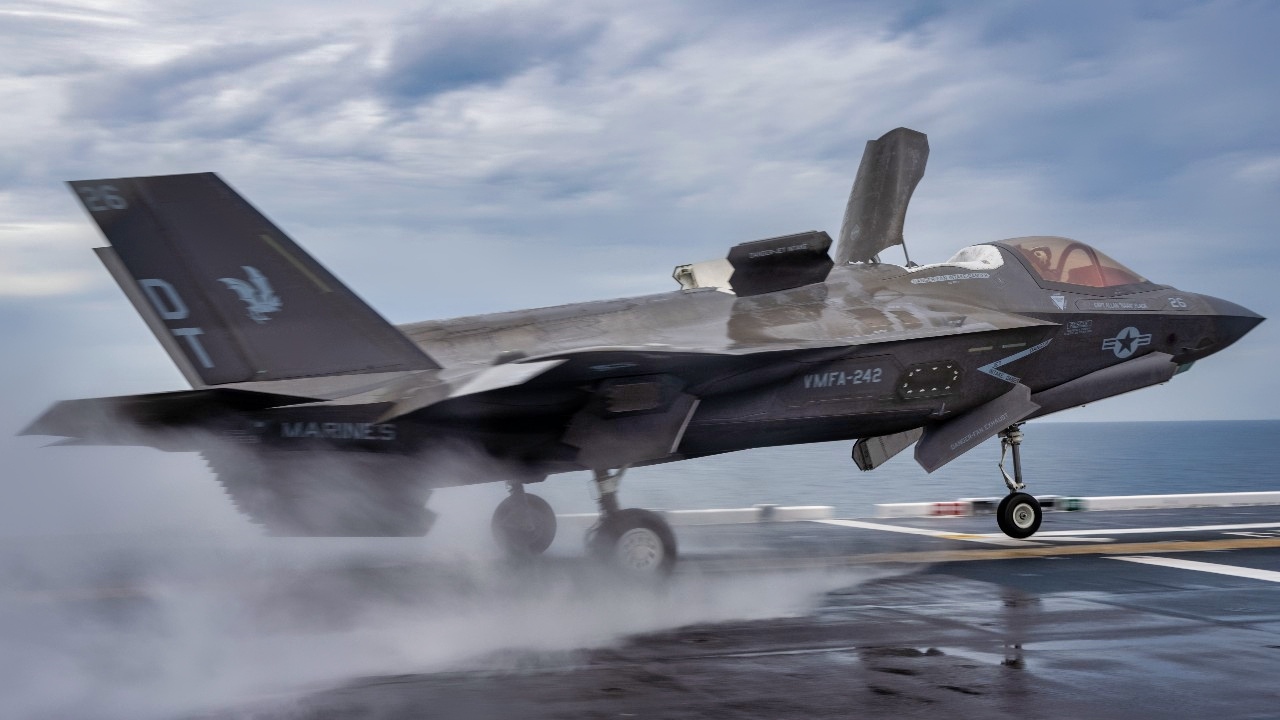
(July 6, 2025) A U.S. Marine Corps F-35B Lightning II aircraft assigned to Marine Fighter Attack Squadron (VMFA) 242, 31st Marine Expeditionary Unit, takes off from the flight deck of the forward-deployed amphibious assault ship USS America (LHA 6) while conducting flight operations in the Coral Sea, July 6. America, lead ship of the America Amphibious Ready Group, is operating in the U.S. 7th Fleet area of operations. U.S. 7th Fleet is the U.S. Navy’s largest forward-deployed numbered fleet, and routinely interacts and operates with allies and partners in preserving a free and open Indo-Pacific region. (U.S. Navy photo by Mass Communication Specialist Seaman Sam McNeely)
Defense Department officials are especially concerned about China’s military advancements, which include Beijing flying two new 6th-generation fighter jets in December of last year.
These aircraft are the most worrying of the new weapon systems Beijing is developing, as they represent what the US Navy carrier air wings would have to fight against someday.
The US Navy’s Next-Generation Requirement
“The Navy’s ongoing efforts to maintain technological superiority will ensure our ability to challenge any adversary. Deterring and denying China will require an ‘All Hands on Deck’ approach from the Joint Force including the massing of lethal fires from the sea, which comes from carrier strike groups with the latest and most capable strike fighters,” Caudle told the Senate committee.
“The Navy has a validated requirement for carrier-based 6th- generation aircraft, and it is critical that we field that capability as quickly as possible to give our warfighters the capabilities they need to win against a myriad of emerging threats,” he wrote.
In June, the Chairman of the Joint Chiefs of Staff, Gen. Dan Caine, told lawmakers that he believes the requirement for a platform like the F/A-XX is “still valid.”
“As we look at the threat picture out in the Pacific, the requirements themselves I think are still valid. I think it comes down to a question that many of the folks on the committee have talked about, and that’s the ability [for industry] to produce at a particular time. And I’ll defer to my civilian leaders on the timing and synchronization [of] that program.
But we do need, you know, capability that is mobile, whether it’s F/A-XX or others, that enable us to win on the battlefield to the future,” Caine said at a House Armed Services Committee hearing.
Boeing F-47 NGAD’s Pre-Dominance
The Navy’s problem is that the Pentagon is currently funding development of the US Air Force’s 6th-gen fighter, the Next-Generation Air Dominance (NGAD) F-47, above all else.
This means a budget plan to spend $3.5 billion on the program in fiscal 2026 alone.

NGAD. Image Credit: Creative Commons
US Defense Department officials have stated that they will defer funding for the Navy’s F/A-XX program over concerns about the defense industrial base.
Their fear is prompted by the shrinking of defense industrial sector and limited engineering manpower.
Specifically, they see the current crop of major combat aircraft firms not operating enough capacity collectively to support the development of two 6th-gen fighter programs – one US Air Force and one US Navy – simultaneously.
Navy officials have stated that the F/A-XX is expected to be extra stealthy and also have a significantly greater range than the Super Hornet fighter jets currently operated in the fleet.
Moreover, the F/A-XX is expected to incorporate AI capabilities as well.
Caudle said the service also plans to develop highly autonomous unmanned platforms, also known as Collaborative Combat Aircraft (CCAs).
These will complement any 6th-generation fighters and other Naval aviation platforms. He also suggested the drones would be “multi-role capable” in any future conflict.
“It is too early to predict the exact mix of manned and unmanned aircraft. However, as autonomous systems demonstrate increasing capability and warfighting effectiveness, we intend to iterate to deploy the most effective combination of manned and unmanned aircraft to maximize the lethality, combat effectiveness, and range of the naval aviation combat power,” Caudle told lawmakers.
Trump nominated Caudle for the CNO role last month. Caudle, who is currently serving as commander of Fleet Forces Command, wasn’t a controversial pick for the top job, and his nomination is expected to be confirmed by the Senate.
About the Author: Reuben F. Johnson
Reuben F. Johnson has thirty-six years of experience analyzing and reporting on foreign weapons systems, defense technologies, and international arms export policy. Johnson is the Director of Research at the Casimir Pulaski Foundation. He is also a survivor of the Russian invasion of Ukraine in February 2022. He worked for years in the American defense industry as a foreign technology analyst and later as a consultant for the U.S. Department of Defense, the Departments of the Navy and Air Force, and the governments of the United Kingdom and Australia. In 2022-2023, he won two awards in a row for his defense reporting. He holds a bachelor’s degree from DePauw University and a master’s degree from Miami University in Ohio, specializing in Soviet and Russian studies. He lives in Warsaw.
More Military
We Almost Touched the F-117 Stealth Fighter


