

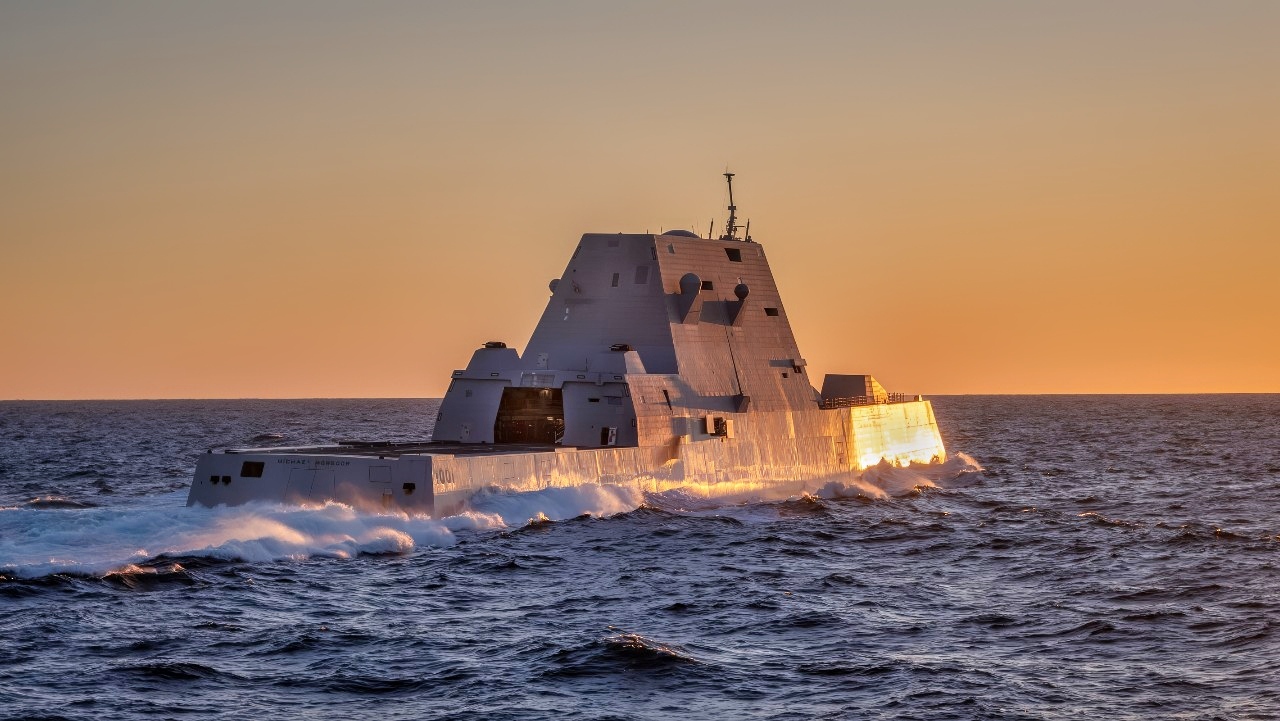
Earlier this year, it was announced that the troubled Zumwalt-class destroyers are starting to hit the waves again as the USS Zumwalt (DDG1000) recently concluded her sea trials after a long modernization process.
While the Zumwalt-class is losing its Advanced Gun System, it is gaining 12 Conventional Prompt Strike launchers, which enable the ships to launch hypersonic missiles.
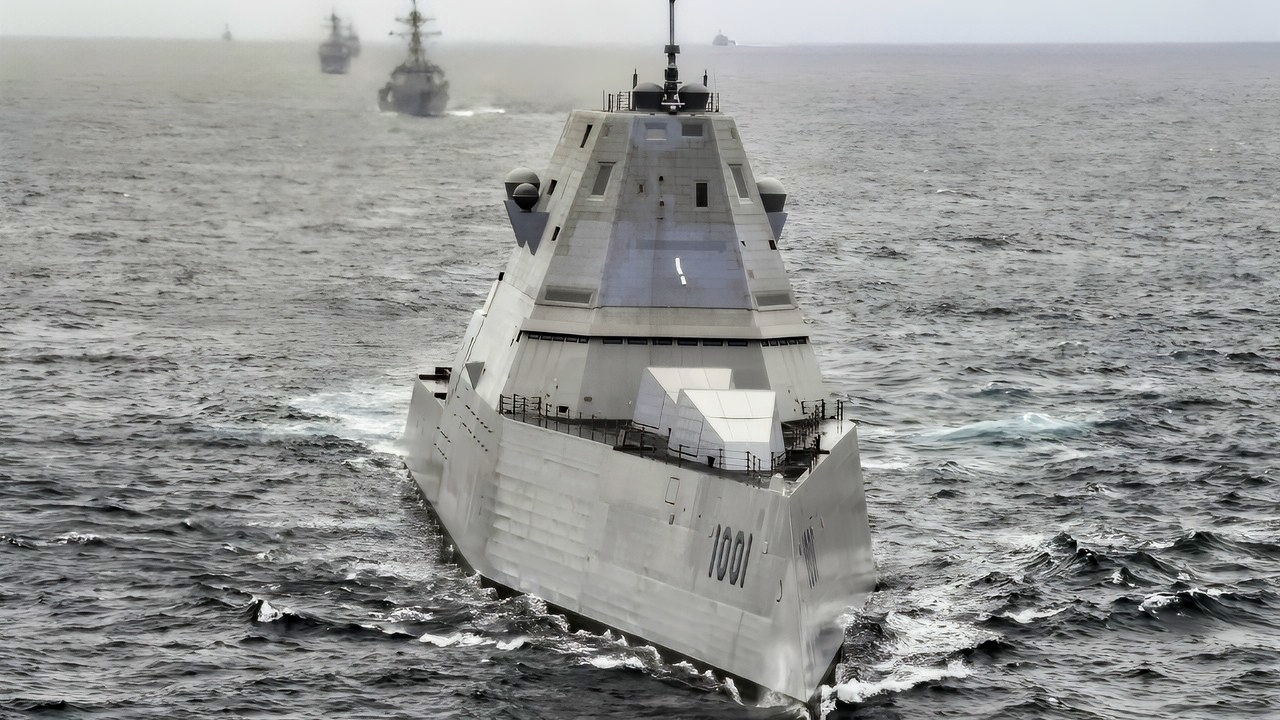
(April 21, 2021) The Zumwalt-class guided-missile destroyer USS Michael Monsoor (DDG 1001) leads a formation including the Arleigh Burke-class guided missile destroyers USS Fitzgerald (DDG 62), USS Spruance (DDG 111), USS Pinckney (91), and USS Kidd (DDG 100), and the Independence-variant littoral combat ship USS Coronado (LCS 4) during U.S. Pacific Fleet’s Unmanned Systems Integrated Battle Problem (UxS IBP) 21, April 21. UxS IBP 21 integrates manned and unmanned capabilities into challenging operational scenarios to generate warfighting advantages. (U.S. Navy photo by Chief Mass Communication Specialist Shannon Renfroe)
Currently, Zumwalt is the only ship of the class with CPS integrated; Lyndon B. Johnson (DDG1002) is undergoing modernization, and Michael Monsoor (DDG1001) is set to receive upgrades later.
The Death and Rebirth of the Zumwalt-class
Originally conceived as land-attack destroyers with advanced naval gunfire support capability, the ships were built around AGS guns intended to fire Long-Range Land-Attack Projectiles.
When the LRLAP ammunition program became prohibitively expensive and was ultimately canceled, the guns were left with no viable rounds, leaving the Navy with three highly advanced, power-rich destroyers but without a meaningful main battery. The class was heavily criticized for being a waste of everybody’s time and money.

Zumwalt-class Guided Missile Destroyer USS Michael Monsoor (DDG 1001) transits the Pacific Ocean, June 25, 2022. Twenty-six nations, 38 ships, four submarines, more than 170 aircraft and 25,000 personnel are participating in RIMPAC from June 29 to Aug 4 in and around Hawaiian Islands and Southern California. The world’s largest international maritime exercise, RIMPAC provides a unique training opportunity while fostering and sustaining cooperative relationships among participants critical to ensuring the safety of sea lanes and security on the world’s oceans. RIMPAC 2022 is the 28th exercise in the series that began in 1971.

(July 28, 2022) U.S. Navy Zumwalt-class guided-missile destroyer USS Michael Monsoor (DDG 1001) sails in formation during Rim of the Pacific (RIMPAC) 2022, July 28. Twenty-six nations, 38 ships, three submarines, more than 30 unmanned systems, approximately 170 aircraft and 25,000 personnel are participating in RIMPAC from June 29 to Aug. 4 in and around the Hawaiian Islands and Southern California. The world’s largest international maritime exercise, RIMPAC provides a unique training opportunity while fostering and sustaining cooperative relationships among participants critical to ensuring the safety of sea lanes and security on the world’s oceans. RIMPAC 2022 is the 28th exercise in the series that began in 1971. (U.S. Navy photo by Mass Communication Specialist 3rd Class Aleksandr Freutel)
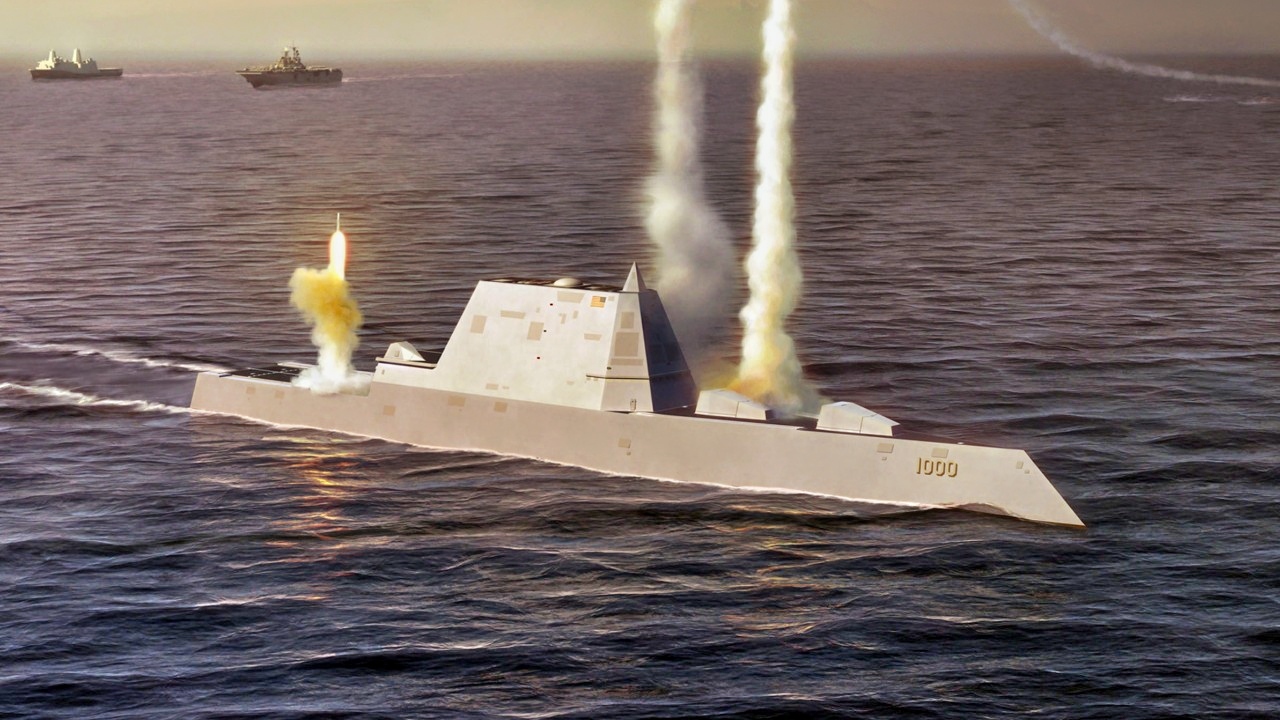
The US Navy’s troubled Zumwalt-class destroyers are being revitalized with the integration of Conventional Prompt Strike (CPS) hypersonic missiles, transforming them into powerful long-range strike platforms. The original class of 32 ships was cut to just three after its Advanced Gun System failed due to exorbitant costs. Now, these stealthy, $8 billion warships are having their defunct guns replaced with vertical launch tubes for hypersonic weapons. This upgrade will dramatically increase their strike range from a mere 63 miles to over 1,700 miles, making the Zumwalts relevant and formidable assets for deterring adversaries like China in the 21st century.
By 2023, the Navy made the bold decision to strip out both guns and convert the destroyers into long-range hypersonic strike platforms. The decision meant repurposing large volumes of internal space extending several decks below the forward gun position and reclaiming useful area beneath the aft mount as well.
What replaced the guns is a weapons architecture unlike anything previously installed on a U.S. surface combatant.
Four 87-inch-diameter missile launch tubes were embedded in the bow, each capable of housing an Advanced Payload Module that holds three CPS missiles. The result is a 12-round hypersonic magazine, the first of its kind aboard an American surface warship.
These launcher modules closely resemble the vertical launch systems planned for Virginia-class Block V submarines, allowing the Navy to use the Zumwalt conversions as real-world risk-reduction testbeds for the undersea fleet’s future CPS deployment.
The Conventional Prompt Strike System
Rather than functioning as a traditional ballistic or cruise missile, CPS uses a two-stage solid rocket booster to deliver a Common Hypersonic Glide Body (C-HGB) to extreme speeds, after which it releases and maneuvers unpredictably toward its target.

Zumwalt-Class U.S. Navy. Image Credit: Creative Commons.
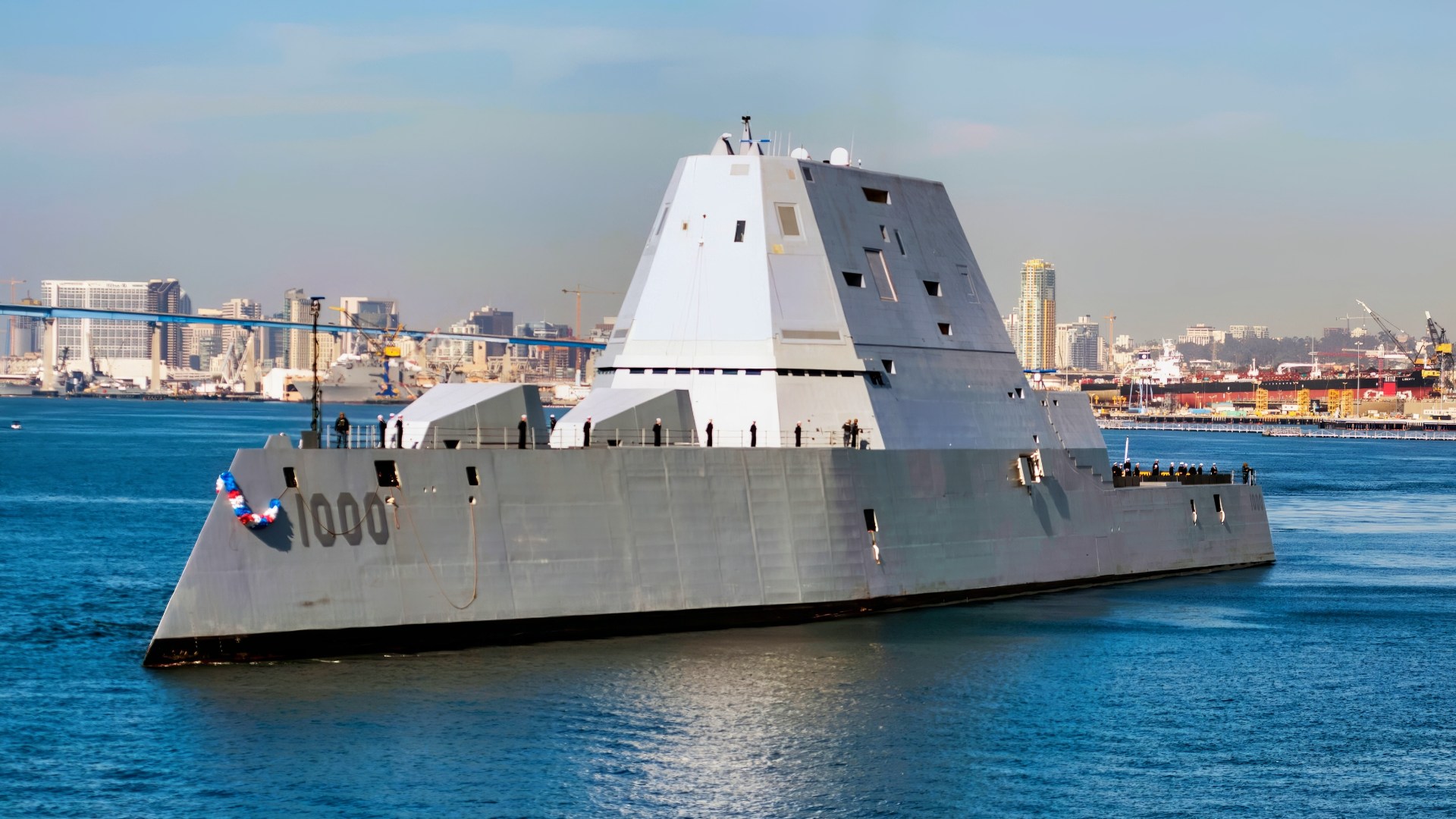
(Dec. 8, 2016) The guided-missile destroyer USS Zumwalt (DDG 1000) arrives at its new homeport in San Diego. Zumwalt, the Navy’s most technologically advanced surface ship, will now begin installation of combat systems, testing and evaluation and operation integration with the fleet. (U.S. Navy photo by Petty Officer 3rd Class Emiline L. M. Senn/Released)
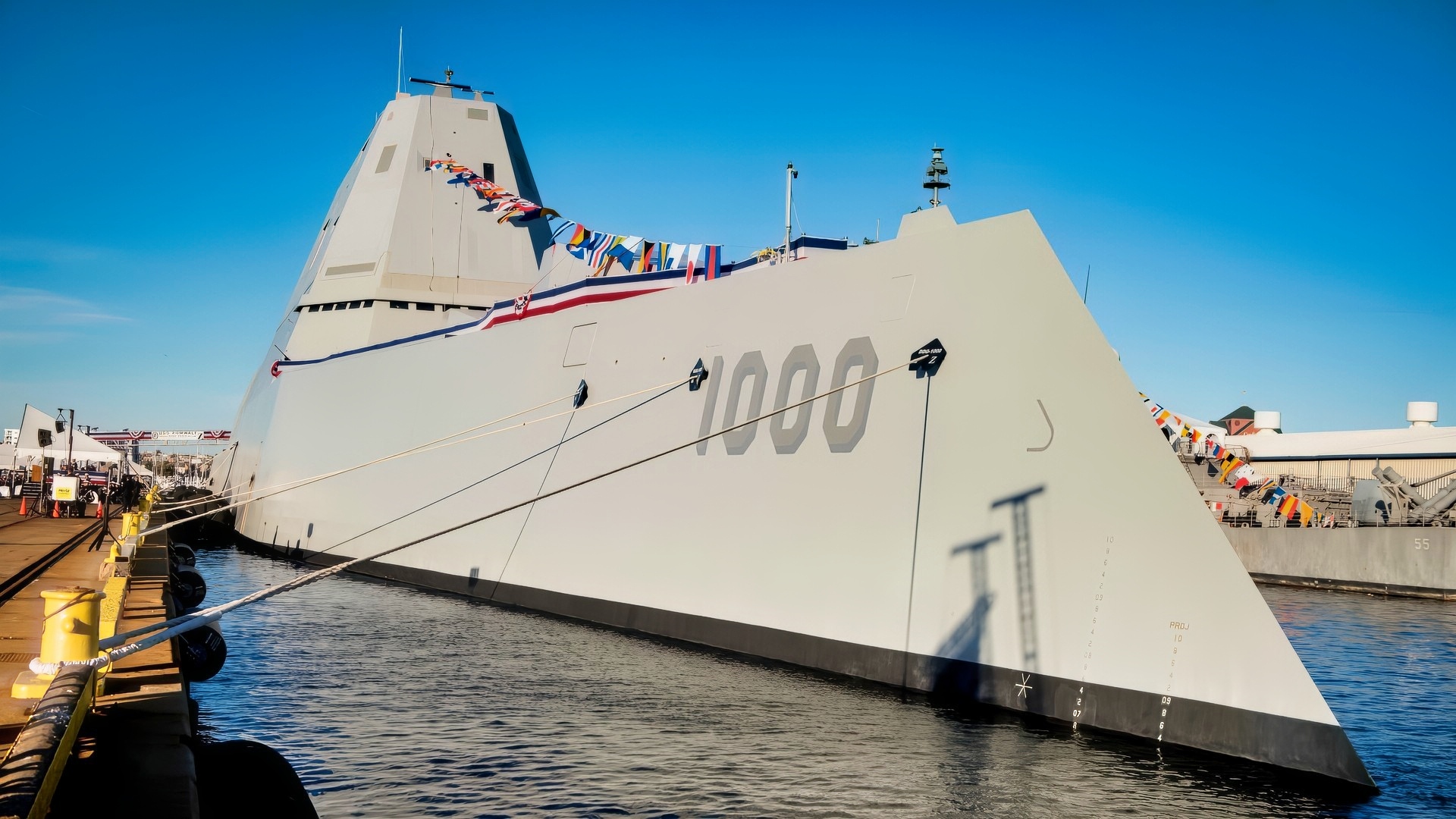
The Navy’s newest and most technologically advanced warship, USS Zumwalt (DDG 1000), is moored to the pier during a commissioning ceremony at North Locust Point in Baltimore. (U.S. Navy photo by Petty Officer 1st Class Nathan Laird/Released)
This design allows CPS to fly above Mach 5 while exploiting lower, non-ballistic trajectories that make detection and interception exceptionally difficult. Both the Army and the Navy share the same “all-up-round” missile, which has allowed the services to consolidate development and accelerate testing.
Their progress was demonstrated by a series of successful end-to-end flight tests in 2024 and, more notably, by the Navy’s successful cold-gas ejection demonstration in May 2025, which safely pushes the missile clear of a ship before booster ignition. These events eliminated the last major engineering hurdles that previously stood between the program and its first full-scale at-sea launch.
With Zumwalt now back at sea, the Navy’s modernization strategy for the class has come into sharper focus.
The ship’s January 2026 ship builder trials validated her propulsion, combat-systems interfaces, and structural modifications after her time ashore, confirming that the conversion had not compromised the destroyer’s signature power-generation capacity or low-observable design.
This underway period formally reopened the destroyer’s operational life as a radically reconfigured platform, effectively rebirthing it as the Navy’s first hypersonic-armed surface combatant.
Why the Zumwalt-class is Now a Big Deal
Instead of conducting the availability solely in dry dock, Ingalls moved Zumwalt completely ashore, treating the overhaul more like new-construction assembly work.
This unique approach was described by some officials as a “build-yard modernization” period, enabling shipyard teams to sequence structural changes more efficiently and avoid the bottlenecks typical of repair shipyards. This method, first used on Zumwalt, may influence future deep conversions across the fleet.
While there are still concerns about the Zumwalt-class, the integration of CPS into these vessels makes them an important asset to the U.S. Navy.
A 16,000-ton destroyer with a stealth-oriented hull, vast electrical power reserves, and a 12-round hypersonic battery offers a uniquely survivable and flexible strike asset. The ship can hold high-value targets at risk from thousands of miles away while remaining difficult to detect.
The retention of the ship’s original 80 Mk 57 Peripheral VLS cells further expands the destroyer’s mission options, allowing commanders to mix hypersonic CPS rounds with Tomahawk cruise missiles, SM-6 interceptors, and other long-range weapons according to evolving operational requirements.
Zumwalt leads the class back into service while the other two destroyers are following close behind. USS Lyndon B. Johnson (DDG-1002) began its CPS integration period in early 2025 after entering dry dock at Ingalls, where the Navy has extended its combat-system activation timeline by roughly two years to incorporate the same bow launcher conversion.
The Navy’s sequencing allows USS Michael Monsoor (DDG-1001) to remain operational long enough to maintain a Zumwalt presence at sea, providing important fleet experience while the other two destroyers undergo structural work. Monsoor is set to arrive at Ingalls in 2026 for her own conversion, after which all three ships will eventually carry the 12-round CPS battery.
About the Author: Isaac Seitz
Isaac Seitz, a Defense Columnist, graduated from Patrick Henry College’s Strategic Intelligence and National Security program. He has also studied Russian at Middlebury Language Schools and has worked as an intelligence Analyst in the private sector.


Krystal cane
April 29, 2026 at 8:38 pm
Waste of money
Marc J Epstein
May 4, 2026 at 3:31 pm
Why do you call a DDG a Battleship? In this case, it is a stealth Destroyer. Properly label your stories in the future.
John Ulmer
May 4, 2026 at 6:02 pm
Even if we have them, which I’m highly suspect, we won’t have many for long. These missiles are highly dependent on rare earth materials, certain metals and alloys and magnets, all of which we produce very little or none of. With China’s export bans to the United States of these materials, most which only they produce, our days of building these missiles and weapons systems are numbered.
Alex Koval
May 5, 2026 at 7:33 am
Yes, $8 billion destroyer is a sure bargain…🤣