

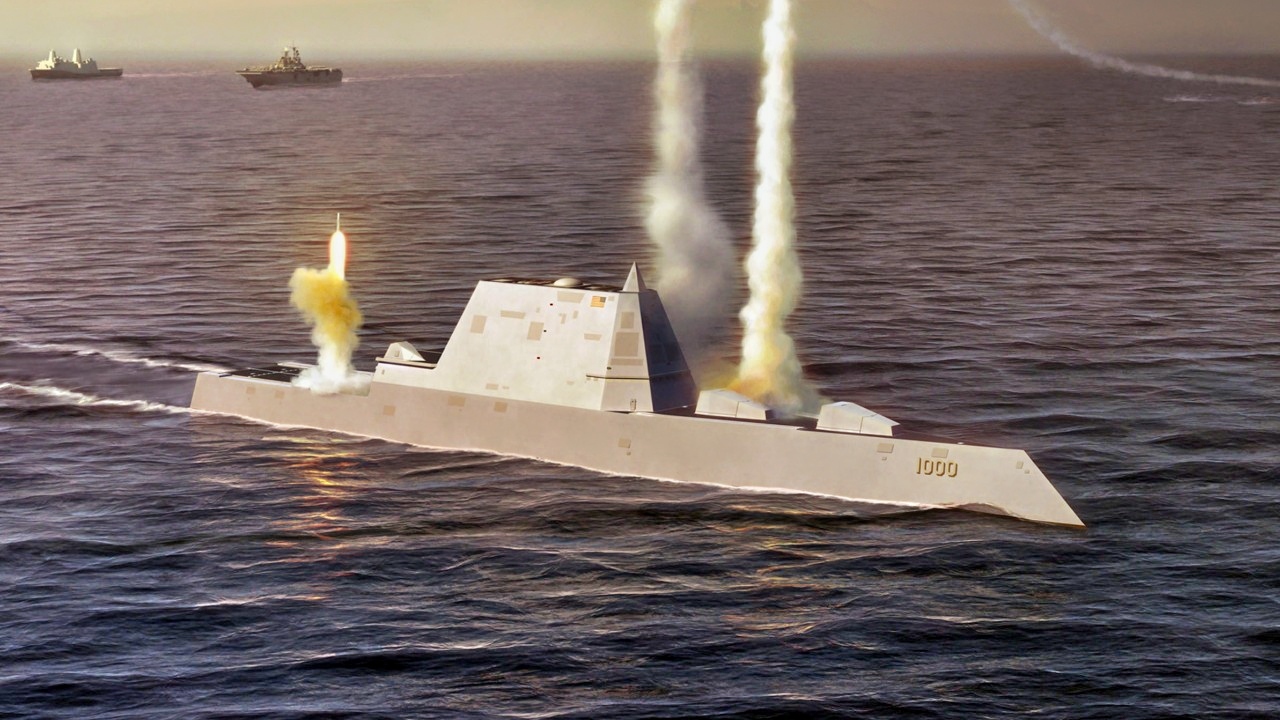
Summary and Key Points: USS Zumwalt is returning as something new: a stealthy surface combatant armed with four 87-inch tubes capable of launching twelve Conventional Prompt Strike hypersonic missiles.
-The concept fits a Taiwan contingency, where survivability inside the first island chain depends on stealth, electronic power, and the ability to hit high-value targets at long range.

Zumwalt-Class U.S. Navy. Image Credit: Creative Commons.
-Yet the timeline remains long—first ship-launched testing is still ahead, and full operational capability across the three-ship class is projected for 2029.
IN 3 Words: Just Not Enough?
The U.S. Navy’s Zumwalt-Class Program Is “Back”—But Three Ships Aren’t a Strategy
The upgrade also doubles as risk reduction for submarine launch modules, reinforcing a hard truth: three ships can prove a capability, not define a fleet strategy.
The USS Zumwalt returned to the water in December 2024, three years after it entered a major modernization availability in 2023 at HII’s Ingalls Shipbuilding facility in Pascagoula. It came back carrying something it never had before: four 87-inch launch tubes sunk into its bow, each one capable of cold-launching three Conventional Prompt Strike (CPS) hypersonic missiles for a total complement of twelve.
The other two ships in the class — Michael Monsoor and Lyndon B. Johnson — are getting identical treatment on a rolling schedule, with full operational capability across all three projected for 2029.
Hypersonics Come to the Surface Fleet
The Navy’s program manager, Captain Clint Lawler, described the Zumwalt class as “the Navy’s premier offensive surface combatant.” CNO Project 33, the service’s much-discussed 2027 readiness initiative, lists CPS as a key capability for penetrating integrated air defenses and striking high-value, time-sensitive targets. The institutional enthusiasm is genuine. And it is warranted — up to a point.
Let’s be clear about what CPS actually is. The Intermediate-Range Conventional Prompt Strike system is a boost-glide hypersonic weapon traveling at Mach 5 and above, maneuvering on an unpredictable depressed trajectory that current air defense architectures have no reliable answer to, with range often reported in the roughly 1,700-mile class.
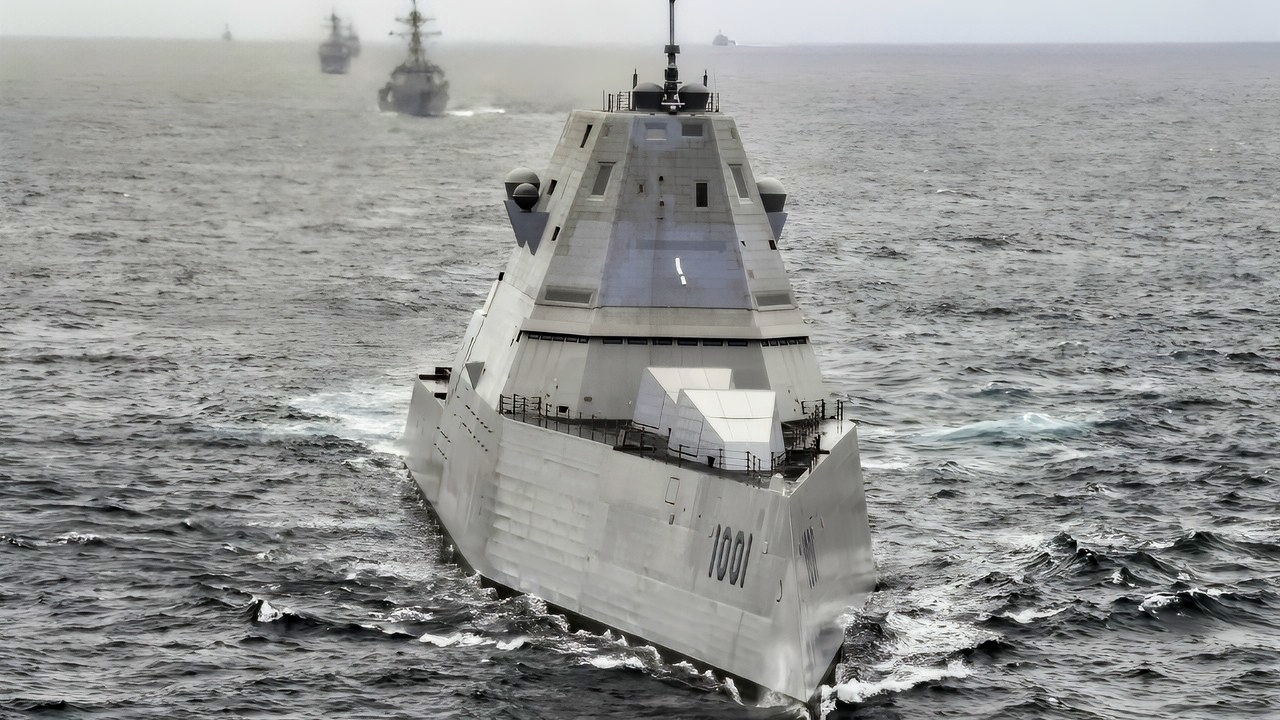
(April 21, 2021) The Zumwalt-class guided-missile destroyer USS Michael Monsoor (DDG 1001) leads a formation including the Arleigh Burke-class guided missile destroyers USS Fitzgerald (DDG 62), USS Spruance (DDG 111), USS Pinckney (91), and USS Kidd (DDG 100), and the Independence-variant littoral combat ship USS Coronado (LCS 4) during U.S. Pacific Fleet’s Unmanned Systems Integrated Battle Problem (UxS IBP) 21, April 21. UxS IBP 21 integrates manned and unmanned capabilities into challenging operational scenarios to generate warfighting advantages. (U.S. Navy photo by Chief Mass Communication Specialist Shannon Renfroe)
DOT&E has noted that insufficient test data exists to fully assess lethality — an honest caveat that the program office would prefer not to lead with, but one that belongs in any serious accounting of where the system actually stands. The system was jointly developed with the Army, which is fielding its own ground-launched version as the Long-Range Hypersonic Weapon, better known as Dark Eagle, and shares the Common Hypersonic Glide Body across both services. Each round costs tens of millions; GAO has cited estimates above $40 million. The first live ship-launched test is now scheduled for 2027.
Stealth, Power, and the Taiwan Geometry
There is a genuine strategic rationale for putting these weapons on a Zumwalt hull — and to understand it, consider the geometry of a Taiwan contingency. PLAN doctrine envisions pushing U.S. surface forces beyond the first island chain in the opening hours of any conflict, using layered DF-21D and DF-26 anti-ship ballistic missiles to deny the Navy the maneuvering room it has historically assumed.
A conventional destroyer operating within that envelope — detectable, predictable in its transit corridors — presents a tractable targeting problem for Chinese ISR networks that have spent twenty years solving exactly that problem. The Zumwalt presents a different one. Its tumblehome hull design gives it a radar cross-section the size of a small fishing vessel despite displacing over 14,000 tons.
Its Integrated Power System generates 78 megawatts — roughly double what a conventional Burke-class destroyer produces — creating headroom for directed-energy systems and active electronic countermeasures that a standard hull simply cannot support.
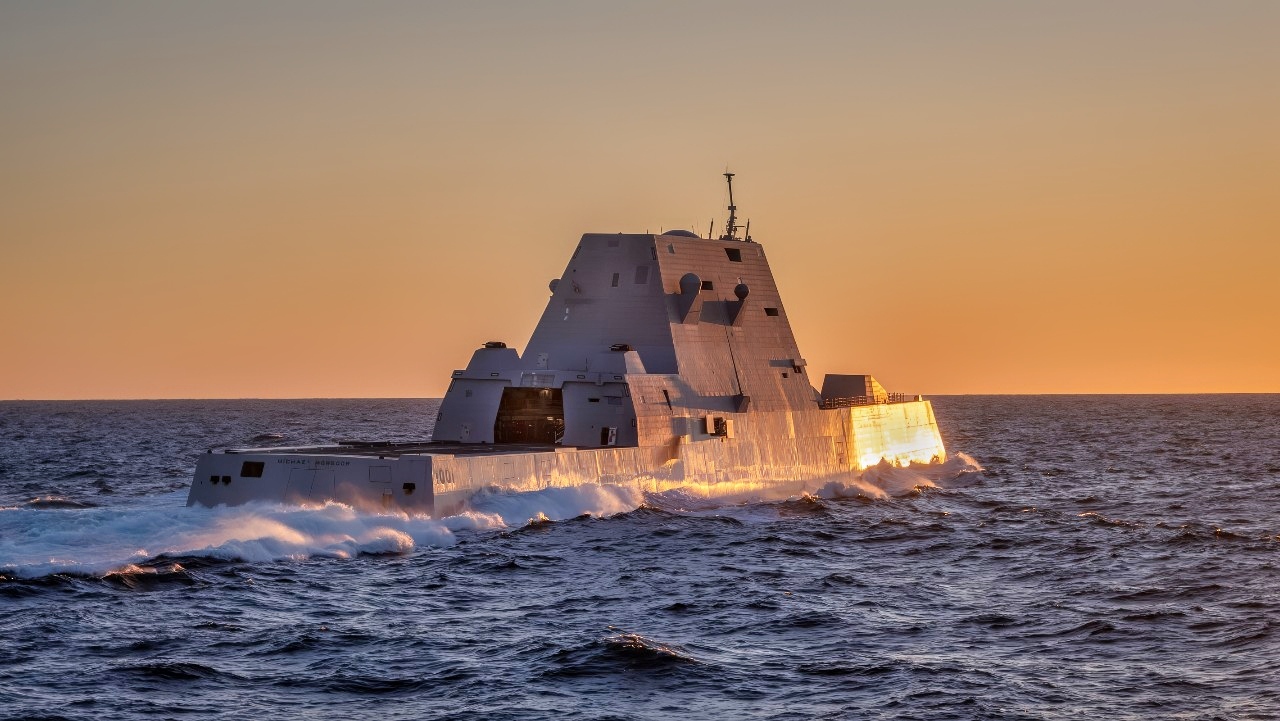
(February 10, 2024) — The Zumwalt Class Guided Missile Destroyer USS Michael Monsoor (DDG 1001) breaks away from the Henry J. Kaiser-class fleet replenishment oiler USNS Pecos (T-AO 197) shortly before sunset after taking on fuel. (U.S. Navy photo by Chief Mass Communication Specialist Mark D. Faram)
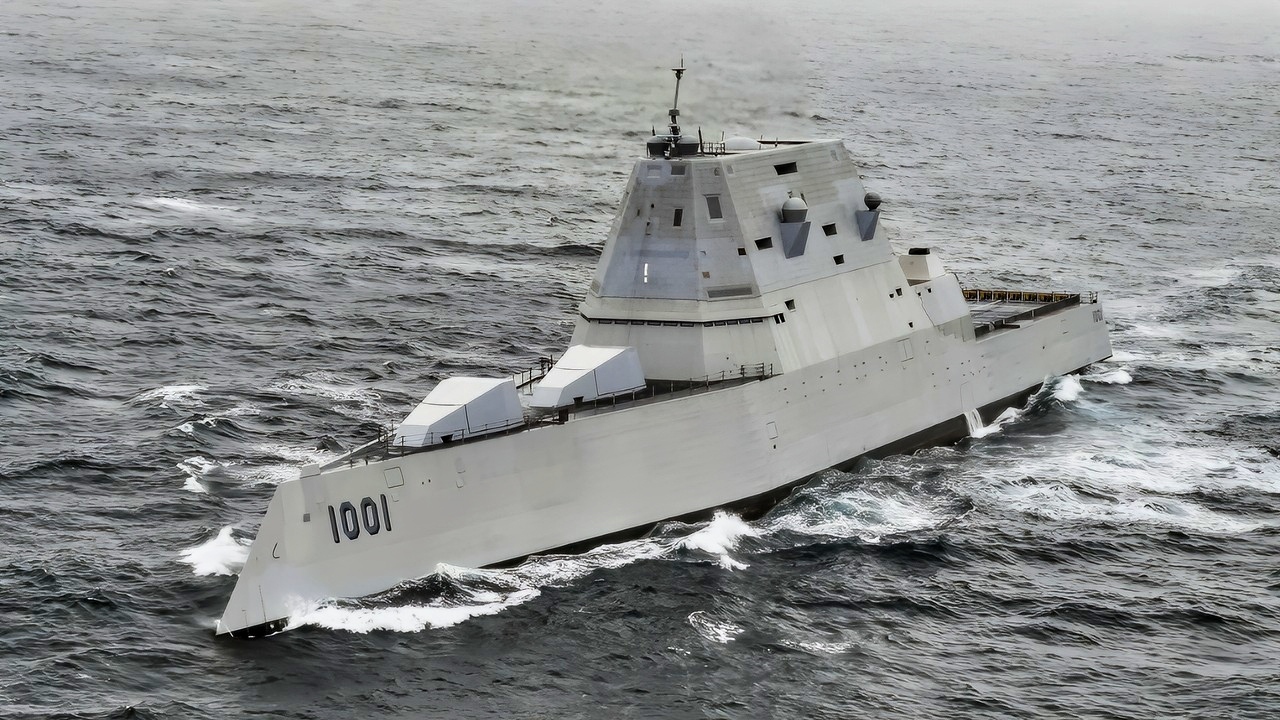
(April 21, 2021) Zumwalt-class guided-missile destroyer USS Michael Monsoor (DDG 1001) participates in U.S. Pacific Fleet’s Unmanned Systems Integrated Battle Problem (UxS IBP) 21, April 21. UxS IBP 21 integrates manned and unmanned capabilities into challenging operational scenarios to generate warfighting advantages. (U.S. Navy photo by Chief Mass Communication Specialist Shannon Renfroe)
A stealthy ship that PLAN targeting officers cannot reliably locate cannot be reliably killed. And a ship that survives long enough to fire twelve hypersonic rounds from within or near the first island chain — against PLAN carrier groups, hardened command nodes, or the logistics infrastructure supporting an amphibious operation across the strait — forces Chinese planners to account for a threat vector they have no current intercept solution for. That is not a trivial targeting dilemma to impose. Stealth and power, in this theater, at this moment, are not design flourishes. They are operational prerequisites.
A Test Bed Disguised as a Combatant
The CPS installation also serves a secondary purpose that the Navy is appropriately candid about. The four launch tubes installed on the Zumwalt are, by the program manager’s own description, nearly identical to the modules going into future Block V Virginia-class submarines.

Zumwalt-class Guided Missile Destroyer USS Michael Monsoor (DDG 1001) transits the Pacific Ocean, June 25, 2022. Twenty-six nations, 38 ships, four submarines, more than 170 aircraft and 25,000 personnel are participating in RIMPAC from June 29 to Aug 4 in and around Hawaiian Islands and Southern California. The world’s largest international maritime exercise, RIMPAC provides a unique training opportunity while fostering and sustaining cooperative relationships among participants critical to ensuring the safety of sea lanes and security on the world’s oceans. RIMPAC 2022 is the 28th exercise in the series that began in 1971.

(July 28, 2022) U.S. Navy Zumwalt-class guided-missile destroyer USS Michael Monsoor (DDG 1001) sails in formation during Rim of the Pacific (RIMPAC) 2022, July 28. Twenty-six nations, 38 ships, three submarines, more than 30 unmanned systems, approximately 170 aircraft and 25,000 personnel are participating in RIMPAC from June 29 to Aug. 4 in and around the Hawaiian Islands and Southern California. The world’s largest international maritime exercise, RIMPAC provides a unique training opportunity while fostering and sustaining cooperative relationships among participants critical to ensuring the safety of sea lanes and security on the world’s oceans. RIMPAC 2022 is the 28th exercise in the series that began in 1971. (U.S. Navy photo by Mass Communication Specialist 3rd Class Aleksandr Freutel)
Putting them on a surface ship first is deliberate risk reduction — a chance to work out integration problems, validate software, and refine tactics before the same hardware goes onto submarines that carry far heavier strategic weight. This is how mature acquisition programs should work. It is also, implicitly, an acknowledgment that the Zumwalt class’s most lasting contribution to American sea power may be as a test bed rather than as a frontline combatant in its own right.
That distinction matters. Three ships, thirty-six missiles at full complement, with the first at-sea test still two years out and full operational capability not expected until 2029 — this is not a fleet. It is a capability demonstration, a hedge, and a precedent-setter, all valuable things, none of them transformative on their own.
The Ghost of Programs Past
There is also the history, which deserves an honest accounting. The Zumwalt program was conceived in the early 1990s as a 32-ship class built around a revolutionary concept: stealthy close-in naval surface fire support for amphibious operations, centered on the 155mm Advanced Gun System and its precision Long-Range Land Attack Projectile. By 2009 the class had shrunk to seven ships, and by the time building ended, to three.
The LRLAP was cancelled in 2016 after the per-round cost reached approximately $800,000. The guns themselves — never fully operationally tested — were eventually cut from the hull entirely, their associated magazines scooped out across multiple decks to make room for the CPS tubes.
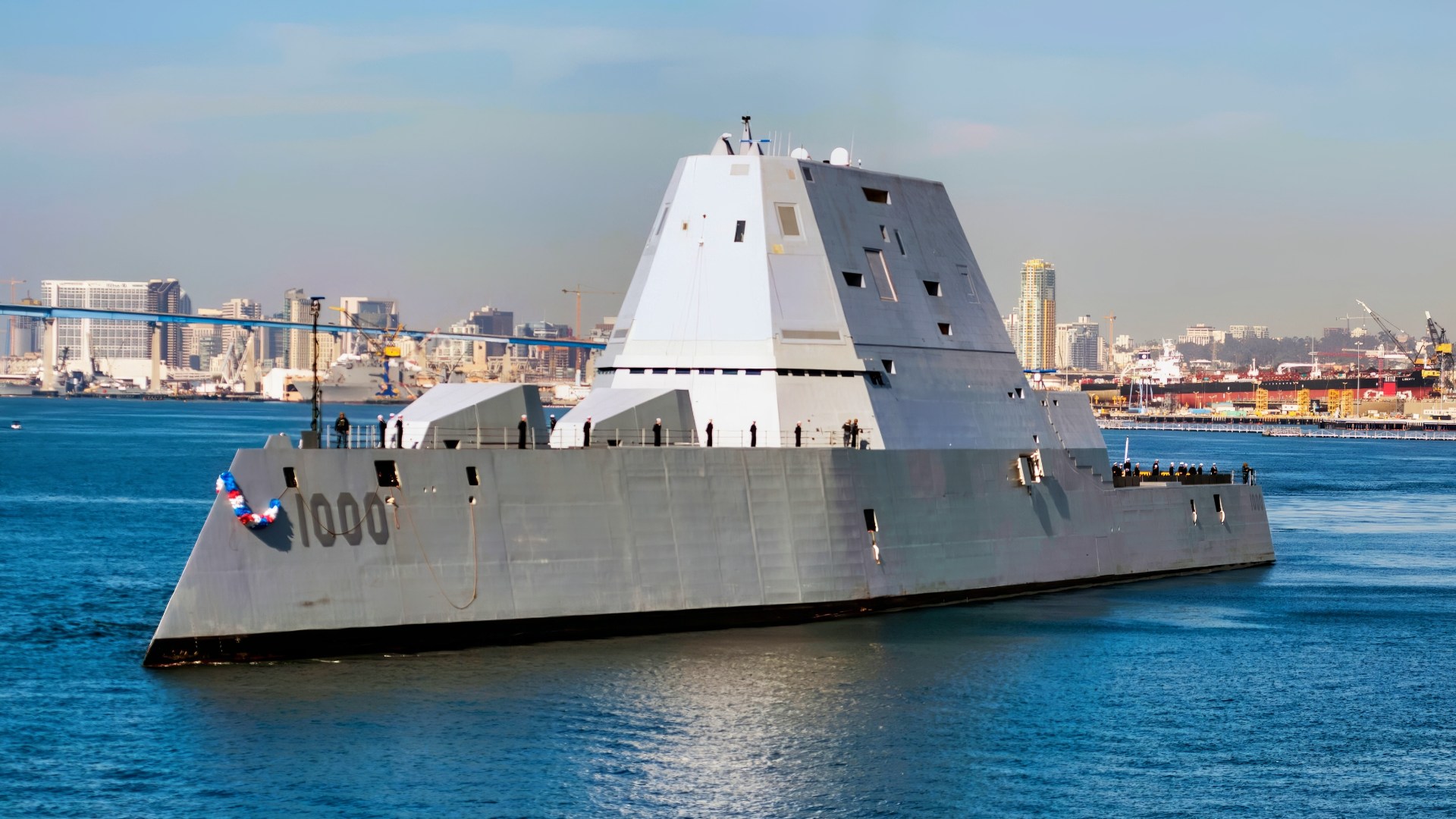
(Dec. 8, 2016) The guided-missile destroyer USS Zumwalt (DDG 1000) arrives at its new homeport in San Diego. Zumwalt, the Navy’s most technologically advanced surface ship, will now begin installation of combat systems, testing and evaluation and operation integration with the fleet. (U.S. Navy photo by Petty Officer 3rd Class Emiline L. M. Senn/Released)
What remained was an exceptionally capable and somewhat purposeless warship that the Navy spent years trying to find a mission for before settling on long-range hypersonic strike. Each iteration of that search was rational. The pattern underneath it — a revolutionary platform whose original concept collapsed, requiring serial justifications to sustain — is a recurring feature of American naval acquisition, not a Zumwalt-specific anomaly.
Capability Is Not Strategy
Which is why the more consequential question isn’t whether the Zumwalt program has been saved. It has been, in the narrow sense. The question is whether arming three stealthy destroyers with hypersonic missiles constitutes a naval strategy for the Indo-Pacific, or merely a very expensive proof of concept that defers harder choices.
The Navy faces genuine strategic tensions that three Zumwalts cannot resolve. The service must sustain a surface fleet that is simultaneously too small for its commitments, increasingly vulnerable to the anti-ship missile salvos that potential adversaries can generate in volume, and aging faster than the shipbuilding industrial base can replace it.
Distributed lethality — spreading firepower across larger numbers of smaller, cheaper, more expendable platforms — represents one answer to that problem. Concentrating exquisite capability in a handful of high-cost hulls represents another. These are not complementary strategies. They compete for resources, for doctrine, and for the kind of institutional commitment that shapes a generation of naval officers.
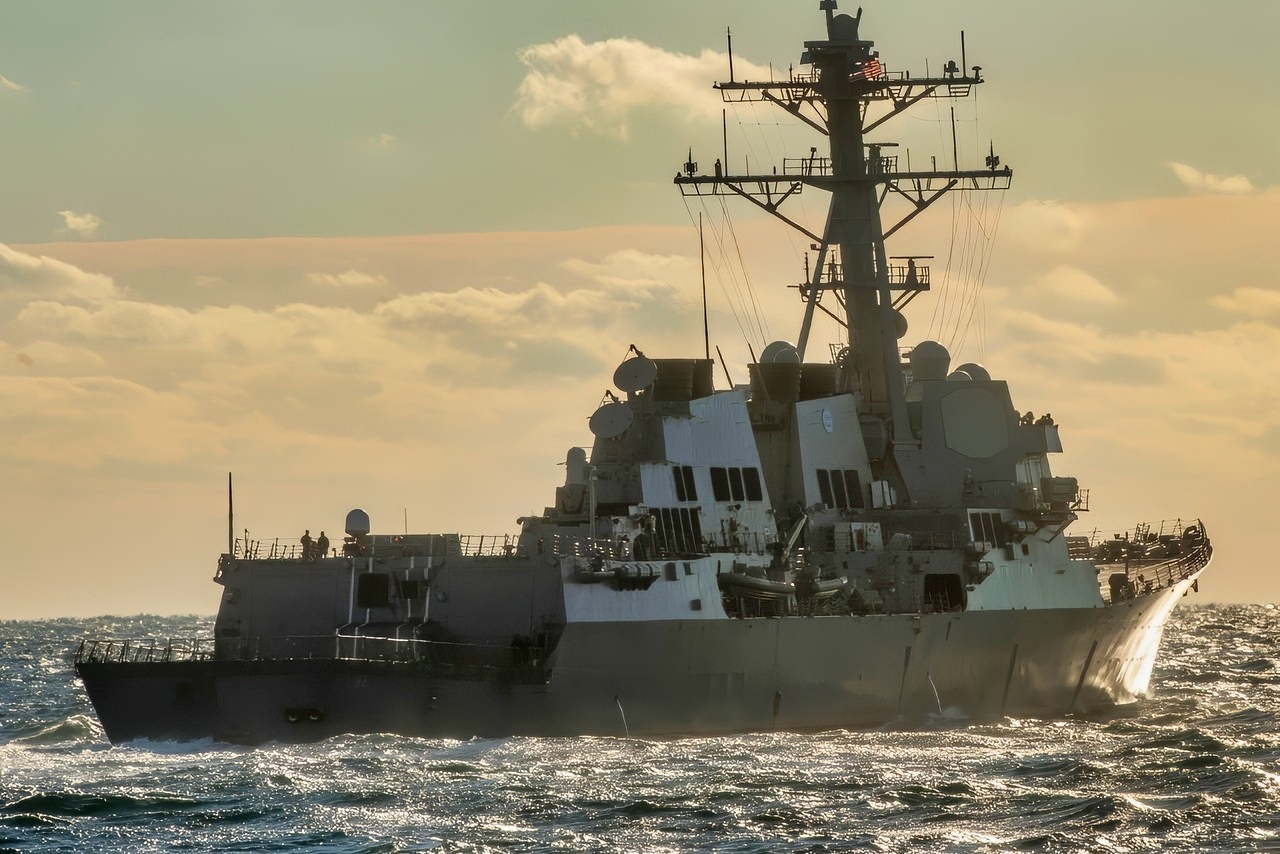
The Arleigh Burke-class guided-missile destroyer USS Lassen (DDG 82) moves into position for an underway exercise with the British Royal Navy aircraft carrier HMS Queen Elizabeth (R08) and Pre-Commissioning Unit (PCU) Michael Monsoor (DDG 1001). The future USS Michael Monsoor is the second ship in the Zumwalt-class of guided-missile destroyers. (Photo by Mass Communication Specialist 1st Class John Philip Wagner, Jr./Released)
The Zumwalt with its hypersonic missiles is a serious weapon in the hands of a capable crew. It will bring a genuinely new strike capability to the surface fleet, one with no current adversary intercept solution and strategic reach that changes the calculus for high-value targets from the South China Sea to the Taiwan Strait.
That matters. What it does not do is answer the foundational question the Navy has been circling for two decades: what kind of fleet does the United States actually need, and is it willing to build it?
Getting the answer wrong on three ships costs $22 billion — including R&D and total program expenditures, by most GAO and CBO accounting. Getting it wrong on the fleet costs something considerably larger.
About the Author: Dr. Andrew Latham
Andrew Latham is a non-resident fellow at Defense Priorities and a professor of international relations and political theory at Macalester College in Saint Paul, MN. You can follow him on X: @aakatham.


