


The US Defense Budget After the Iran War – The United States and Iran are trapped in a bizarre, slow-motion war in the Persian Gulf. Neither seems to actually want to fight the war. But now, neither can back down. The war continues to drag on and is likely to do so for a while. Earlier, the conventional wisdom was that US President Donald Trump would be compelled to end the war before the US midterm elections. The war is woefully unpopular and will likely hurt Republicans’ chances in November.
A persistent semi-war with Iran – a ‘forever war’ in the terminology of the war on terror – would be an unlikely outcome given the comparative weight of the two players. Iran’s gross domestic product is approximately 300 billion USD; America’s GDP is around 33 trillion USD. Until this conflict, it was widely assumed that the US military was vastly more capable than its potential opponents. Yet smallish medium power has successfully blunted US efforts to coerce and used cheap technologies like drones and missiles to beat back the US Navy from its shores.
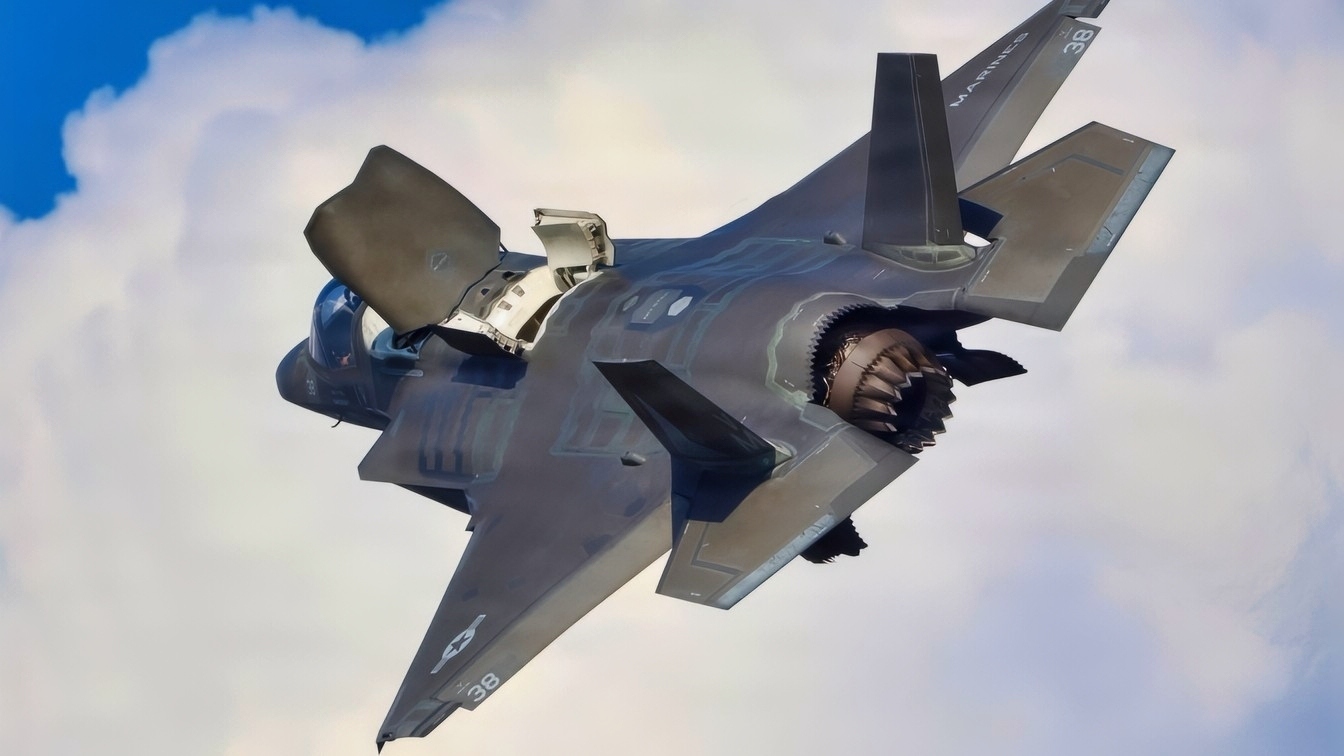
A U.S. Marine Corps F-35B Lightning II aircraft assigned to Marine Fighter Attack Training Squadron (VMFAT) 501 performs a flight demonstration over Washington, D.C., July 4, 2026. The 89th Maintenance Group furnished specialized ground equipment, tools and apron parking locations at nearby Joint Base Andrews, Maryland, to support the staging and execution of VMFAT 501 transient airshow assets during the national Freedom 250 celebration. (U.S. Air Force photo by 1st Lt. Christopher Guerra)
This signals much greater problems if the US ends up fighting China in the near future. China will mobilize far better and more forces than anything Iran can field. If Iran successfully withstood US airstrikes, ran down stockpiles of US interceptors and smart weapons, and kept the US Navy over the horizon, it is reasonable to extrapolate that China can do the same and more. The US clearly needs to buy different capabilities, or more, after this conflict concludes. There are three possibilities:
Massively Expand Defense Spending to Continue to Fight with Expensive, Exquisite Weapons
Fairly early in the Iran war, the distinction emerged that the US was fighting with ‘exquisite’ weapons. These are highly capable, but very expensive and time-consuming to produce. As such, US stockpiles of these weapons were small, and the US used them extensively in the war’s early days. This created the now well-known problem of US stockpile depletion. Apparently, this is so severe that it has impacted Trump’s decision-making. Escalation options against Iran have been rejected for fear of depleting US critical stockpiles even further.
The most blunt answer to US overextension is to simply ramp up and spend more. This appears to be the Trump administration’s preference. Secretary of Defense Hegseth is seeking a gargantuan expansion of the defense budget, including major increase in a huge expansion of the interceptor budget.

The guided-missile destroyer USS Donald Cook (DDG 75) steams behind the aircraft carrier USS Theodore Roosevelt (CVN 71) in the Persian Gulf on Jan. 31, 2006. The Roosevelt Carrier Strike Group is conducting maritime security operations in the Persian Gulf.
(DoD photo by Airman Apprentice Nathan Laird, U.S. Navy. (Released))
Pull-Back and Focus on China
Another alternative is to accept that the US is overstretched in the Persian Gulf and retrench. This is far more financially sustainable than the Trump build-up option. America’s national debt is already about the size of its GDP, an astonishing ‘feat’ in peacetime.
At some point, the money will stop because interest rates or domestic spending will compete with ever-increasing defense spending. A wiser option, recognizing that China is far more important and capable than Iran, would be to pull back and focus on regions that matter most for US security.
The notion that America should ‘pivot to Asia’ is an old one. The US keeps choosing (foolishly) to fight wars in the Middle East, but it need not do so. And a less grand ‘grand strategy’ would be more sustainable too.
Focusing on China while demoting other regions would allow the military to maintain its preference for expensive, high-end weapons without ballooning the defense budget to unsustainable levels.
Switch to Cheap, Mass-Producible Platforms
If the US cannot limit its regional commitments per the pull-back suggestion raised above, nor afford full global commitment with expensive, exquisite weapons, there is one other choice. America could maintain its global interventions, but do so with far cheaper weapons.
Ukraine, in particular, has demonstrated that masses of cheap airpower are a functional alternative to the US preference for superweapons, which are also super-expensive, such as aircraft carriers or stealth fighters.
Dramatically lowering the acquisition costs of US firepower would free up funds to continue US global intervention. Using a cheap, slightly lower-quality kit would free up money and allow bulk purchasing. There are reasonable alternatives to exquisite but expensive options.
The US defense community’s instinct is to neither retrench nor step back from cutting-edge weapons. This places a huge burden on the defense budget and is increasingly unsustainable given America’s debt load. Choices will have to be made.
Author: Dr. Robert Kelly, Pusan National University
Dr. Robert E. Kelly is a professor of international relations in the Department of Political Science and Diplomacy at Pusan National University in South Korea. His research interests focus on Security in Northeast Asia, U.S. foreign policy, and international financial institutions. He has written for outlets including Foreign Affairs, the European Journal of International Relations, and The Economist, and has appeared on television news services such as the BBC and CCTV. His personal website/blog is here; his Twitter page is here.


