


Key Points and Summary – How can tiny Sweden challenge the F-35 stealth fighter in Canada? Simple, fighters during the Cold War enabled Sweden to build a robust aviation industry that culminated in the JAS 39 Gripen today. Today, we look at one of the fighters who helped Sweden develop such a fighter. Saab’s A 32 Lansen was born from Sweden’s Cold War fear of a Soviet invasion: a rugged, low-level, all-weather strike jet meant to hit Warsaw Pact forces and ships in the Baltic, and even to deliver a homegrown nuclear weapon that never materialized.
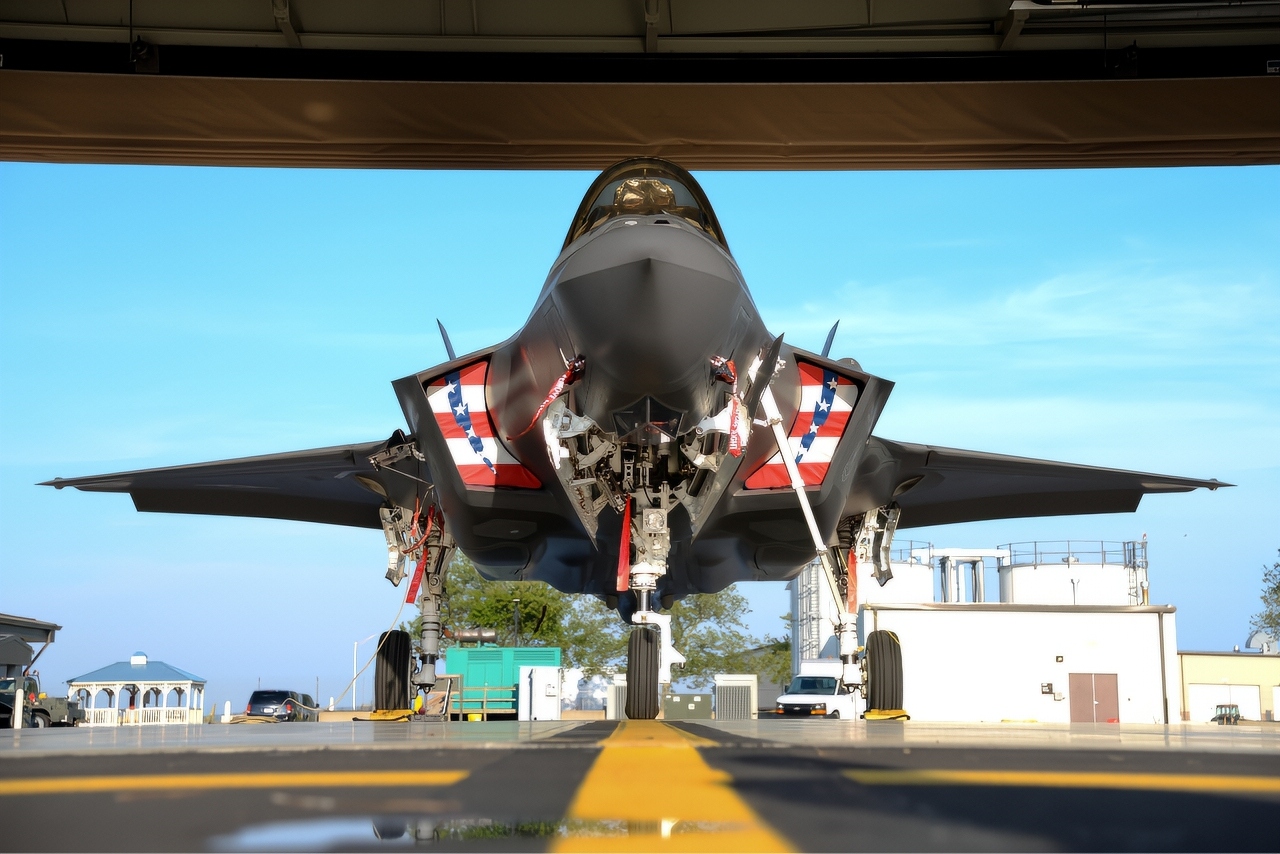
A U.S. Air Force F-35 Lightning II fighter jet from the 56th Fighter Wing, Luke Air Force Base, Arizona, displays it’s crew-designed red, white and blue inlet covers while parked in a military aircraft shelter at the Atlantic City International Airport in Egg Harbor Township, N.J. on May 26, 2016. Pilots and crew from the USAF F-35 Heritage Flight Team made a stop at the 177th Fighter Wing of the New Jersey Air National Guard on the way to their performance at the Jones Beach Airshow in Wantagh, New York on May 28 and 29. (U.S. Air National Guard photo by Master Sgt. Andrew J. Moseley/Released)
-Powered by a license-built Rolls-Royce Avon and flown by a two-man crew, it later morphed into fighter and reconnaissance variants.
-But the Lansen was slow, heavy, and unforgiving. A third of the fleet was lost in accidents, killing about 100 crew. Even so, upgraded variants soldiered on in secondary roles until 1997.
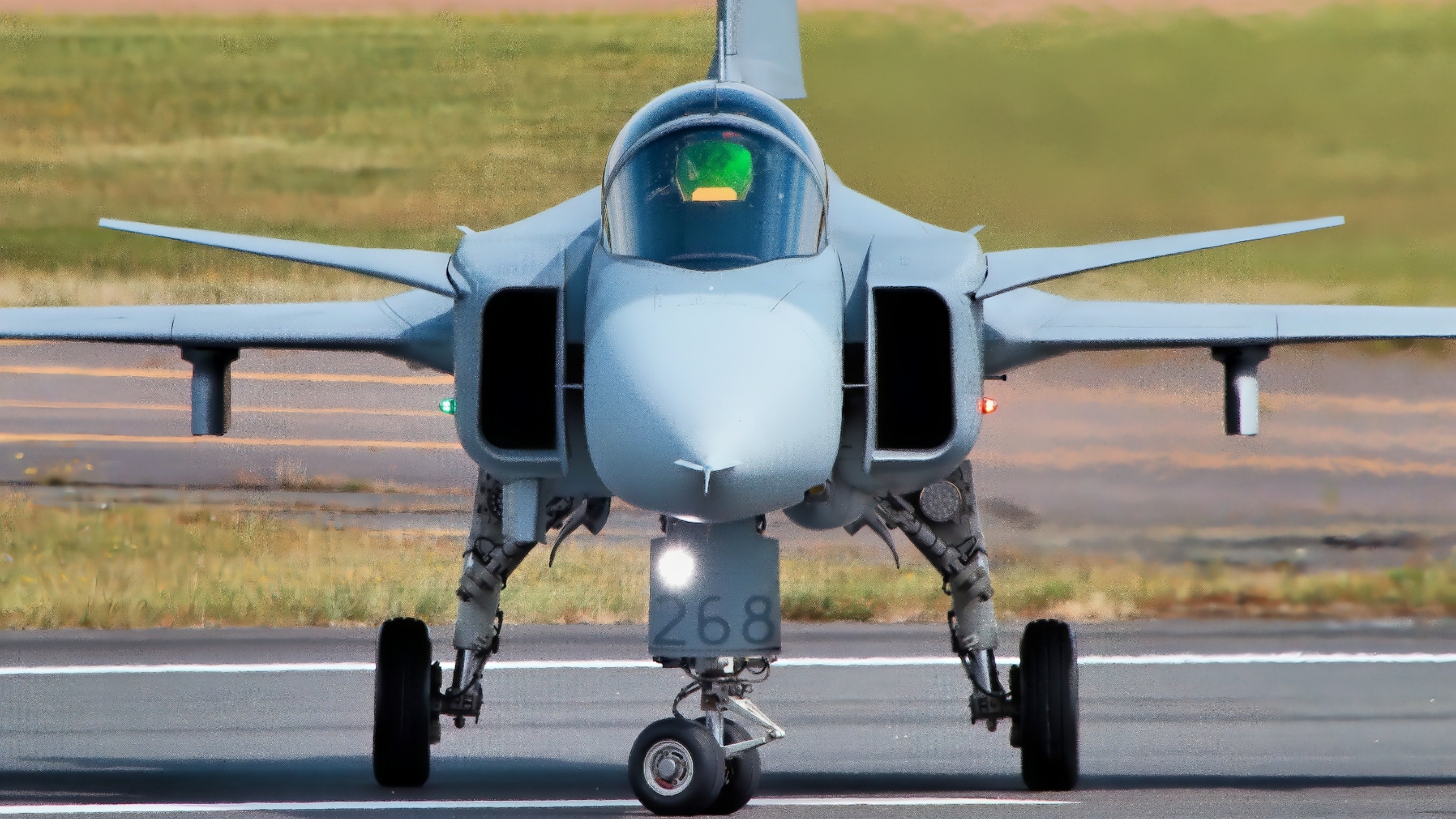
JAS 39 Gripen Front and Center. Image Credit: Creative Commons.
Saab’s A 32 Lansen: Sweden’s First Supersonic Jet Was Deadly to Its Own Pilots
Saab’s A 32 Lansen was designed in the early 1950s, after the end of the Second World War, as an attempt to give Sweden a fast, all-weather airplane capable of low-altitude bombing runs.
It featured a unique combination of characteristics that kept it in service throughout the Cold War and holds the special distinction of being Sweden’s first supersonic airplane.
The aircraft was conceived during a time when open nuclear war with the Soviet Union seemed not only possible but a likely scenario.
Given Sweden’s geography, the intent for the bomber would have been to carry out strikes against invasion forces on land and naval ships at sea in the Baltic.
To that end, Saab gave the bomber a license-built Rolls-Royce Avon engine, which afforded a good mix of high performance and reliability.
Its two-man crew, pilot and navigator, were initially tasked with piloting the attack aircraft. However, the Lansen’s mission profiles changed as the platform matured, and it was later used as a fighter or reconnaissance aircraft.
The jet’s airframe was robust and considered sufficient to cope with the demands of low-level flight at speed.
The aircraft would also have delivered Swedish nuclear weapons, had they been built under the auspices of Stockholm’s clandestine nuclear weapons program, though that initiative was ultimately unfruitful. While later Saab combat aircraft favored a large delta wing and forward canards, offering good maneuverability and handling, the Lansen instead opted for a more traditional swept-wing design.
The A 32 Lansen Fighter Wasn’t Perfect
Though the jet had several strengths, it also had its limitations.
The A 32 Lansen was relatively slow and heavy at a time when jet engine technology was taking off in a big way and moving towards supersonic designs.
Although the Lansen was capable at low altitudes, it lacked the high-speed and climb performance to excel in a modern air-defense environment.
And while the airplane’s navigation and radar systems were adequate for the 1950s, they were rapidly outclassed by increasingly sophisticated alternatives within the Soviet Union and more widely in Europe.
The A 32 Lansen was a deadly aircraft for its pilots.
As one Swedish source explained, a third of all A32 Lansens aircraft were destroyed during accidents and crash-landings, with 100 crew members killed.
There was no single factor in the jet’s abysmal safety record; instead, a combination of insufficient training, design issues, and adverse weather conditions contributed to it.
During one incident, a Lansen pilot bailed out of his airplane after experiencing an engine failure.
While the pilot was unharmed, the plane continued to fly for several miles before crash-landing on a Swedish farmhouse, killing seven.
The jet also struggled within Sweden’s dispersed basing system, a mainstay of Sweden’s Cold War-era air forces.
Unlike Saab’s 37 Viggen fighter, which could take off and land from very short runways off of Swedish highways, the Lansen required more traditional runways and support infrastructure, putting it at odds with Bas 60, the Swedish Air Force’s dispersed basing strategy, and later the updated Bas 90 basing system.
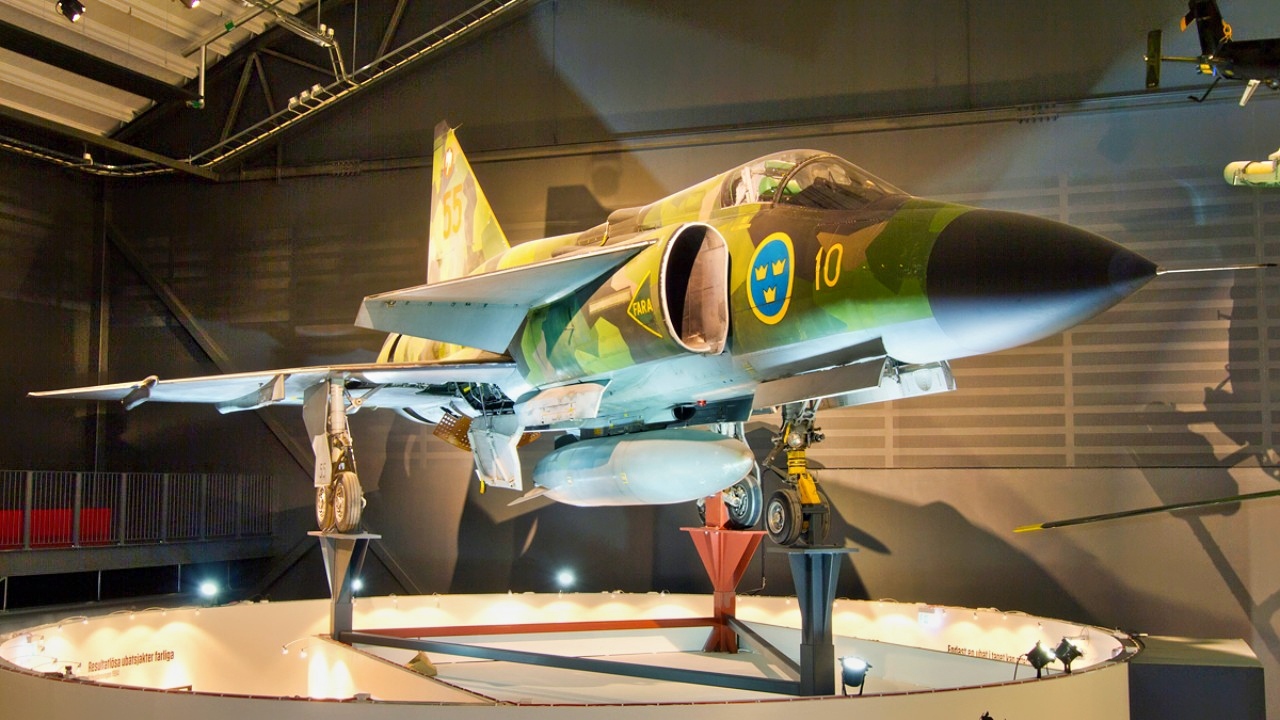
Saab 37 Viggen Fighter. Image Credit: Creative Commons.
More Challenges
Another of the Lansen’s shortcomings was its aerodynamics.
In the pre-fly-by-wire era of relaxed-stability aircraft, the jet’s aerodynamics favored stability and regular, predictable handling over high agility for transonic flight efficiency.
When heavily loaded with a full weapons and fuel payload, the plane was slow and less responsive. But by the mid-1960s, the jet had definitively shown its age: its survivability was in question, thanks in part to a dearth of sophisticated electronic countermeasures, and only fundamental self-protection measures. Still, the jet was upgraded continuously.
As Saab explains, “The J 32B Lansen fighter version had a more powerful engine and was equipped with radar, which enabled it to detect hostile aircraft both in bad weather and in the dark. In 1958-59, this version was based at the F 1 air wing in Västerås and F 12 in Kalmar. During the 1960s, they were transferred to F 4 on Frösön and F 21 in Luleå, in order to be used in the air defence of northern Sweden. They remained in service until the early 1970s.”

Saab 37 Viggen Flying. Image Credit: Creative Commons.
Another version of the jet, the S 32C reconnaissance aircraft, was equipped with aerial surveillance cameras and a radar optimised for ship detection during maritime reconnaissance missions.
During the period 1958-78, these were flown by the F 11 air wing in Nyköping, often on operational reconnaissance missions over the Baltic Sea.”
Despite the myriad issues with the A 32 Lansen, it served in the Swedish Air Force until 1997, albeit in research and training roles as tug planes rather than as front-line combat aircraft.

JAS 39 Gripen Saab. Image Credit: Creative Commons.
About the Author: Caleb Larson
Caleb Larson is an American multiformat journalist based in Berlin, Germany. His work covers the intersection of conflict and society, focusing on American foreign policy and European security. He has reported from Germany, Russia, and the United States. Most recently, he covered the war in Ukraine, reporting extensively on the war’s shifting battle lines from Donbas and writing on the war’s civilian and humanitarian toll. Previously, he worked as a Defense Reporter for POLITICO Europe. You can follow his latest work on X.


