

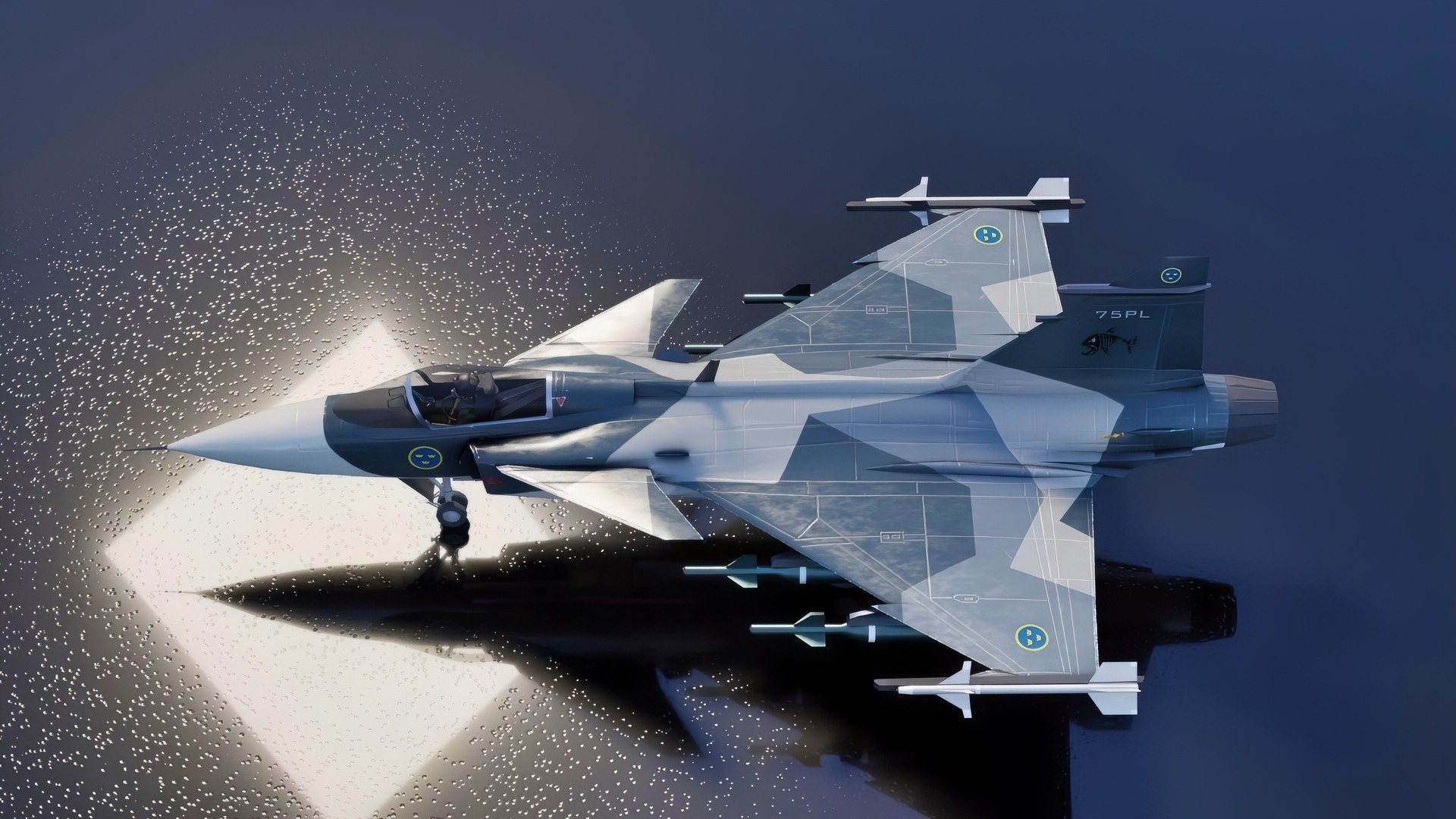
Article Summary – Ukraine’s interest in up to 100 Saab JAS 39 Gripens is about more than replacing aging Soviet jets; it’s about surviving against Russia’s top dogfighter, the Su-35.
-The Swedish Gripen is a light, affordable, multirole jet built around advanced avionics, data links, and long-range missiles like Meteor.

JAS 39 Gripen Fighter from Back in 2017. Image Credit: Creative Commons.

JAS 39 Gripen. Image Credit: Creative Commons.
-The Russian Su-35 brings brute strength: twin AL-41 engines, huge payload, and thrust-vectoring agility backed by the powerful Irbis-E radar.
-On paper, the Su-35 dominates in raw performance and close-in maneuvering.
-The Gripen counters with electronic warfare, sensors, and networked tactics—making pilot skill, doctrine, and support assets decisive in any real clash.
JAS 39 Gripen vs Su-35 Flanker: The Fighter Matchup We Could Someday See?
Recently, Ukrainian President Zelensky signed a letter of interest to the Swedish government regarding the possibility of procuring approximately 100 Saab JAS 39 Gripen aircraft for the Ukrainian Air Force.
This is part of a broader effort to modernize Ukraine’s Air Force and replace its dwindling stock of Soviet-era aircraft.
Many hurdles need to be cleared before the Gripen is confirmed for Ukraine deliveries, which are unlikely to be made for another several years.
Still, there is a significant chance that the JAS 39 will fly for Ukraine in the future.

JAS 39 Gripen Flying in Formation.
However, the Gripen faces some stiff competition.
The Su-35 is currently Russia’s strongest fourth-generation fighter and boasts advanced capabilities. How does the Saab Gripen fare against Russian aircraft?
Design Philosophies
The Saab JAS 39 was built to replace Sweden’s aging Saab 35 Draken and Saab 37 Viggen with a more capable multi-role fighter.
The aircraft was designed to be as light and cost-effective as possible, with a strong emphasis on future-proofing for potential future upgrades.
It features a canard delta-wing configuration with a single engine. It is designed to perform several roles, from anti-air to close air support, to precision strike missions.
The most recent variant, the Gripen F, features more advanced avionics, better engine performance, EW systems, and much more.
The Sukhoi Su-35 was initially intended to be a modernization of the original Su-27 Flanker.
Originally designated Su-27M, the aircraft was given a new designation after extensive upgrades. The Su-35 retains the airframe of the original, but with much more advanced avionics and electronics, fly-by-wire systems, better engines equipped with 2D thrust vectoring for improved maneuverability, and the latest Russian weaponry.

Sukhoi Su-35 Fighter. Image Credit: Creative Commons.
Though it is less commercially successful than the Gripen, the Su-35 is operated by China and Algeria, with Iran also placing an order for about 50 aircraft.
Armaments and Engine Performance
The JAS 39 carries up to 5,000 kg of ordnance on its eight hardpoints, including the Meteor BVR missile, alongside IRIS-T, Taurus air-launched cruise missiles, and precision-guided munitions.
This payload enables the Gripen to perform multiple missions, from air superiority to precision strikes.
The Su-35 has a larger overall payload of up to 8,000 kg and can mount a diverse array of weapons, including R-77 and R-37M air-to-air missiles and Kh-series air-to-ground and anti-ship missiles.
The Su-35’s heavy payload makes it a formidable strike platform, though the JAS 39 leverages quality over quantity, using advanced missiles and data links to achieve BVR superiority.
The Gripen uses a single Volvo RM12 engine in earlier variants and the General Electric F414G in the Gripen E, producing around 22,000 pounds of thrust with afterburner. This provides a thrust-to-weight ratio close to 1:1 at combat load, enabling Mach 2 speeds and excellent fuel efficiency for a lightweight fighter.
In contrast, the Su-35 employs two Saturn AL-41F1S engines, each producing approximately 31,000 pounds of thrust with afterburner, for a combined thrust of over 62,000 pounds. This results in a superior thrust-to-weight ratio, especially when lightly loaded, and supports extreme supermaneuverability through thrust-vectoring nozzles.
While Gripen’s engine prioritizes reliability and low operating costs, the Su-35’s powerplants deliver raw performance, high acceleration, and sustained supersonic flight, albeit at the expense of greater fuel consumption.
Avionics and Electronics
The Gripen E/F employs the Raven ES-05 AESA radar, sensor fusion, and robust electronic warfare systems, enabling it to excel in network-centric operations.
The aircraft’s radar offers a whole 100-degree field of view in specific configurations, although its maximum range remains classified.
Its range is likely in the 200 km zone, but there are no sources to back this up. Its cockpit features modern glass displays and HOTAS controls.
The aircraft’s avionics suite also includes EW systems, jamming pods, and air-launched decoys, all fully integrated into the system’s computers, providing the pilot with a clear picture of the battlefield.
Not to be outdone, the Su-35 boasts some advanced avionics of its own. It uses the Irbis-E PESA radar, which boasts impressive detection ranges of around 400 km with a narrow FOV and 200 km with a wider FOV.
The radar can track 30 targets simultaneously and reportedly engage up to eight targets. It also includes an infrared search and track (IRST) system and the Khibiny-M electronic warfare suite, which helps disrupt enemy radar signatures.
In Three Letter: Tie?
In a battle between the two aircraft, the winner largely depends on who can achieve the first lock-on and fire the first missiles.
Both possess sophisticated EW systems that aim to make lock-ons as tricky as possible, but in real warfare, no system works with 100 percent accuracy.
At close range, the Su-35 has the advantage with its high maneuverability and a wide array of short-range missiles.
Overall, both aircraft are evenly matched in most areas, although the Su-35 has a slight advantage in close-range combat. The winner depends heavily on context and pilot skill.
For this battle, maybe best to call it a tie for now.
About the Author: Isaac Seitz
Isaac Seitz, a Defense Columnist, graduated from Patrick Henry College’s Strategic Intelligence and National Security program. He has also studied Russian at Middlebury Language Schools and has worked as an intelligence Analyst in the private sector.
More Military
Who Has the Fastest Hypersonic Missile? Russia, China, or the US?


