

The United States and Iran spent the weekend striking each other over the Strait of Hormuz, with hundreds of targets hit inside Iran and Iranian missiles and drones answering against American bases across six Gulf states. The ceasefire is dead, oil is climbing, and the war has settled into a contest neither side can sustain indefinitely. Iran’s collapsing economy cannot survive long without oil revenue, and the American military is burning through interceptors it cannot quickly replace while its allies absorb an oil shock. The real question of this war is now a simple one: whose clock runs out first.

A Terminal High Altitude Area Defense (THAAD) interceptor is launched from the Pacific Spaceport Complex Alaska in Kodiak, Alaska, during Flight Experiment THAAD (FET)-01 on July 30, 2017 (EDT). During the test, the THAAD weapon system successfully intercepted an air-launched, medium-range ballistic missile (MRBM) target.
The weekend made the stakes explicit. U.S. Central Command struck roughly 140 Iranian military sites overnight Saturday, part of hundreds of targets hit in successive waves ordered by President Trump to degrade Iran’s ability to attack shipping, while Iran answered with missile and drone barrages against American bases in Kuwait, Bahrain, Jordan, Oman, Qatar, and the UAE. Traffic through the strait has collapsed to as few as six transits in a 12-hour window, down from 18 to 22 a day earlier this month, amid the war that began on February 28.
As Mohammed Soliman of the Middle East Institute framed it, “The question is which clock will run first.”
Iran’s Clock: The Oil Lifeline
Iran entered this war already in economic crisis, and oil is the regime’s lifeline. Before the conflict, Tehran exported about 1.7 million barrels a day, roughly 90 percent of it to China, according to International Energy Agency estimates, revenue the government cannot replace.
That lifeline is now severed twice over. Washington has revoked the temporary waiver that had legalized Iranian oil sales as a negotiating carrot, with all transactions barred after July 17. And Iran’s own weapon cuts against it, because the strait Tehran is choking is the same one its exports must exit.
Analysts cited in economic assessments of the war project that Iran’s economy is shrinking by roughly 10 percent, in a country that imports much of its grain through the very Gulf ports now threatened by the fighting, and whose blockade strategy carries costs Tehran cannot sustain forever, including its dependence on imported gasoline. A war economy can run on ideology for a while. It cannot run without revenue.
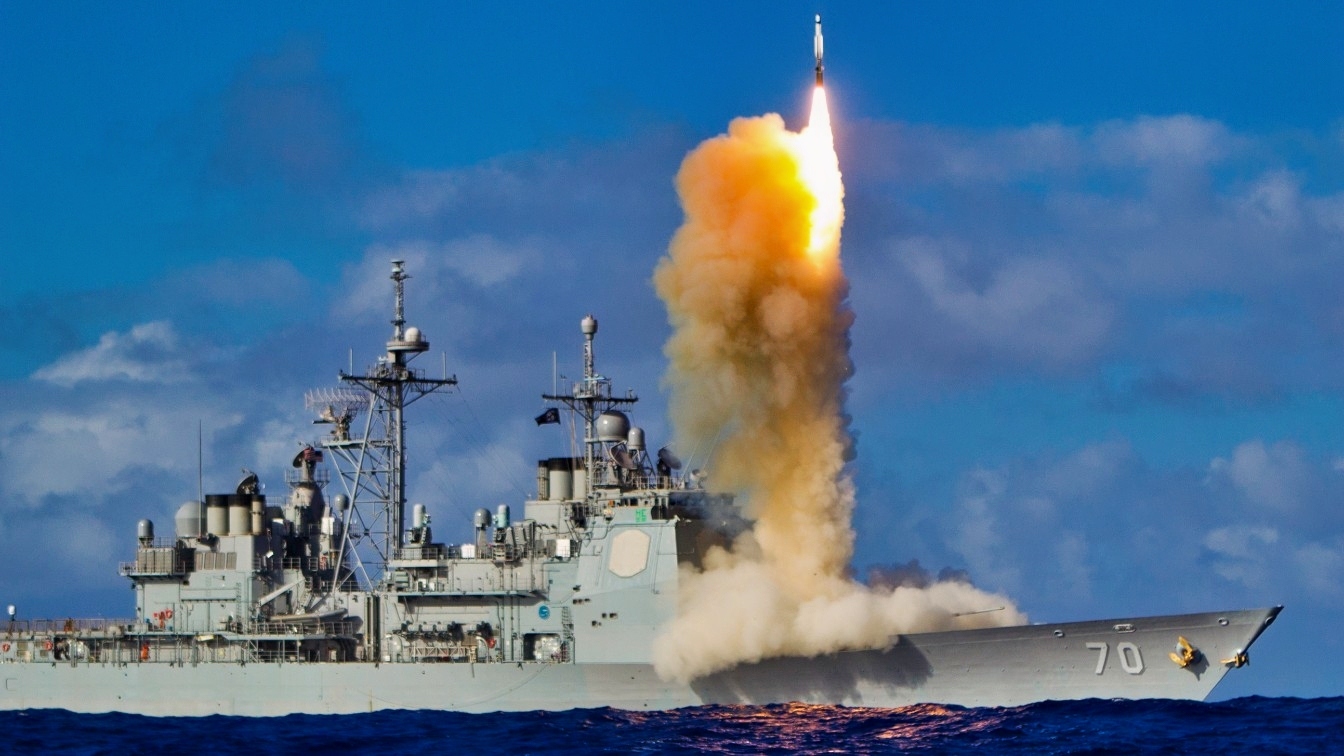
A Standard Missile-3 (SM-3) Block 1B interceptor missile is launched from the guided-missile cruiser USS Lake Erie (CG 70) during a Missile Defense Agency and U.S. Navy test in the mid-Pacific. The SM-3 Block 1B successfully intercepted a target missile that had been launched from the Pacific Missile Range Facility at Barking Sands in Kauai, Hawaii. Lake Erie detected and tracked the target with its on board AN/SPY-1 radar. The event was the third consecutive successful intercept test of the SM-3 Block IB missile. (U.S. Navy photo/Released)
America’s Clock: The Interceptor Ledger
The American vulnerability is different, and it is counted in missiles. By the time the spring ceasefire took hold, the Pentagon had expended at least half its THAAD ballistic-missile interceptors, nearly half its Patriots, 45 percent of its Precision Strike Missiles, and about 30 percent of its Tomahawks, according to CSIS analysis that CNN confirmed against internal Defense Department assessments. Those stocks were never rebuilt. As fighting resumed this weekend, CNN reported the replenishment arithmetic: roughly 15 new Tomahawks and 20 new Patriots arriving per month, with no THAAD deliveries forecast in 2026, and a three-plus-year timeline to restore pre-war inventories.
Stimson Center analysts note such missiles take years, not months, to replace. CSIS’s Mark Cancian warns that days more at the current tempo push stockpiles toward a “new, higher level of risk” for a Pacific contingency, and Senator Mark Kelly has made the uncomfortable arithmetic plain: Iran retains a huge stockpile of cheap ballistic missiles and drones, so every barrage trades million-dollar interceptors against munitions costing a fraction as much.
The Army is asking for more than $20 billion just to replace THAAD and Patriot expenditures, inside a war supplemental estimated at $80 to $100 billion, and the bill extends beyond munitions, with the Navy’s newest carrier returning from the campaign to face a year or more in the repair yard. The Pentagon insists, on the record, that it has everything needed to fight, and CSIS’s own analysis agrees that the U.S. can sustain the fight against Iran under any plausible scenario. The risk is not losing this war, but what is left in the arsenal for the next one.
The Crunch Everyone Pays
Between the two clocks sits the strait itself, carrier of about a fifth of the world’s traded oil. Brent climbed past $78 a barrel as two-year Treasury yields hit their highest since early 2025, the market’s way of saying the war is now an inflation problem, and American pump prices average $3.87 per AAA data, up roughly 30 percent since February. The International Energy Agency has characterized the crisis as the largest supply disruption in the history of the global oil market, and emergency stockpile releases are winding down just as analysts project that traffic will remain below half of pre-war levels for months.
Neither side advertises its breaking point, and both are betting that the other’s arrives first. Iran is wagering that oil pain fractures American patience before bankruptcy fractures the regime. Washington is wagering that economic strangulation works faster than interceptor depletion. Two dates now measure the race: July 17, when Iran’s last legal oil sales end, and a THAAD delivery schedule that reads zero for the rest of the year.
MORE – The Ukraine War Could Get Far Worse
About the Author: Harry J. Kazianis
Harry J. Kazianis (@Grecianformula) was the former Senior Director of National Security Affairs at the Center for the National Interest (CFTNI), a foreign policy think tank founded by Richard Nixon based in Washington, DC. Harry has over a decade of experience in think tanks and national security publishing. His ideas have been published in the NY Times, The Washington Post, The Wall Street Journal, CNN, and many other outlets. He has held positions at CSIS, the Heritage Foundation, the University of Nottingham, and several other institutions related to national security research and studies. He is the former Executive Editor of the National Interest and the Diplomat. He holds a Master’s degree focusing on international affairs from Harvard University.


Joey Bumpers
July 13, 2026 at 9:52 am
The problem, the Iranian government hates America more than it will support its citizens. They don’t give a squat about the harsh reality imposed on their people. Regime change is the only option. How does that happen? It doesn’t seem likely that there is any internal opposition that can make this happen.
Fred Thompson
July 13, 2026 at 12:28 pm
Why do you think the US “needs” to replace those old pre-drone weapons systems? Hmm….
DeadSandnGoodSandn
July 13, 2026 at 6:21 pm
america has more than one kind of weapon. they got plenty of them too. with the disposable drones that can be mass produced now, it doesn’t take a million dollar missile anymoore now that the air defenses are knocked out.