

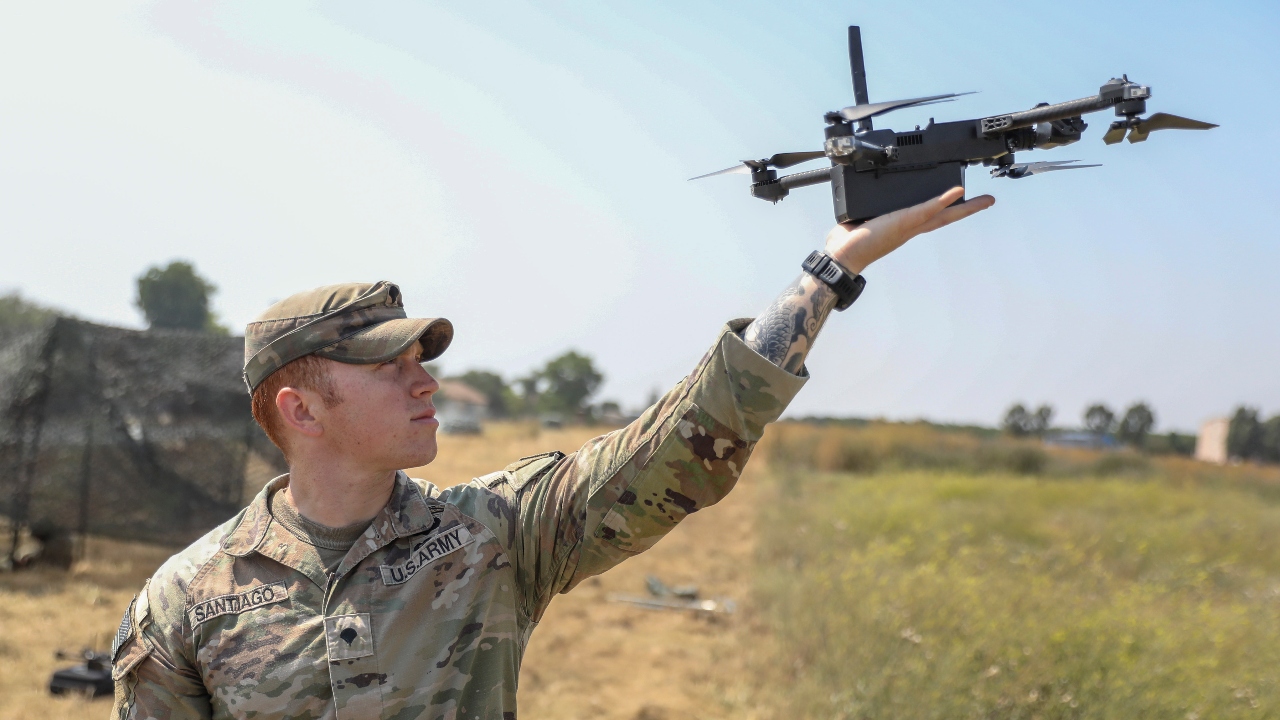
Key Points and Summary – U.S. Defense Secretary Pete Hegseth has launched a radical new drone strategy to “unleash” American unmanned warfare capabilities and outpace Russia and China.
-In a July 10 memo, Hegseth ordered a dramatic overhaul of procurement, slashing red tape to equip every U.S. Army squad with small, lethal attack drones by 2026.
-The war in Ukraine is the reason for such a major drone push.
After Watching Ukraine, the US Army is Getting Serious About Drones
WARSAW, POLAND – On 10 July, US Defense Secretary Pete Haegseth announced a dramatic new increase in the production and operation of small drones that will include weaponized designs.
The intention is that they will be placed into service across all branches of the US armed services.
Hegseth announced the new drone policies today with a professionally produced video that showed a small unmanned aerial system delivering him a copy of the official DoD memo, which is entitled “Unleashing US Military Drone Dominance”.
One of the significant criticisms of past drone programs in the US is that the systems take too long to progress from concept to prototype to production to finally enter service.
Some of them are also prohibitively expensive when it is considered that many of the drone systems that have been seen in Ukraine only last a few missions, if that many, before they are destroyed by enemy fire.
The objective of this program has three crucial elements. One is that there are numerous lessons to be learned from the use of these weapons in the war in Ukraine. The US has been far too slow in taking those lessons on board and then utilizing that insight and the experience of others to field new systems as quickly as possible, say critics of the US efforts to date.
The second is that many of these drones, particularly the smaller attack drones, will be treated like artillery shells or grenades. Rather than being considered as aircraft that must be maintained and operated for years, they will instead be looked upon as consumable items.
Thirdly, these low-cost and in many cases one-time use drones will not be procured through the usual laborious and often impenetrable DoD procurement apparatus.
Even low-level commanders will be able to purchase them directly and also authorize their operation.
Significant authority is to be pushed down to the O-6 (Colonel/Navy Captain) rank level.
Leveraging Commercial Industry and Suppliers
The Secretary’s memo outlines three main initiatives that are the center of the new drone program.
“First, we will bolster the nascent US drone manufacturing base by approving hundreds of American products for purchase by our military,” it reads. “Leveraging private capital flows that support this industry, our overt preference is to Buy American.”
This part of the new push for more drones is linked to the executive order US President Donald Trump signed in June, entitled “Unleashing American Drone Dominance.”
This order was intended to dramatically increase America’s domestic drone developments for both military and non-military applications.
“Second, we will power a technological leapfrog, arming our combat units with a variety of low-cost drones made by America’s world-leading engineers and AI [artificial intelligence] experts,” the memo continues. “Drone dominance is a process race as much as a technological race. Modern battlefield innovation demands a new procurement strategy that fuses manufacturers with our frontline troops.”
“Finally, we’ll train as we expect to fight. To simulate the modern battlefield, senior officers must overcome the bureaucracy’s instinctive risk-aversion on everything from budgeting to weaponizing and training,” Hegseth wrote.
“Next year I expect to see this capability integrated into all relevant combat training, including force-on-force drone wars.”
Avoiding Excess Regulation
Hegseth made a point of emphasizing what is seen of drone usage in the ongoing conflict in Ukraine.
Small drones, especially first-person-view (FPV) kamikaze models and others that are configured to drop small munitions, are present at every level and on both sides of the conflict, which has been a key motivator for his “quick, cheap, and easy to acquire” provisions of the program.
“Drones are the biggest battlefield innovation in a generation, accounting for most of this year’s casualties in Ukraine. Our adversaries collectively produce millions of cheap drones each year,” Hegseth wrote in another section of the memo.
“While global military drone production skyrocketed over the last three years, the previous administration deployed red tape. US units are not outfitted with the lethal small drones the modern battlefield requires.”
As mentioned above, what are classified as Group 1 and Group 2 UASs will now be “accounted for as consumable commodities, not durable property,” according to a detailed attachment to Hegseth’s memo.
Group 1 drones are vehicles that weigh up to 20 pounds, can fly up to an altitude of 1200 feet, and achieve speeds of up to 100 knots. The next higher tier, Group 2, includes types with gross weights between 21 and 55 pounds, can reach altitudes of 3500 feet, and with top speeds of up to 250 knots.
The memo also describes how the drones will be subject to minimal levels of the regulations that traditionally inhibit the progress of major programs. “Small UAS do not require STANAG 4856 standards,” wrote Hegseth. STANAG 4856 is a NATO standard requirements regime mandating commonality in drone control architectures in order to enhance interoperability.
The DoD’s position is that these kinds of requirements add too much cost and complex procedures to creating designs, which will now only be applied to larger drones.
“The Secretaries of the Military Departments shall determine airworthiness and material release requirements for UAS, exempting Group 1 and Group 2 UAS, with few exceptions,” reads another section of the attachment to the memo.
About the Author: Reuben F. Johnson
Reuben F. Johnson has thirty-six years of experience analyzing and reporting on foreign weapons systems, defense technologies, and international arms export policy. Johnson is the Director of Research at the Casimir Pulaski Foundation. He is also a survivor of the Russian invasion of Ukraine in February 2022. He worked for years in the American defense industry as a foreign technology analyst and later as a consultant for the U.S. Department of Defense, the Departments of the Navy and Air Force, and the governments of the United Kingdom and Australia. In 2022-2023, he won two awards in a row for his defense reporting. He holds a bachelor’s degree from DePauw University and a master’s degree from Miami University in Ohio, specializing in Soviet and Russian studies. He lives in Warsaw.
More Military
The U.S. Navy’s Submarine Crisis Is Real


