


The U.S. Navy is currently experiencing a submarine crisis.
It needs more submarines than it has at its disposal.
America’s naval shipyards are backlogged, understaffed, and lack the capacity to maintain or repair existing submarines, let alone complete new builds in a reliable and affordable manner.
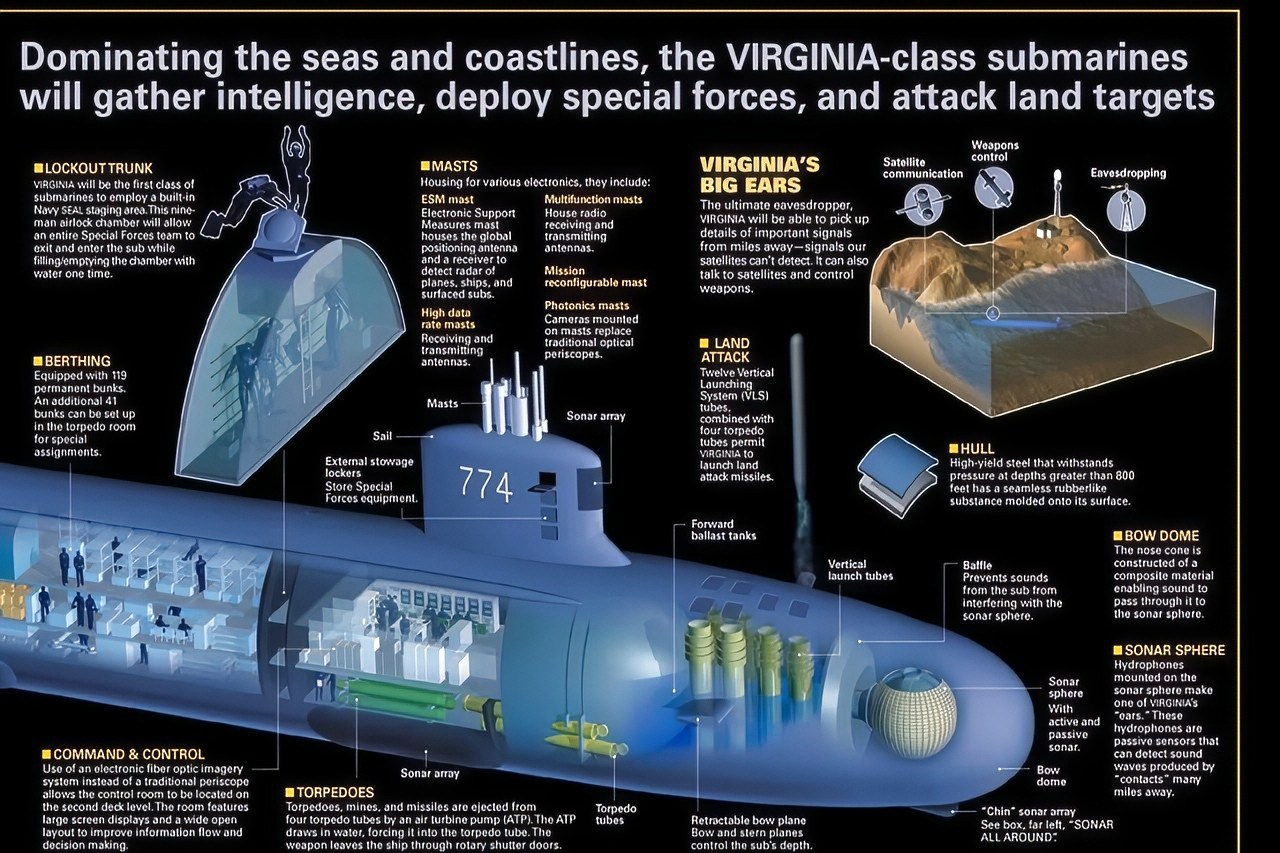
Virginia-Class Submarine Cut Out. Image Credit: Creative Commons.
This has strained the force as never before.
While America’s submarine force is likely the most advanced in the world, it is under severe strain due to America’s global commitments (and Washington’s unwillingness to reduce them).
So long as the US defense industrial base languishes in its present dilapidated condition, turgidly repairing and turning out new submarines at a reduced pace than what the present moment requires, America’s rivals will continue catching up with the Navy’s submarine capabilities.
Diesel-Electric Subs are Not the Easy Answer
Clearly, something must give.
One solution is for the United States to stop building such complex systems, like nuclear-powered submarines. Instead, many analysts are advising the Navy to consider cheaper, less sophisticated alternatives, such as diesel-electric air-independent propulsion (AIP) submarines.
Indeed, during the Second World War, diesel-electric subs were the only system available to any of the great powers at that time. The US Navy excelled in using these submarines to great effect in that war. Many naval legends were born from the experience of diesel-electric submarine warfare in World War II.
Nevertheless, the world moved on from those early days of submarine warfare.

241204-N-VW723-2064 PACIFIC OCEAN (Dec. 4, 2024) The Los Angeles-class fast-attack submarine USS Greeneville (SSN 772) transits the Pacific Ocean while supporting a distinguished visitor embark, Dec. 4, 2024. Greeneville is one of four Los Angeles-class fast-attack submarines assigned to Commander, Submarine Squadron 11. These submarines are capable of supporting various missions, including: anti-submarine warfare; anti-ship warfare; strike warfare; and intelligence, surveillance, and reconnaissance. (U.S. Navy photo by Mass Communication Specialist 1st Class Keenan Daniels)
The Cold War gave the Americans their first taste of nuclear-powered submarines, and the Navy never looked back. There is no doubt that nuclear-powered submarines are wonderful platforms. They allow the Navy to have a limitless range.
And, during the Cold War, that was key as most of those US subs were carrying America’s important nuclear weapons second-strike capability. Today, nuclear-powered submarines give the US Navy essential long-range conventional strike options.
AIP-Powered Subs Have Proven They Can Threaten Aircraft Carriers
Yet, diesel-electric submarine technology has advanced considerably since the Navy last employed it. Many European and Asian allied nations employ diesel-electric AIP technology.
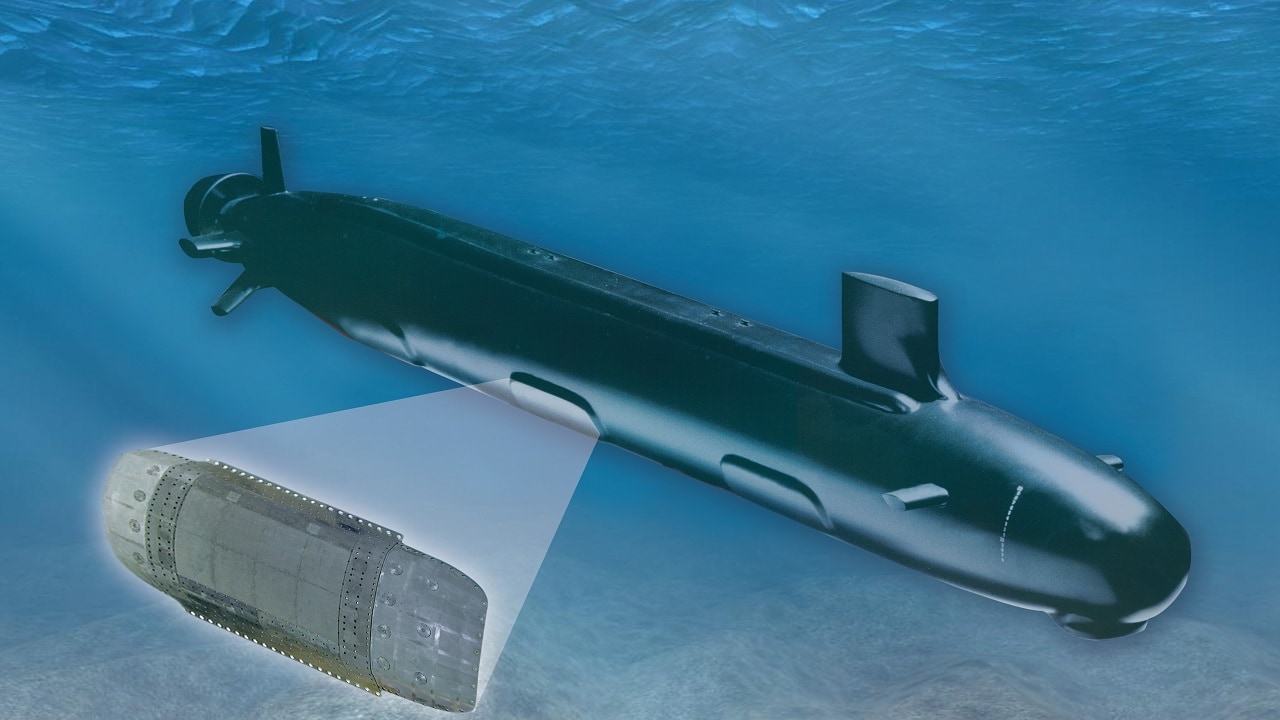
Image of Virginia-Class Submarine. Image Credit: Creative Commons.
In fact, AIP-driven diesel-electric submarines have consistently demonstrated an impressive ability to sneak up on US nuclear-powered aircraft carriers, get within firing range during multinational wargames, and simulate sinking them successfully.
America’s Allies Already Use Them
And it isn’t only one type of AIP-driven diesel-electric attack submarine that has proven so effective against American carriers. Diesel-electric submarines belonging to France and Switzerland have showcased this capability to sink American carriers.
Meanwhile, other US allies, like Israel, happily employ diesel-electric AIP submarines because they are cheaper than nuclear-powered ones and they provide similar–though not as good, of course–options that nuclear-powered subs provide.
Israel employs German-made, AIP-driven Dolphin-class submarines as part of its nuclear strike capability, too. Of course, the Israelis have never officially acknowledged their possession of a nuclear weapons arsenal. It is, in fact, the worst-kept secret in the Middle East. Many believe that the Israelis have armed their Dolphin-class diesel-electric submarines with nuclear-tipped cruise missiles that serve as a sea-based nuclear strike capability.
Of course, diesel-electric submarines, even ones sporting advanced AIP Stirling engines, are limited when compared to nuclear-powered submarines. But many advanced navies have no qualms about employing diesel-electric submarines to meet their immediate mission needs.

NAVAL BASE GUAM (Dec. 11, 2024) – The Los Angeles-class fast-attack submarine USS Annapolis (SSN 760) transits Apra Harbor, Naval Base Guam, Dec. 11, 2024. Assigned to Commander, Submarine Squadron 15, based at Polaris Point, Naval Base Guam, Annapolis is one of five forward-deployed fast-attack submarines. Renowned for their unparalleled speed, endurance, stealth, and mobility, fast-attack submarines are the backbone of the Navy’s submarine force. Regarded as apex predators of the sea, Guam’s fast-attack submarines serve at the tip of the spear, helping to reaffirm the submarine force’s forward-deployed presence in support of a free and open Indo-Pacific. (U.S. Navy photo by Lt. James Caliva)
Even the Russian Navy, in possession of one of the world’s most advanced submarine forces, has multiple iconic diesel-electric submarine classes that have more than proven themselves in the great game undersea.
China, despite its rapidly modernizing and expanding submarine fleet, continues to employ diesel-electric submarines to augment it.
Why the US Navy Won’t Build Them
So, why doesn’t the US Navy just commission a handful of these smaller, cheaper, less complex systems as a stopgap for its strained fleet?
Well, the problem redounds to the defense industrial base and the limits of US naval shipyards. No large, manned platform can be produced reliably under current industrial conditions. Thus, even diesel-electric subs cannot be built any more than additional nuclear-powered submarines can be built reliably. Plus, the US Navy is not going to shift its undersea warfare doctrine to procure cheaper, less effective subs.
Only Unmanned Undersea Vehicles Can Help
If it’s a stopgap that the Navy is seeking, they might want to focus on scaling their unmanned undersea vehicles (UUVs). These would augment existing submarines without draining significant resources. Indeed, undersea drones are the wave of the future. It is clear that the Navy cannot keep waiting for its shipyards to catch up with demand, nor can it just click its heels together and begin producing diesel-electric subs.

USS Connecticut Seawolf-Class Submarine. Image Credit: Creative Commons.
The Navy can, however, begin surging UUV production. They should immediately do that. We live in an age where quantity trumps quality, after all. Time is not on the Navy’s side. They must act to plug the sizable gaps America’s broken naval shipyards have created in its nuclear submarine force. Diesel-electric subs cannot do that. Only UUVs can.
About the Author: Brandon J. Weichert
Brandon J. Weichert is the Senior National Security Editor at 19FortyFive.com. Recently, Weichert became the editor of the “NatSec Guy” section at Emerald. TV. He was previously the senior national security editor at The National Interest. Weichert hosts The National Security Hour on iHeartRadio, where he discusses national security policy every Wednesday at 8 p.m. Eastern. He hosts a companion show on Rumble entitled “National Security Talk.” Weichert consults regularly with various government institutions and private organizations on geopolitical issues. His writings have appeared in numerous publications, among them Popular Mechanics, National Review, MSN, and The American Spectator. And his books include Winning Space: How America Remains a Superpower, Biohacked: China’s Race to Control Life, and The Shadow War: Iran’s Quest for Supremacy. Weichert’s newest book, A Disaster of Our Own Making: How the West Lost Ukraine, is available for purchase at any bookstore. Follow him via Twitter/X @WeTheBrandon.


