

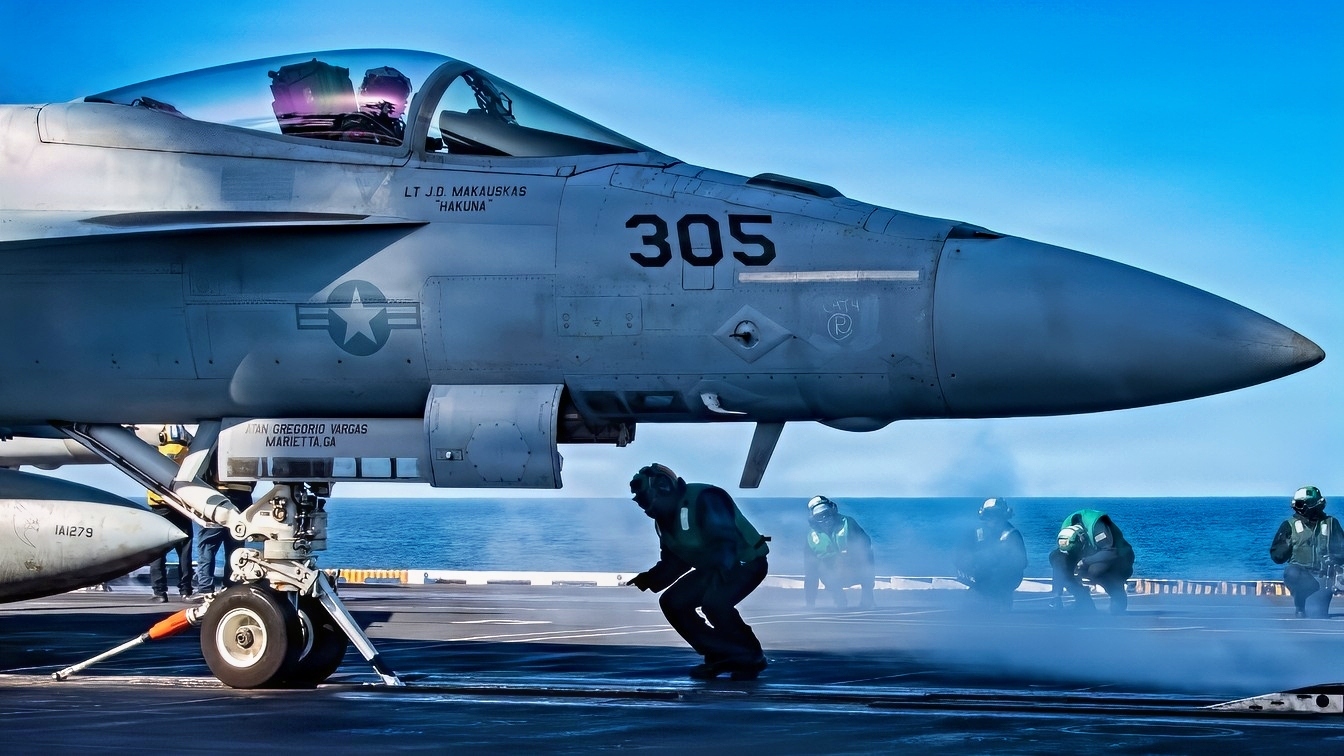
The U.S. Navy’s F/A-18 Super Hornet Service Life Extension Program has extended the aircraft from 6,000 flight hours all the way to 10,000 — buying years of additional service life for a 1970s McDonnell Douglas-Northrop design while the Navy waits for the F/A-XX sixth-generation fighter. The Super Hornet has been retrofitted with conformal fuel tanks designed to reduce radar signature, rounded external weapons pods, Magic Carpet glide-slope landing software, the Joint Helmet-Mounted Cueing System, and an enhanced AESA radar.
The U.S. Navy Is Making Its 1970s-Era F/A-18 Super Hornet Quietly Stealthier — to Cover The Delayed F/A-XX
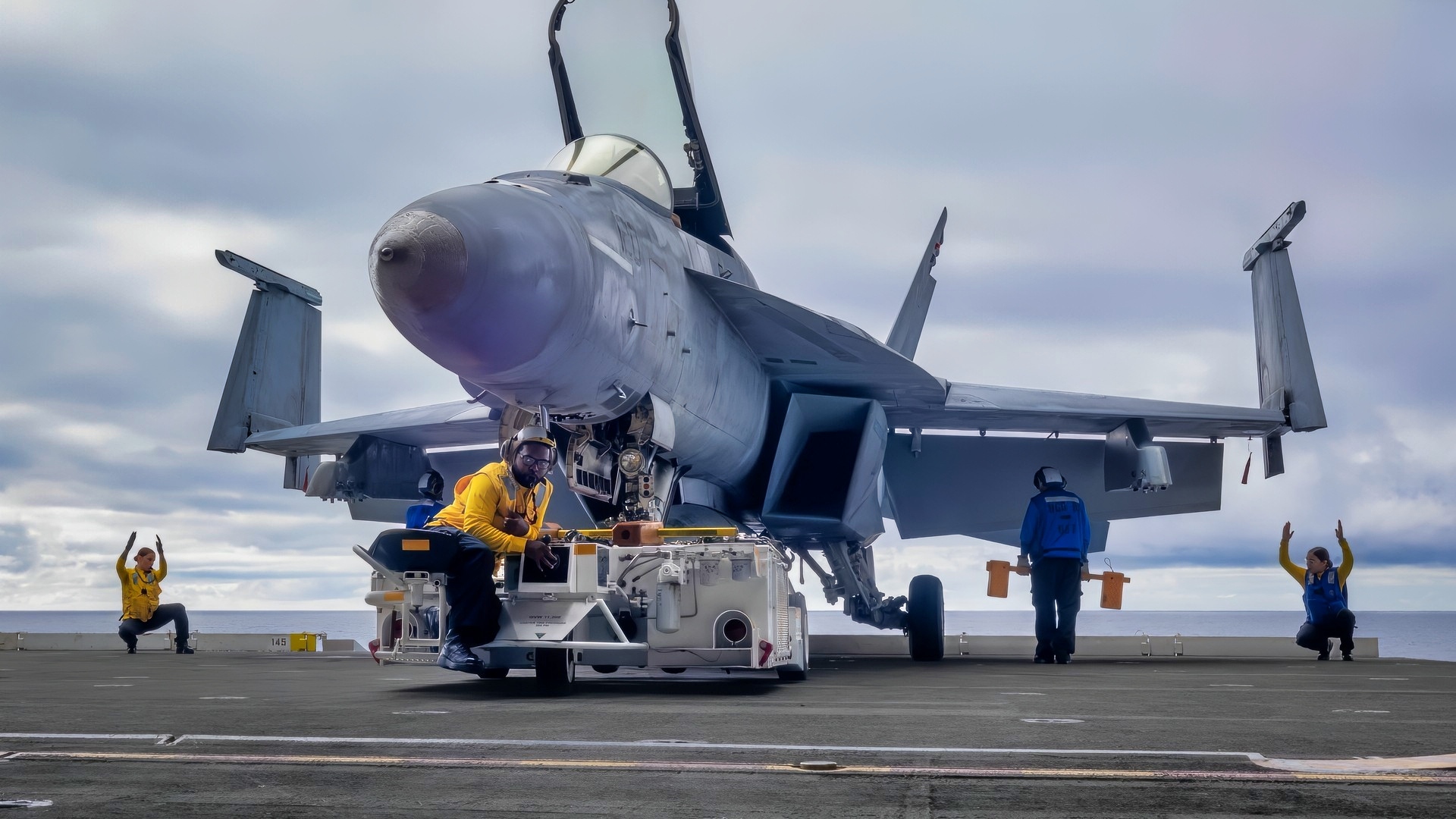
ATLANTIC OCEAN (Aug. 13, 2025) Sailors transport an F/A-18E Super Hornet attached to the “Gladiators” of Strike Fighter Squadron (VFA) 106 onto an aircraft elevator aboard the Nimitz-class aircraft carrier USS George H.W. Bush (CVN 77). George H.W. Bush is underway conducting carrier qualifications and routine operations in the Atlantic Ocean. (U.S. Navy photo by Mass Communication Specialist Seaman Apprentice Kayleigh Tucker)
Next-generation infrared target tracking, conformal fuel tanks, a fully redesigned digital cockpit, and new “glide slope” carrier-landing software are just a few of the many life-extending enhancements woven into the U.S. Navy’s classic F/A-18 Hornet and Super Hornet.
The Navy’s F/A-18 has already outlived its anticipated service life through extension programs, upgrades, and extensive modernization, ensuring the 1980s-launched jet remains relevant, lethal, and cutting-edge in a modern threat environment.
The F/A-18 Super Hornet Fighter Flex
What if the Super Hornet were again asked to “flex” further into the future, in the event that the promising F/A-XX were delayed?
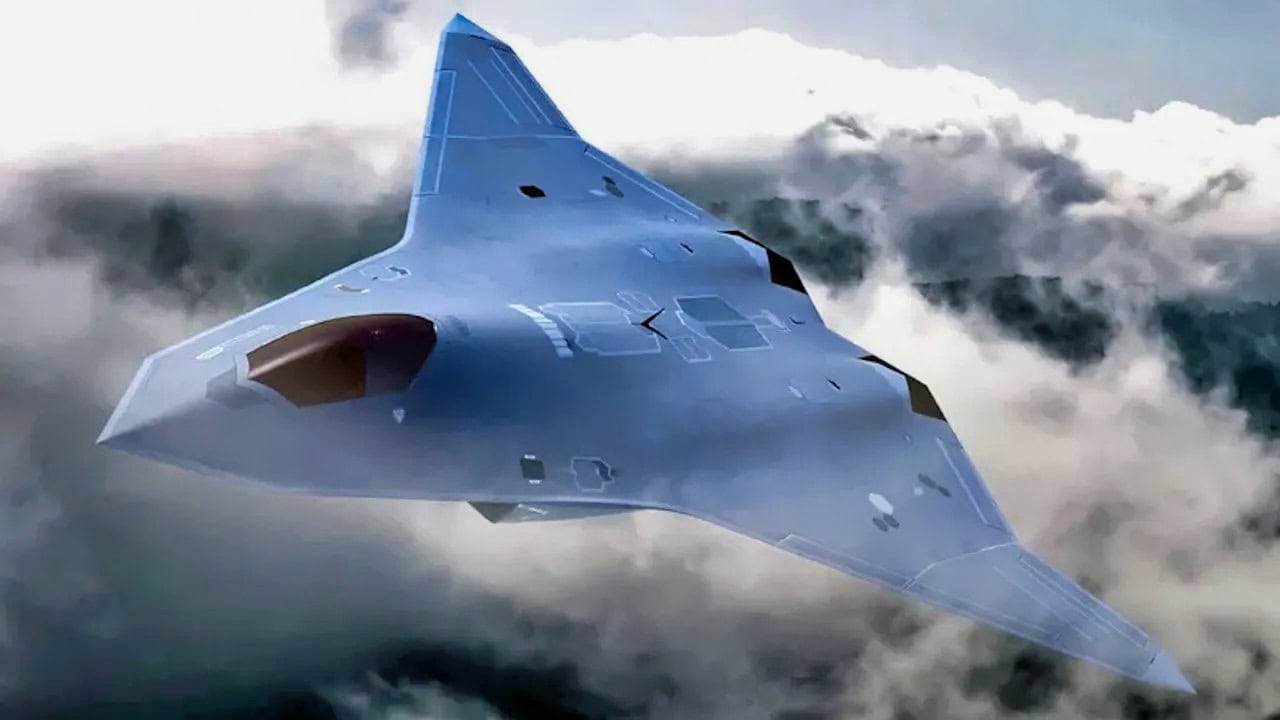
F/A-XX Fighter Mockup. Image Credit: Creative Commons.
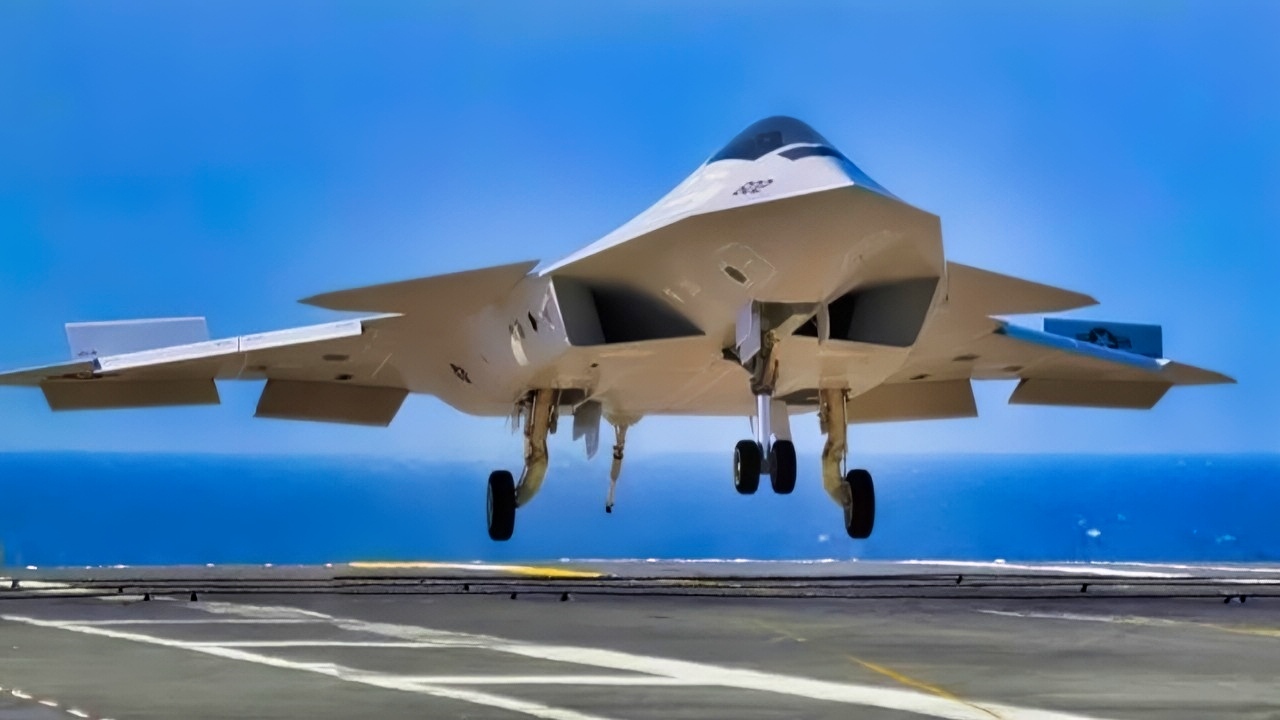
F/A-XX Fighter. Image Credit: Creative Commons.

F/A-XX U.S. Navy Fighter. Image Credit: Creative Commons.

F/A-XX U.S. Navy Fighter. Image Credit: Creative Commons.
The F/A-18 was previously flexed more than 10 years ago, extending itself for thousands of miles beyond its anticipated service life.
This became necessary due to delays with the arrival of the F-35C. As a result, the U.S. Navy not only reinforced the frame and revamped the cockpit and avionics but also conducted a series of experiments with new innovations designed to help ensure the F/A-18 remained competitive in the years ahead.
To a large extent, this has happened, as the F/A-18 has continued to prove extremely worthwhile in recent conflicts. During the 2014 attacks on ISIS, the F/A-18s not only attacked targets from the air but also functioned as targeting “sensors” for other aircraft and ship-based command and control.
The cockpit of the Super Hornet had been reworked with new digital cockpit displays and the aircraft was integrated with a new generation of sensing and targeting called Infra-Red Search and Track.
Most recently, prior to Epic Fury, the F/A-18 proved effective in the Red Sea against Houthi drones and anti-ship cruise missiles.
Not only could the aircraft target and destroy identified ground and surface targets from the air, but the carrier-launched jets proved extremely effective in the realm of “targeting” when it came to “seeing” approaching Houthi cruise missiles from beyond a ship’s radar horizon.
In one instance, the former Commanding Officer of Carrier Strike Group 2 said that an EA-18 Growler aircraft was able to detect, verify, and destroy an attacking Houthi drone from the air, by firing an air-to-air missile.
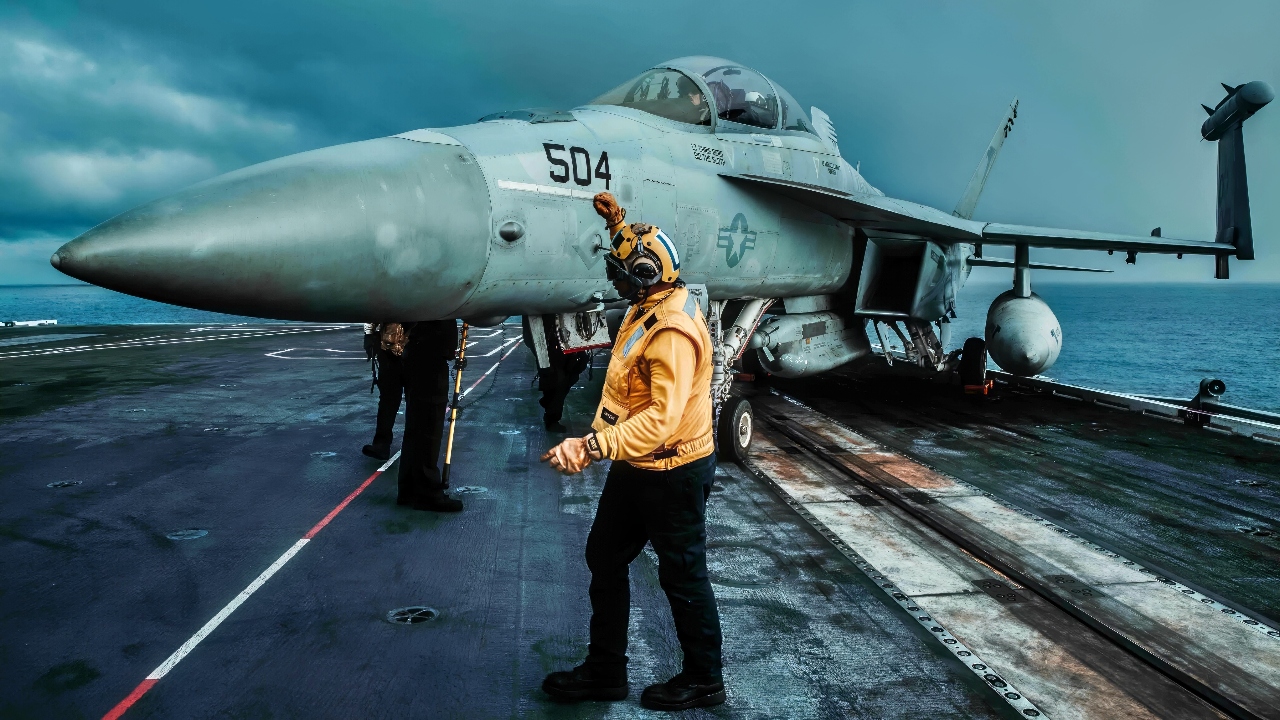
An E/A-18G Growler, attached to Electronic Attack Squadron (VAQ) 141, taxis on the flight deck of Nimitz-class aircraft carrier USS George Washington (CVN 73), while underway in the Indian Ocean, July 24, 2025. The USS George Washington Carrier Strike Group (GWA CSG) is conducting routine operations in the U.S. 7th Fleet area of operations. George Washington is the U.S. Navy’s premier forward-deployed aircraft carrier, a long-standing symbol of the United States’ commitment to maintaining a free and open Indo-Pacific region, while operating alongside allies and partners across the U.S. Navy’s largest numbered fleet. (U.S. Navy photo by Mass Communication Specialist Seaman Nicolas Quezada)
1970s F/A-18
While the original McDonnell Douglas-Northrop airframe dates back to the mid-1970s, today’s F/A-18 is virtually a new aircraft due to the scope of its technological enhancements.
In recent years, the aircraft has been the focus of an extensive Service Life Extension Program (SLEP) designed to upgrade and reinforce the airframes, onboard electronics, and engine performance.
Specifically, Navy and industry engineers modified the center barrel section to reinforce the airframe.
The impact of this SLEP has been quite substantial, as it has extended the F/A-18’s flight hours from 6,000 all the way up to 10,000 over the course of many years.
Simply put, this has added many years to the relevance, performance, and continued operational functionality of the F/A-18 This has been and continues to be critical for the Navy as the service fast-tracks the arrival of its 6th-generation F/A-XX The SLEP program, which now goes back nearly 10 years, was intended to ensure the Carrier Air Wing remained sufficiently lethal during a gap in time when fleet size was decreased by the retirement of the F-14 Tomcat and delayed arrival of the F-35Cs.
For many years, since 2014 or earlier, the Navy has been requesting additional F/A-18s and regularly placing them on the service’s unfunded priorities list.
All this considered, there is also widespread recognition that there are limits to exactly how much a 1970s and 1980s-era airframe can ultimately be extended and upgraded.
Perhaps most of all, the F/A-18 is not stealthy, meaning its edges, shapes, and external configuration make it extremely difficult to hide from modern air defenses.
Stealthy F/A-18?
Nonetheless, the U.S. Navy has, in recent years, added radar-signature-reducing, curved, conformal fuel tanks and experimented with rounded external weapons pods to add some measure of “stealth-like” attributes to the aircraft.

A U.S. Navy F/A-18F Super Hornet, attached to Air Test and Evaluation Squadron (VX) 9, takes off from Naval Air Station Point Mugu during Gray Flag, Sept. 12, 2025. Gray Flag 2025 is the naval aviation test community’s premier large force test event, providing unique venues for large-scale integration of new capabilities across services and platforms. Working with the Joint Force, industry, and our nation’s allies to ensure seamless integration and interoperability is key to ensuring warfighters have a decisive advantage in the field. (U.S. Navy photo by Mass Communication Specialist 2nd Class August Clawson)
While these initiatives would seem to lower the radar signature or cross-section of the aircraft by smoothing over some of the sharp edges or contours likely to generate a return signal and creating a slightly more horizontal blended wing-body type of structure, Navy developers certainly understood these adaptations would not likely qualify the F/A-18 as sufficiently “stealthy” to evade modern air defenses.
Joint Helmet-Mounted Cueing Systems enable a wider, higher-resolution field of view for pilots. JHMCS is a technology upgrade that engineers a viewing module providing a 20-degree field-of-view visor.
Additional technologies for Super Hornets include Digital Communication System Radio, MIDS – Joint Tactical Radio System, Digital Memory Device, Distributed Targeting System
Years ago, the U.S. Navy also experimented with building smooth, somewhat rounded external weapons pods designed to carry ordnance while lowering the aircraft’s radar signature by reducing the number of sharp protruding edges that are likely to generate a return “ping” or signal to enemy radar.
Magic Carpet
Active Electronically Scanned Array (AESA) on the F/A-18 has also been enhanced, and, perhaps of greatest technological complexity, the F/A-18s have received a specially developed software application called “magic carpet” designed to assist pilots with a smooth landing and successful glide-slope as they bank and align for what can often be challenging carrier landings at sea.
About the Author: Kris Osborn
Kris Osborn is a Military Technology Editor. Osborn is also President of Warrior Maven – Center for Military Modernization. Osborn previously served at the Pentagon as a highly qualified expert in the Office of the Assistant Secretary of the Army—Acquisition, Logistics & Technology. Osborn has also worked as an anchor and on-air military specialist at national TV networks. He has appeared as a guest military expert on Fox News, MSNBC, The Military Channel, and The History Channel. He also has a Masters Degree in Comparative Literature from Columbia University.


