

Key Points and Summary – The U.S. Navy faces a “glaring” aircraft carrier shortage, a “tragedy” of American manufacturing, as it builds less than 1% of the world’s ships while China builds 50%.
-The new Ford-class is severely delayed (only one of ten is complete), while aging Nimitz-class ships are stuck in multi-year RCOH maintenance backlogs, crippling readiness.

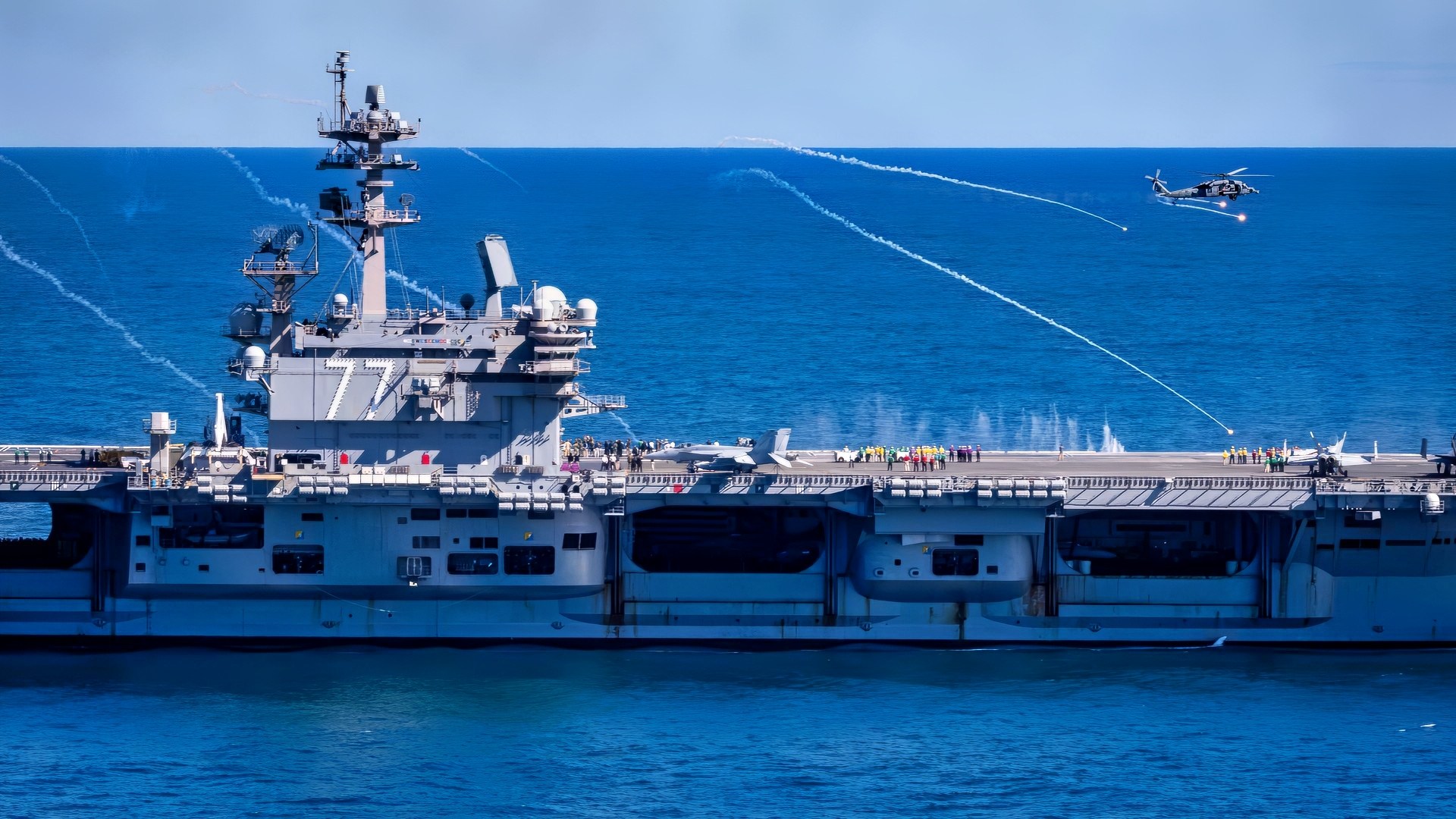
(September 24, 2021). The navy’s only forward deployed aircraft carrier USS Ronald Reagan (CVN 76) transits the South China Sea. Reagan is attached to Commander, Task Force 70/Carrier Strike Group 5 conducting underway operations in support of a free and open Indo-Pacific. (U.S. Navy Photo by Mass Communication Specialist 1st Class Rawad Madanat)
-This crisis is blamed on a fragile industrial base with only four capable shipyards and a severe shortage of skilled labor.
-While President Trump signed an executive order in April 2025 to address this, the article proposes a “BuildCarriers” program, modeled after the “BuildSubmarines.com” campaign, which is already seeking 140,000 new workers.
Aircraft Carrier Shortage: What Should the US Navy Do About It?
The decline of the U.S. shipbuilding industry is one of the great tragedies in the history of American manufacturing.
Recent data shows that the United States constructs less than 1 percent of commercial ships globally, while America’s biggest maritime adversary, the People’s Republic of China, produces approximately half the world’s seagoing vessels.
One specific area of concern is the U.S. Navy’s insufficient number of aircraft carriers. Carriers in active service already are held back by maintenance maladies, thus adversely impacting the Navy’s warfighting readiness. So, what can and should the U.S. Navy be doing to address this glaring need?

201117-N-NH257-1123 NORTH ARABIAN SEA (Nov. 17, 2020) The aircraft carrier USS Nimitz (CVN 68) steams ahead of the guided-missile cruiser USS Princeton (CG 59) while participating in Malabar 2020 in the North Arabian Sea. Malabar 2020 is the latest in a continuing series of exercises that has grown in scope and complexity over the years to address the variety of shared threats to maritime security in the Indo-Asia Pacific where the U.S. Navy has patrolled for more than 70 years promoting regional peace and security. Nimitz Carrier Strike Group is currently deployed to the 7th Fleet area of operations in support of a free and open Indo-Pacific. (U.S. Navy photo by Mass Communication Specialist 3rd Class Elliot Schaudt/Released)
The Why and the Wherefore of the Shortages
The Navy’s Gerald R. Ford-class carriers are the largest and most technologically advanced warships ever built.
The class is intended to replace the Navy’s aging Nimitz-class carriers, which are time-honored and battle-tested, but are also reaching past their prime.
The problem is that out of 10 Fords planned, only one of them—the eponymous lead ship of the class, USS Gerald R. Ford (CVN-78)—has been completed.
CVN-78 took years to complete from the time her construction began (her keel was laid in November 2009; she was christened Nov. 9, 2013) to the time she was finally commissioned (July 27, 2017).
Meanwhile, only two sister ships have been laid down thus far: The USS John F. Kennedy (CVN-79) was laid down on July 20, 2015, and the USS Enterprise (CVN-80) was laid down on Aug. 27, 2022.
Why are these mighty warships taking so long to build—and why are their predecessors having so many issues? The answers come to us from the anonymous author of an October 2025 article for the You Think Official website, appropriately titled “Why the United States Navy is Facing a Carrier Shortage.”
To wit:
-Maintenance delays are caused by high costs, staff shortages, supply chain issues, and lengthy construction and repair times.
–The Navy has only four national shipyards capable of handling carrier repairs.
-Many experienced workers have retired, and new hires lack expertise. The Covid-19 lockdowns disrupted production and maintenance even further, creating multi-year delays that continue to affect readiness.
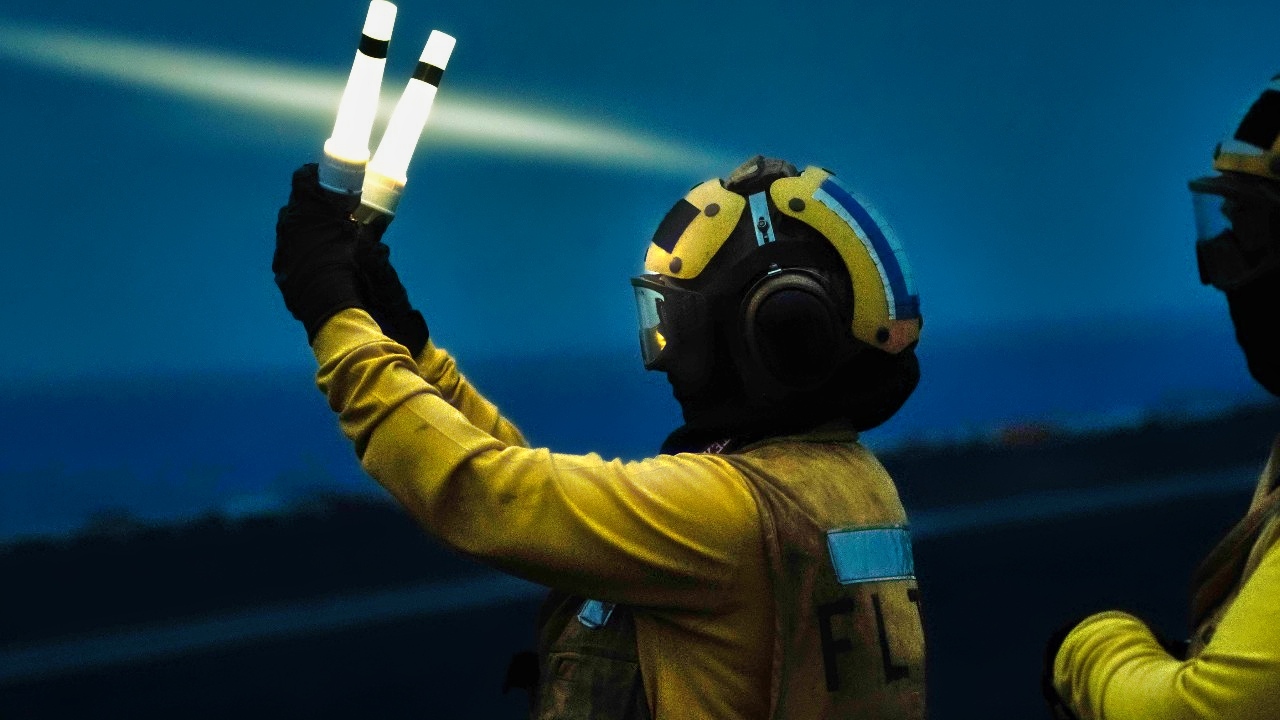
U.S. 5TH FLEET AREA OF OPERATIONS (Aug. 6, 2024) An Aviation Boatswain’s Mate (Handling) signals aircraft on the flight deck of the Nimitz-class aircraft carrier USS Theodore Roosevelt (CVN 71), Aug. 6. Theodore Roosevelt is deployed to the U.S. 5th Fleet area of operations to support maritime security and stability in the U.S. Central Command area of responsibility. (Official U.S. Navy photo)
-Once every 25 years, CVNs require refueling via a complex process called Refueling and Complex Overhaul (RCOH), which involves cutting a massive hole into the hull and replacing everything from catapult systems to water purifiers.
-Delays in the RCOH process have extended repair times for carriers such as the USS George Washington (CVN-73) and USS John C. Stennis (CVN-74), forcing the Navy to reshuffle crews and vessels for operational coverage.
Trump Administration Initiatives
In recognition of the shipbuilding shortcomings, on April 9, 2025, U.S. President Donald Trump signed Executive Order 14269, with the self-explanatory title of “Restoring America’s Maritime Dominance.”
In terms of quantifiable numerical goals, one item that stands out is Section 4, which reads (in part):
“Within 180 days of the date of this order, the Secretary of Defense, in coordination with the Secretary of Commerce, the Secretary of Transportation, and the Secretary of Homeland Security, shall provide to the APNSA and the OMB Director for inclusion in the MAP [Maritime Action Plan] an assessment of options both for the use of available authorities and resources, such as Defense Production Act Title III authorities, and for the use of private capital to the maximum extent possible to invest in and expand the Maritime Industrial Base including, but not limited to, investment and expansion of commercial and defense shipbuilding capabilities, component supply chains, ship repair and marine transportation capabilities, port infrastructure, and the adjacent workforce.”
That is fine in a general sense, but how can the measures specifically be applied to aircraft carriers?
BuildSubmarines.Com : A Model Carriers Can Emulate?
The Navy is currently going full speed ahead on its BuildSubmarines recruiting push, with the intended goal of boosting submarine production to three per year—one Columbia-class and two Virginia-class—by 2028.
As the program’s Mission page declares, “However, this military mandate will require the addition of more than 100,000 skilled workers with the training and commitment to ensure success. . . . And there’s not a moment to spare. . . . No ordinary assembly line exists to piece together these giants. This is a meticulous process, guided by visionaries and craftspeople who design, calibrate, inspect, assemble, and test every inch of these extraordinary vessels.”
Further down the page, a specific need for a 140,000-strong workforce is articulated.
That same sales pitch and exhortation could be just as easily (and urgently) applied to a hypothetical BuildCarriers program.
Presumably, this would require even more than 140,000 skilled workers to make it happen, owing to the sheer size differential between subs and flattops.
For example, a Block V Virginia-class sub will have a hull length of 460 feet and a submerged displacement of 11,200 tons, while the Columbia-class boats will be 560 feet in length and displace 21,140 tons submerged.
By contrast, a Ford-class carrier sports a whopping 1,106-foot-long hull and a fully laden displacement of 100,000 tons.
About the Author: Christian D. Orr, Defense Expert
Christian D. Orr is a Senior Defense Editor. He is a former Air Force Security Forces officer, Federal law enforcement officer, and private military contractor (with assignments worked in Iraq, the United Arab Emirates, Kosovo, Japan, Germany, and the Pentagon). Chris holds a B.A. in International Relations from the University of Southern California (USC) and an M.A. in Intelligence Studies (concentration in Terrorism Studies) from American Military University (AMU). He is also the author of the newly published book “Five Decades of a Fabulous Firearm: Celebrating the 50th Anniversary of the Beretta 92 Pistol Series.”
More Military
Northrop Grumman Is Likely Winner of F/A-XX, But Big Questions Remain
USS United States: The Aircraft Carrier Designed to Launch Bombers
The U.S. Air Force’s B-21 Raider Bomber Nightmare Has Just Begun
How Long Can a Nuclear U.S. Navy Aircraft Carrier Stay in Service?
The Air Force’s B-52 Stratofortress Bomber ‘Nightmare’ Is Real


