

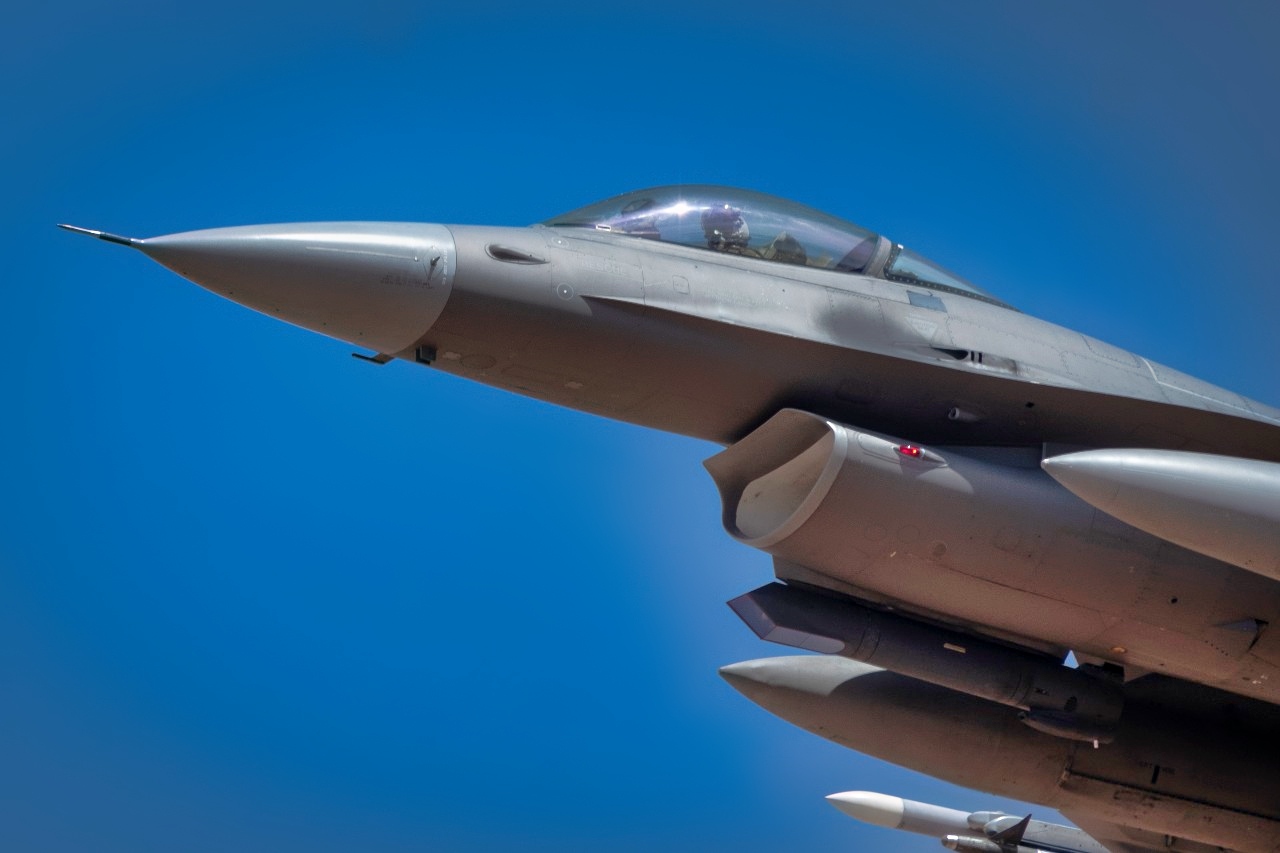
Key Points – The US Air Force is reportedly considering a new, highly advanced “F-16 Block 80” variant, a concept raised by Senator Tom Cotton to USAF Chief General David Allvin on May 20th.
-This proposal suggests integrating the latest technologies from export-only F-16 versions (like the AESA-equipped Block 70/72) along with some F-35 systems into an F-16 airframe for the USAF, which currently operates older Block 50 F-16s.
-Mirroring the F-15EX program’s revival of an export-focused line for US needs, a Block 80 could bolster the strike fighter fleet. However, no concrete configuration exists, and production capacity at the current F-16V facility is limited.
Would The US Air Force Buy a F-16 Block 80
The F-16 has been one of the longest-running airframes in production and the best-selling export aircraft in the history of jet fighter aviation. More than 25 countries fly the F-16 in their air force fleets. There are more than 2,000 variants in operation.
However, the latest and most advanced versions of the aircraft have been export-only models. The F-16E/F Block 60 was developed only for the United Arab Emirates Air Force and was the first model equipped with an Active Electronically Scanning Array (AESA) radar, the AN/APG-80.
The version currently in production, the F-16V Block 70/72, has also been—like the Block 60—financed solely by export customers. It also features an AESA radar, the AN/APG-83. It is manufactured in a separate facility in Greenville, South Carolina—almost as far away from the original F-16 production line in Fort Worth, Texas, as you can get and still be within the Continental US.
Does The US Air Force Need a More Advanced F-16?
The situation is that the United States Air Force (USAF) does not operate these more advanced versions of the single-engine fighter jet. The USAF stopped buying the aircraft with the advanced versions of the Block 50 C/D models, which employ older technology systems, such as the AN/APG-68 (V)9 Mechanically Steered/Scanned Array (MSA) radar set.
This aspect of the aircraft and its other onboard systems make the Block 50s almost obsolete in comparison with the F-15EX, the F-22, and the F-35 models operated by the USAF. The suggestion has been made, therefore, to develop a new variant of the F-16 called the Block 80.
As proposed, the Block 80 version would comprise some of the latest technologies and onboard systems developed for the latest F-16 versions, along with other hardware designed for the F-35, and integrate them into an F-16 airframe.
Inquiries into just such a possibility were raised on May 20 by Senator Tom Cotton, Chairman of the Senate Intelligence Committee.
“Focusing on just the next decade, then, our current acquisition options are pretty limited. Would you be able to use newly built US-configured Block 80 F-16s to strengthen our strike fighter fleet, if Congress can find additional funds for such an effort?” Cotton asked.
Responding to the inquiry, the USAF Chief of Staff General David Allvin replied he needed to investigate what would be involved “to take that export variant and adapt it to a Block 80, and the time it would take, and where that would fall in the production line,” in order “to see if that would be an advisable situation.”
Following the F-15EX Lead
The precedent for this kind of “new wine in old bottles” development would be the F-15EX program. Like the F-16, this aircraft had not been produced for the USAF for two decades and had only been sold to export customers since.
Now that there is a need for a long-range, two-engine fighter to tackle the increasing air power challenge presented by the People’s Republic of China (PRC), the F-15EX fits that requirement more than adequately.
The idea would be to use the F-16V Block 70/72 as the basis for a next-generation Block 80 design of the aircraft—making it to Block 70/72 what the F-15EX is to previous export models, such as the F-15SG for Singapore.
There is, at present, no proposed concrete Block 80 configuration for the F-16, which is one small problem. The other is that the Block 70/72 production line operates in a very small facility that has only been building approximately three aircraft per month. Introducing another new variant into an already crowded build plan could cause additional delays for export customers.
What remains unanswered is why the Senate Committee believes that in the out years, there will still be a need for improved variants of these older aircraft, such as the F-16. Do they think that there will not be enough F-35s and F-47s to do the job, and does the Senate Committee know something we don’t know?
About the Author:
Reuben F. Johnson is a survivor of the February 2022 Russian invasion of Ukraine and is an Expert on Foreign Military Affairs with the Fundacja im. Kazimierza Pułaskiego in Warsaw. He has been a consultant to the Pentagon, several NATO governments and the Australian government in the fields of defense technology and weapon systems design. Over the past 30 years he has resided in and reported from Russia, Ukraine, Poland, Brazil, the People’s Republic of China and Australia.
Fighter Jet Fails


