

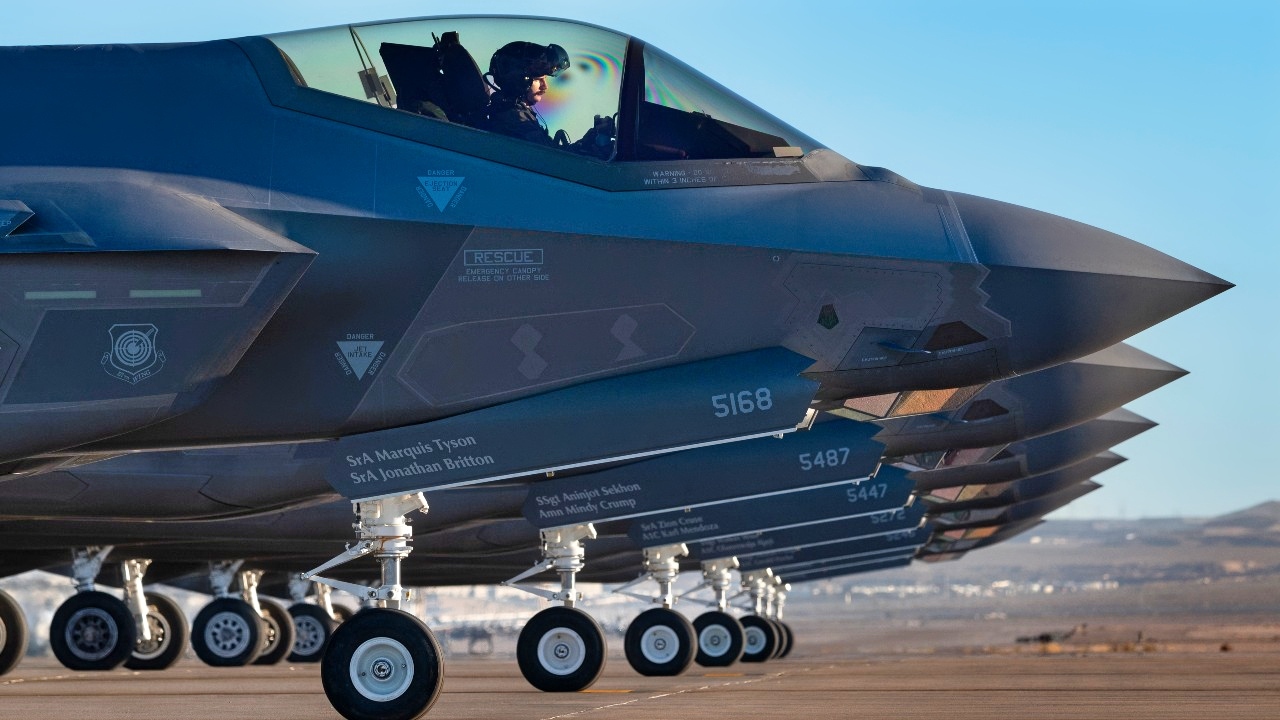
Key Points – President Trump’s May 15th remarks in Qatar proposing new “F-55” (a twin-engine F-35 “super upgrade”) and “F-22 Super” fighter concepts continue to sow confusion.
-While the F-35 is receiving known Block 4 upgrades and the F-22 is undergoing enhancements (like new sensors and weapons integration) to bridge to the F-47 NGAD, developing a twin-engine F-35 derivative is deemed technically impractical and would constitute an entirely new aircraft.
-Trump’s “F-55” designation might be a misnomer for the Navy’s F/A-XX sixth-generation program or an impromptu idea, creating uncertainty about US fighter development priorities.
New F-55 and F-22 Super Fighters Might Never Fly
In comments made this month in Doha, U.S. President Donald Trump suggested the United States is pursuing several fighter-jet projects, including some outlandish designs. Seated between Boeing CEO Kelly Ortberg and General Electric CEO Larry Culp, Trump announced a number of new fighter programs that may or may not exist. He described otherworldly craft with seemingly no technical basis in reality.
Trump began his rant with a mention of the F-35, stating, “we’re doing an upgrade, a simple upgrade” of the aircraft. This is likely a reference to Block 4, a scheduled update of the worldwide F-35 fleet that will fix issues with the aircraft and introduce a number of new features, including new weapon systems.
The F-35 Joint Program Office, responsible for the global Lightning II fleet, describes it as “missile-carriage capacity, added advanced non-kinetic electronic warfare capabilities and improved target recognition”. This is a well-known development and has been scheduled for a decade or more.
Trump’s second statement is that an “F-55” fighter is coming in the future. Trump admits that F-55 is his name for it, and he goes on to describe a fighter with two engines – because he believes a single-engine aircraft is not safe.
Is there any truth to this? During the Cold War, when jet engines were relatively new and aircraft accident rates were much higher, many air forces preferred two-engine aircraft. Canada, a country whose territory is nearly 40 percent uninhabited arctic and tundra, preferred twin-engine jets capable of limping home if one engine malfunctioned. The U.S. Navy preferred twin-engine jets to give pilots a chance of returning to an aircraft carrier if there were no friendly air bases within range.
High-performance engines are much more reliable these days, and as a result, these same air forces have embraced cheaper-to-fly single-engine jets. The Pentagon replaced several twin-engine aircraft with the single engine F-35, including the F/A-18C and F/A-18D Hornet fighters, as well as the A-10 Thunderbolt II. The F-35’s track record shows it is one of the safest fighters in the world: With the worldwide fleet recently hitting a milestone of more than 1 million flight hours, only 14 F-35s have been lost to accidents.
Of that number, only about six were lost due to mechanical failure or some defect with the aircraft. That’s a loss rate of less than one aircraft per 100,000 flight hours. In 1996, by comparison, the Navy’s F-14 Tomcat fleet had a loss rate of 7.61 aircraft per 100,000 hours.
F-55: Could It Happen?
Could there be a twin-engine version of the F-35 under development?
Making a twin-engine version of a single-engine aircraft is not a great design choice. For one, simply adding a second engine without bulking up the aircraft to accommodate additional fuel will result in a faster, but shorter-range aircraft, at a time when the U.S. military needs longer-range fighters. The concept is so impractical that no two-engine fighter derived from a single-engine fighter has ever been fielded.
Further, the second engine would interrupt the fighter jet’s stealthy profile, necessitating a redesign to keep it hidden from enemy radar. While it sounds easy to add a second engine, in the end it’s easier to just develop a new fighter.
So what is this new fighter? The most likely explanation is that the “F-55” is Trump’s name for F/A-XX, the program to develop the U.S. Navy’s sixth-generation fighter. The F/A-XX, also known as Naval Next Generation Air Dominance, will eventually replace early-model F/A-18E/F strike fighters starting in the 2030s. The aircraft was reportedly due to be announced earlier this year but has not yet been revealed.
The F/A-XX will almost certainly incorporate a great deal of technology already in the F-35 and may indeed feature a second engine. While it may take some inspiration from the F-35, it would be a totally different aircraft.
F-22 Super: Just a Trump Word Salad?
As for the F-22 Super, the Air Force has a number of modest improvements scheduled for the F-22 Raptor that intend to keep it competitive until the F-47 is operational. These include a new infrared search and track pod; a sensor that will allow the F-22 to detect and track threats without using its radar; an advanced threat warning receiver; new open architecture electronics; and new weapons, likely including the secretive AIM-260 JATM long-range air-to-air missile.
That said, the F-22 production line was permanently closed in the 2010s, and no new aircraft are forthcoming. Restarting F-22 production would take away resources from the F-47 program, and it would not make sense to expend all that effort for a fifth-generation fighter if it comes at the expense of a newer fighter.
What did the president of the United States mean? Is any of it rooted in fact? It’s rare that a President can utter 258 continuous words and leave people even more confused than when he first started speaking, but this is America in 2025. Maybe there is an aircraft like the “F-55.” Maybe there isn’t. Is this strategic ambiguity to confuse our enemies? Maybe it is, and maybe it isn’t.
About the Author: Kyle Mizokami
Kyle Mizokami is a defense and national-security writer based in San Francisco. His work has appeared in Popular Mechanics, Esquire, The National Interest, Car and Driver, Men’s Health, and many others. He is the founder and editor for the blogs Japan Security Watch, Asia Security Watch and War Is Boring.
Meet the Best Tanks on Earth



Pingback: Relax: Trump Won't Be 'Banned' from the Big G7 Summit in Canada - National Security Journal
Pingback: Trump Is No Fool: The F-22 Super and F-55 Fighters 'Could' Fly - National Security Journal
Pingback: The US Air Force Could 'Merge' the F-16 and F-35 Fighters - National Security Journal