


Iran is running out of good options, and its military is in rough shape. So it is sending its proxies into the fight.
Over the past two weeks, Tehran and its Houthi allies in Yemen have unleashed a series of attacks on tankers in the Strait of Hormuz and on Saudi airports, including King Khalid International in Riyadh.

An F/A-18F Super Hornet, attached to Strike Fighter Squadron (VFA) 195, taxis on the flight deck of Nimitz-class aircraft carrier USS George Washington (CVN 73) while underway in the Celebes Sea, Nov. 29, 2025. George Washington is the U.S. Navy’s premier forward-deployed aircraft carrier, a long-standing symbol of the United States’ commitment to maintaining a free and open Indo-Pacific region, while operating alongside allies and partners across the U.S. Navy’s largest numbered fleet. (U.S. Navy photo by Mass Communication Specialist 2nd Class Tyler Crowley)

Aircraft Carrier USS Nimitz Coming Home. Image Credit: Creative Commons.
The Wall Street Journal has been tracking these developments, reporting that Iran and its allies have been hunting for ways to slow Saudi oil exports and raise the pain on the United States and the world economy.
The latest salvos fit that playbook.
This also looks like a deliberate attempt to regain initiative that Tehran has lost over the past weeks.
The Attack Numbers In The Strait Are Climbing
Between September 28 and October 5, the U.K. Maritime Trade Operations agency counted at least 12 attacks on oil, LNG, and LPG tankers around the Strait of Hormuz.
That is the highest weekly total since the U.S. began its war with Iran on February 28.
One of the victims, the Panama-flagged tanker On Peace, was struck by an unknown projectile that injured 12 crew members, according to India’s foreign ministry.
The WSJ reported that an oil and chemical tanker near Qatar was struck by several missiles late Wednesday, causing an unreported number of casualties, according to maritime intelligence firm Vanguard.
The timing is no coincidence. Gulf producers had topped pre-war export levels for roughly half of September, and the Iranians noticed.
The U.S. Navy-led Joint Maritime Information Center said the IRGC’s drone overflights, VHF hailing, and outright strikes show Tehran wants to keep pressure on every ship moving through those lanes.
Meanwhile, Iran’s economy is in freefall. A U.S. naval blockade has halted its oil exports out of the Persian Gulf, and on Thursday the Treasury Department sanctioned 17 more tankers, which it says make up what’s left of Iran’s shadow fleet.
Iranian Parliament Speaker and chief negotiator Mohammad Bagher Qalibaf warned that if Iran is blocked from selling its oil, no other country in the region will be able to export oil either.
Riyadh’s Airport Is Now A Target Of Choice
Then there is the air campaign out of Yemen.
The Iranian proxy Houthis have gone after King Khalid International repeatedly this fall.
On September 19, a missile attack set a jet-fuel depot on fire at the airport, the first direct hit on Riyadh in months.
On October 5, the Houthis claimed strikes on the airport and Aramco’s Rabigh refinery using drones, ballistic missiles, and cruise missiles.
This week, the Houthi attacks got bloodier.
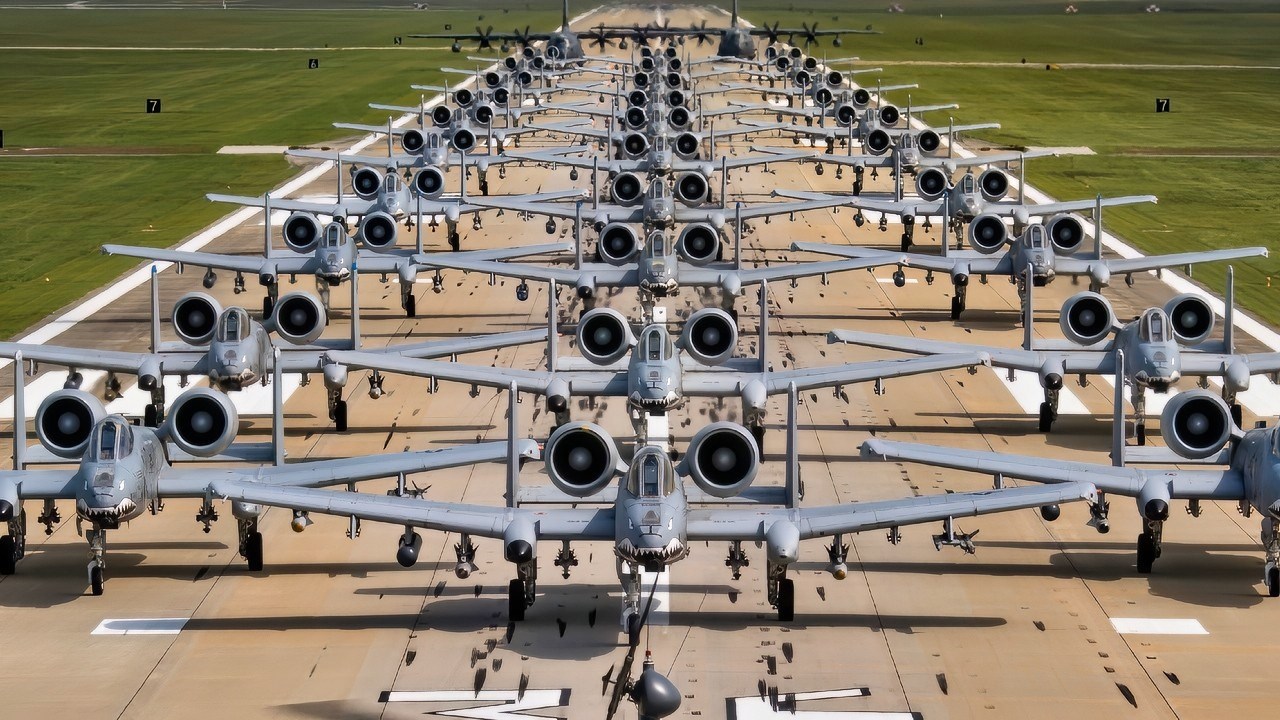
A-10 Warthog Elephant Walk. Image Credit: Creative Commons.
Saudi civil aviation authorities said attacks on the Abha and King Khalid airports on October 6 and 7 killed three people and wounded 36.
In the attack on Thursday, three more people, including a Saudia airline captain, were killed in two attacks targeting the Riyadh airport and a Saudia aircraft.
The Houthis also claimed strikes on Najran’s airport and the Royal Saudi Air Force’s King Khalid Air Base.
The Saudi’s are building drone defenses.
Aramco put up cage-like fences around fuel tanks and equipment near the Riyadh airport this week.
That’s a quick-and-dirty fix against drones.
It also admits the threat isn’t going away.
Houthi Offensive Aimed At Blocking The Mouth Of The Red Sea
In early September, Houthi forces swept into Mokha and took Perim Island in the Bab al-Mandeb, the narrow southern mouth of the Red Sea.
That move put teeth behind the blockade on Saudi shipping the Houthis declared back in July, when they hit the tankers Encelia and Layla off Jizan.
Some Saudi tankers have since rerouted around southern Africa, adding at least 25 days to the voyage.
However, the momentum has shifted.
Yemen’s government announced a major counteroffensive on October 4.
The Yemeni military said it carried out more than 1,000 strikes while the Saudi-led coalition put 100 warplanes in the air at dawn.
Government forces say they have retaken Mokha and are pushing around the strait.
Saudi Arabia, Turkey, and Pakistan also activated a collective-defense arrangement to rush forces into the kingdom.
That development will bear close watching in the coming days.
The Houthis are losing ground they spent a month taking. Firing missiles at Riyadh is how they reacted to their loss of territory.
The Institute for the Study of War summed up the logic: the Houthis, like their Iranian masters, believe that hitting civilian targets like airports and oil facilities will drive Saudi costs high enough to force Riyadh to give in.
The Trade-Off For Riyadh
Say what you will about Saudi Arabia’s long, messy war in Yemen.
That’s beside the point now.
Riyadh is choosing between grinding out a ground campaign while its capital takes hits, or cutting a deal that leaves the Houthis sitting on the Bab al-Mandeb.
In any conventional or irregular war, the side holding the initiative dictates the tempo.
The Houthis understand that.
Cheap drones and ballistic missiles are an economy-of-force tool.
They don’t need to win the ground fight to make the Saudis bleed money.
Every tanker that turns around and every canceled flight goes on their scorecard.
However, there’s a ceiling.
Every strike on Riyadh hardens Saudi resolve and pulls Turkish and Pakistani forces closer to the fight.
Killing an airline captain and foreign workers doesn’t win anybody over in Ankara or Islamabad.
The Turkish government will not send any troops to fight in Yemen; however, the Turks are assessing how they can help Saudi Arabia defend against attacks by the Houthis under a joint defense pact with Pakistan, Foreign Minister Hakan Fidan said on Thursday.
What Comes Next? More Of The Same
Expect more of the same. Iran can’t break the American blockade by force, so it will keep hammering tankers in Hormuz while the Houthis keep Saudi air defenses busy.
The question is whether the Saudi-backed Yemeni forces push down Yemen’s west coast to reach Perim Island before Gulf export numbers start sliding again.
Tehran wants the initiative back.
By launching missiles and drones, they’re trying to increase the price of oil to affect the upcoming US midterm election and force Washington to negotiate on their terms.
About the Author: Steve Balestrieri
Steve Balestrieri is a National Security Columnist. He served as a US Army Special Forces NCO and Warrant Officer. In addition to writing on defense, he covers the NFL for PatsFans.com and is a member of the Pro Football Writers of America (PFWA). His work was regularly featured in many military publications.


