

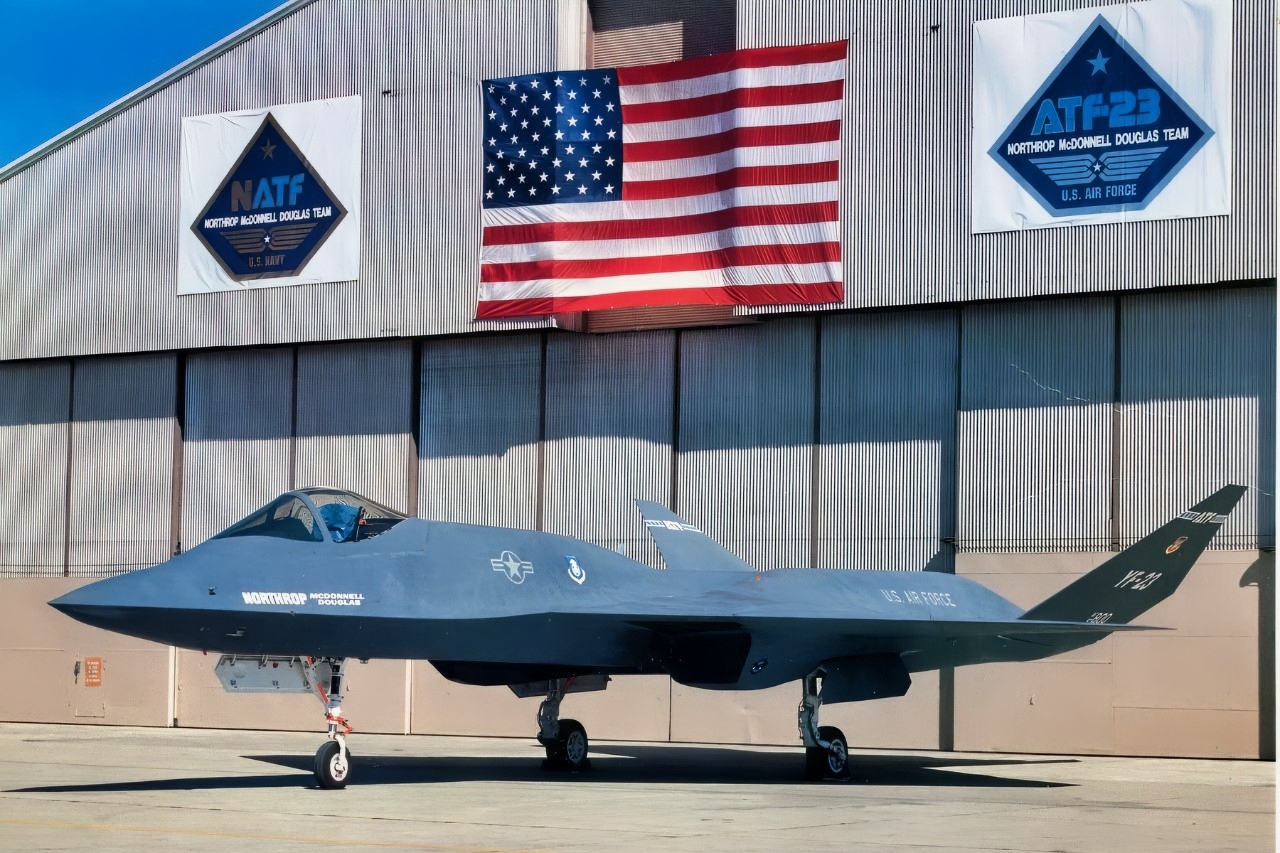
Key Points and Summary – Even if the faster, stealthier YF-23 Black Widow II had won the competition against the F-22, it still would have been a failure. The “Black Widow” was the superior aircraft, better suited for modern warfare.
-However, it still would have fallen victim to the same broken system of “budgetary myopia” and “bureaucratic cowardice” that crippled the F-22 program, resulting in a tiny, unsustainable fleet.

YF-23 National Security Journal Photo. Taken by Harry J. Kazianis at U.S. Air Force Museum on 7/19/2025.
-The real failure wasn’t choosing the wrong jet; it was that the American political and military establishment no longer had the discipline to support the right one.
The Real YF-23 Black Widow II Stealth Fighter Failure
They called it the Black Widow, but we never let it bite. Northrop’s YF-23 was faster, stealthier, and in many ways more survivable than Lockheed’s eventual winner, the F-22 Raptor. Yet it lost the Advanced Tactical Fighter (ATF) competition—and then disappeared into the graveyard of world’s that might have been.
But the real counterfactual isn’t just how the YF-23 might have performed in combat—it’s whether the program would have survived the political gauntlet that ultimately gutted the F-22. Would it, too, have been slashed back, left half-built, and quietly strangled by the same short-term thinking and shifting political tides? The uncomfortable answer is that even the superior aircraft might have shared the same destiny, because the deeper failure wasn’t technological. It was political, bureaucratic, and ultimately strategic.
Let’s dispense with the standard nostalgia. Yes, the YF-23 was a marvel. It pushed the design envelope, prioritizing speed and low observability over raw maneuverability. Its diamond-shaped wings, canted tailfins, and flush-mounted engine intakes weren’t just aesthetic innovations—they were aerodynamic and stealth features that gave it the profile of a predator, not a showman. Compared to the Raptor, it sacrificed the airshow theatrics of post-stall maneuvering for better range and a lower radar cross-section.
It was built for first-look, first-kill dominance, not dogfighting acrobatics. And that was the right call, because by the late Cold War, close-in air combat was becoming a liability, not a virtue. In a world of beyond-visual-range missiles and sensor fusion, agility was becoming overrated.
The YF-23’s biggest strength, ironically, might have been its biggest liability in the political arena. It was just too far ahead. Its radical design didn’t inspire the same visceral confidence among senior Pentagon brass and political stakeholders. The Lockheed X-35 was flashier. More familiar. More sellable. And sellability, not survivability, won the day. That should have been a warning sign.
The F-22 Failure Would Have Been the YF-23 Failure
Because even the winner—the F-22—got shortchanged. Conceived as a fleet of 750 aircraft, it barely limped to 187. Why? The usual excuses: cost overruns, the post-Cold War “peace dividend,” and the siren song of counterterrorism.
But the truth is more brutal. America never had a coherent grand strategy for great power competition after the Cold War. It had procurement wish lists, threat inflation, and PowerPoint fantasies—but no discipline, no clarity of purpose, and no stomach to sustain the kinds of investments needed to maintain air dominance for the long haul. That was true for the F-22. And it would’ve been true for the YF-23.

F-22 Raptor National Security Journal Image
Still, it’s not quite fair to say the YF-23 would’ve met exactly the same fate. Its aerodynamic advantages and stealth profile arguably made it more adaptable to the evolving threat environment. Its longer range would have made it more useful in the Indo-Pacific, where tyranny of distance dominates operational planning. Its speed and low observability could have served as a more credible deterrent against China’s rapidly improving air defense networks. The F-22 was optimized for the Fulda Gap. The YF-23, whether by design or accident, looked more like a preview of the Pacific battlespace.

YF-23 National Security Journal Photo. Taken by Harry J. Kazianis at U.S. Air Force Museum on 7/19/2025.
Moreover, had the YF-23 been chosen, Northrop—and by extension the U.S. defense industrial base—would have evolved in a very different way. Instead of consolidating behind Lockheed Martin’s air dominance monopoly, we might have seen a more diverse and competitive landscape.
That would have meant more innovation, more cost discipline, and fewer industrial bottlenecks. The NGAD program—the sixth-generation follow-on—might have looked less like a Lockheed repeat and more like a true national project. The Black Widow would have spread its wings across the American arsenal, influencing not just fighter design but command-and-control philosophy and unmanned teaming from a different starting point.
But let’s not delude ourselves. The deeper structural problems that killed the F-22 in its prime—the strategic drift, the budgetary myopia, the bureaucratic cowardice—would have stalked the YF-23 too. After all, this wasn’t just a failure of procurement.

F-22 Raptor at USAF Museum. Image Credit: National Security Journal.
It was a failure of imagination. In the 1990s and 2000s, the U.S. political class could not imagine peer conflict returning. It couldn’t grasp that air superiority is not a birthright, that high-end war doesn’t wait politely for the next program review.
Would the YF-23 have performed better than the F-22? Almost certainly—in range, stealth, and strategic relevance. Would the YF-23 program have survived better than the F-22 program? Almost certainly not. In the absence of political will, even the best weapons are left to rot in the hangar.
And here we are again. NGAD is moving forward, but with a budget forecast already under siege, a political class again distracted by populist theater and fiscal brinksmanship, and a procurement culture still mired in risk aversion and opacity.
History doesn’t repeat. It doesn’t even rhyme, as Twain probably never actually said. But it does return again and again to familiar themes. And the United States seems ready to replay the YF-23 tragedy in a new key.

YF-23 Black Widow II from National Security Journal Photo Shoot.
The System Fails, Not the Fighter Jets
The real failure wasn’t picking the wrong jet—it was building a system that couldn’t sustain the right one even if it had.
The truth is brutal: the United States no longer possesses a defense apparatus capable of producing and maintaining a fighter fleet that is both large enough and lethal enough to deter great power war or win it if deterrence fails. The Black Widow didn’t lose because it wasn’t good enough.
It lost because the political class, the bureaucracy, and the defense-industrial complex no longer have the stomach or the discipline to back serious airpower with serious follow-through. Procurement is treated as a jobs program.

YF-118G Bird of Prey and F-22 Raptor. Image Taken at U.S. Ai Force Museum on 7/20/2025.
Strategy is performed as theater. And the entire system—Pentagon, Congress, and contractors alike—has grown comfortable with fielding too little, too late, for too much.
This is the core rot. America still knows how to design cutting-edge fighters. It can still run competitions, stage rollouts, and crank out promotional videos. But it can no longer turn promise into mass. It cannot field squadrons in time. It cannot build at scale.
And it cannot—will not—marshal the clarity of purpose required to do what airpower actually demands: sustained investment, ruthless prioritization, and a willingness to break the bureaucratic rice bowls that feed on failure.

YF-23 Back. Image Credit: National Security Journal.
The YF-23 was never just a lost aircraft. It was an early warning—a signal that the arsenal of democracy had become the showroom of delay. And we ignored it.
About the Author: Dr. Andrew Latham
Andrew Latham is a non-resident fellow at Defense Priorities and a professor of international relations and political theory at Macalester College in Saint Paul, MN. You can follow him on X: @aakatham. He writes a daily column for National Security Journal.
Editor’s Note: All photos (besides the ‘hero’ image) and video in this article were taken on a July 19-20, 2025, National Security Journal visit to the U.S. Air Force Museum in Dayton, Ohio. We asked, and were denied, a request to take closer photos of this fighter due to “budget” and “low staffing” issues.
More Military
‘Captain, We Have Been Hit’: A Tiny Nuclear Submarine ‘Sank’ $4.5 Billion Navy Aircraft Carrier
America’s F-35 Stealth Fighter Simply Summed Up In Just 1 Word
China’s New J-35 Stealth Fighter Simply Summed Up In Just 1 Word
The U.S. Navy Is Now ‘Cannibalizing’ Its Own Fighter Jets and Submarines
Operation Black Buck: How Avro Vulcan Bombers Broke Range Records in the Falklands War


Tindmish
July 31, 2025 at 8:42 am
YF-23 just couldn’t shake off the thought that comes very quickly to mind, when you look at it, the aircraft looked a lot like a flying giant tadpole.
On the other hand, the YF-22 looked a lot more sensible and seemed quite awesome, a sort of flying mako shark.
Anyway, the YF-23’s cockpit instrumentation and front landing gear were taken directly from existing F-15 stocks, and the effort at trying to save an extra penny didn’t benefit Northrop and brothers.
SAM BULL
August 1, 2025 at 10:36 am
110%. And this is why America should get OUT of the Bullying business. Pundits have been pointing out this flaw of our MIC for years. It is especially evident in our proxy war with Russia. Their weapons are crude but, just as effective and 1 10th the cost. China is the same way. And in a war, numbers matter most. America needs to come to the realization it is better to cooperate with the world instead of sanctioning it. Don’t hold your breath! We are the most corrupt country that ever existed.
Cameron Mael
August 1, 2025 at 12:49 pm
It’s hard to tell if you’re an actual supporter or not. I’m not sure that matters as new weapons of war that are presently being brought into use, such as lasers, drones, and technology that will likely make no aircraft…or ship…safe from being easily destroyed. It could be that manned naval and air weapons may soon be too unsafe for “any” country. I realize we still have to proceed with presently developments…but i truly believe it won’t be safe for any “manned” naval or air warfare. With Robots, AI, Lasers, and the anti ship and aircraft missiles improving at scary speeds…war is soon to be much different. It could be that soon everyone will have enough “deterrent” to make war very unwise for any of the main superpowers. That leaves the smaller terrorist mentality nation for everyone to fear. In a perfect world it sure would be nice to see the USA, China, and Russia to all be on the same side before these rogue nations get the better of the rest of us.
Cameron
August 1, 2025 at 1:33 pm
Clint Eastwood can steal the plane
Joe Kaufmann
August 3, 2025 at 5:42 am
The biggest truth that is never brought up is that they’re all failures just like that Orange cowardice clown they call president. The US is an impotent, failed state that only attacks and starve civilians.
Richard Kendsll
August 3, 2025 at 1:33 pm
The Air Force has a long history of putting the career goals , and post military careers of officers above the mission. Also above the lives of personnel.
Pingback: The Designer of the YF-23 Black Widow II Has a Radical New Plan for the F-35 - National Security Journal