


What Can End the Strait of Hormuz Crisis? With the ceasefire between the United States and Iran now over, the world is plunged back into a high level of uncertainty. What will happen next? The military attacks against Iran are liable to continue indefinitely. Look for more U.S. strikes against Iran that would last for the next 48 to 72 hours. What does this mean for the Strait of Hormuz?
Iran is likely to shut it down again. More sea mines are available for deployment. Iran’s mosquito fleet of swift boats can swarm international commercial shipping. Drones and missiles can be fired at tankers and cargo ships. Shipping in the strait will grind to a halt.
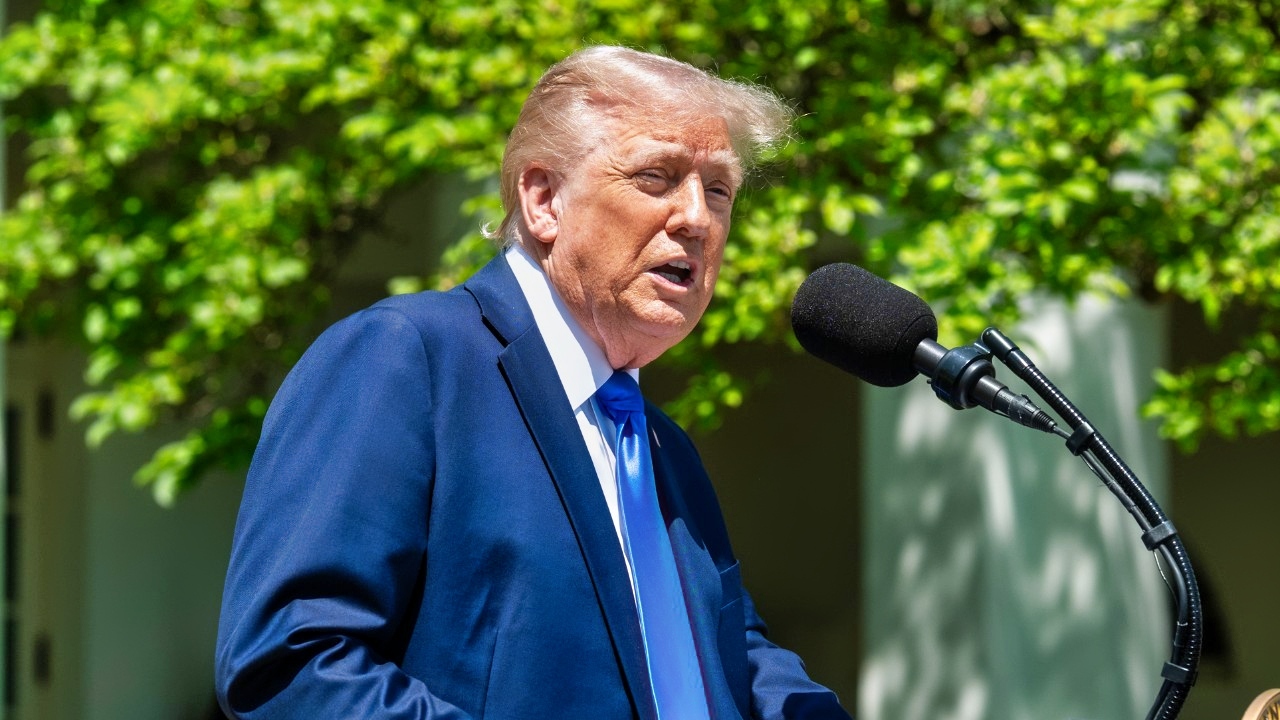
President Donald Trump delivers remarks at a National Day of Prayer event, Thursday, May 1, 2025, in the White House Rose Garden. (Official White House Photo by Joyce N. Boghosian)
This crisis has driven oil prices higher. West Texas Intermediate crude is $73.86 a barrel, up nearly 4 percent as of 1:30 pm ET on July 8.
Trump Is Frustrated with NATO
President Donald Trump visited the NATO summit in Turkey this week and has likely heard an earful from allies suffering from higher gasoline prices. The president has not been happy with NATO partners who he believes have not supported the war against Iran sufficiently.
Can the United States Win the War Alone?
But the United States is used to having a “go it alone” mentality. Trump has not listened to warnings from NATO members who believe the war against Iran has been a questionable endeavor they want no part of.
Slapping a Toll on Shipping
Now, global commerce is likely to suffer from the new closure of the strait through which 20 percent of the world’s hydrocarbons transit. Given this importance, Iran wants to charge a toll for ships crossing the waterway. There is not much the United States or its allies can do to prevent Tehran from requiring ships to pay a fee to transit the strait.

Donald Trump In a Meeting. Image Credit: Creative Commons.
Reinstating Sanctions and a Blockade on Iran
The White House has decided to reimpose sanctions on Iran and will likely restart a blockade on Iranian exports. To answer back, Iran’s Islamic Revolutionary Guard Corps ordered attacks to counter U.S. aggression. The ceasefire has ended.
“To me, I think it’s over,” Trump said about the agreement during the NATO summit in Ankara on Wednesday. He later claimed that further strikes were necessary. “We hit them [Iran] very hard last night,” he told reporters, “and we’re going to hit them hard again tonight.”
The Pathway to Peace That Failed
The idea behind the agreed-upon Memorandum of Understanding was to allow for a lengthy ceasefire. At the same time, both sides negotiated thorny issues related to nuclear disarmament and control of the Strait of Hormuz. Iran has been cagey and difficult to predict. Some days, there would be momentum during talks. Other days, both sides would exchange vitriol. Now the state of affairs is perilous.
Iran has continued drone and missile strikes against international shipping by targeting three tankers earlier this week. This prompted Trump to respond with strikes of his own.
Opening the Strait for Good This Time
How long will this state of war continue, and can the Americans force open the strait once more? It will take a concerted U.S. effort of armed diplomacy, with the military option always available.
More Military Muscle Needed
Trump may need to send another aircraft carrier strike group to the region to add more muscle to U.S. Marine Corps and Army personnel there. He can try an amphibious operation and an airborne attack against terrain like the Kharg Island oil processing facility. This would punish Tehran and allow the United States to own the military initiative in the strait, but would be fraught with risk. The island would be difficult to hold and could incur heavy casualties.
Iran doesn’t seem to be intimidated by the U.S. military. Tehran’s strategy for the strait has been to focus on future revenue from tolls as a way to rebuild the country after the American bombing campaign. Iran could perhaps raise as much as $40 billion per year with tolls on international shipping.
The Call for Strategic Patience
The Americans are not accepting this outcome and plan to intervene militarily in the strait to deter Iranian plans to collect tolls. They can also wait the crisis out until Iran has less leverage.
“The best strategy for the United States could be patience, avoiding a return to all-out war and buying time to rally the world to oppose Iran’s claims and invest in assets that weaken Hormuz as a chokepoint. Oil prices have plummeted to near prewar levels, and as commercial stockpiles are replenished, Iran’s leverage will diminish. If Tehran pushes the envelope too far, continually striking commercial vessels and demanding exorbitant fees, it will only accelerate other countries’ efforts to reduce their reliance on the strait by building bypass pipelines, increasing storage capacity and stockpiles, and adopting alternative energy sources,” according to Edward Fishman, whom the Council on Foreign Relations interviewed.
Time Is Not on the Americans’ Side
But how long can the United States continue this open-ended conflict? Iran is adept at playing the waiting game. It is likely to continue shenanigans in the strait until the midterm elections, when Trump’s political party could lose power on Capitol Hill. Iran senses that the American people are tired of the war and do not support the use of boots on the ground.
Thus, strategic patience for the United States may not work. Trump wants the strait to be open for business and the Iranians to permanently give up their nuclear weapons program. It looked like those stipulations had a chance at working a month ago, but now diplomatic hopes have scattered to the winds.
The Murky Path Forward
Look for more U.S. air strikes after the strait is closed again. Trump is not ready for a ground attack, though, as that carries too much political and military risk. Iran can choose to wait for its toll strategy to work and use that as a bargaining chip. It doesn’t appear that shipping traffic will return to its pre-war state in the Strait of Hormuz.
Iran knows it has a chance to cause the United States to lose momentum and leverage in negotiations. The American path forward is unclear and lacks a winning strategic vision. The Trump national security team may find that the Middle East remains a treacherous region that has repeatedly led Americans astray over the last several decades. The Strait of Hormuz crisis is not over, and there is only a murky path forward for U.S. foreign policy.
About the Author: Dr. Brent M. Eastwood
Author of now over 3,500 articles on defense issues, Brent M. Eastwood, PhD, is the author of Don’t Turn Your Back On the World: A Conservative Foreign Policy and Humans, Machines, and Data: Future Trends in Warfare, plus two other books. Brent was the founder and CEO of a tech firm that predicted world events using artificial intelligence. He served as a legislative fellow for US Senator Tim Scott and advised the senator on defense and foreign policy issues. He has taught at American University, George Washington University, and George Mason University. Brent is a former US Army Infantry officer. He can be followed on X @BMEastwood.


