


U.S. leaders have mismanaged their country’s policy toward Iran for decades. The Eisenhower administration’s willingness in 1953 to join the coup against Iran’s elected president, Mohammad Mosaddegh, that British intelligence masterminded set the tone. Washington not only helped restore the autocratic Shah of Iran to power, but the United States also made that ruler its de facto gendarme in the Middle East and excused his many abuses committed against domestic critics. When the Islamic revolution finally ousted the Shah in 1979, bilateral relations with Tehran soured even more. America’s fury at the seizure of the U.S. embassy by Islamic militants and their subsequent holding of those U.S. diplomats hostage completed the poisonous estrangement between the United States and Iran.
Donald Trump and Iran
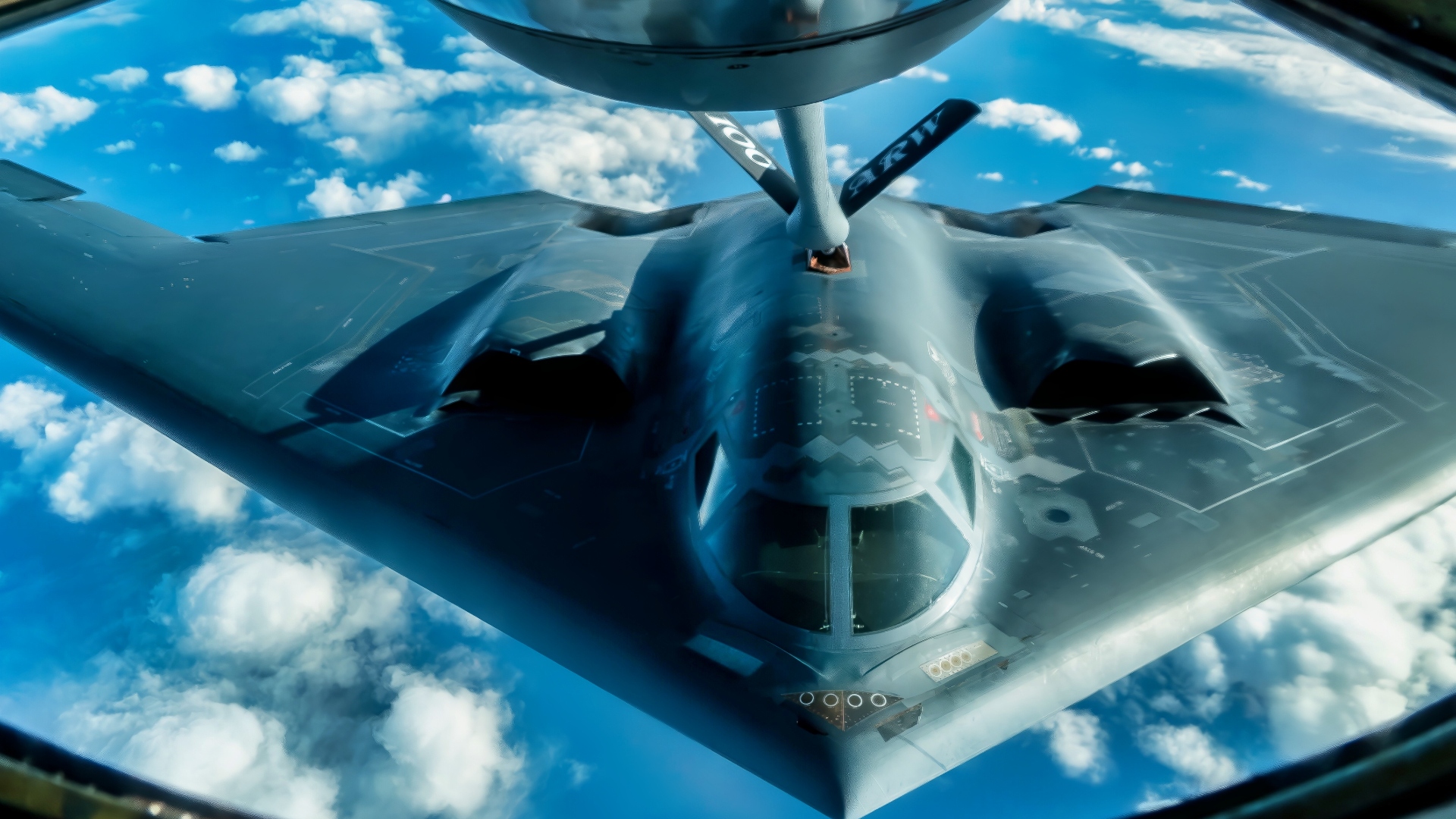
A U.S. Air Force B-2 Spirit assigned to the 509th Bomb Wing from Whiteman Air Force Base, Missouri, receives fuel from a 100th Air Refueling Wing KC-135 Stratotanker during Global Thunder 20, Oct. 28, 2019. Global Thunder is an annual command and control exercise that provides training opportunities for all of U.S. Strategic Command’s mission areas, tests joint and field training operations, and has a specific focus on nuclear readiness. (U.S. Air Force photo by Staff Sgt. Trevor T. McBride)
Donald Trump has made matters even more contentious during both of his periods in the Oval Office. In his first term, the United States repudiated the multilateral agreement that the major powers had reached with Iran to limit its nuclear program and place it under international safeguards.
The track record has been much worse during Trump’s current administration. Indeed, bilateral relations have reached their worst point since the embassy hostage crisis.
U.S. officials have allowed Israel, a U.S. client, to dictate policy toward Iran. In the late spring of 2025, Israel pounded Iranian air defenses with missile strikes, drastically reducing Tehran’s capabilities. Prodded by Tel Aviv, the Trump administration then launched attacks on Iran’s nuclear facilities using B-2 stealth bombers.
The stated motive for the attacks was to neutralize Tehran’s alleged looming ability to build nuclear weapons (a dubious “imminent threat” that Tel Aviv had cited for many years).
Despite Trump’s subsequent boast that the United States had “obliterated” those facilities, the damage turned out to be far more modest. Moreover, Iran now had virtually no incentive to abide by the restraints that it had maintained despite the U.S. withdrawal from the multilateral agreement.
The Conflict
Tel Aviv inflamed tensions further by orchestrating a campaign of assassinations against prominent Iranian political and military figures.
By early 2026, a full-scale war was underway.
It soon became very clear that the conflict would not be a “cakewalk”—the infamously inaccurate prediction that Kenneth Adelman, an official in George W. Bush’s administration, made about the Iraq War.
Iran quickly responded with attacks on Kuwait, Qatar, Bahrain, and Washington’s other political, economic, and military allies in the Persian Gulf region. Those attacks graphically illustrated the rising financial and political costs to those countries of retaining their close ties to the United States.
Tehran also took steps to disrupt maritime traffic, especially oil tanker traffic, through the narrow Strait of Hormuz. Those actions drove up global energy prices dramatically and triggered a worrisome rise in overall global inflation.
Major energy producers, especially Russia, enjoyed a windfall in both government revenues and corporate earnings. Countries, including Russia and China, that cooperated with Iran fared well.
Their ships usually passed through the Strait unimpeded. The ships of other countries found lengthy disruptions, delays, and periodic attacks to be the new normal.
China and Russia: The Big Winners in the Iran War?
Both Beijing and Moscow thus benefited from Washington’s latest clumsy policy toward Iran.
China has been a default strategic, diplomatic, and economic beneficiary of the previous U.S. wars in the Muslim world. PRC leaders likely had to shake their heads in disbelief at their geostrategic good fortune when the United States wasted trillions of dollars, sacrificed thousands of American lives, and made millions of new enemies among Islamic populations by waging its military crusades in Iraq, Afghanistan, Syria, and elsewhere.
With the war against Iran, the Trump administration made the same blunder as its predecessors—and Beijing is poised to be a prominent beneficiary again. All the PRC has had to do is quietly support Tehran’s efforts and impede Washington’s.
Iran and China Get Closer, and Beijing Learns Military Lessons
The PRC’s tilt toward Iran is not nearly as blatant and massive as the U.S. tilt toward Ukraine in that country’s war against Russia, but it is not trivial either. PRC leaders pointedly declined President Trump’s request to join the U.S. campaign to blockade Iran’s ports.
As the blockade began, the head of China’s navy stated that China’s civilian cargo ships would continue to traverse the Strait of Hormuz, irrespective of the U.S. Navy’s presence there.
That approach amounted to a de facto policy of undermining Washington’s blockade and pursuing a mutually beneficial relationship with Iran regarding commerce through the strait.
Even without using Iran as an overt proxy against the United States, Beijing has absorbed some valuable lessons and derived significant benefits from quietly supporting Tehran’s war effort.
That point is especially true in the areas of military hardware and military strategy.
Indeed, the estimated cost of the 358 is one-tenth that of comparable conventional air defense munitions.
The PRC also has worked to shape the international diplomatic environment to benefit Tehran and disadvantage Washington. Indeed, Beijing is positioning itself as the responsible voice for restraint and peace.
That benign reputation is seen globally in sharp contrast to Washington’s growing image as a disruptive, coercive, destabilizing power.
Moscow Takes Notice
Moscow has been noticeably less subtle than Beijing in its approach.
As the world’s second-largest producer of oil and natural gas, Russia was already positioned to benefit from higher prices resulting from Washington’s latest armed intervention in the Middle East.
However, with the onset of the war in Iran, Russia also had an ideal opportunity to retaliate against the United States (and its NATO allies) for supporting Ukraine’s military efforts.
Russian leaders did not show any hesitation to torment Washington. Russia immediately deepened its food and other economic ties with Iran, providing a potential lifeline for that country if the conflict turned against Tehran.
Evidence emerged in early March 2026 that Moscow was even assisting Iran militarily by providing crucial intelligence data on U.S. troop movements and other maneuvers.
That assistance apparently included giving Iranian units targeting data on U.S. bases in the Middle East. In early May, the Economist reported that Russia was also providing highly sophisticated military drones to Iran.
Can Trump Find a Way Out?
By June 2026, the Trump administration was apparently seeking an exit from its Iran policy, and the contending parties negotiated a ceasefire.
That agreement remains extremely tenuous, but most of the combat has stopped. Of course, back-and-forth strikes seem to come and go, but full-scale conflict seems to be on hold. The results, though, are yet another example of Washington’s mishandling of relations with Iran. Critics have correctly noted that, in all likelihood, the administration could have secured an agreement with Tehran on more favorable terms for U.S. interests before the fighting began. To have waged a war that produced the current outcome is a major policy failure.
Consider those results:
-Higher energy prices for American consumers.
-A spike in overall inflation for the U.S. economy.
-A worrisome drawdown of the inventories of key U.S. armaments.
-Iran now has even fewer incentives and is facing fewer international provisions to refrain from joining North Korea in the global nuclear weapons club.
-Increasingly nervous, wary Gulf Arab allies who now understand the limits of U.S. protection.
-An increase in Israel’s arrogance and unwillingness to abide by implicit or even explicit U.S. calls for policy restraint.
-Both Russia and China, Washington’s principal great power rivals, are emerging from the latest -U.S. confrontation with Iran stronger economically, diplomatically, and strategically.
Even with an abundance of lipstick, it is hard to make that Trump policy pig look attractive.
About the Author: Ted Galen Carpenter
Ted Galen Carpenter is a senior fellow at the Randolph Bourne Institute and a contributing editor at The National Security Journal and The American Conservative. He is the author of 13 books and more than 1,500 articles on national security, international affairs, and civil liberties. His latest book is Unreliable Watchdog: The News Media and U.S. Foreign Policy (2022).


Earnest Wayne Scott
July 8, 2026 at 12:31 pm
This author is delusional.
high-end faight
July 8, 2026 at 5:11 pm
Trump’s dirty evil war on Iran (precipitated by seductive voices of netanyshu & AIPAC) is a huge massive disaster for the global economy and for mankind.
But the Iran war, described by tucker carlson as absolutely EVIL AND DISGUSTING, is a most vital warning, or a brief yet very appropriate foretaste of what’s comin’ for China in the next few years.
To fight off such an evil, terrible and disgustin’ threat which is looming right ahead on the horizon, china, today, now, must develop space-based nuke delivery systems and earth-based FOBS systems.
Otherwise, today’s evil Iran war could be just an ordinary American excursion, or American weekend picnic by comparison.
Chinw needs to get rid of xi jinping, now !!!