


Key Points and Summary – After Russian MiG-31s violated Estonian airspace for 12 minutes, NATO scrambled Italian F-35s and Tallinn invoked Article 4.
-Czech President Petr Pavel argued the Alliance must respond decisively—including, if necessary, shooting down trespassing Russian jets—to deter further probing. Kyiv’s Volodymyr Zelenskyy called the incursions part of a broader campaign against Europe.

MiG-31 Flying High Russian Air Force. Image Credit: Creative Commons.
-Recent intercepts also tracked a Russian Il-20 over the Baltic flying without standard procedures (but in international airspace).
-Drawing on Turkey’s 2015 shootdown of a Russian Su-24, the piece notes Moscow ultimately avoided major escalation—suggesting the Kremlin tests boundaries but seeks to stop short of war—while NATO weighs firmer countermeasures.
Czech President: We Should Shoot Down Trespassing Russian Jets
WARSAW, POLAND – Russia has followed up on a 9-10 September nighttime incursion into Polish airspace by as many as two dozen drones with committing airspace violations in recent days. On 19 September, Estonia’s border was violated by three Mikoyan MiG-31 fighter interceptor aircraft.
Making it clear that this incident was not accidental, the three Russian aircraft did not cross inside Estonian airspace for just a brief moment, but instead loitered inside the Baltic country’s territory for 12 minutes.
According to the Estonian military it was the fourth such violation by Russian aircraft this year.
“The Russians have been flying this exact airspace for decades. It’s difficult to see how this wasn’t intentional,” a US official was quoted as saying to POLITICO.eu.
Colonel Ants Kiviselg, commander of Estonia’s Military Intelligence Center, told the Associated Press there was no question that the Russian pilots were aware they were inside of the airspace of a NATO alliance member.
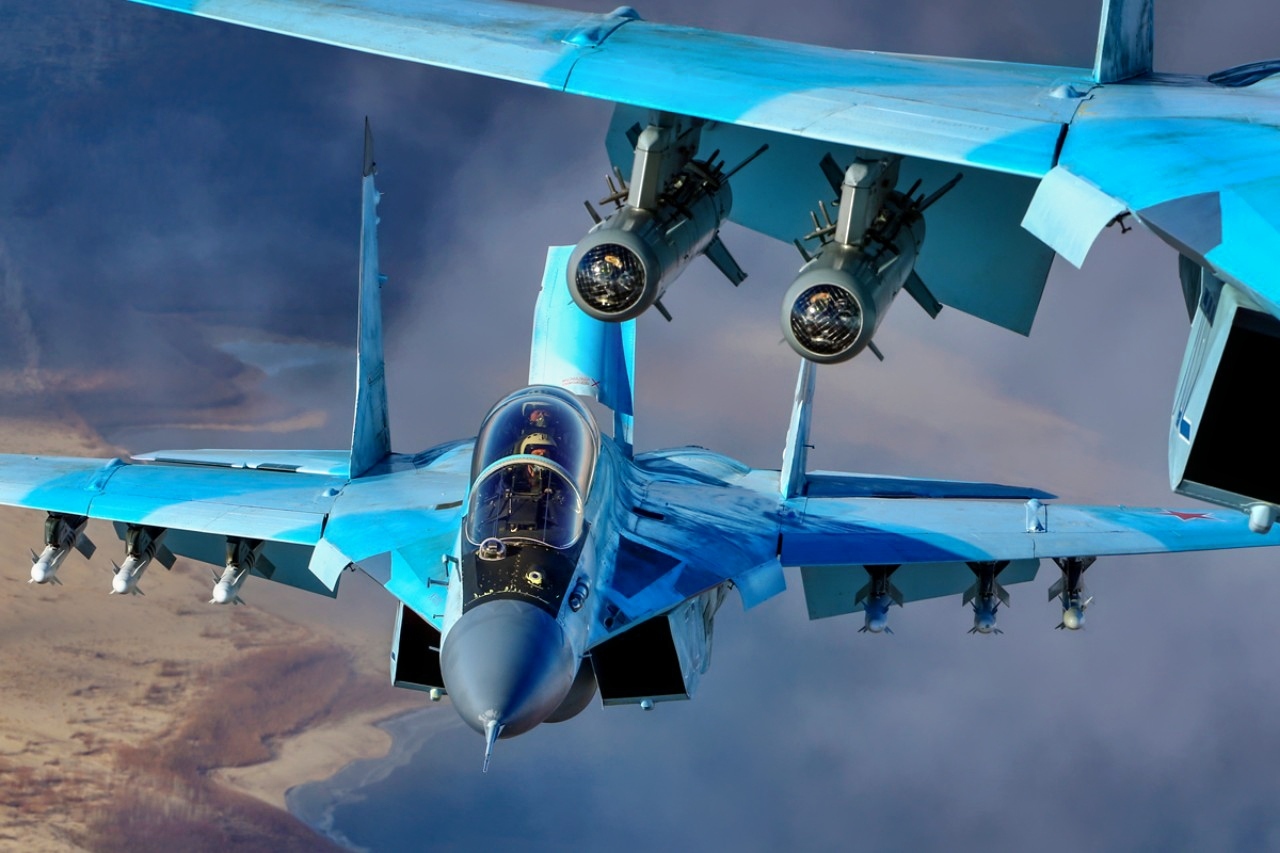
MiG-35 Fighters from Russia. Image Credit: Creative Commons.
He explained that the Italian F-35 jets that were scrambled to intercept signaled the Russian aircraft.
Although the MiG-31 air crews acknowledged communication from the NATO aircraft, they apparently ignored it and “didn’t actually follow the signs.”
Estonia has, as Poland did after the earlier drone attack has invoked NATO’s Article 4 in response.
This is the codicil to the alliance treaty, which requires alliance members to convene for discussions on any issues that could potentially amount to a violation of Article 5. The Article 4 activation was confirmed by Estonian Foreign Minister Margus Tsahkna to POLITICO as well.
“This is yet another example of reckless Russian behavior and NATO’s ability to respond,” NATO Spokesperson Allison Hart said.
It’s Time to Start Shooting Russians Down
For his part, Czech President Petr Pavel has stated that the time for dithering and splitting hairs is over.
NATO, he says, must respond adequately to Russian airspace violations, including potentially by shooting down Russian jets.
“Russia will realize very quickly that they have made a mistake and crossed the acceptable boundaries. Unfortunately, this is teetering on the edge of conflict, but giving in to evil is simply not an option.”
The Czech News Agency carried his comment and later reported up by the Associated Press.
In Kyiv, Ukrainian President Volodymyr Zelenskyy observed that Moscow’s attacks were expanding into new countries and directions.
“They use every tool: from interference in political processes, as in Romania and Moldova, to violations of airspace, as in Poland, Romania, and now Estonia,” he wrote in a post on X.
“This is a systematic Russian campaign directed against Europe, against NATO, against the West. And it requires a systemic response,” Zelenskyy said.
There have been other recent violations by Russian aircraft as well.
On 20 September, it was reported that two Swedish JAS 39 Gripen jets and two German Eurofighter aircraft were deployed in international airspace to monitor and photograph a Russian Ilyushin IL-20 reconnaissance aircraft over the Baltic Sea.
The IL-20 had been flying in international airspace and did not cross into any nation’s borders, but there were not operating in accordance with standard procedures. Aircraft are required to provide a flight path or radio contact that can signal its presence, according to Swedish and German air force officials said.
Aftermath of a Shootdown
The immediate question is how Russia could react if an allied interceptor or air defense battery were to bring down one of its aircraft.
There may be some clues in what took place in Syria almost a decade ago.
On 24 November 2015 a Turkish Air Force F-16 shot down a Russian Sukhoi Su-24M that had flown through Turkey’s airspace for about 17 seconds.
The aircraft had been warned to change its heading ten times over a period of five minutes before entering the incursion took place.
It was one of a number of similar violations that had been made by Russian aircraft in previous weeks when returning to the Khmeimim aerodrome in Syria.
A flurry of diplomatic activity and a trading of threats ensued, along with the movement of military units to create an atmosphere of intimidation.
Russian President Vladimir Putin, who constantly falls back on a narrative of victimhood, claimed that the attack was a premeditated “ambush” on the part of Turkey, which is a NATO member state.
In the end, as one colleague here in Poland pointed out, all that really happened was that “Russia stopped buying tomatoes from Turkey for a couple of months.”
It is not likely that Moscow would want to attack NATO if one of its aircraft were brought down. The whole point of these violations and incursions is to try to see how far Moscow can press NATO without having to go to war.
For its part, if these Russian actions continue as they have in recent weeks, other measures by NATO may need to be considered to take corrective action.
About the Author: Reuben F. Johnson
Reuben F. Johnson has thirty-six years of experience analyzing and reporting on foreign weapons systems, defense technologies, and international arms export policy. Johnson is the Director of Research at the Casimir Pulaski Foundation. He is also a survivor of the Russian invasion of Ukraine in February 2022. He worked for years in the American defense industry as a foreign technology analyst and later as a consultant for the U.S. Department of Defense, the Departments of the Navy and Air Force, and the governments of the United Kingdom and Australia. In 2022-2023, he won two awards in a row for his defense reporting. He holds a bachelor’s degree from DePauw University and a master’s degree from Miami University in Ohio, specializing in Soviet and Russian studies. He lives in Warsaw.
More Military
Russia Now Has a Death Star Battlecruiser
France’s Charles de Gaulle Aircraft Carrier Has a Message for Any Navy on Earth
Russia’s Last Aircraft Carrier Might Soon Be Headed to the Grave


