
Trump’s Plan to Stop Iran Attacking Oil Tankers – U.S. President Donald Trump has authorized a new strategy intended to stop Iran from wreaking havoc in the Strait of Hormuz and forcing the regime to pay every time Iranian forces strike commercial shipping vessels in the waterway. It is the latest in a series of efforts intended to reduce Iran’s power over the strait as Washington attempts to normalize shipping through the Gulf.
In response to Iranian strikes, the U.S. military is now targeting Iranian government tankers. The U.S. military struck two such vessels during a massive wave of attacks on Tuesday, September 1, marking the first time Washington has deliberately targeted Iranian tankers in response to Tehran’s attacks on other vessels, rather than because they were attempting to violate the U.S. naval blockade.
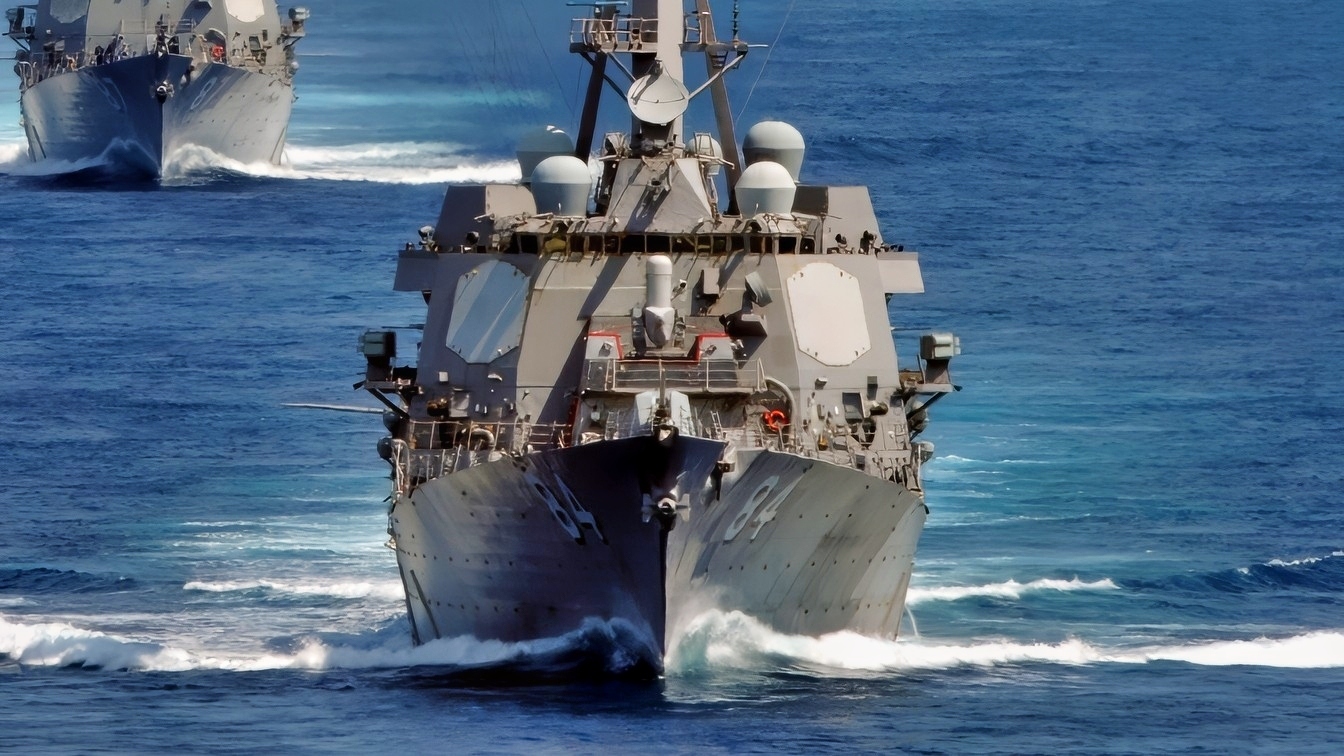
The Arleigh Burke-class guided-missile destroyers USS Bulkeley, right, and USS Mason participate in a strait transit exercise. Bulkeley and Mason are part of the Enterprise Carrier Strike Group and are conducting work-ups and flight operations in preparation for an upcoming deployment. (U.S. Navy photo by Seaman Jared M. King)
One U.S. official described the new strategy to Axios as a “tanker for tanker” policy that has been approved by the president, in which Washington will impose losses on Iran’s fleet for every strike on a commercial vessel. But the question now is whether threatening Iranian tankers will be enough to convince the regime to come back to the negotiating table, or if it will further embolden the regime.
America Is Trying to Keep Iran Down
The new tanker policy is part of a larger overall strategy aimed at preventing Iran from being able to rebuild the military infrastructure it needs to threaten shipping – a measure that, at least in the short term, will allow oil to keep moving through the Strait of Hormuz while Washington seeks a long-lasting deal with Tehran.
U.S. forces attacked roughly 100 targets on Tuesday, according to U.S. officials cited by Axios, including Islamic Revolutionary Guard Corps air defenses, radar and communications systems, anti-ship cruise missile launchers, attack-drone launchers and mine-laying capabilities.
The two Iranian tankers were anchored off the Iranian coast north of the U.S. blockade line when American drones struck their engine rooms.
One U.S. official compared the strategy to “mowing the lawn,” whereby the U.S. military periodically destroys Iranian capabilities before Tehran can rebuild enough of them to pose a threat to commercial vessels or U.S. Navy ships. Another source told the outlet that Tuesday’s operation had bought commercial shipping at least a month of reduced danger.
The strikes also followed attempted attacks from Iran on commercial shipping and American personnel, and constituted the biggest exchange of fire between Tehran and Washington since July.
Iran Is Still Trying to Hit Ships
Iran responded with a barrage of missile and drone attacks against U.S. facilities throughout the Gulf region, firing around 25 ballistic missiles toward Jordan. Jordan said that 10 of the 13 missiles entering its airspace were intercepted, while the remaining three fell in remote areas without causing any casualties.
Iranian forces also launched drones toward U.S. facilities in Bahrain and carried out attacks against American bases located in Iraq and Kuwait.
Fighting in the Strait of Hormuz continued, too, with U.S. forces guiding roughly 40 ships through the Strait of Hormuz on Tuesday while intercepting a series of Iranian anti-ship cruise missiles and drones intended to disrupt the successful nightly U.S. convoy system that has been gradually restoring traffic through the waterway.
Shipping traffic, however, remains well below normal levels despite recent increases.
Could It Work?
The new strategy could work for a simple reason, and Washington is betting it will. Iran cannot afford to lose its tankers, let alone face months or years of continued restrictions on its oil exports. Without its tankers, the hope of shipping returning to normal dwindles to virtually nothing unless Iran first rebuilds its fleet.
Years of sanctions have so far failed to stop Tehran from exporting substantial quantities of crude oil, largely because Iran developed a shadow fleet and network of intermediaries that facilitate the movement of crude oil to China.
The American naval blockade, however, is much harder to circumvent, as the U.S. Navy physically prevents those ships from passing through the waterway.
Iran Is Hurting
Iran is seeing the effects.
Iranian crude loadings fell from roughly 2 million barrels per day in March to around 220,000 to 255,000 barrels per day in August, according to tanker-tracking data reported by Reuters.
Iran has gone roughly seven weeks without substantial crude exports through Hormuz, leaving tankers trapped inside the Persian Gulf and forcing Tehran to rely increasingly on oil already stored aboard vessels in Asian waters.
And until now, Iran has proven it is capable of imposing massive costs on Saudi Arabia, the UAE, and other Gulf producers – and by extension the global economy – by threatening commercial vessels with drones, mines, and missiles.
Under the new policy, however, Washington is attempting to ensure those attacks, which are cheap and easy for Iran to conduct, are substantially more expensive.
Iran may be able to attack, but for every new strike, it loses an expensive shipping vessel that it needs to restore its oil trade if the blockade is lifted.
MORE – A NATO-Russia War Is Possible
About the Author: Jack Buckby
Jack Buckby is a British researcher and analyst specializing in defense and national security, based in New York. His work focuses on military capability, procurement, and strategic competition, producing and editing analysis for policy and defense audiences. He brings extensive editorial experience, with a career output spanning over 1,000 articles National Security Journal, and has previously authored books and papers on extremism and deradicalization.


