
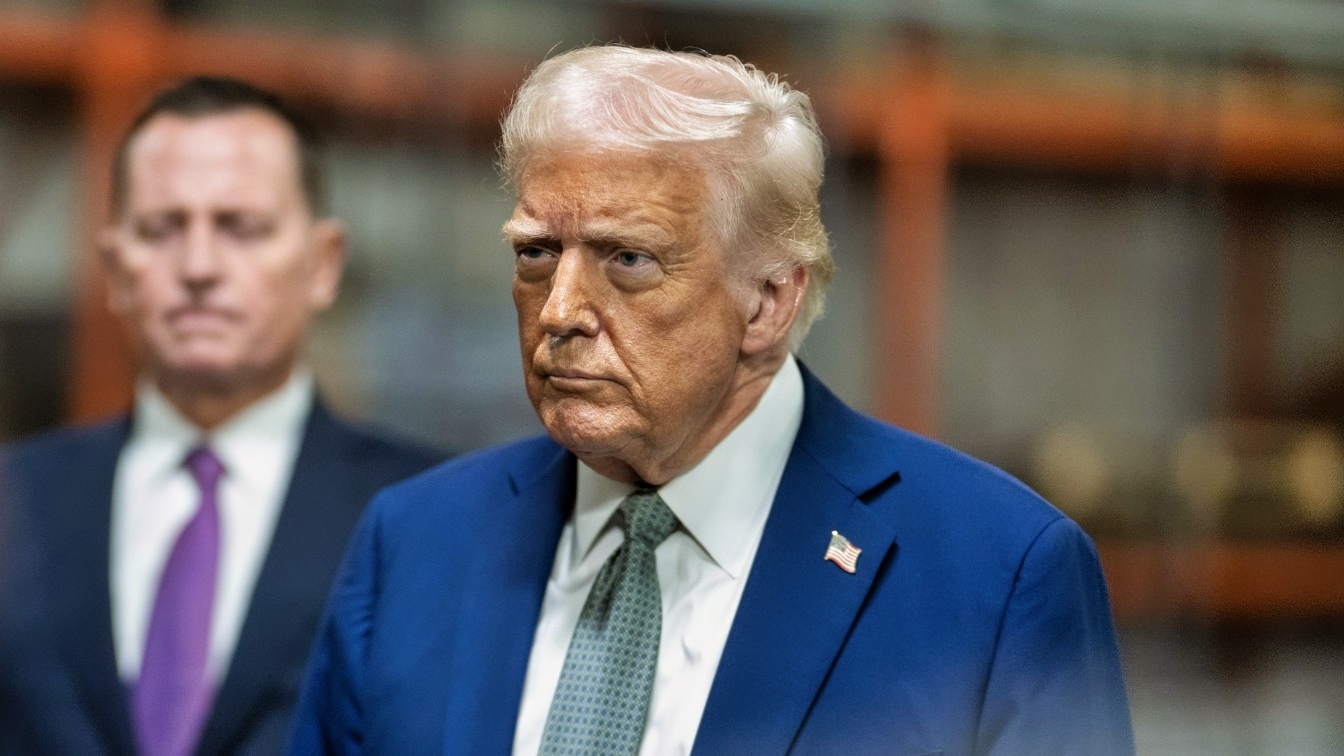
In response to Iranian strikes in the Strait of Hormuz, U.S. President Donald Trump issued a statement that could be interpreted as a nuclear threat. Writing on Truth Social, Trump criticized the regime in Tehran for violating the terms of the memorandum of understanding (MOU), and warned that Iran may “no longer exist” if he follows through on his own military threats.
“United States aircraft just struck Iranian missile and drone storage locations, and coastal radar sites, for violating the Cease Fire Agreement, AGAIN!” Trump said.
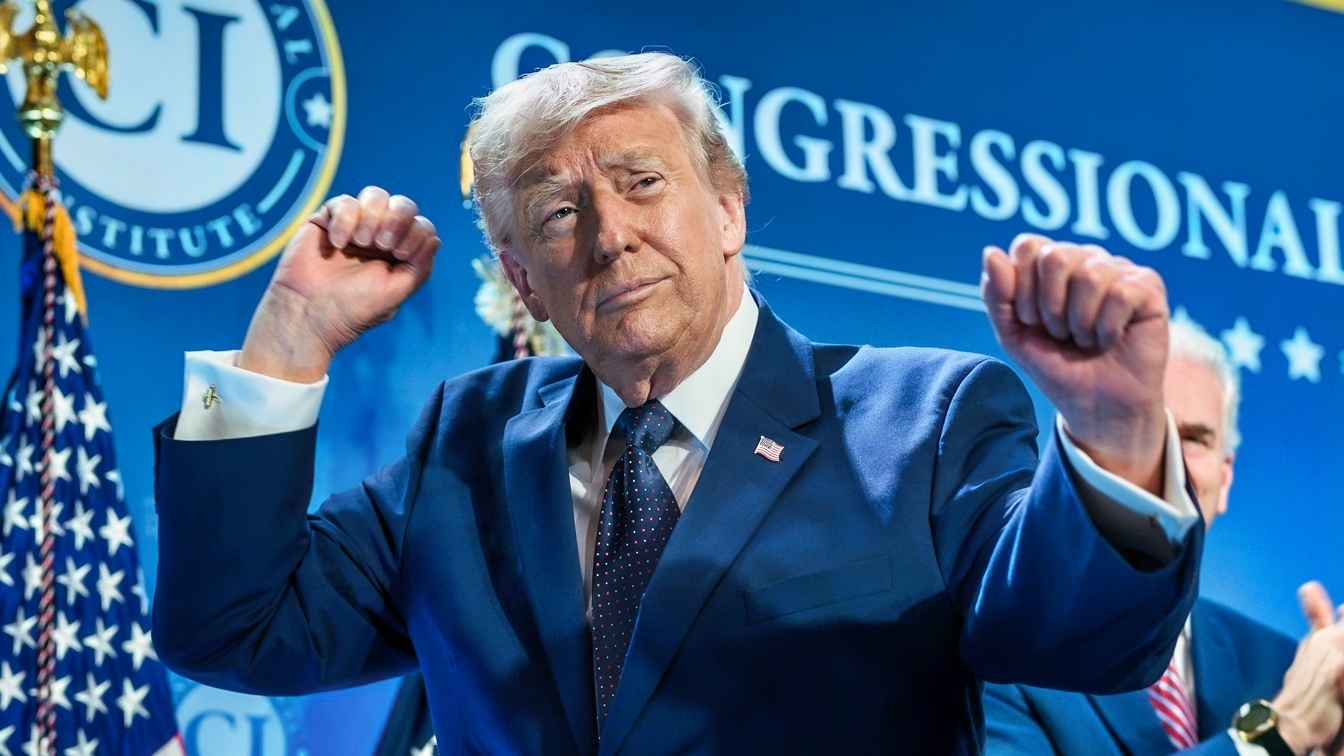
President Donald J. Trump delivers remarks at the Republican Members Issues Conference at Trump National Doral Miami, Monday, March 9, 2026, in Miami, Florida. (Official White House Photo by Molly Riley)
“It is very possible that they will never learn! There may come a point when we are no longer able to be reasonable and will be forced to militarily complete the job that we very successfully started. If that happens, the Islamic Republic of Iran will no longer exist!” the president continued.
What Did Trump Mean?
The threat can be interpreted in several ways – and that’s probably by design.
This isn’t the first time the president has issued extreme threats to Tehran, and his latest could be seen as intentionally vague.
The most extreme interpretation would be that Trump is signaling his willingness to deploy weapons of mass destruction to follow through on a previous threat of killing an “entire civilization,” while the most conservative would be that Trump is simply threatening regime change.
The idea that Trump would even consider the use of a nuclear weapon seems to be in conflict with his own stated views.
The president has often expressed his concerns about nuclear proliferation and, despite the recent Iran invasion, has long been an advocate of preventing protracted warfare.
But it was only in April this year that the president was issuing threats to Iran that, presumably, he hoped would strike fear in the heart of the Iranian regime.

Donald Trump In New York City White House Photo
On April 7, the president sought to bring Iran to the negotiating table through extreme means.
“A whole civilization will die tonight, never to be brought back again. I don’t want that to happen, but it probably will. However, now that we have Complete and Total Regime Change, where different, smarter, and less radicalized minds prevail, maybe something revolutionarily wonderful can happen, WHO KNOWS?” the president wrote on Truth Social. “We will find out tonight, one of the most important moments in the long and complex history of the World. 47 years of extortion, corruption, and death will finally end.”
Trump famously refrained from launching strikes by the end of his two-week deadline in April, leading analysts to speculate that the threat was always empty.
Did Trump Consider Nuclear Before?
In April, former CIA analyst Larry Johnson made shocking allegations about the president, claiming in an interview that President Trump considered using nuclear weapons against Iran.
According to Johnson, Trump was stopped by General Dan Caine, the chairman of the Joint Chiefs of Staff, in what was described as a “blow-up” situation.
Speaking on the Judging Freedom podcast, Johnson claimed that during an emergency briefing, the president faced pushback from Gen. Caine, who “stood up and said ‘no’” to the president, and “invoked his privilege as the head of the military.”
The claim is, of course, unverified – but with the president issuing threats that could reasonably be interpreted as a threat to use weapons of mass destruction, it’s hard to dismiss reports like this as mere partisanship or sensationalism.
And if the claim is indeed untrue, the president’s choice of wording in his most recent threats is not only seen as empty by Tehran, but they also play into the theory that the sitting U.S. president is willing to use nuclear weapons.
Perhaps, though, that’s precisely what Trump wants.
Why Trump Was Making Threats This Time
The president’s most recent threat came hours after the U.S. military launched strikes against Iranian missile and drone storage sites, as well as coastal radar positions.
The strikes were a response to Iranian drone attacks on commercial vessels passing through the Strait of Hormuz – a violation of the terms of the MOU signed by both Tehran and Washington. The agreement temporarily halted hostilities in the region and was intended to give both parties time to settle the details of a lasting peace agreement.
Iran Negotiations Canceled
The diplomatic fallout of the latest exchange of strikes and threats arrived quickly. On Sunday, June 28, Mehdi Fazaeli, a member of the Office of Preservation and Publication of the Works of Iran’s Supreme Leader, told Iranian state television that Tehran had not engaged in technical talks scheduled with the United States for that day.
“For example, one of the reasons is checking if we have access to the unfrozen funds; if there is no access, then this condition has not been fulfilled,” Mehdi Fazaeili said.
The talks were due to continue in Switzerland, but Fazaeli said recent attacks on Iran – and other perceived failures to abide by the terms of the MOU, including gaining access to unfrozen funds – made continued participation impossible.
For now, it looks like the talks are off. Again.
About the Author: Jack Buckby
Jack Buckby is a British researcher and analyst specializing in defense and national security, based in New York. His work focuses on military capability, procurement, and strategic competition, producing and editing analysis for policy and defense audiences. He brings extensive editorial experience, with a career output spanning over 1,000 articles at 19FortyFive and National Security Journal, and has previously authored books and papers on extremism and deradicalization.


