

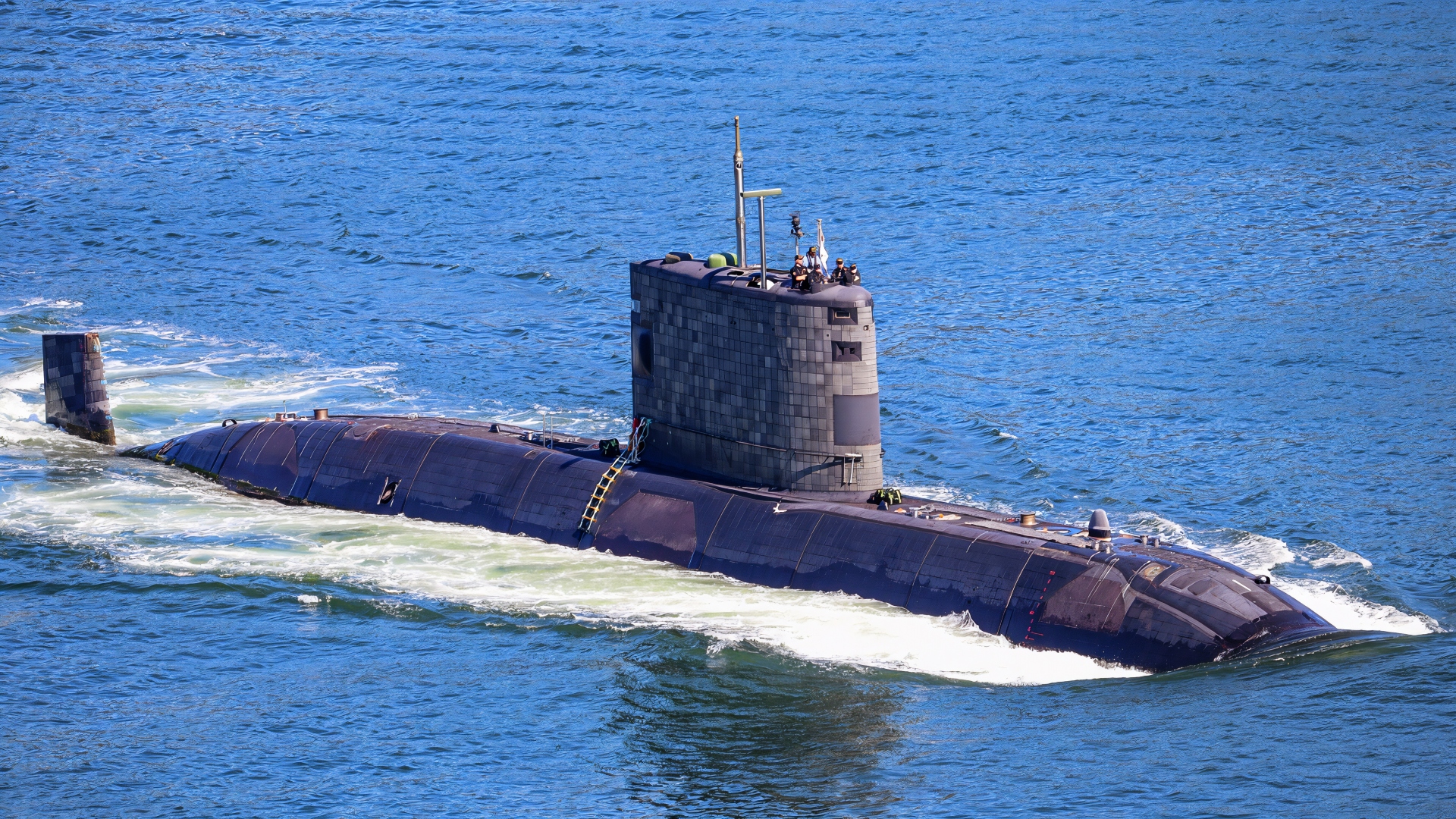
Canada has spent so many years talking about replacing the Victoria-class submarines that it is easy to forget the project might actually happen. The Canadian Patrol Submarine Project began with a crowded field of twenty-five expressions of interest and has now narrowed to two serious contenders, Germany’s Type 212CD and South Korea’s KSS-III. Both formal proposals are in Ottawa’s hands. Prime Minister Mark Carney has said the government intends to identify a preferred supplier before the end of June, though the contract itself is expected much later.
Canada’s Big Submarine Call

The Royal Canadian Navy long-range patrol submarine HMCS Victoria (SSK 876) arrives at Naval Base Kitsap-Bangor for a port call and routine maintenance. The visit is Victoria’s first to Bangor since 2004. (U.S. Navy photo by Lt. Ed Early/Released)
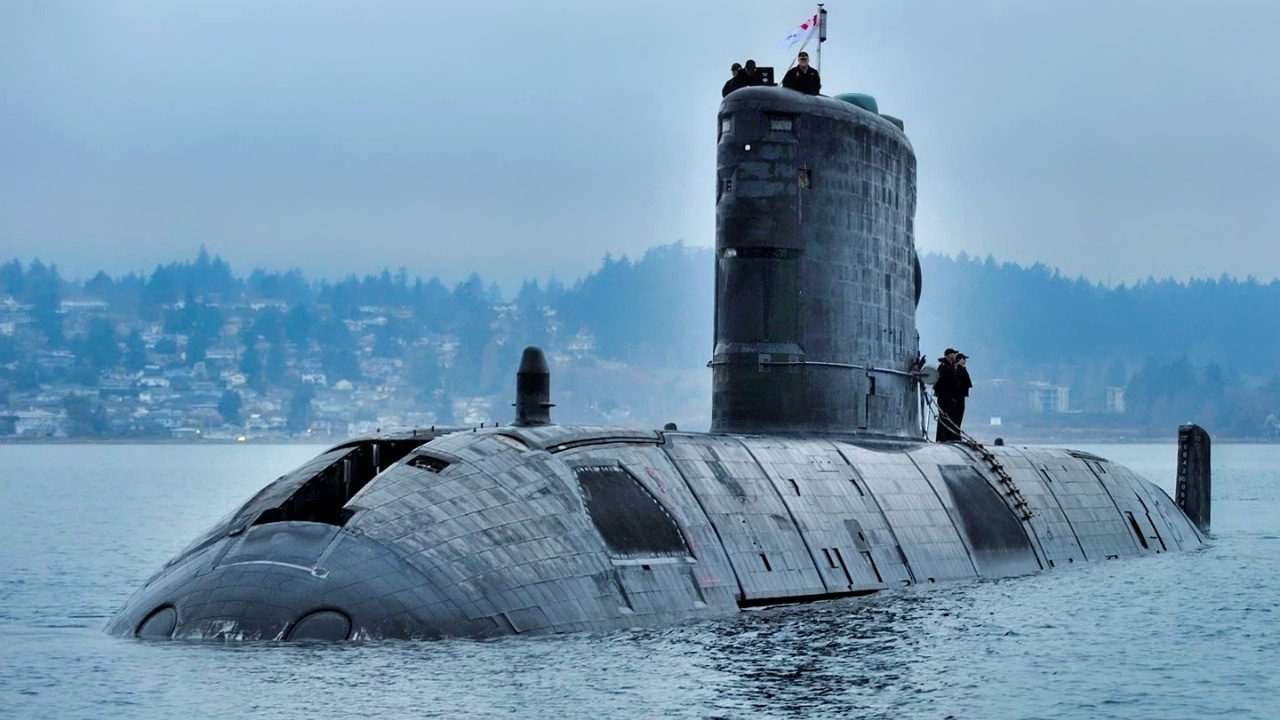
Victoria-Class Submarine Canada Navy. Image Credit: Creative Commons.
The competition has also become something larger than a straightforward naval procurement. Germany has sent Defense Minister Boris Pistorius to Ottawa to make the case for its bid and has even floated measures intended to accelerate deliveries. South Korea has wrapped its proposal in a broad industrial package that reaches well beyond shipbuilding. By any Canadian standard, this has become a major strategic and political decision.
That is enough to make old hands in Ottawa a little suspicious. Canadian governments have announced defense procurements before. They have also postponed them, redesigned them, and quietly let them drift while the world moved on.
Still, this one appears to be moving.
The conversation around it has settled into familiar territory. One bid promises one set of industrial opportunities, another promises a different set. There are discussions about jobs, regional development, manufacturing partnerships, and technology transfer. None of that is unusual. It would be strange if a government preparing to spend something approaching sixty billion dollars ignored those questions altogether.
The stranger thing is how little time gets spent on what the submarines are actually for.
The Geography Has Not Changed
A few years ago, it was still possible to hear Canadian defense discussions framed around expeditionary operations and broad notions of being a middle power with global responsibilities. Some of that language survives, mostly because governments are slow to abandon old habits.
But that language is no longer grounded in geopolitical reality.
Canada’s real strategic problems now sit much closer to home than they once appeared to. The North Pacific matters because that is where competition among the major powers increasingly reaches North America. The Arctic matters because it is becoming more accessible even as it remains politically unsettled. The North Atlantic matters because Europe and North America are still tied together by infrastructure and sea lanes that suddenly look vulnerable again.
Submarines occupy an odd place in all this. Most of the time, they are valuable precisely because nobody sees them. They complicate an adversary’s planning. They gather information. They make uncertainty expensive.
A country that intends to operate seriously in the North Pacific, the Arctic, and the North Atlantic ought to begin there when it chooses a fleet.
That does not automatically point toward Germany’s Type 212CD or South Korea’s KSS-III. People can argue that question in good faith. But the argument should turn on the operational demands those waters impose. A submarine that cannot do what Canadian geography demands is the wrong submarine, no matter how attractive the package around it happens to be.
There is another aspect to the decision that receives less attention than it probably should. Buying a submarine also means settling into a way of doing business for a very long time. Crews learn from the people who built the boat. Refits happen in familiar places. Supply arrangements develop their own momentum. Canada already spends much of its strategic life looking across the North Atlantic, and the German proposal fits comfortably inside that world. The Korean bid would pull some of that activity toward an Indo-Pacific partner that has been making an energetic push into the global defense market.
None of that settles the argument, but it does mean that Ottawa is choosing more than a design for the next generation of submarines.
Politics Usually Wants Something Else
Stephen Fuhr, the secretary of state for defense procurement, said earlier this year that economic benefit to Canada would drive the decision. The remark attracted some attention because politicians rarely put matters quite so directly.
It also reflected a political reality that is older than this project.
Large procurements create winners and losers long before the first piece of equipment enters service. Provincial governments pay attention. Labor unions pay attention. Industry pays attention. Members of Parliament notice where the factories are going and where they are not.
The Korean proposal has amassed an impressive array of industrial partnerships that extend beyond shipbuilding itself. The German side has made its own economic case. That is what serious competitors do. They respond to the priorities their customers appear to have.
There is nothing inherently wrong with that. Industrial capacity is part of national strength, and countries that cannot manufacture complex systems for themselves eventually discover the limits of strategic dependence.
But there is a difference between treating economic benefits as an important consideration and treating them as the central one.
The qualities that decide whether a submarine survives in combat are difficult to turn into a political announcement. They do not photograph especially well. They cannot easily be translated into regional investment figures. They become visible only when someone has to take the boat north and trust it to do what it was built to do.
Canadian politics has always had a practical streak. Governments prefer things they can count. Jobs can be counted. New facilities can be counted. Under-ice endurance is a harder sell.
Perhaps that is simply how democratic politics works.
The Decision That Lasts
There is a temptation to assume that if Ottawa chooses either of the finalists, it cannot really go far wrong. Both are capable designs. Both come from advanced industrial states. Both would represent a substantial improvement over the status quo.
That may all prove true.
The risk lies somewhere else.
A government can gradually convince itself that the industrial package and the operational requirement point in the same direction because admitting otherwise creates a political problem. If that happens, the military logic quietly adjusts itself to fit the economic one.
Nobody has to make a reckless decision for that to occur. Nobody has to ignore military advice. It is enough for the larger political conversation to revolve around different questions.
There is also a habit in Canadian defense policy of assuming that time is abundant. A preferred supplier can be announced. Negotiations can continue. Cabinets change. Trade disputes intrude. Lawyers become involved. The file remains active, but the years pass anyway.
The submarines that Canada is replacing are not especially interested in those political rhythms.
Sometime in the next decade, the country will discover what it really decided to buy. It may be found that the industrial and operational arguments pointed to the same answer all along. It may not.
The waters to the north and on either coast will not become less important while Ottawa sorts that out. They were there before this competition began, and they will still be there long after the headlines about jobs and investment have faded.
About the Author: Dr. Andrew Latham
Andrew Latham is a professor of international relations and political theory at Macalester College in Saint Paul, MN. You can follow him on X: @aakatham.


Htos1av
June 11, 2026 at 11:38 am
The chinese can “remote” hijack via a back door in the electronics and attack America. THAT’S why.
NOT happening.
Swamplaw Yankee
June 11, 2026 at 12:49 pm
Billions of tons of near pure copper were mined 3000 years ago in Lake SUPERIOR’s Isle Royale. Poof, vanished!
One assumes that the ruler of Canada, 3T, knows that the MAGA POTUS will vanish as completely when he is still legal + total ruler.
AD Rem: what defends the 3 Canadian shores from the PRC Underwater fleets currently + under construction, now + for the next 11 years?
The ALASKA + GREENLAND, ICELAND sub fleets?
Does Canada even have the aerial capacity to identify who in in and about the 250 mile coastal zones?
How about the op-ed push for the huge population of Mexico to fund the purchase of 75% of the sub fleet. AS it is, the legal ruler is forcing legal low income Canadian born seniors to live in near poverty! Free health Care is shovelled out to those who have just fallen out of the plane, as the tax paying legal senior has to face long lines behind the newly arrived.
Who in the senior ages needs expensive tax funded sub systems, when the Ukrainians show daily that they effectively control the Black Sea with other tech: that is, zero subs.
Brian Carter
June 13, 2026 at 9:50 am
Re article on Canadian Subs and why no one is asking what they are for.
First civilians should never be asked what military equipment is for simply because they have no clue as to what the military threats to our nation are and how to counter those threats. Asking the punlic to chime in on this is like asking you neighbour the electrician to do your open heart surgery.
The answer is with our military. They have asked for the subs as the best option to protect the north which we have neglected forever.
Surface ships are vulnerable and used more to go on foreignmilitary missions.
Subs can sit on the bottom wait for the target, hit it and get out of there.
We have new northern patrol navy ships but they are totally unarmed. Rhey can not defend against air or sea attacked and rhey can not attack threats.
So the answer to your question is obvious based on simple military analysis. Never ask civilians such questions. They along with politicians likely came up with the unarmed northern patrol ships idea.
Craig Tyson Roberts
June 13, 2026 at 5:10 pm
Canada needs the submarines to defend Canadian territory from people who want to get in charge or control the resources in Canada. The resources are worth $10 trillion to $50 trillion dollars here. Canada must control its borders and sea lanes much more effectively. I am a Canadian from British Columbia and I know what I am talking about.
Timothy Olheiser
June 16, 2026 at 2:29 pm
The South Korean learned submarine tactics and design from the Germans. They bought a 212 kit and built it themselves. They seen the need of vertical launch tubes, as necessary for their defense against North Korea, and China threats. The KSS-III, is built to be a killer attack sub. An advancement over the German sub. They sail 14,000 km to prove that their tech works, and actively participated in Canadian Naval war games. Our personnel actively are learning, running the Korean sub and tech and expertise is being transferred. Korea is guaranteeing 5 subs being built by 2035, with one sub completed every year. The Germans and Norwegians are giving up places, so Canada can have 4 subs by 2036, but what can be guaranteed after that? The Germans are promising a Carbon Capture plant in Alberta, a CO2 ducking machine that will increase the cost of production of oil and gas, and make Alberta oil and gas manufactures less competitive. Then They want to improve the port of Churchill to ship oil and gas to europe, as well battery plant, favoring the auto sector. Korea will improve the mill soas to produce the steel for the subs construction. Provide Hyundai car manufacturing in Ontario, as well as start hydrogen run trucks, and manufacture. Military tanks, self propelled artillery, and other vehicles. I favour the Korean sub. More value a true hu ter killer sub, with options to get into their nuclear sub.
Balter
June 17, 2026 at 9:45 pm
Yeah, might be a new PM but it’s the same old cabinet full of grifters, all wanting some kind of something or other built to get them re-elected. In the past I’d have trusted the RCN to put its foot down and say which one is the best for their purposes but we had a clown firetruck government for ten years, including various “tensions” with the purchasing and allocation of various funds and I don’t know if the tough nuts stuck it out. Guess we’ll see – certainly we will be paying for it. And you’re correct Canada is all about Europe these days, but only if you have embraced the East Canada mindset. Personally I’d want the vertical launch tubes and long dwell times, but those are only minor deterrence without a nuclear payload.