

Summary and Key Points: Ukraine has officially received the final batch of 80 promised M1A1 Abrams tanks, with Australia delivering the last 49 vehicles via Operation Kudu in late 2025.
-While the $245 million donation bolsters Kyiv’s heavy armor, the fleet faces a grim reality: nearly 87% of the original U.S. batch has already been lost or damaged.
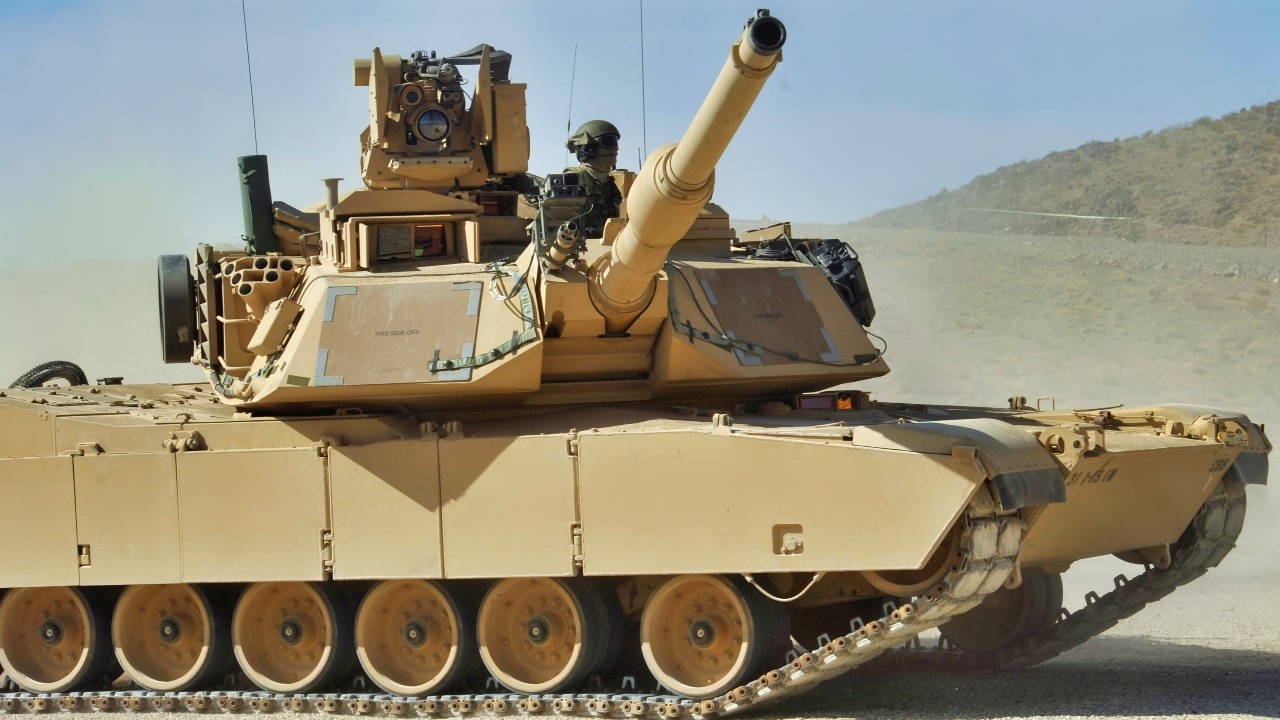
Australia is sending 49 of its retired M1A1 Abrams tanks to Ukraine, a move that bolsters Kyiv’s armored firepower but raises significant questions about survivability on the modern battlefield. While the donation is a welcome gesture, US officials have reportedly expressed private frustration, warning that Ukraine struggles to sustain the complex tanks and highlighting their vulnerability to cheap, top-attack FPV drones. The war in Ukraine has become a “drone war,” where even advanced main battle tanks are at constant risk. The effectiveness of these donated Abrams will ultimately depend on Ukraine’s ability to counter this pervasive threat.

A U.S. M1A1 Abrams tank needed for training the Armed Forces of Ukraine awaits offloading at Grafenwoehr, Germany, May 14, 2023. The M1A1 training is expected to last several weeks and will include live fire, crew qualification, maneuver, and maintainer training. Armed Forces of Ukraine training is conducted by 7th Army Training Command at Grafenwoehr and Hohenfels training areas in Germany on behalf of U.S. Army Europe and Africa. (U.S. Army photo by Spc. Christian Carrillo)
-Struggling against top-attack drones and logistical bottlenecks, Ukrainian forces have resorted to ad-hoc “anti-drone cages.”
-Reports now reveal the U.S. privately warned Australia against the transfer, fearing the 60-ton tanks would become a “sustainment nightmare” on the modern battlefield.
Cages and Scap Metal: Inside Ukraine’s Desperate Fight to “Drone-Proof” the M1A1 Abrams
Ukraine has now taken delivery of the last of 80 M1A1 Abrams main battle tanks promised by Western allies, finally completing a heavy armor transfer pledge that began in 2023.
The Australian Defence Force confirmed on December 19, 2025, that the 49 remaining promised M1A1 Abrams tanks have been delivered to Ukrainian forces after a months-long transit from Australia to Poland and onward into Ukraine.
The donation has been valued at roughly $245 million and forms part of roughly $1.7 billion in total military and security assistance to Kyiv from Canberra since Russia’s full-scale invasion, under what Australia calls “Operation Kudu.”

An M1A1 Abrams tank from 1st Tank Battalion, 3rd Marines, maneuvers before a live fire assault at Shoalwater Bay Training Area, Queensland, Australia, on May 25, 2001 for Exercise Tandem Thrust 2001. Tandem Thrust is a combined military training exercise involving more than 18,000 U.S., Australian, and Canadian personnel who are training in crisis action planning and execution of contingency response operations.

Soldiers from 2nd Battalion, 70th Armor Regiment, 2nd Armored Brigade Combat Team, 1st Infantry Division, fire at a target while conducting the defensive position live fire portion of the Strong Europe Tank Challenge at the Grafenwoehr Training Area, Germany, on June 5.The Strong Europe Tank Challenge is an annual training event designed to give participating nations a dynamic, productive and fun environment in which to foster military partnerships, form Soldier-level relationships, and share tactics, techniques and procedures. The participating nations this year are Austria, France, Germany, Poland, Sweden, Ukraine, United Kingdom and the United States.

U.S. Marine Corps M1A1 Abrams tank provides suppressive fire against simulated insurgents during day 18 of the Integrated Training Exercise 13-1 at Twentynine Palms Marine Corps Base, Calif., Jan 22, 2013. The ITX is the training exercise that Marines come to prior to deploying. (U.S. Air Force photo by Staff Sgt. Stephany Richards)
“It is a huge undertaking to bring a 60-tonne tank half way across the world and make sure that when we give it to our Ukrainian friends, it is ready to use,” Commander of Operation Kudu – Europe, Colonel James Smith, said in a press release issued by the Australian government.
The latest deliveries complete a full effort that was preceded by the delivery of 31 Abrams tanks supplied by the United States in 2023, bringing Ukraine’s total received Abrams count to 80.
The Politics Behind the Abrams Decision
The decision to provide Abrams tanks to Ukraine was made in January 2023 when the Biden administration approved the transfer of U.S.-made M1A1 Abrams tanks as part of a larger security assistance package.
That decision was aimed not just at bolstering Ukraine’s armored capability but also at strengthening the alliance supporting Ukraine and synchronizing the delivery of heavy armor from Western partners – including Germany’s pledges of Leopard 2 tanks.
And although the Abrams tank is widely considered to be one of the most capable main battle tanks in the world, its deployment in Ukraine has not been without controversy.
Visual open-source analyses have indicated that Ukrainian forces have already lost a significant number of U.S.-supplied Abrams tanks in combat, including vehicles destroyed, abandoned, or captured by Russian gha.
As of mid-2025, approximately 87 percent of Ukraine’s fleet of U.S.-supplied Abrams tanks have been visually confirmed as destroyed, damaged, abandoned, or captured.
What’s Going Wrong?
Beyond attrition from battlefield losses, the M1A1 Abrams faces a dilemma regarding general sustainment and operations.
Ukrainian units operating the Abrams have faced a battlefield dominated by new technology – from drones and precision munitions to anti-armor weapons that efficiently exploit vulnerable top armor on the Abrams and the logistical vulnerabilities that come with operating the platform.
While those vulnerabilities were harder to exploit in the early days of the war, the battlefield has since evolved into a futuristic warzone where an increasing number of drones on both sides are assuming greater responsibility in combat.
The problem is so bad that reports indicate Ukraine has fitted some Abrams tanks with improvised additional armor and anti-drone cages to improve their resilience.
Still, those adaptations are ad hoc responses to an evolving threat and not a real solution to the problem.
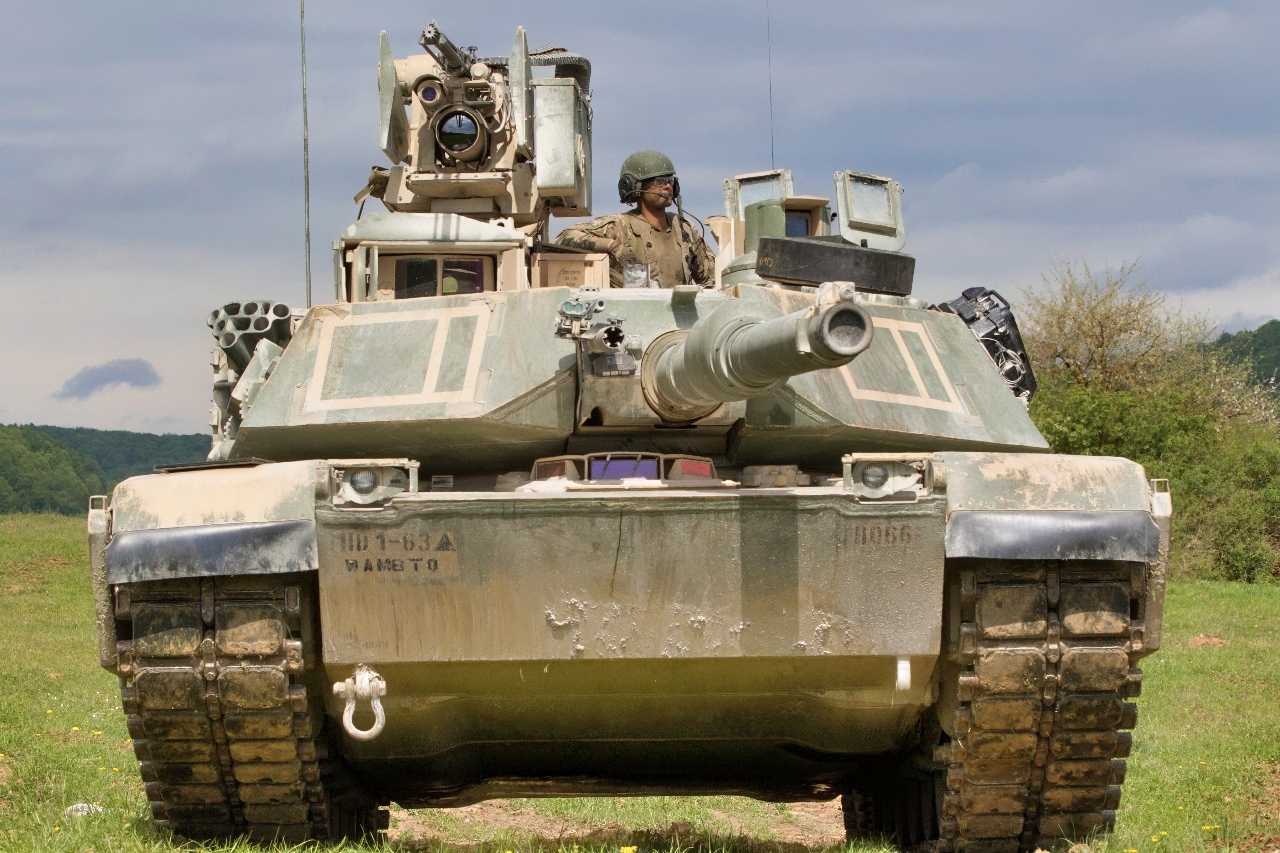
An M1A2 Abrams tank from 1st Battalion, 63rd Armor Regiment, “Dragons,” 1st Infantry Division, Fort Riley, Kansas, pulls during Combined Resolve X at the Hohenfels Training Area, Germany, May 1, 2018. Exercise Combined Resolve X is a U.S. Army Europe exercise series held twice a year in southeastern Germany. The goal of Combined Resolve is to prepare forces in Europe to work together to promote stability and security in the region. (U.S. Army photo by Spc. Andrew McNeil / 22nd Mobile Public Affairs)
The complexities of sustaining heavy Western armor like this in a protracted war against an adversary like Russia extend well beyond attrition, too.
The Abrams platform is highly demanding, requiring specialized maintenance, spare parts, complex fuel logistics, and trained crews to keep them in good working order – all of which pose significant challenges for Ukrainian forces that are already stretched.
In short, the Abrams are not as helpful as the Biden administration had hoped in 2023.
U.S. Frustration Behind the Scenes on M1A1 Abrams Tank Call
Although the Abrams transfers have been successful and proceeded with public support from Washington, some U.S. officials were reluctant about the idea from early on.
According to reports, American officials advised Australia in 2024 to reconsider or delay its transfer of Abrams tanks to Ukraine, warning that the vehicles would impose substantial sustainment burdens once they finally reached the battlefield.
Speaking to ABC, one U.S. official described efforts to convince Australia to reverse course.
“Last year, even before Donald Trump returned as president, we warned the Australians that sending these Abrams tanks would be complicated, and once they finally get to the battlefield the Ukrainians will find them difficult to sustain,” the source said.
The concerns were expressed even as Washington ultimately granted the necessary export approvals under the U.S. International Traffic in Arms Regulations (ITAR), which govern the transfer of U.S.-origin defense equipment.
So, for Kyiv, the arrival of the last Abrams is good news and bad. It represents a boost in armored capability, but also poses new challenges for forces already struggling to protect them on the battlefield.
About the Author:
Jack Buckby is a British researcher and analyst specialising in defence and national security, based in New York. His work focuses on military capability, procurement, and strategic competition, producing and editing analysis for policy and defence audiences. He brings extensive editorial experience, with a career output spanning over 1,000 articles at 19FortyFive and National Security Journal, and has previously authored books and papers on extremism and deradicalisation.


