


Key Points and Summary – Australia has delivered most of the 49 M1A1 Abrams tanks it pledged to Ukraine, a symbolic boost that may offer limited battlefield utility.
-The Cold War–era Abrams was built for tank-on-tank fights, not today’s drone-saturated, sensor-driven battles.

An M1A2 Abrams Tank fires a round at Fort Stewart, GA., June 23, 2025. (U.S. Army photo by Sgt. David Resnick)
-Lacking modern active protection and demanding heavy logistics, M1A1s risk becoming high-value targets without tight integration into Ukraine’s evolving combined-arms approach.
-If paired with counter-drone cover, rapid-repair teams, and networked ISR, they can still kill anything Russia fields—but misused, they’ll die as museum pieces.
-Canberra’s gift is generous yet dated; Ukraine’s challenge is to make legacy metal fight a 2025 war.
Ukraine Gets M1A1 Tanks. In a Drone War, Do They Help or Hurt?
Australia has delivered the majority of the 49 M1A1 Abrams tanks it committed to providing to Ukraine, fulfilling a pledge made by Prime Minister Anthony Albanese last year.
The first batch of the armored vehicles left Australia in May and arrived in Ukraine in July, and the last ones are due to arrive by late 2025.
Australia’s decision to give Kyiv its aging battle tanks is as noble as it is nonsensical.
It is a gesture of solidarity doomed by a lack of understanding of how war is waged today. Canberra is trying to help Ukraine win, but the Abrams tank is a machine built to dominate a battlefield that no longer exists.
The M1A1 Move By Australia: Does Ukraine Need This?
The M1A1 Abrams is not yet a relic, but it is an old warhorse charging into a new age of drones, sensors, and data.
When he announced the transfer of the tanks in October 2024, Albanese was already upgrading Australia’s armored corps to the M1A2 SEPv3.
It made sense, both logistically and politically, to donate the older tanks to Ukraine rather than mothball them.

U.S. Army soldiers assigned to Bravo ‘Bad Bet’ Company, 2nd Battalion, 12th Cavalry Regiment, 1st Armored Brigade Combat Team, 1st Cavalry Division, conduct Table V exercises with the M1A2 Abrams Tank at Bemowo Piskie Training Area, Poland, July 12, 2024. The purpose of the training is to ensure the Abrams were fully functional and fit to fight. The 1st Cavalry Division’s mission is to engage in multinational training and exercises across the continent, strengthening interoperability with NATO allies and regional security partners, which provides competent and ready forces to V Corps, America’s forward-deployed corps in Europe. (U.S. Army photo by Spc. Kali Ecton)
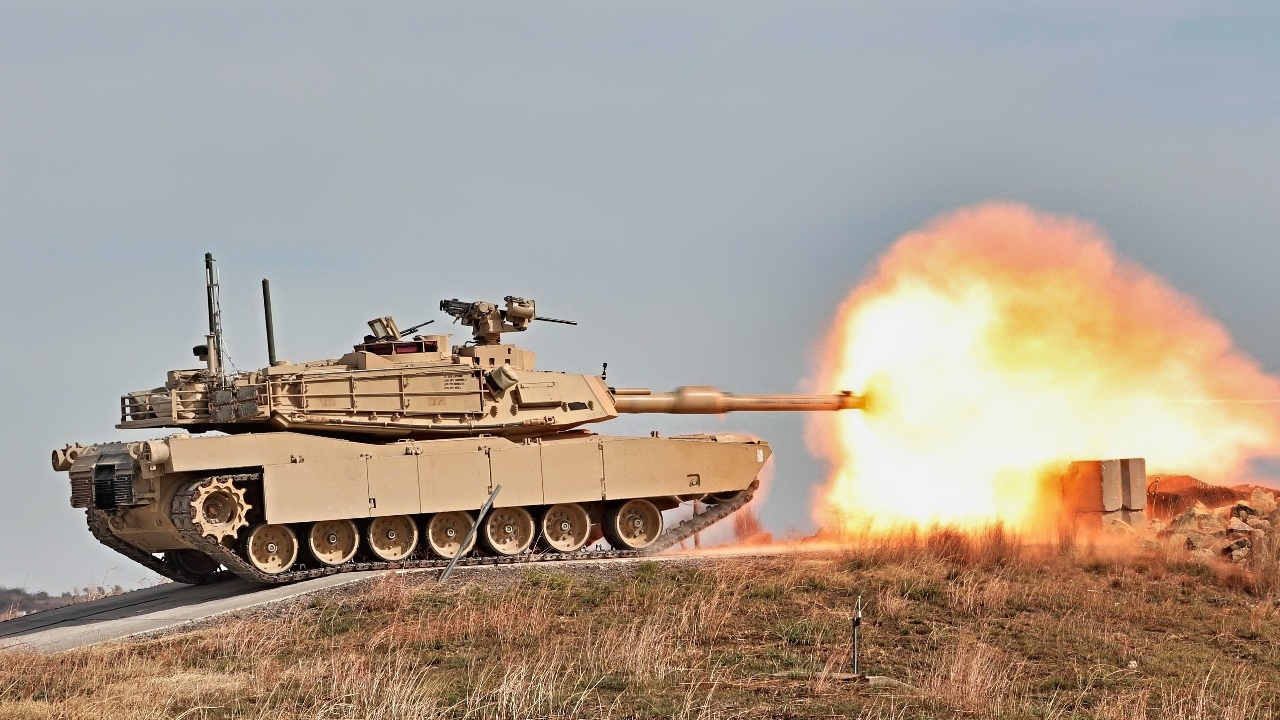
An M1A1 Abrams tank operated by Soldiers with the 2nd Battalion, 70th Armored Regiment, 2nd Armored Brigade Combat Team, 1st Infantry Division, fires over a barricade at the Douthit Gunnery Complex on Fort Riley, Kansas, Oct. 20, 2022. The tank crew was conducting gunnery qualification. (U.S. Army photo by Sgt. Jared Simmons)
The M1A1 Abrams was battle-proven, surplus to Australia’s requirements, and expensive to store.
Shipping them to Ukraine looked strong, but at relatively little cost to Australia’s own war-fighting capability.
In the short term, Ukraine has noticeable gains.
In a war of attrition where victory is measured in meters, every tank that works counts.
The Abrams is an icon of Western power, and on paper, at least, it’s a significant shot in the arm for Ukraine’s dwindling armor stocks.
But that logic misses the point.
The M1A1 Was Built for a Different War
The Abrams is a product of the late Cold War, designed in the 1970s and last given any significant updates two decades ago. It was built to fight high-intensity, force-on-force warfare against massed Soviet armor on open ground.
The fight in Ukraine is the opposite of that: dispersed, drone-saturated, and determined by the flow of information. The Abrams still has one of the best frontal armors of any tank. But it has a weak roof, which is unprotected by modern active protection systems such as Trophy or Iron Fist.
In an age of inexpensive FPV drones, loitering munitions, and top-attack missiles, that vulnerability is a death sentence.
The M1A1’s own advantages, its size, its power, and its unmistakable silhouette make it an inviting target for a munition costing less than a single Abrams track pad.
Australia’s M1A1 AIM SA variant reportedly has been fitted to run on diesel as well as the U.S. Army’s jet-fuel-powered gas turbine, which gives it some logistical commonality with Ukraine’s diesel-fueled fleet.

A U.S. Army M1A2 SEPv2 Abrams assigned to Alpha Company, 1st Battalion, 67th Armor Regiment, 3rd Brigade Combat Team, 1st Armored Division prepares to move off the live fire range after completing the day portion of Table VI Tank Gunnery conducted at McGregor Range, New Mexico, Sept. 29, 2023. Gunnery Table VI evaluates crews on engaging stationary and moving targets while utilizing all weapons systems in offensive and defensive positions, ensuring our crews are trained and ready for any mission. (U.S. Army photo by Spc. David Poleski)
But that single change aside, it remains a fuel-guzzling, maintenance-intensive system that demands a constant diet of spare parts, lubricants, and a corps of highly trained mechanics. The tank is effectively its own self-contained ecosystem of sustainment that Ukraine’s overtaxed military can scarcely afford to support.
The Abrams’ optics and networked datalinks are similarly years behind those of newer tanks and squad vehicles. In this war, where the side that sees and strikes first usually wins, the M1A1’s technical backwardness is not a minor quirk but a fatal flaw.
America Was Not Happy
Washington saw all this early on. American officials privately warned that the Abrams would be “difficult to sustain” and would likely consume more effort and resources than they were worth. The administration’s concerns were more political than logistical.
Every new platform and system has its own training cycle, spare-parts pipeline, and maintenance regime. As Ukraine’s arsenal diversifies, achieving and maintaining efficiency and readiness will become more complicated.
Intent still matters. For Australia, the tanks were both a demonstration of its strategic autonomy and an assertion of Canberra’s new willingness to act without awaiting Washington’s approval. The Abrams may not be essential for Ukraine, but they are symbolically important.
For Kyiv, the question is how to use them, even if it is only for endurance.
These tanks are less about a Ukrainian armored transformation than a stopgap —an insurance policy that can buy Ukraine time while it rebuilds its own industry. If used well, with plenty of cover from electronic warfare and air defenses, even an old Abrams could still fight.
The question is whether Ukraine can integrate them and make them part of a mixed arsenal rather than a showpiece.
The true test will be how the Ukrainians use them. If Ukraine simply deploys them for morale or political effect they will die as museum pieces.
But if used wisely and carefully, integrated into Ukraine’s evolving combined-arms doctrine, and supported by rapid-repair teams, counter-drone systems, and networked reconnaissance, they could still play a role. It will be less a matter of the tanks than of how the Ukrainians adapt to use them.
The Abrams is still capable of killing anything Russia puts in its path. Ukraine must find a way to make it smart enough to fight long enough to do that.
The Bottomline: M1A1 Mistake? Well…
Australia’s donation reflects both the generosity and the cluelessness of Western military aid.
It is an act of fraternal solidarity, yes, but also one that betrays a lack of understanding of how war has evolved.
The Abrams was built for a different era of war, one of attrition and aggression, where weight and armor could be decisive.
Ukraine’s war is a war of sensors, drones, and data, and adaptability is of greater value than tonnage.
Canberra’s gift is thus both magnanimous and anachronistic, a reminder that metal alone doesn’t win wars anymore.
Whether those tanks live or die, their real value may be in goading the West into realizing that victory in this century’s war goes not to the one with the heaviest metal, but to the one who can learn the fastest and think the clearest in the fog of war.
About the Author: Dr. Andrew Latham
Andrew Latham is a non-resident fellow at Defense Priorities and a professor of international relations and political theory at Macalester College in Saint Paul, MN. You can follow him on X: @aakatham. He writes a daily column for the National Security Journal.
More Military
China’s H-20 Stealth Bomber Has a Message for the U.S. Air Force
China’s New J-35 Stealth Fighter Has a Message for the U.S. Air Force
China Is Studying the Ukraine War to Become a Drone Superpower
The Road to a China-America Nuclear War
China Could Fire Mach 6 Hypersonic Missiles from Bombers to Sink Navy Aircraft Carriers


