


As the war in Ukraine has shown, a cheap $500 drone can defeat the heaviest armored tank with frightening regularity.
The U.S. Army just got a hard lesson in that, courtesy of the people who know it best.
According to a New York Post article this week, Ukrainian drone operators playing the role of the OPFOR (opposing enemy forces) in a recent major exercise in Germany caused roughly 70 percent of an American armored brigade’s casualties in the first three days.
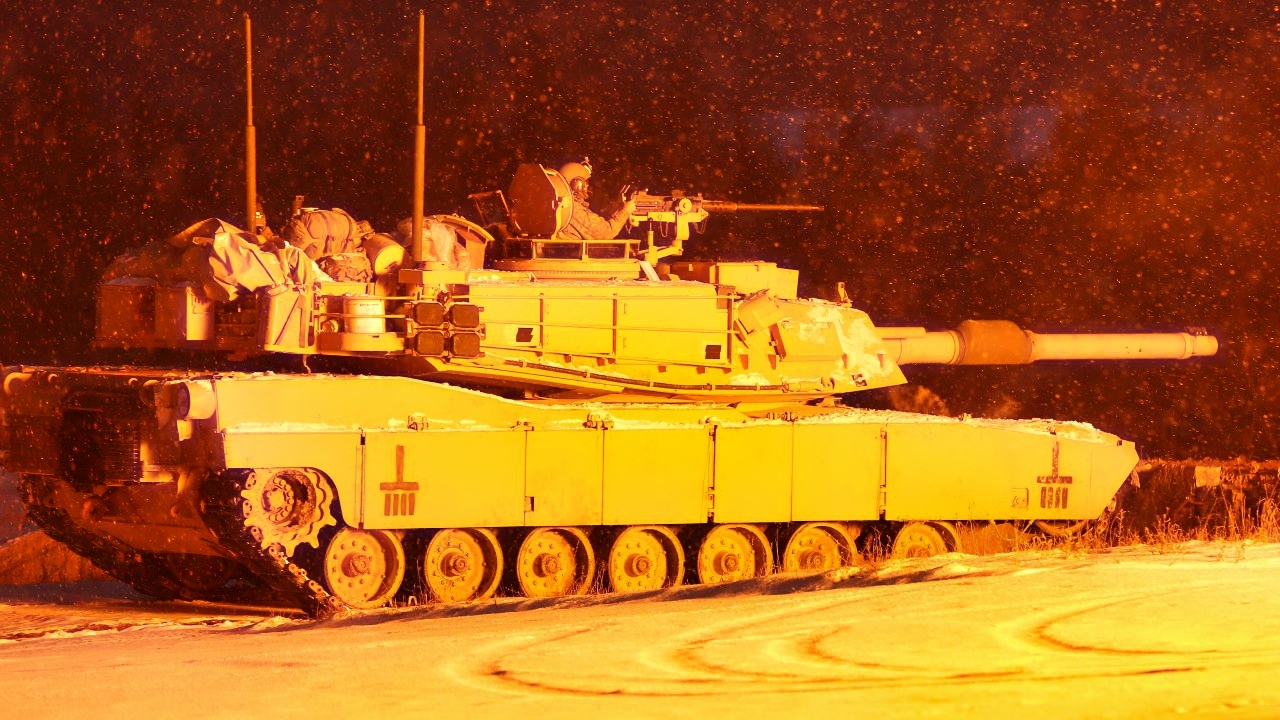
U.S. Soldiers assigned to 1st Squadron, 7th Cavalry Regiment, 1st Armored Brigade Combat Team, sit ready to engage targets in an M1 Abrams Main Battle Tank during Combined Resolve XV live fire exercise at Grafenwoehr Training Area, Germany, Feb. 9, 2021. Combined Resolve XV is a Headquarters Department of the Army directed Multinational exercise designed to build 1st Armored Brigade Combat Team, 1st Cavalry Divisions’s readiness and enhance interoperability with allied forces to fight and win against any adversary. (U.S. Army photo by Sgt. Randis Monroe)
The Post stated that $500 drones were used against fully upgraded M1A2 Abrams tanks valued at $25 million apiece (M1A2 Abrams actually cost between $10-15 million each), plus M2A3 Bradleys.
The exercise’s results were confirmed in an article in Military Review, the Army’s own professional journal, written by Col. Michael Ziegelhofer and six of his officers.
Ziegelhofer commands the 3rd Armored Brigade Combat Team, 1st Cavalry Division, the Greywolf brigade out of Fort Hood.
Ziegelhofer wrote that the Brigade had to change how it fought because enemy drones affected the exercise.
He added that the “persistent surveillance combined with strikes from unmanned aircraft (drones) or tube and rocket artillery has created what a recent RAND report calls “a new and unresolved dilemma for offensive operations.”
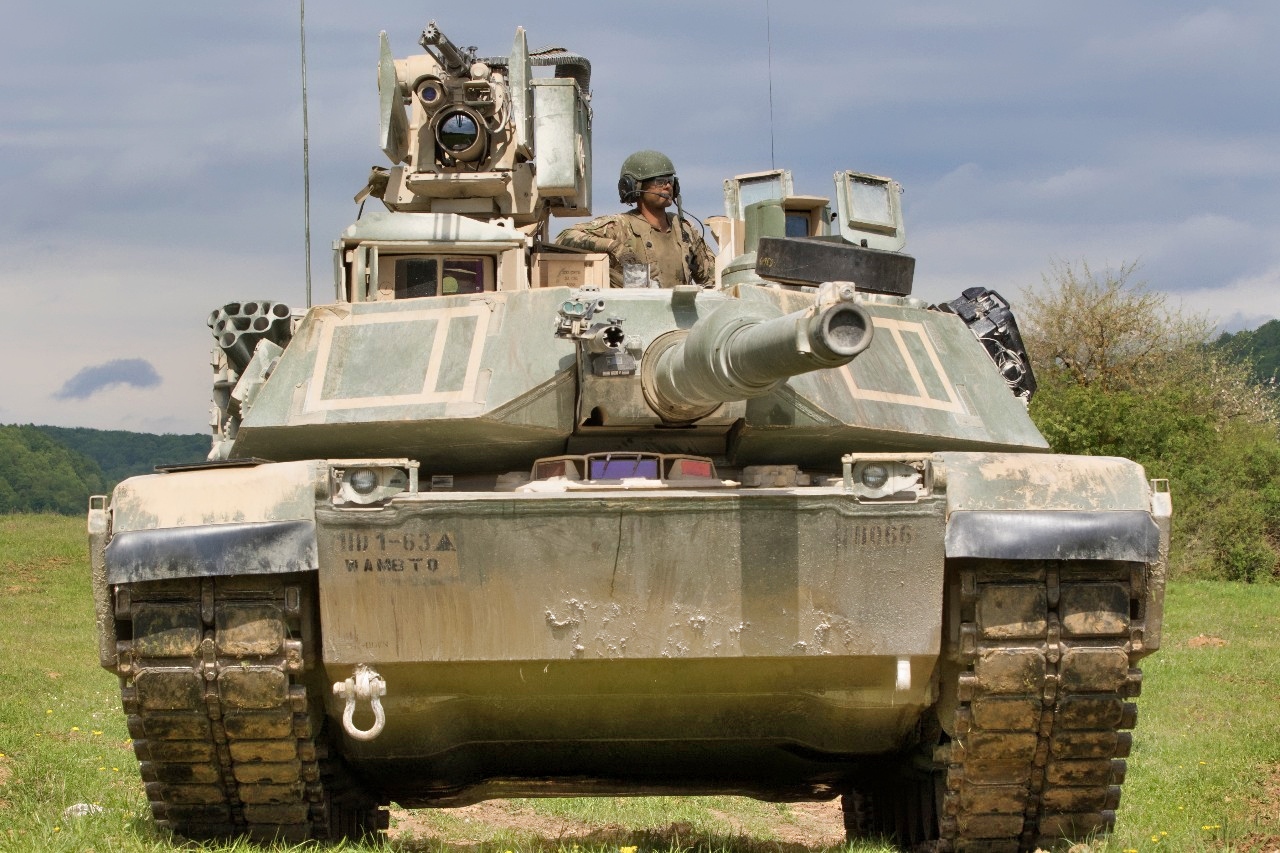
An M1A2 Abrams tank from 1st Battalion, 63rd Armor Regiment, “Dragons,” 1st Infantry Division, Fort Riley, Kansas, pulls during Combined Resolve X at the Hohenfels Training Area, Germany, May 1, 2018. Exercise Combined Resolve X is a U.S. Army Europe exercise series held twice a year in southeastern Germany. The goal of Combined Resolve is to prepare forces in Europe to work together to promote stability and security in the region. (U.S. Army photo by Spc. Andrew McNeil / 22nd Mobile Public Affairs)
Ukrainian Drone Operators Are Well-Versed In Combat Operations
The Ukrainian drone force has been growing and adapting to the quickly changing aspects of the war with Russia incredibly fast.
It hasn’t gone unnoticed by NATO’s leaders, who see the drone threat as one that they are lagging far behind in.
The United States, in particular, faced critical gaps in drone warfare preparedness before the conflict with Iran.
While the US military excels at high-end, traditional air dominance, decades of lopsided conflicts left forces underequipped for cheap, mass-produced, and autonomous aerial threats.
Defense analysis and recent combat incidents highlight major systemic vulnerabilities. US air defenses are geared toward defeating ballistic missiles.
As a result, they have relied on the Terminal High Altitude Area Defense (THAAD) and Patriot missile defense systems, which are highly effective but also very expensive.
Each Patriot missile costs roughly $4-5 million; however, Lockheed is developing a lower-cost interceptor, the PAC-3, projected at under $2 million per round. Legacy variants (PAC-2) range between $1 million and $3 million.
Such defenses, however, are not effective against swarms of cheap drones.
The Ukrainians have become masters of these tactics, which is why NATO has taken notice.

An M1A2 Abrams tanks, assigned to 1st Battalion, 16th Infantry Regiment, 1st Armored Brigade Combat Team, 1st Infantry Division, maneuver into fighting position during a battalion live-fire range during Agile Spirit 19 at Orpholo Training Area, Georgia, August 9, 2019. AgS19 is a joint, multinational exercise co-led by the Georgian Defense Forces and U.S. Army Europe which incorporates a command post exercise, field training and joint multinational live fires. (U.S. Army photo by Staff Sgt. True Thao)
“Ukraine needs NATO, but NATO needs Ukraine as much as the other way around,” said Finland’s President Alexander Stubb, who joined NATO in 2023.
Fewer Than 20 Ukrainian Drone Operators Against A Brigade
The exercise took place during Combined Resolve 26-07 at the Hohenfels Training Area in Bavaria, which ran from April 9 to May 10.
Roughly 3,500 American troops faced an opposing force reinforced by Ukraine’s 412th Unmanned Systems unit, better known as Nemesis.
The Ukrainian detachment was tiny. Kyiv Post estimated that fewer than 20 pilots and technicians were on hand for the exercise, but they punched far above their weight.
Over the roughly 10-day rotation, enemy drones initiated contact more than 750 times, according to Defense Blog’s breakdown of the Military Review piece. Some struck directly. Other drones sought artillery targets.
The Wall Street Journal first reported on the exercise back in August, stating that the Ukrainians logged simulated kills on the US Armor so fast that controllers had to bring destroyed vehicles back to life just to keep the exercise running, as the Daily Wire summarized.
The Dust Gave The US Armor’s Positions Away
Heavy armor on the move kicks up dust, and Ukrainian reconnaissance drones spotted it right away.
Recognizing this, the Ukrainian drone operators launched a variety of bomber and FPV drones immediately after the surveillance drones spotted the dust clouds.
The Ukrainian crews have four and a half years of experience fighting Russian armored formations while repairing and rearming drones under fire.
American operators don’t have that experience.
The Greywolf brigade’s counter-drone and electronic warfare systems could throw up jamming bubbles as wide as 2 km.
They also had to be set up at fixed sites and leapfrogged forward in bounds, which left units exposed every time they moved.
The jammers did little against fiber-optic FPV drones steered through a thin cable, which can’t be jammed.
So more than half the formation went back to basics: cover, concealment, dispersion, smaller routes and fast battle drills to clear out before the artillery landed.
The authors estimate that roughly 60 percent of the brigade-level counter-drone fight comes down to fieldcraft and drills.
That was the most important aspect of the entire exercise.
Fieldcraft is the first skill a garrison army lets slide, and the authors concede it took heavy simulated losses before soldiers applied what they’d practiced.
Seventy percent.
From an armored brigade.
Survival came at a price.
Crews shut off Blue Force Tracker, cut radio traffic, and even dropped Starshield satellite links to shrink their electronic signature.
Resupply took twice as long as planned because the enemy hunted the logistics lines, as they’ve done with incredible effectiveness against the Russians.
It worked anyway.
By the end of day three, drone-caused casualties had fallen below 30 percent, and the Ukrainians hadn’t eased off.
Greywolf Learned To Bite Back
For the offensive phase, the brigade brought in elements of the 3rd Battalion, 504th Parachute Infantry Regiment, then an experimental drone battalion, and flew more than 700 drones from platoon to brigade level.
Relay drones stretched nearly every aircraft’s reach to 25 to 40 km, enough to cover the entire 14-by-27 km training box.
That flood initially swamped headquarters.
The staff never had a complete picture of how many drones were in the air.
So they stopped micromanaging, gave drone units clear priorities, and let them hunt within the commander’s intent.
OPFOR drone ground control stations were at the top of the target list.
By the end of the rotation, Greywolf ran two simultaneous breaches through dense forest about 6 km (3.7 miles) apart, and the opposing force couldn’t tell which one was the main effort.
Allan Watson, the Blackhawk company commander in the brigade, wrote in Task & Purpose that Nemesis drones were already overhead as his company rolled through the only gate into the training area.
He gave the Ukrainian operators a strong compliment, calling the exercise’s early days “a masterclass in sensor-to-shooter kill chain management.”
The Honest Trade-Off
While a drone “kill” in training can be as simple as hovering over a vehicle, some U.S. officers argue drones dominate in Ukraine only because the front has stalled.
The lessons being learned are invaluable.
Ukrainian operators also gave British, Estonian, and other NATO troops a pointed lesson in a Baltic exercise in May 2025, then outperformed a Swedish-led NATO force this spring.
Army Secretary Dan Driscoll has said publicly that the Army keeps buying “exquisite machines that very cheap drones can take out.” He’s right, but that statement has a second part.
The tank and armored infantry vehicles still have a job.
They just need counter-drone protection that works while the unit is on the move, which is exactly what the Greywolf officers are asking for; their lives depend on it in a future conflict.
As Watson pointed out, the exercise didn’t show armored units as obsolete or a liability.
Still, they remain dangerous offensive weapons when troops use cover and concealment and have dedicated counter-drone units attached.
About the Author: Steve Balestrieri
Steve Balestrieri is a National Security Columnist. He served as a US Army Special Forces NCO and Warrant Officer. In addition to writing on defense, he covers the NFL for PatsFans.com and is a member of the Pro Football Writers of America (PFWA). His work was regularly featured in many military publications.


