

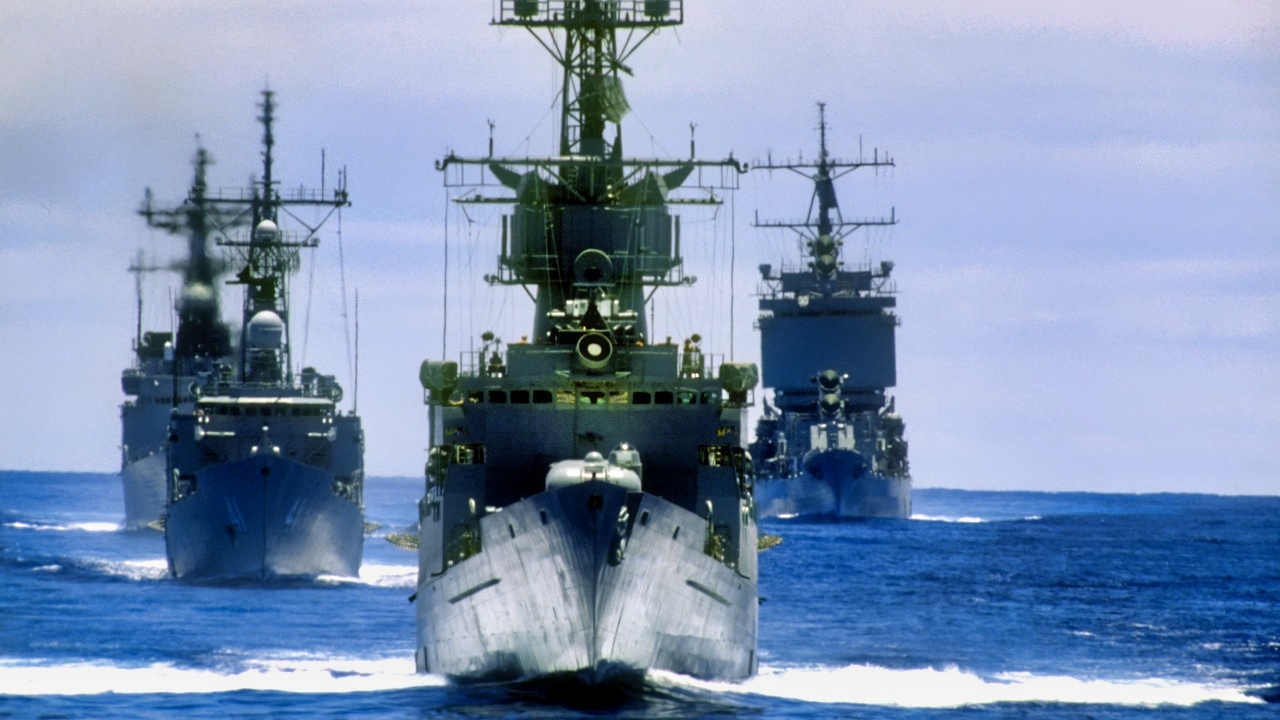
Key Points – The USS Long Beach (CGN-9), commissioned in 1961, was the US Navy’s first nuclear-powered surface warship and the world’s first nuclear-powered cruiser.
-Its two reactors gave it unprecedented range and endurance, showcased in the 1964 all-nuclear “Operation Sea Orbit.”
-The Long Beach was a technological pioneer, armed with an array of missiles and guns, and its high, box-like superstructure housed the SCANFAR radar, a direct precursor to the modern Aegis Combat System’s AN/SPY-1 radar.
-Though scrapped after its 1995 decommissioning, the “last real cruiser” served as a vital bridge to a new era of naval warfare.
-The first nuclear-powered surface vessel began an era capable of extended range, efficiency, and combat power for the United States Navy. This trajectory continues to inspire a massive and growing nuclear-powered force.
Meet the USS Long Beach
The USS Long Beach cruiser followed the first nuclear-powered submarine, the USS Nautilus.
The USS Long Beach, known as the last real cruiser, launched a new nuclear-powered era in surface combat wherein warships could operate at sea for extended periods without refueling.
Long Beach participated in the 1964 Operation Sea Orbit, the first nuclear-powered naval circumnavigation, showcasing American technological prowess and the arrival of nuclear propulsion.
USS Long Beach: The Last Cruiser
The USS Long Beach was considered the last cruiser because it was the last one built before cruisers began being constructed using a DDG 51 destroyer hull.
As the swansong ship of an original cruiser fleet, the USS Long Beach was heavily armed with nuclear-capable cruise missiles, Polaris missiles, and a 38-caliber gun. The ship also carried an ASROC anti-submarine system and a twin Mk-10 launcher firing surface-to-air missiles; an essay in the National Interest further explains that the USS Long Beach was also equipped with a Mk-12 launcher, Mk-15 Vulcan-Phalanx 20mm CIWSm 12.75-in ASW torpedo tubes and a launcher for Harpoons and Tomahawks.
“USS Long Beach was powered by two General Electric D2G nuclear reactors. The nuclear-powered boat’s weapons were the most advanced of their time. These included the Terrier missile system that provided air defense, along with an anti-submarine rocket system and multiple five-inch guns,” an article in The National Interest states.
The USS Long Beach was heavily armed with a wide range of weapons, which likely informed many of the weapons systems subsequently woven into future ships. One key example of this is the addition of a Phalanx-gun-armed Close-in-Weapons System (CIWS), an area defense weapon able to “blanket” an area with hundreds of projectiles per second to defend a ship hull against close threats such as small boats or incoming enemy attack drones.
In more recent years, CWIS has been upgraded to what the US Navy calls the 1b variant, which covers air threats and operates with an ability to fire hundreds of area projectiles at close-in surface threats. This greatly expanded the protective envelope of warships and introduced new dimensions to layered defenses.
The ship’s configuration also included a high box-like superstructure that housed the SCANFAR arrayed radar system. This was quite significant because it contained what became the foundation precursor for what has become known as the famous AN/SPY-1 radar installed on Aegis-equipped cruisers and destroyers.
Operating as what could be referred to as a prelude to Aegis cruisers and destroyers, now famous for deploying the ultra-long-range, highly sensitive AN/SPY-1 radar, the USS Long Beach functioned as a bridge toward a new era in ship-based ballistic missile defense.
Advanced Aegis radar, some of which is configured in what the Navy calls Baseline 10, has ushered in a new era of ship-based weaponry, layered defense, and carrier protection. It is, therefore, quite significant that the radar on the USS Long Beach informed, inspired, and preceded the arrival of the Aegis era.
Commissioned in 1961, the USS Long Beach was originally designed as an all-missile ship but was subsequently armed with two 5″/38 caliber gun mounts per direction from President John F Kennedy.
The ship performed successfully during the Vietnam War and continued supporting various missions until the Gulf War in 1991 before decommissioning in 1995.
Ultimately, the USS Long Beach was sold for scrap but is remembered for its famous successful shoot down on two North Vietnamese MiG-21s in 1968.
Author Expertise
Kris Osborn is the President of Warrior Maven – Center for Military Modernization. Osborn previously served at the Pentagon as a highly qualified expert in the Office of the Assistant Secretary of the Army—Acquisition, Logistics & Technology. Osborn has also worked as an anchor and on-air military specialist at national TV networks. He has appeared as a guest military expert on Fox News, MSNBC, The Military Channel, and The History Channel. He also has a Masters Degree in Comparative Literature from Columbia University.
Iran War
30,000 Pound Bunker-Buster Bombs Might Not Be Able to Destroy Fordow


Ross R Blankert
June 19, 2025 at 9:10 pm
I spent 4 years and 19 days on the USS Long Beach CGN9. She was 721 ft long and could go 35 knots at sea indefinitely and did at times. I learned to be proud of her for all her capabilities and served in the engineroom and as the engineering technical librarian for years. I updated all the manuals and did research all day at times looking for part numbers etc. We did some very long Western Pacific cruises off the coast of Viet Nam doing plane guard. There were no females on these ships and the guys had beards. Things changed over time and Viet Nam war stopped while I was on there. They sent us everytime because of an oil embargo and we did not have to refuel except for the helicopters. It was a steam ship with an unending supply fuel for propulsion. It was my first ship but not my last. I ended up sailing merchant marine and telling sea stories for many years. I’m retired in the Republic of Panama enjoying the weather.
Pingback: The Navy's Ticonderoga-Class Cruiser Nightmare Has Begun - National Security Journal