

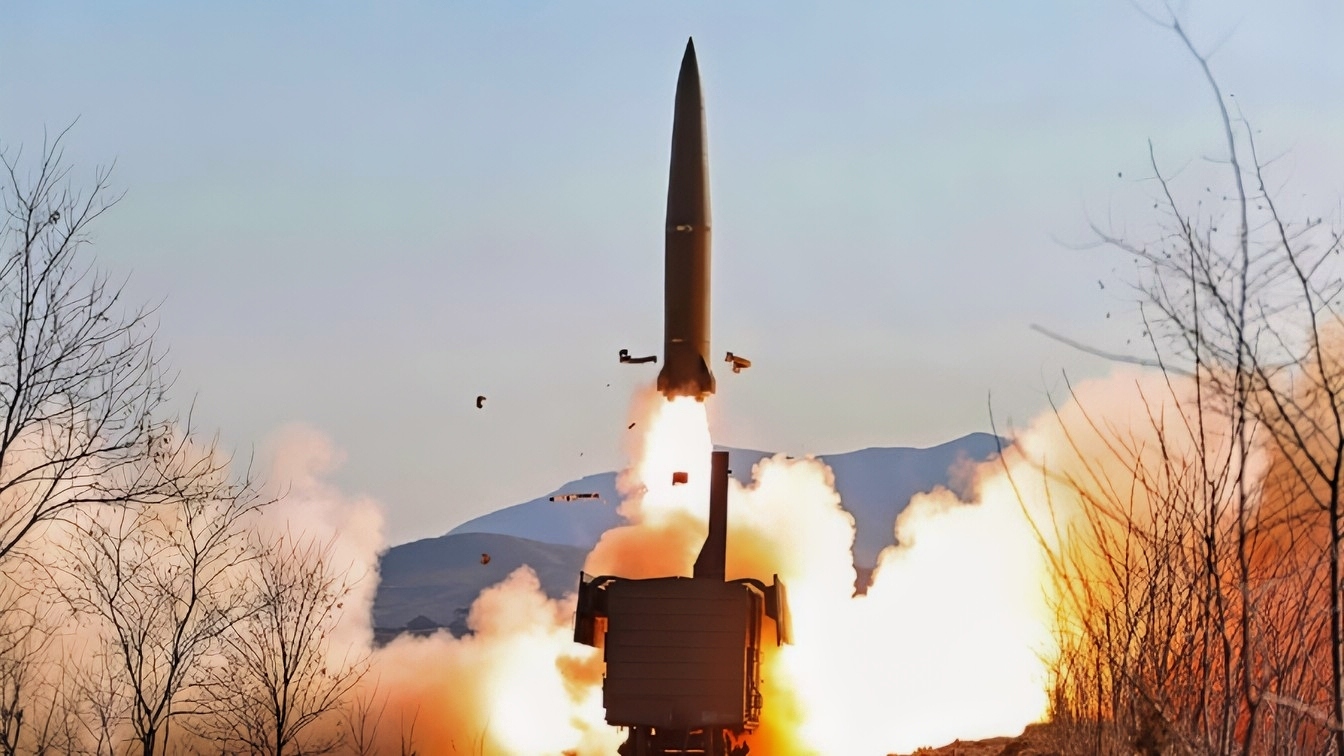
According to an official with Ukraine’s Defense Intelligence Service (HUR), a missile unit from the Democratic People’s Republic of Korea (DPRK) has begun deploying its personnel, missiles, and launchers into western Russia.
Estimates reportedly put the unit’s strength at as many as 120 ballistic missiles and six launchers. They will be employed for missile strikes against Ukraine, said the same HUR official.

Russian President Vladimir Putin (R) meets with North Korea’s leader Kim Jong Un in Vladivostok, Russia April 25, 2019.
The news comes at a more than inopportune moment.
Ukraine has, by its own admission, run out of its US-supplied interceptor missiles that are fired by its Patriot air and missile defense systems.
The city’s capital, Kyiv, was pounded the night of Tuesday, 4 August, and on into the morning of Wednesday the 5th by combined Russian drone and missile attacks.
Ukraine’s President Volodymyr Zelenskiy wrote on his X account that 44 people were injured and that 17 people were killed in this attack.
He pointedly added that “Ballistic missile interceptors could have saved the lives of those killed today.
It is very important that our partners understand that delays in supplying them, or an unwillingness to provide anti-ballistic systems, lead directly to such horrific casualties and destruction.”
Russia has been exploiting this shortage by adding more ballistic missiles to the standard mix of drones plus missile attack packages.
Moscow realizes that the ballistic missiles are particularly hard to shoot down, which is why the number of these weapons used in these attacks on Kyiv and other cities is increasing.

Typhon Hypersonic Missile. Image Credit: YouTube Screenshot.
Highlighting the indiscriminate use of these missiles against non-military targets, the Ukrainian president also wrote: “It was a heavy strike: 24 ballistic missiles, 4 “Zircon/Onyx” missiles, and another 115 drones, a significant portion of which were decoy drones. The main targets of the attack were warehouse facilities belonging to civilian enterprises; there were also strikes against infrastructure and a railway station. Objects unrelated to the war: a brewing company, construction materials warehouses, civilian logistics.”
In another post on the same X page on Wednesday, he said that the number of air defense missiles supplied by partners “has dropped threefold compared with 2025.” He also added that “A significant share of Russia’s ballistic missile production is still not under sanctions. Even now. New steps are needed -from the G7, the European Union, and everyone who supports the protection of life.”
Where The North Korean Missiles Will Be Used
Since the end of 2023, Russia has been firing considerable numbers of DPRK ballistic missiles at Ukraine, but the movements of these mobile launchers and the firing of the missiles themselves have been carried out up until now by Russian personnel.
This new deployment of DPRK missile forces to be manned by North Korean troops would amount to a marked escalation of the growing military cooperation between Moscow and Pyongyang.
Andrii Cherniak of the HUR said Russia planned to base this missile unit, comprising around 90 North Korean personnel, in the western Russian region of Voronezh and deploy it as a component of the Russian 112th Missile Brigade.
Cherniak stated that the DPRK has already sent a new batch of 40 KN-23 and KN-24 ballistic missiles and personnel to Russia.
However, the configuration of the DPRK unit’s deployment and total number of missiles they will be equipped with is supposed to be finalized at talks between Moscow and Pyongyang only next month, he said.
At this point, it is also not discernible what role this Korean People’s Army (KPA) missile unit would be conducting in Russian missile operations. This unit being deployed in Russia now appears to occur in parallel with Russia’s firing of its first two DPRK missiles at Ukraine last week, since this time last year.
A Significant Threat to Kyiv from North Korea
Rob Lee, a senior fellow at the Foreign Policy Research Institute, a Philadelphia-based think tank, told Reuters that, in his estimate, the DPRK sending this weaponry to Russia constitutes a significant threat to Kyiv.
“Ballistic missile defense is [at present] one of Ukraine’s greatest vulnerabilities, so any increase in the quantities of ballistic missiles they face will pose a greater challenge,” he commented.
Recent reports suggest that Russian designers have been able to improve the accuracy of DPRK missile designs by as much as 3,000-fold, further exacerbating the lack of missile defense interceptors Kyiv is suffering from.
Previously, the DPRK has supplied millions of artillery shells to Russia’s war effort and sent 14,000 troops to Russia’s Kursk region to repel a Ukrainian ground incursion in 2024, said Ukrainian officials.
Other reports from last month are that as many as another 30,000 KPA soldiers could soon be on their way to the Ukraine theatre.
About the Author: Reuben F. Johnson
Reuben F. Johnson has thirty-six years of experience analyzing and reporting on foreign weapons systems, defense technologies, and international arms export policy. Johnson is the Director of Research at the Casimir Pulaski Foundation. He is also a survivor of the Russian invasion of Ukraine in February 2022. He worked for years in the American defense industry as a foreign technology analyst and later as a consultant for the U.S. Department of Defense, the Departments of the Navy and Air Force, and the governments of the United Kingdom and Australia. In 2022-2023, he won two awards in a row for his defense reporting. He holds a bachelor’s degree from DePauw University and a master’s degree from Miami University in Ohio, specializing in Soviet and Russian studies. He lives in Warsaw.


