


The U.S. Navy heavy cruiser USS Indianapolis secretly delivered components of the atomic bomb “Little Boy” to the island of Tinian in July 1945 for the bombing of Hiroshima. The Japanese submarine I-58 spotted the cruiser in the Philippine Sea shortly after midnight on July 30, 1945. The I-58 fired torpedoes that struck the USS Indianapolis on her starboard side. The USS Indianapolis sank in about 12 minutes. Approximately 900 sailors were left in the water. The voyage had been secret, and communication failures prevented an immediate alarm. The survivors drifted for nearly 4 days before rescue aircraft accidentally discovered them. She found it once again in 2017.
The USS Indianapolis Has Been Found
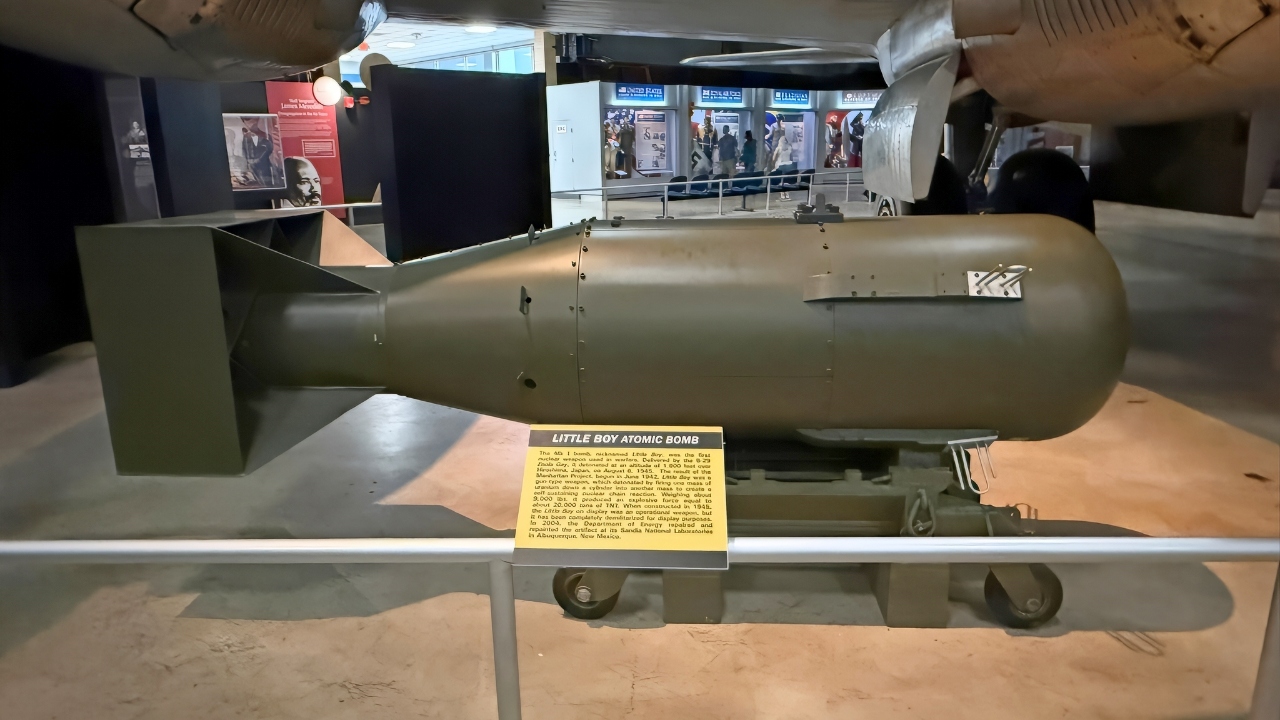
Little Boy Atomic Bomb. Image Credit: Harry J. Kazianis/National Security Journal.
The discovery of the wreck of the USS Indianapolis in 2017 marked the end of one of the most tragic and mysterious stories of the Second World War, as the ultimate location of the famous wreckage had eluded searchers for decades.
For more than seventy years, the exact location of the heavy cruiser remained unknown beneath the Philippine Sea.
The ship’s sinking in July 1945 resulted in the greatest single loss of life at sea in the history of the United States Navy, and the survivors’ ordeal became legendary because of exposure, dehydration, and shark attacks. The eventual discovery of the wreck not only solved a historical mystery but also provided historians and naval experts with new insights into the final mission and destruction of the famous warship.
The USS Indianapolis was a Portland-class heavy cruiser commissioned in 1932.
During World War II, the ship served in numerous Pacific campaigns and became especially important in July 1945 when it secretly transported components of the atomic bomb “Little Boy” to the island of Tinian.

B-24 Bomber from WWII. Image Credit: Creative Commons.
This mission was highly classified because the United States was preparing for the atomic bombing of Hiroshima. After successfully delivering the cargo, the Indianapolis was ordered to sail toward the Philippines to prepare for the planned invasion of Japan.
Japanese Torpedo Attack
Shortly after midnight on July 30, 1945, the Japanese submarine I-58 spotted the cruiser in the Philippine Sea.
The submarine fired torpedoes that struck the ship on its starboard side. The Indianapolis sank in only about twelve minutes, leaving approximately 900 sailors in the water.
Because the ship’s voyage had been secret and communication failures prevented immediate alarm, the survivors were left drifting for nearly four days before rescue aircraft accidentally discovered them. By the time help arrived, only 316 men remained alive. Hundreds had died from wounds, dehydration, exhaustion, saltwater poisoning, and shark attacks. The tragedy became one of the most haunting naval disasters in American history.
For decades, locating the wreck proved extraordinarily difficult. The ship sank in a remote section of the Philippine Sea where depths exceed 18,000 feet. In addition, wartime records contained conflicting information about the vessel’s final location.
Early search efforts were hindered by inaccurate coordinates and the immense challenge of deep-ocean exploration. Unlike more famous shipwrecks such as the Titanic, the Indianapolis lay in a region with little commercial or scientific traffic.
Found by Microsoft Co-Owner Paul Allen
In August 2017, a research expedition funded by Microsoft co-founder Paul Allen finally located the wreck. Allen had become known for financing expeditions to discover historically significant World War II naval wrecks.

Yamato-Class Battleship from WWII. Image Credit: Creative Commons.
Using the research vessel Petrel, the expedition deployed advanced autonomous underwater vehicles and remotely operated cameras capable of operating at extreme depths. On August 19, the search team discovered the wreck resting approximately 18,000 feet below the surface. The ship’s identifying hull number, “35,” was clearly visible on the bow, confirming the discovery beyond doubt.
The recovery mission also revealed important historical and technical information.
Although the wreck itself was not physically raised from the ocean floor, extensive photographic and video documentation enabled experts to assess the ship’s condition.
The wreck showed catastrophic torpedo damage consistent with survivor testimony about the rapid sinking.
The wreck site also demonstrated the remarkable preservation possible in the deep ocean.
Parts of Indianapolis remained surprisingly intact despite spending more than seven decades underwater. Naval guns, propellers, and sections of the superstructure could still be identified clearly. Personal artifacts and equipment also remained visible, serving as haunting reminders of the crew’s final moments.
Heroic Survival
Beyond its military significance, the wreck became a symbol of human endurance.
The survivors’ struggle in shark-infested waters for four days remains one of the most extraordinary survival stories in naval history.
Many survivors described hallucinations, psychological breakdowns, and the constant terror of attacks from the sea. Their experiences became widely known through books, documentaries, and popular culture, especially after the famous monologue about the Indianapolis in the film Jaws.
About the Author: Kris Osborn
Kris Osborn is a Military Technology Editor. Osborn is also President of Warrior Maven – Center for Military Modernization. Osborn previously served at the Pentagon as a highly qualified expert in the Office of the Assistant Secretary of the Army—Acquisition, Logistics & Technology. Osborn has also worked as an anchor and on-air military specialist at national TV networks. He has appeared as a guest military expert on Fox News, MSNBC, The Military Channel, and The History Channel. He also has a Masters Degree in Comparative Literature from Columbia University.


