

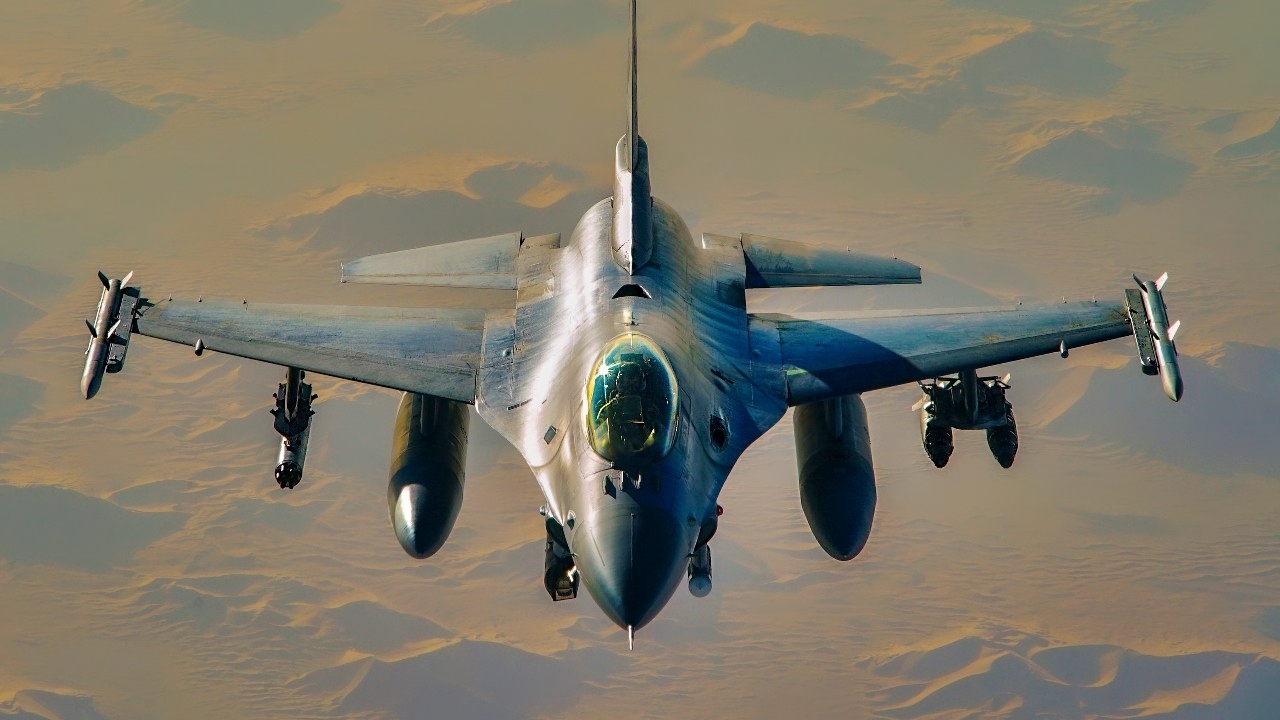
Key Points and Summary – Tragedy struck in Poland on August 28 when a Polish Air Force F-16C fighter jet crashed during a practice flight for the Radom air show, killing the pilot.
-The pilot was identified as Major Maciej “Slab” Krakowian, an experienced instructor and the leader of the air force’s Tiger Demo aerial display team.
-Video of the incident shows the aircraft impacting the ground at the bottom of a loop maneuver.
-While the official cause is under investigation, speculation points to potential pilot error or a G-LOC (G-force induced loss of consciousness) event.
Polish Air Force F-16C Aircraft Crashes Preparing for Air Show, Pilot Killed
WARSAW, POLAND – On August 28 at approximately 1925 hours, a Polish Air Force (Sił Powietrznych or SP) US-made F-16C Block 52+ fighter aircraft crashed while preparing for this weekend’s annual air show at Radom-Sadków Airport.
The aerodrome, which has been the site of this air show at the end of every August for decades, is located 100 kilometers south of Warsaw.
Information about the crash was first reported from OSINT monitoring channels, stating that the aircraft was practicing an aerobatic set of maneuvers typical of an air show flight display.
Training flights for the SP’s Tiger Demo aerial display team were for Friday, but the pilot, Major Maciej “Slab” Krakowian, took to the air as dusk was approaching at the aerodrome site.
According to the former Polish Interior Minister and Coordinator of Special Services, Tomasz Siemoniak, Krakowian was killed in the incident. The Polish military authorities have yet to issue an official statement regarding the incident.
The SP identified Krakowian and described him as a top ace, as the leader of the display team. Earlier in the month, he had won the “As the Crow Flies” trophy for the “best overall flying demonstration” at the 2025 Royal International Air Tattoo that takes place outside of London in Fairford, Gloucestershire.
The Polish SP Major was described as an experienced combat pilot with over 1,000 hours of F-16 flying experience.
He had been assigned as an instructor at the 31st Tactical Air Base near Poznań. The General Command of the Polish Armed Forces said on Thursday that today’s accident involved an aircraft from that airbase.
Krakowian was a graduate of the Aviation Training Institute in Dęblin, the SP’s chief training site in Poland, and the United States Air Force Academy in Colorado Springs, where he studied for four years.
At The Site of the Accident
Upon the news of the tragedy, the Polish Minister of Defense, Władysław Kosiniak-Kamysz, traveled to the crash site and confirmed the pilot’s death. In a message posted on social media, he expressed condolences to the pilot’s family.
His posting reads: “I am at the scene of the tragedy. In the crash of the F-16 aircraft, a pilot of the Polish Armed Forces has died—an officer who always served his homeland with dedication and great courage. I pay tribute to his memory. To his family and loved ones, I extend my deepest condolences. This is a great loss for the Air Force and for the entire Polish Armed Forces.—Władysław Kosiniak-Kamysz”
The SP originally procured 48 F-16C/D Block 52+ fighter jets, which were delivered between 2006 and 2008. Since that time, these aircraft formed up as the “tip of spear of Poland’s air power assets.
These aircraft are equipped with the AN/APG-68(V)9 mechanically-steered array (MSA) radar and Pratt & Whitney F100-PW-229 IPE engines. Poland’s military utilizes these aircraft as the first line of the country’s air defense and has been a key element in Poland’s integration into NATO’s combined air operations.
This crash occurred just two weeks after Poland signed a $3.8 billion contract to upgrade the entire F-16 fleet to the F-16V Viper Block 70/72 configuration under a Mid-Life Upgrade (MLU) program. The agreement was announced on August 13, with the lead item of the modernization package being the replacement of the older MSA radar with the AN/APG-83 Scalable Agile-Beam Radar (SABR).
The AN/APG-83 is an Active Electronically Scanning Array (AESA) fire control radar, a core technology of the upgrade, which also includes a new mission computer, an advanced electronic warfare system, an improved communications suite, and several other interoperability features.
Cause of the Crash
There are several video recordings of the crash, which, while they show the tragic occurrence up close, offer few clues as to what went wrong on this day.
In the video, Krakowian is descending towards the ground when the aircraft impacts the ground at the bottom of a loop maneuver and explodes.
At one point, it is clear that the aircraft will hit the hard deck at a catastrophic speed if the pilot does not pull up, but the aircraft’s trajectory never alters to recover from the dive.
There have been several accidents at air shows in the past few decades, with several of them resulting from the pilot not realizing that they had insufficient altitude, airspeed, or energy to avoid colliding with the ground.
In 2009, at the same Radom aerodrome, a two-seat Su-27UB of the Belarus Air Force suffered just such an incident, with both air crew killed as well.
Other speculation, besides this circumstance, is that the pilot could have suffered a G-LOC. This is when the pilot suffers enough G-forces, and due to not enough blood reaching the brain, he suffers tunnel vision and blackout.
About the Reuben F. Johnson
Reuben F. Johnson has thirty-six years of experience analyzing and reporting on foreign weapons systems, defense technologies, and international arms export policy. Johnson is the Director of Research at the Casimir Pulaski Foundation. He is also a survivor of the Russian invasion of Ukraine in February 2022. He worked for years in the American defense industry as a foreign technology analyst and later as a consultant for the U.S. Department of Defense, the Departments of the Navy and Air Force, and the governments of the United Kingdom and Australia. In 2022-2023, he won two awards in a row for his defense reporting. He holds a bachelor’s degree from DePauw University and a master’s degree from Miami University in Ohio, specializing in Soviet and Russian studies. He lives in Warsaw.
More Military
The New Boeing Stealth F-47 Fighter Might Be the Best Ever
The U.S. Navy Can’t Touch Russia’s Titanium Alfa-Class Submarine
The Air Force’s F-22 Raptor Fighter Nightmare Is a ‘Self-Inflicted Wound’
J-36 vs. F-47: Which 6th Generation ‘NGAD’ Fighter Will Be ‘First’?


