

With the aircraft carrier USS Gerald R. Ford finally heading home after what has become the longest U.S. Navy carrier deployment since the Vietnam War, senior Navy leaders are now openly questioning whether the fleet can continue sustaining its current wartime operational tempo.
During a recent Military Officers Association of America forum, Master Chief Petty Officer of the Navy John Perryman said the service is reassessing how to maintain a fighting force after Ford spent more than 300 days deployed across multiple theaters during a period that included operations in Venezuela, the Mediterranean, the Red Sea, and Iran.

USS Ford Aircraft Carrier U.S. Navy Photo

(April 14, 2018) An MH-60S Sea Hawk helicopter assigned to the “Chargers” of Helicopter Sea Combat Squadron (HSC) 14, prepares to onload cargo during a replenishment-at-sea between the aircraft carrier USS John C. Stennis (CVN 74) and the fleet replenishment oiler USNS Henry J. Kaiser (T-AO 187). John C. Stennis is underway with Carrier Air Wing (CVW) 9 conducting routine, tailored ships training availability and final evaluation problem. (U.S. Navy photo by Mass Communication Specialist 3rd Class William Ford/Released)
The debate is occurring just as the Navy confirms that the future Trump-class battleship, designated BBG(X), will be nuclear-powered.
The Trump-class is being increasingly pitched as a symbolic return of the battleship, as well as a response to the growing strategic problem that is becoming increasingly visible across the fleet: existing destroyers and carriers are being stretched across too many simultaneous crises while operating in increasingly missile-saturated environments.
The Navy describes a future vessel as a nuclear-powered guided-missile battleship, or BBGN, intended to provide greater endurance and higher sustained speed in its newly released 30-year shipbuilding plan.
The vessel is also described as having sufficient electrical power to support next-generation weapons such as lasers and railguns. The ship is projected to displace between 30,000 and 40,000 tons, potentially making it one of the largest surface combatants ever built outside aircraft carriers.
Trump-Class Battleships Coming: Navy Returning to Nuclear Surface Combatants
The Navy has not operated nuclear-powered surface combatants since the retirement of the Virginia-class nuclear cruisers and USS Long Beach decades ago. Trump-class changes that entirely. According to the Navy’s May 2026 shipbuilding blueprint, the service intends to procure 15 Trump-class battleships through 2055, with the first ship currently projected for procurement in Fiscal Year 2028.
Current cost estimates already place the lead ship above $17 billion, while the first three vessels are projected to cost approximately $43.5 billion combined. Huntington Ingalls Industries and General Dynamics Bath Iron Works are both involved in the design effort.

Trump-Class Battleship. Image Credit: White House.

Trump-Class Battleship. Image Credit: White House.
The Navy has also repeatedly said that the ship is not intended to replace the Arleigh Burke-class destroyer fleet.
Instead, the Trump-class appears intended to operate as a high-end, survivable command ship capable of long-range strike warfare, fleet air defense, command-and-control operations, and future directed-energy combat. It is a forward-looking ship envisioned as a platform for weapons that aren’t yet fully operational – and that marks a significant shift in naval thinking.
For years, the Navy focused heavily on distributing its lethality, using smaller surface combatants and unmanned systems designed to spread power across large areas.
But recent operations in the Middle East and Pacific appear to be pushing planners back toward large, survivable ships capable of sustaining operations for long periods without constantly depending on vulnerable logistics networks.
The ships will complement the next generation of aircraft carriers and their sixth-generation airwings.
How the Iran War Exposed Growing Fleet Strain
Ford’s deployment is arguably the clearest example of the strain currently being placed on the fleet. Since departing Norfolk in June 2025, the carrier has supported operations in multiple theaters before moving to the Middle East during Operation Epic Fury.
During deployment, the carrier has even suffered an onboard fire, plumbing failures, crew fatigue problems, and repeated operational extensions that keep putting pressure on a ship overdue for maintenance.
At one point during the conflict, the United States simultaneously surged three carrier strike groups into the CENTCOM region while also maintaining naval commitments in Europe and the Indo-Pacific.
Meanwhile, shipping instability in the Strait of Hormuz and continued threats in the Red Sea placed additional strain on destroyers, logistics vessels, escort vessels, and other nearby assets.
It is this operational environment that explains why the Navy is increasingly interested in a ship built around endurance and missile capacity rather than simply on fleet numbers.

Iowa-Class 5-Inch Guns. Image by Harry J. Kazianis/National Security Journal.
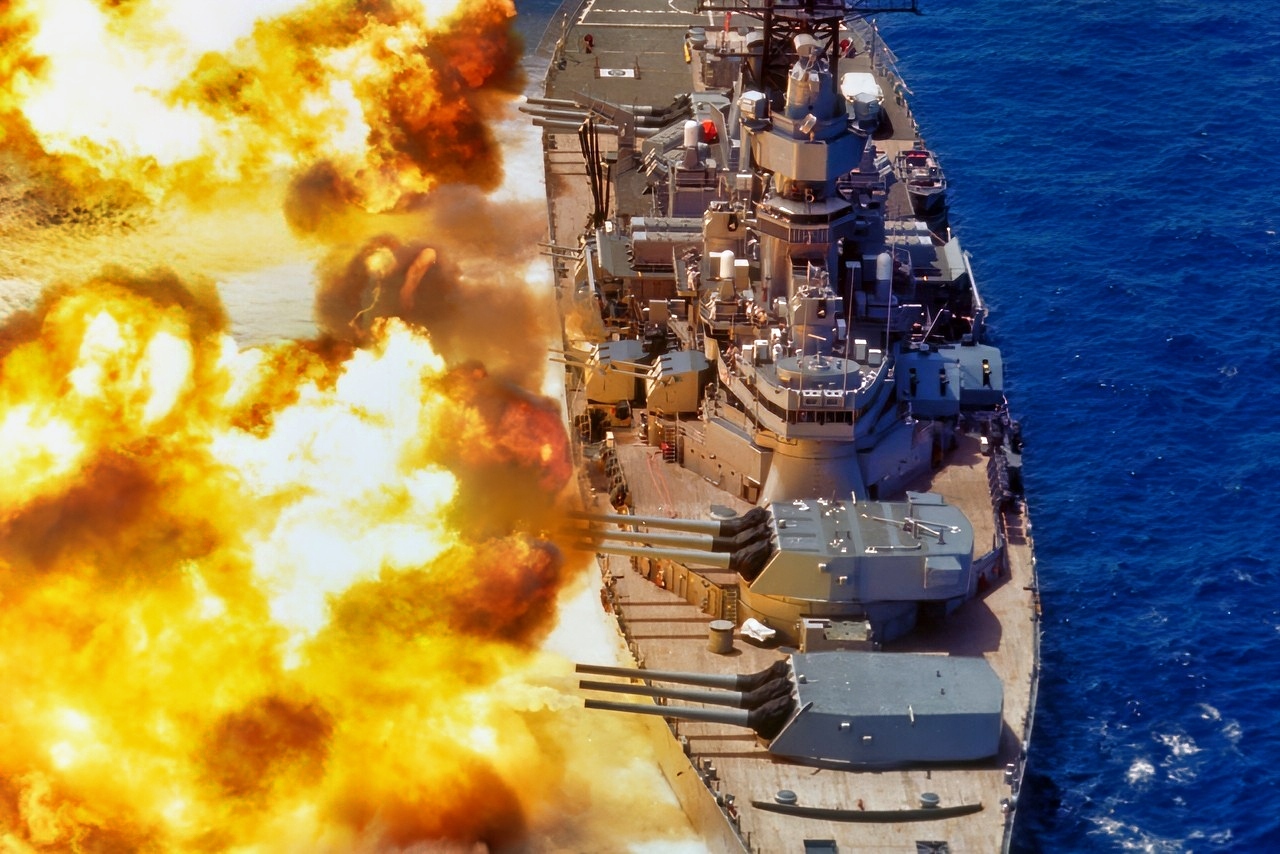
USS Iowa Opening Fire. Image Credit: Creative Commons.
Unlike conventional destroyers, a nuclear-powered surface combatant could operate for extended periods without requiring regular refueling. That will become increasingly important in a future war where replenishment and support shops could become primary targets. Nuclear propulsion also provides vastly greater electrical generation capacity for systems the Navy considers essential to future warfare, including lasers, advanced radar arrays, electronic warfare suites, and, potentially, railguns.
The planned ships are also expected to carry large vertical launch missile batteries alongside Conventional Prompt Strike hypersonic missiles and potentially nuclear-armed sea-launched cruise missiles.
The Navy’s newly confirmed plan to build a fleet of 15 nuclear-powered Trump-class guided-missile battleships over the next three decades also comes as the service prepares to retire some of its most powerful Cold War-era warships.
According to the new 30-year shipbuilding plan released Monday, the Navy will begin retiring the first Arleigh Burke-class destroyers in 2030 and will also dismantle aging Ohio-class submarines and Nimitz-class carriers throughout the coming decade.
The same blueprint projects the procurement of the first Trump-class battleship beginning in Fiscal Year 2028, making the new nuclear-powered vessel a centerpiece of the Navy’s long-term effort to rebuild high-end surface combat power rather than simply maintain fleet numbers.
About the Author: Jack Buckby
Jack Buckby is a British researcher and analyst specializing in defense and national security, based in New York. His work focuses on military capability, procurement, and strategic competition, producing and editing analysis for policy and defense audiences. He brings extensive editorial experience, with a career output spanning over 1,000 articles at 19FortyFive and National Security Journal, and has previously authored books and papers on extremism and deradicalization.


John
May 13, 2026 at 9:21 am
Did the navy have a plan for ANY surface ship with these capabilities last year?
The US Navy did away with surface nuke ships due to the cost of the crew.
The US Navy was looking towards smaller distributed targets. If one ship sinks the mission is not lost.
If the Navy thought the DARPA low observable missle carrying truck would work they would hace built it in the 1980’s.
And a surface ship that is mission capable after a torpedo hit is simply laughable.
This is VANITY project.
MICHAEL RICHARDSON
May 13, 2026 at 2:12 pm
Name Ships after people who actually Did something in the Navy Career. He doesn’t Deserve a Vessel Named after him. Since he didn’t want to Serve When our country needed him… He can try to explain it. But, you didn’t do it… You made excuses…Just like you are doing now with the economy. If you wat to impress us be about what say.We are struggling because of the madness you created. Call Secret service don’t care.. I Served my country with conviction.. I said what I said an I’m good with it…
Engineer_1371
May 13, 2026 at 9:22 pm
This will never, ever happen because the navy is “eternal” to the US, trump is not. He will be forgotten like the trash put at the curb
John Ulmer
May 13, 2026 at 9:57 pm
Nice pipe dream. None of these ships will ever be built. We don’t have the materials to build them. With the Chinese export band on almost all rare earth and critical metal alloys vital for defense production, we’ll be lucky to keep what we already have operating.
George K. John
May 13, 2026 at 10:47 pm
These Trump class vessels are not battleships. News media get this wrong years. All naval vessels that have any sort weapon is a battleship.
Wrong.
Are ships classified as destroyers actually battleships? Uh, no.
Are aircraft carriers battleships? Wrong.
Battleships are very specifically ships that have large caliber guns.
12 inch caliber and up if I remember correctly.
I don’t care what the navy calls these Trump class vessels.Calling them battleships is just plain inaccurate.
Words have meaning. It would be helpful to use the right words.
Tratios
May 14, 2026 at 9:20 am
This is the same thing as trying to use a WW2 dive bomber plane in 2026….
Even if remove the main guns and replace with missiles to give it standoff ability it’s just a big target. One or two anti ship missiles at a faction of the cost just have to hit it, can overload it’s defense umbrella and it’s a sunken ship all for pennies on the dollar.
What is it even designed to fight…is there a single battle ship or even a heavy cruiser left in another nation’s inventory that cannot also be sunk just shooting an anti ship missiles at it from way outside it’s engagement window?
Krystal cane
May 14, 2026 at 5:42 pm
Sorry but we don’t want any ships named after a serial rapist
Øystein Jakobsen
May 15, 2026 at 12:13 am
Europe comisssioned 8 new frigates last year. Australia ordered 11, Norway 5 and so on. Mid sized and multi-mission capable.
South Korea is producing Sejong the Great destroyers with the same missile payload as this Dump class – not in 10 years but now. They cost 1 billion USD each, not maybe 17.
Cost is capability. What do you think wins – 1 Dump class with 132 VLS cells, or 17 Sejong with over 2000?
John
May 15, 2026 at 9:09 am
I hope we’re joking and congress needs to rein in worthless DOD projects. We don’t need more battleships…Drones and aviation.
Maaku
May 15, 2026 at 12:45 pm
It’s fun to read liberal idiots melting down