


The forthcoming USS Doris Miller (CVN-81), a Ford-class supercarrier, has been delayed by an additional 2 years. The new delivery date is February 2034, a delay from the previously projected February 2032. That means the total build time for the aircraft carrier will be about 15 years.
Why so long for one ship?

A U.S. Sailor, assigned to Airborne Command and Control Squadron 124, signals the launch of a Carrier Air Wing 8 E-2D Hawkeye aircraft on the flight deck of the world’s largest aircraft carrier, Ford-class aircraft carrier USS Gerald R. Ford (CVN 78), while underway in the Caribbean Sea, Nov. 29, 2025. U.S. military forces are deployed to the U.S. Southern Command area of responsibility in support of Operation SOUTHERN SPEAR, Department of War-directed operations, and the president’s priorities to disrupt illicit drug trafficking and protect the homeland. (U.S. Navy photo)

A U.S. Sailor inspects an aircraft catapult launch track on the flight deck of the world’s largest aircraft carrier, Ford-class aircraft carrier USS Gerald R. Ford (CVN 78), while underway in the Caribbean Sea, Nov. 25, 2025. U.S. military forces are deployed to the U.S. Southern Command area of responsibility in support of Operation SOUTHERN SPEAR, Department of War-directed operations, and the president’s priorities to disrupt illicit drug trafficking and protect the homeland. (U.S. Navy photo)
Construction bottlenecks at Newport News Shipbuilding suggest the delays aren’t just about one ship—the Doris Miller—but about mounting strain across the US industrial base.
What is the Doris Miller? An Aircraft Carrier Delayed
The Doris Miller is a Ford-class aircraft carrier, the fourth ship in her class. Named for a World War II sailor and Pearl Harbor hero, the Doris Miller is being built by Huntington Ingalls Industries (HII) at Newport News Shipbuilding.
Purchased as part of a block-buy procurement scheme, alongside the USS Enterprise (CVN-80), to reduce costs and stabilize production, the Doris Miller was announced in 2019.
The hope at the time was that block-buy procurement would improve efficiency. But delays are now cascading through the schedule regardless.
Why the Ship is Delayed
The official explanation: limited shipyard construction footprint, meaning Newport News has insufficient capacity to build modules simultaneously. The effect is cascading, with delays to the USS Enterprise spilling over into the Doris Miller production schedule.
Specifically, the dry dock is experiencing a bottleneck, disrupting the structural build. Equipment delays have become a problem, too, with large “sequence-critical” components arriving late.
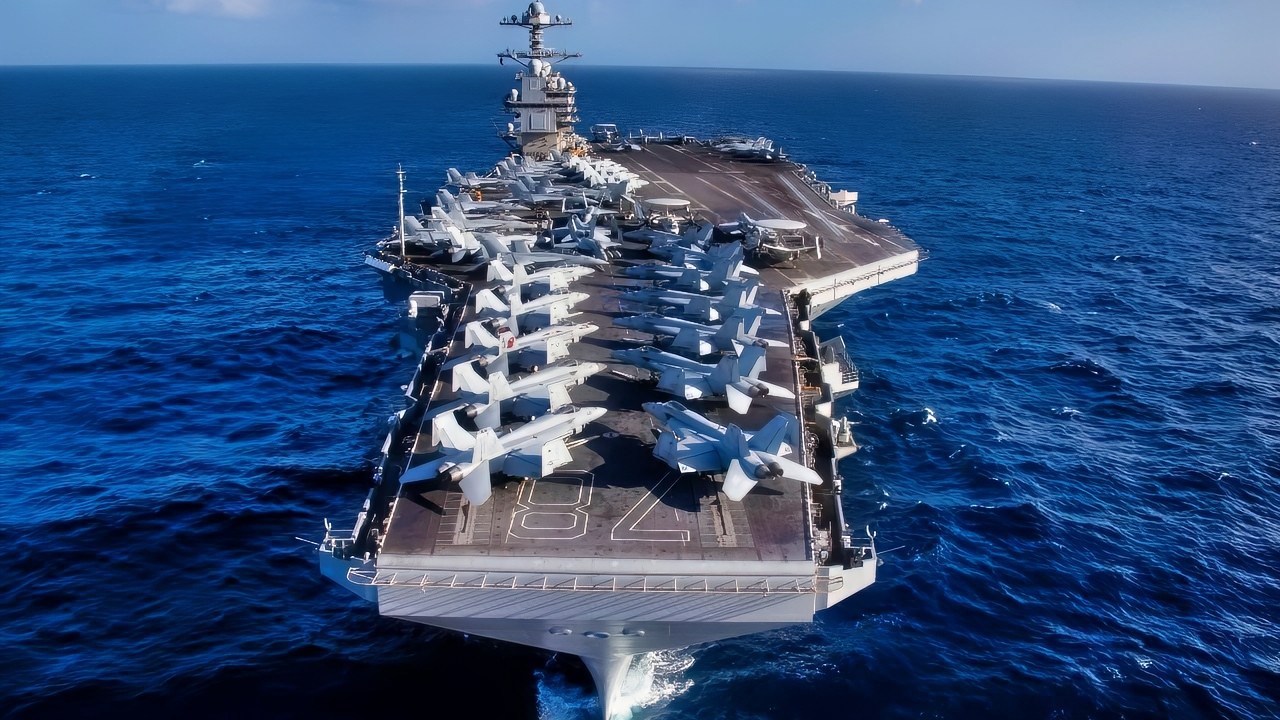
USS Gerald R. Ford Aircraft Carrier At Sea. Image Credit: U.S. Navy.

The first-in-class aircraft carrier USS Gerald R. Ford (CVN 78) transits the Atlantic Ocean, March 19, 2023. Ford is underway in the Atlantic Ocean executing its Composite Training Unit Exercise (COMPTUEX), an intense, multi-week exercise designed to fully integrate a carrier strike group as a cohesive, multi-mission fighting force and to test their ability to carry out sustained combat operations from the sea. As the first-in-class ship of Ford-class aircraft carriers, CVN 78 represents a generational leap in the U.S. Navy’s capacity to project power on a global scale. (U.S. Navy photo by Mass Communication Specialist 2nd Class Jackson Adkins)
The result has been that the shipyard is forced to build its vessels out of sequence, which is more labor-intensive, less efficient, and more expensive. Modern carrier construction has become so complex that one delayed component can ripple through the entire build schedule.
Cascading Delays
Other vessels in the lineup are also delayed. The USS Enterprise is delayed by 8 months, with a new delivery date expected in March 2031. The USS John F. Kennedy (CVN-79) has experienced repeated delays and is now not expected to be delivered until March 2027.
The build times for these supercarriers are becoming increasingly long: 16 years for the JFK, 12 for the Enterprise, and 15 for the Doris Miller. Clearly, the issue is not isolated to one ship. Rather, the issue is systemic, with every single Ford-class carrier behind schedule.
Building the Ford
Building a Ford-class carrier is no simple task.
The vessel is one of the most complex machines ever built. Designed to replace the Nimitz-class, which has served as the backbone of the US carrier fleet for 50 years, the Ford displaces 100,000 tons and relies on two A1B reactors for propulsion and electrical generation.
The Ford is packed with novel technology, including the Electromagnetic Aircraft Launch System (EMALS), which replaces the steam catapults found on the Nimitz and offers smoother launches, reduced aircraft stress, and a higher sortie rate.
The Ford also features the Advanced Arresting Gear (AAG), a digital recovery system that should be more flexible and efficient than the traditional arresting system found on the Nimitz.

The world’s largest aircraft carrier, USS Gerald R. Ford (CVN 78), conducts flight operations in the North Sea, Aug. 23, 2025. Gerald R. Ford, a first-in-class aircraft carrier and deployed flagship of Carrier Strike Group Twelve, is on a scheduled deployment in the U.S. 6th Fleet area of operations to support the warfighting effectiveness, lethality, and readiness of U.S. Naval Forces Europe-Africa, and defend U.S., Allied and partner interests in the region. (U.S. Navy photo by Mass Communication Specialist 2nd Class Maxwell Orlosky)
Ford’s new electromagnetic weapons elevators were also designed with efficiency in mind—but have proven to have reliability problems in the field. From top to bottom, the Ford-class is technologically ambitious, packed with new technologies.
But the development of those new technologies has created a complex, troublesome building process that has repeatedly slowed production.
Strategic Implications
These delays matter because carriers are central to US power projection. Global commitments in the Indo-Pacific, the Middle East, and Europe require a US presence via carriers. And as Ford delays mount, older carriers will be forced to remain in service longer, with their maintenance cycles stretched out.
Readiness is affected, with fewer deployable carriers at any given moment. China, meanwhile, is expanding its shipbuilding capacity rapidly and launching warships at a far faster pace. So these delays directly interfere with the Navy’s ability to sustain a global presence at a time of increasing competition with China.
The problem is that the US depends on Newport News as the only US yard capable of building nuclear carriers. Similarly, labor shortages and training gaps have slowed production, while specialized components are often difficult to source.
At the same time, the Ford-class is competing with upcoming submarines for shipbuilding space in a zero-sum dynamic. Increasingly, the Navy’s shipbuilding bottleneck is about industrial capacity, not just budgeting.
About the Author: Harrison Kass
Harrison Kass is a writer and attorney focused on national security, technology, and political culture. His work has appeared in City Journal, The Hill, Quillette, The Spectator, and The Cipher Brief. He holds a JD from the University of Oregon and a master’s in Global & Joint Program Studies from NYU. More at harrisonkass.com.


