

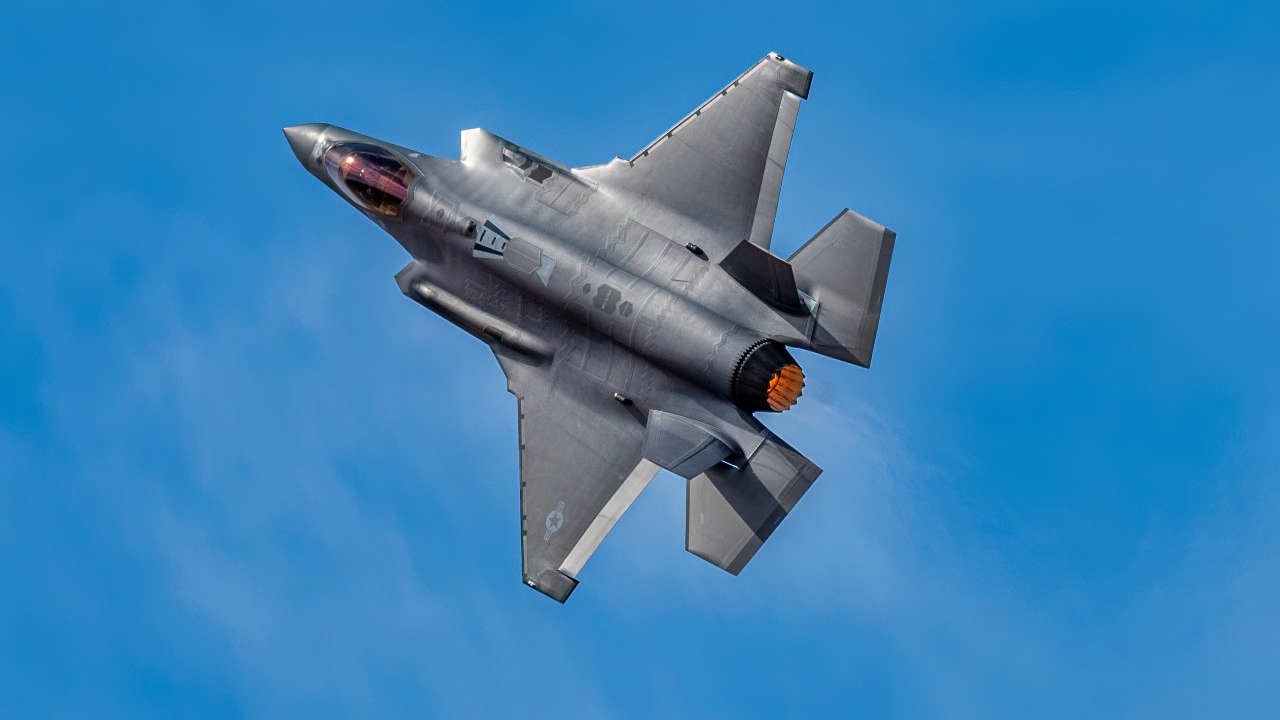
Key Points and Summary – In a historic pivot, the Pentagon is reportedly halving its planned purchase of F-35 stealth fighters, signaling a significant shift in U.S. airpower strategy.
-This analysis argues the move is a long-overdue break from a history of bad procurement choices, like rejecting the superior YF-23.

U.S. Air Force Maj. Kristin “BEO” Wolfe, F-35A Lightning II Demonstration Team pilot and commander, flies a U.S. Air Force F-35 during the Dubai Airshow, United Arab Emirates, Nov. 13, 2023. The U.S. maintains a highly agile fighting force, which leverages the most advanced training and platforms to dominate the warfighting landscape for the long-term security and stability of the region. (U.S. Air Force photo by Staff Sgt. Kaitlyn Ergish)
-Many would argue the F-35 is a vulnerable “procurement Frankenstein,” unsuited for a future war with China or Russia.
-By shifting investment to the 6th-generation F-47 (NGAD), the Air Force is finally treating the F-35 as a temporary bridge, not the final destination, and prioritizing a platform truly designed for future conflict.
The F-35 Fighter Debate Is Just Getting Started
“History doesn’t repeat itself, but it does often rhyme.” Mark Twain’s famous warning ought to be engraved on the bulkhead of every Pentagon acquisition office.
As the U.S. Air Force considers whether to double down on the F-35 or pivot fully to the sixth-generation F-47, the rhyme is unmistakable—and frightening.
Choosing the F-35 Ferrari as a permanent alternative to the F-47 would be a full-throated repetition of the YF-23 and X-35 fiascos: bureaucratic failure disguised as strategic choice.
Indeed, even treating the F-35 as a temporary bridge to the F-47 rhymes with those same failures, diverting resources and attention from the one fighter that might actually dominate in a future war.

NGAD Artist Photo. Image Credit: Creative Commons.
But in a rare and hopeful twist, history seems to have lost its usual rhythm, neither repeating nor rhyming. The Pentagon is now slashing the F-35 buy in half and subtly, but unmistakably, pivoting its focus and investment to the F-47, the flagship of the Next Generation Air Dominance (NGAD) program. For once, it seems the United States is not going to double down on a sunk cost or choose an inferior platform for all the wrong reasons.
A Big Mistake in the Works
This is no small development. For more than two decades, the F-35 has hoovered up the oxygen in every conversation about tactical aviation.
It was sold as the one-size-fits-all answer — stealthy, networked, and interchangeable among three services.
What it ultimately became, of course, was something entirely different: a grotesque procurement Frankenstein with ever-increasing maintenance requirements, persistent availability issues, and a cost that overwhelmed the very force it was intended to empower.

A U.S. Air Force F-35A Lightning II assigned to the 60th Fighter Squadron, flies overhead after conducting a live weapons drop at Camp Shelby, Miss., Oct 25, 2023. During the exercise, pilots tested various munitions including the GBU-12s, GBU-31v1s, and 362 rounds of 25mm Training Munitions from the gun.
But the gravitational pull of the F-35 program was still strong: too many jobs, too many contracts, too much institutional pride to eat crow.
The Big Change on the F-35
That gravitational field, too, might finally be beginning to collapse.
The 2026 budget the Pentagon released would halve the Air Force’s planned F-35A purchase, keeping procurement below previous years, and it represents, an official said on condition of anonymity to discuss the budget before release, a plateauing of the airplane.
The rationale is unmistakable. The F-35 was never designed to fight and win in the dirty, degraded, denied environments that will characterize the next war. It’s a data-intensive house of cards that relies on the very conditions — air supremacy, satellite connectivity, universal comms — that near-peer opponents are already pioneering ways to strip away.

F-35I Adir. Image Credit: Creative Commons.
China’s J-20 and the supporting kill web are being honed in no small measure to destroy the exact kind of platform the F-35 is. The Su-57, awkward but lethal, aims to overwhelm American logistics and adapt to stealth weaknesses. Re-investing in the F-35, either as a permanent answer or a “bridge” to future sixth-gen jets, would be an indulgence the Air Force can no longer afford.
A Look at History on Fighters
This isn’t just about platforms. It’s about breaking a culture of procurement that, for generations, favored style over survival. The YF-23’s relative stealth was even more stealthy, and it was longer-ranged than the F-22, but did so in violation of fighter orthodoxy, and as such was tossed out.
The X-32 was the simple, the sustainment answer, and lost out to the more photogenic X-35. What resulted was the F-35: a triumph of derring-do hobbled by bureaucratic necessity. For years, it appeared that the F-35 would perpetuate the mistakes of its past, and for the opposite reason. Instead of the better fighter that never left the ground, it would be the not-quite-the-best fighter flown for too long.
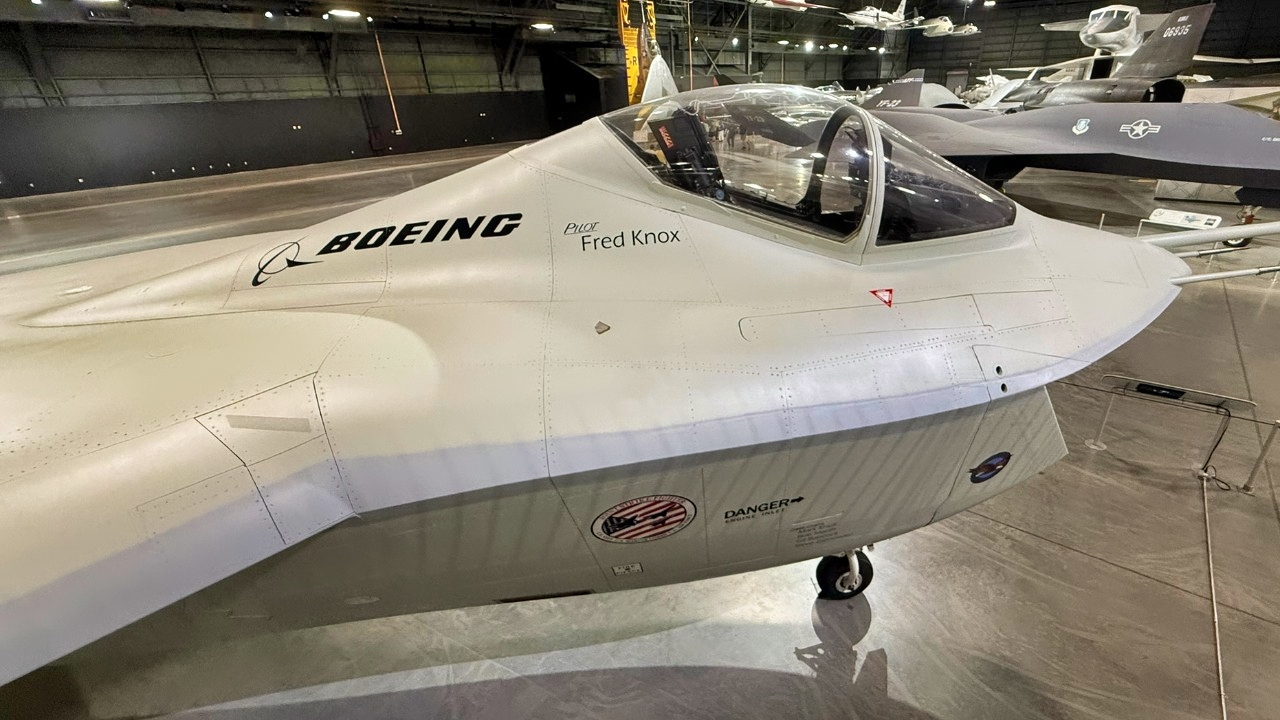
Boeing X-32 National Security Journal Photo.
However, it sends a different message. Curbing its F-35 appetite is not the only thing the Air Force is doing, either—it’s doubling down on investment in the F-47 and the digital ecosystem it will operate within.
This is not a “maybe someday” transition. It’s a realization that the next fight — probably in the Indo-Pacific, possibly in the Arctic, very likely in a denied environment — will need airplanes that can endure without pristine airfields, act independently of vulnerable networks, and operate at a tempo and scale under fire. The F-47 is designed to work under the same terms. It won’t be a tech demo. It won’t be a showroom queen. It’s designed to kill, survive, rearm, and kill again.
Why the F-47 Matters
That is the real break with history. The F-47 isn’t some boutique platform that the Air Force will grab a few of for insurance against future threats. It is being billed as the heart of future U.S. tactical airpower.
It is the opposite of what occurred with the YF-23—a superior aircraft done in by the desire for the tried and true. This time, the Air Force is betting on the unknown because it is closer to the reality of future conflict. This time, the service appears ready to break its habits before an adversary does the same.

YF-23 Black Widow II Fighter Gray Ghost. Image Credit: National Security Journal.
The F-35 Isn’t Going Away Just Yet…
The F-35, of course, still has a job to do. It’s flying with NATO allies. It’ll be in the inventory for a long time. Except it’s not the future anymore. It’s a bridge — and, crucially, it is being treated as such. That distinction matters. As Twain put it, we are not reliving the past. And we don’t even rhyme to it. We are—finally—departing from it.
There will continue to be political pushback. There always is. Defense contractors with traditional equities in the F-35 will lobby Congress. Jobs will be invoked. Nostalgia will be weaponized. However, the fact that the Air Force is already reallocating resources to the F-47 in the face of these headwinds suggests a potential shift. Another life goes unclaimed to the ghost of the YF-23. The mistake with the X-32 is being repeated. The F-35 will not define the sixth generation. That is a question of massive import — and, rarely, wisdom.

YF-23 National Security Journal Photo. Taken by Harry J. Kazianis at U.S. Air Force Museum on 7/19/2025.
What The Air Force Must Do…
Now the Air Force will have to come through. The F-47 should not be so delicate as to be unbuildable in quantity. But then the paper should not be so delicate that it won’t turn in a muddy theater. It has to be repairable, scalable, lethal but survivable — at speed and under pressure. And it must be deployable before the next great-power war renders all this theory moot. That’s the real test ahead. But testing that proposition with the appropriate priority — that is, not by forcing the F-35 to awkwardly retrofit for a role it was never designed for — is a mark of serious strategic adaptation.
We’ve seen what can happen when we use the wrong jet in the wrong war. We’ve seen it when the better design is left on the shelf because it asks too much of the institution. That’s the true lesson of the YF-23 and X-32 — not that they lost, but the reasons behind those losses. This time, it seems the why is finally being addressed.

YF-23 National Security Journal Photo. Taken by Harry J. Kazianis at U.S. Air Force Museum on 7/19/2025.
And so we come full circle. Twain’s insight—“History doesn’t repeat itself, but it often rhymes”—has long served as a grim refrain in the story of American fighter aircraft procurement, echoing through missed opportunities and the quiet burial of superior platforms. But this time, the rhyme is broken. The F-35, once destined to dominate by default, is finally being treated as what it is: a bridge, not a destination.
The F-47 is not a paper promise or a consolation prize. It is the priority.
That shift matters. It signals that the Air Force may finally be choosing based not on flash, inertia, or political expedience, but on the unforgiving demands of future war. It means we are not just rearranging the past with new labels. We are breaking from it.
No longer trapped by the logic that doomed the YF-23 and X-32, the institution is—tentatively, but decisively—charting a new path.

YF-23 Fighter at USAF Museum. Image by Harry J. Kazianis/National Security Journal.
If that holds, then this moment will be remembered not as another verse in a tragic poem, but as the stanza where the rhyme was finally interrupted. For once, Twain’s warning might not just haunt the margins of the story. It might mark the point where it stopped repeating itself, and Washington started making better procurement choices in the fighter aircraft space.
About the Author: Dr. Andrew Latham
Andrew Latham is a non-resident fellow at Defense Priorities and a professor of international relations and political theory at Macalester College in Saint Paul, MN. You can follow him on X: @aakatham. He writes a daily column for National Security Journal.
More Military
We Almost Touched the F-117 Stealth Fighter


Rodger
July 28, 2025 at 9:37 pm
In the end, it’s just an opinion, maybe an educated one, but still, just an opinion. And everyone knows what that means.
Phil Ian
July 28, 2025 at 10:13 pm
Agreed that the YF-23 is closer to a 6th gen fighter than the YF-22 was. However you’re missing some key points. The YF-22 had superior AOA operation because of its thrust vectoring engine which Northrop chose to not incorporate into the YF-23 even though they knew in advance about the jet engine. Also, the YF-23 internal bomb bay layout was significantly inferior to YF-22 design. For these tactical reasons plus the superior sales presentation by Lockheed thus gave the YF-22 the edge. Finally, the F-35 is a critical bridge to the next 6th gen jet because it is a modern stealth strike fighter which the USAF did not have and needed to operate along with its F-22 stealth air superiority fighter. At this time, the F-47 is designated for air superiority and may or may not use drones for strike missions until the developmental phase is farther along. Thus the F-35 was and is needed now and into the future. The Israelis have validated its war fighting success.
J Dragner
July 29, 2025 at 2:02 am
I think this writer is from an alternative universe or something.
R Nason
July 29, 2025 at 8:38 am
A few things that you didn’t mention. The F35 is the best jet fighter in the world. It is also getting a major upgrade with Block 4 and the ECU that will allow it to maintain its air superiority into the next decade. Halving the F35 procurement will significantly increase unit costs due to loss of volume discounts and less economy of scale. This can be an acceptable cost to take on, vs continuing to buy more 5th gen ac, if the actual full scale production timing for the 6th gen F-47 is close enough to allow for a full switchover with no loss in yearly fighter ac output.
JimmyG92
July 29, 2025 at 3:28 pm
The YF-23 may have been Superior in Some ways but not all. And if the f-22 had been procured in proper #’s and if they had built the FB-22 then we may not even be looking into a sixth gen jet. As for the X-32, while it was a fine jet with splendid handling. It was flawed in STOVL and was lighter weight with reduced payload and reduced range. It was not the superior option but in fact was actually inferior the the yf-35
Steven F
July 29, 2025 at 4:26 pm
This makes me happier than I could ever possibly put into mere words. I feel our whole nation has grotesque, rotten egg all over its face thanks to this shameless capability shift in name ONLY. The F-35 is only meant to serve as a Strike Fighter for operating in uncontested skies or pre-degradated Areas of Operation. Which is funny, because area degradation is on its resume. It’s a beautiful platform for operations against sub-peer nations without bleeding edge capabilities. Which, the two hostiles currently sitting across the table (that is tomorrow’s wars) from us certainly are NOT. So maybe our beautiful, once garuanteed military edge might actually have a chance of survival after all. I guess that really depends on development, procurement and method of implementation of the F-47. With the US Navy’s 6th Gen fighter outright canceled (again, merely because it’s NOT called F-47 [can you say egotistical, megalomaniac? Cause I certainly can, and I just did]), the ONLY hope American Air Supremacy has (across the ENTIRE theater) is for the Air Force and Navy to get over the rivalry they been stewing in for the past century and actually sit at the design table together and develop a fighter capable of serving in both services fresh off the line. No more of this “Hey, Navy, here’s an Airforce fighter. You better use half your budget to alter it so it doesn’t shatter into a million pieces on deck landing.” Looking at you, F-35. Sea based aerial combat is more important than ever before with A2/AD on the rise. I would argue, Naval Fighters are now exponentially more important to mission success than Air Force. Cause you’re not going to need Air Force fighters if you can’t even reach the coast of that enemy’s territory. Naval and Air Force aviators both need to get over their egos and realize they need one another almost as much as they need Supercruise. Again, looking at you, F-35. If the final version of the F-47 doesn’t have a reinforced fuselage, then we all know American Air Supremacy successfully got dumped on again. With today’s technology and resources, there is absolutely no legitimate reason why the NGAD can’t come off the line with all the boxes ticked. Put your money into the same pot and get over yourselves Aviators. If the Army and USMC can coordinate, so can you. How do you even fit that swollen head into your flight helmet? It must be a tight fit.
Joey Bagodonuts
July 29, 2025 at 11:45 pm
Sorry I had to stop reading after you said for the second time the F-35 was picked over the YF-23. Your close but the YF-23 lost to the F-22 while the Boeing X-32 Lost to the F-35. Very different aircraft with different intended rolls.
Yankee TR5
July 30, 2025 at 12:56 am
The F-35 was DESIGNED to penetrate heavily defended skies. Where you come up with dribble like “designed for uncontested skies” is beyond a dark imagination. See recent Iran bombing as proof. It currently is the best, most advanced fighter jet in the world. All those foreign Air Forces didn’t line up and buy for nothing. They “fought” against it in both aerial combat and combat with ground radar assist and got smoked so bad they were flabbergasted and promptly lined up to buy (cancelling their own programs in the process btw)
As to your comment re Navy and Air Force aviators. I know both. They like, and RESPECT, each other. So what’s your point? And one lesson we learned from Ukraine is ships are far more vulnerable than a mobile , deployable Air Force. The rest of your comment is just plain vulgar or nonsensical. Maybe both.
Finally…I think the author of the article was paid by Boeing to write a hit piece about the F35. . Living in Seattle, the engineers I know are more then a little nervous that Lockheed is following the path of the F15EX and will provide a close enough plane to the F47 long before the 47 gets off the ground and that the buy for the 47 is the one that will be fading away
Brandon Fullerton
July 30, 2025 at 3:39 am
Kind of completely missed the point it’s not an either/or situation and both jets are designed to do completely different jobs so they aren’t in competition with each other to begin with.
F-35 replaces the F-16 as a multi role fighter which the F-47 replaces the F-15 and F-22 as an air superiority fighter.
You’d think an understanding of simple facts like classification and mission roles would be mandatory before you were allowed to write for a defense blog but here you are.
Tom A
July 30, 2025 at 12:51 pm
You must be on Boeing’s payroll as you seem like a Lockheed Martin hater. It’s easy to look back at history and point out failures but much harder to predict the future.