

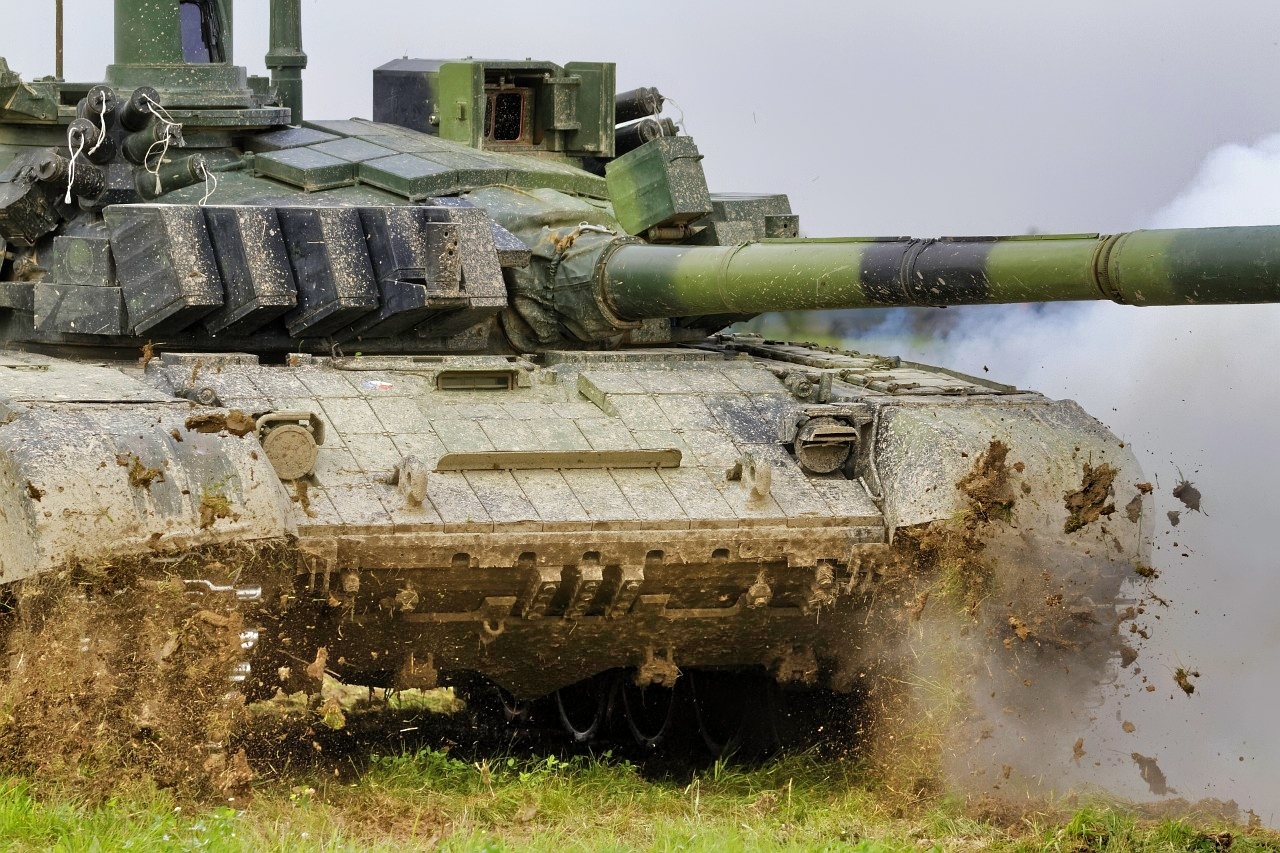
Key Points and Summary – The T-72 once earned fear and respect—from Iran-Iraq and Lebanon to global exports—but its aura eroded in Desert Storm and collapsed in Ukraine.
-Its signature vulnerability is baked in: an autoloader carousel storing propellant around the turret ring. Penetrations trigger rapid “cook-off,” blowing turrets and crews.

Tim Murry, a foreign threats compound contractor, drives a T-72 battle tank into position to serve as adversary targets for a joint service exercise, Emerald Flag, at Eglin Air Force Base, Fla., Nov. 30. Emerald Flag is a multi-service exercise aimed to unify information sharing across joint domain platforms. (U.S. Air Force photo/1st Lt Karissa Rodriguez)
-Modern sensors, drones, and top-attack ATGMs expose that flaw at scale. With T-14 production minimal, Russia leans on T-72s/T-90Ms plus piecemeal upgrades, but separated ammo compartments and robust active protection remain rare.
-The result: persistent losses, even as numbers and quick rebuilds keep units in the field.
-A Cold War icon has become a modern cautionary tale.
The T-72 Tank Has Problems
For the better part of a century, the tank has arguably been the most feared weapons system in the realm of land warfare (even though field artillery has historically been the biggest killer on the battlefield, hence the title of “King of Battle”).
This reign of terror (as it were) began when it first appeared on the battlefield in World War I and continued to ring true in later 20th-century conflicts such as the Second World War (the Nazi blitzkrieg and the Battle of Kursk being prime examples) and the 1991 Persian Gulf War, AKA Operation Desert Storm.
The fearsome reputation of tanks continued in the first decade of the 21st century, as demonstrated during the 2003 Iraq War (AKA Operation Iraqi Freedom) and the 2008 Russo-Georgian War.
However, in the current decade, tanks have lost much of their luster, thanks mainly to the huge materiel losses (not to mention grievous manpower losses) incurred in the Russo-Ukraine conflict by Russia’s previously highly touted and much feared main battle tanks (MBTs), from newer, post-Soviet era tanks like the T-14 Armata and the T-90M, to Cold War leftovers like the current subject at hand, the previously prestigious T-72 MBT.
In Happier Times: The T-72’s Initial Combat History
The “previously prestigious” postulation in the preceding paragraph is no mere puff piece.
As noted by the official website of The Tank Museum at Bovington Camp in South West England’s Dorset County, “The T-72 is the most widely used main battle tank in the world.
It has been manufactured in six countries, is in service with the armies of 35 nations and has fought in all the major wars of the last 20 years.”
The T-72’s ability to both absorb punishment and dish it out was demonstrated during the Iran-Iraq War (September 22, 1980 – August 20, 1988). Throughout this nine-year conflict, Saddam Hussein’s elite Republican Guard wielded the T-72 with telling effect against the Ayatollah Ruhollah Khomeini’s Iranian armor.
For example, early in the war, a battalion of T-72s destroyed an Iranian tank battalion comprised of British-made Chieftain tanks—leftovers from the reign of the Shah—without incurring a single loss.
Indeed, one senior Iranian officer was quoted as saying, “The T-72 has the maneuverability and firepower that British tanks’ Chieftain ‘do not have. Iran has no effective means of dealing with the T-72.”
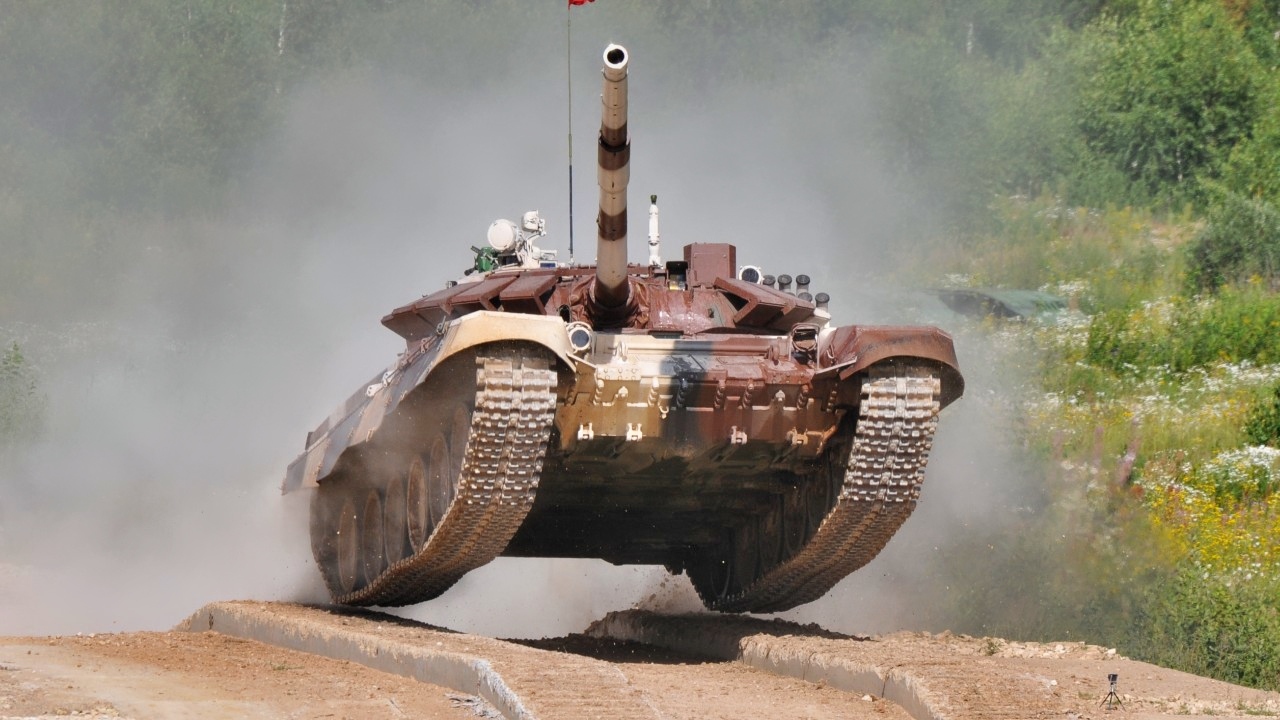
T-72 Tank from Russia. Image Credit: Creative Commons.

Russian T-72 Tank Ukraine War. Image Credit: Creative Commons.
The T-72’s fearsome reputation was further cemented during another 1980s Middle Eastern conflict, the 1982 Lebanon War.
As a result of the war, the Israelis rated the T-72’s armor as extremely tough to defeat from the front but somewhat easier to beat on the flanks; and (2) the Syrian troops under then-strongman Hafez Assad were very appreciative of their tanks, with a September 14, 1982 article in the Christian Science Monitor citing stories of Syria tank crewmen hugging the armor of their MBTs “in gratitude.”
Lost Luster Part I: The Gulf War (1991)
However, during Operation Desert Storm, the T-72’s reputation took a severe hit, both literally and figuratively.
Therein, the Soviet-designed tank ran afoul of the American-made M1A1 Abrams and its supremely accurate and powerful 120mm main gun, which wielded ammunition with the range and power to penetrate Russian armor like a knife through butter.
In particular, there was the Battle of 73 Easting on 26-27 February 1991, which military historians describe as “the last great tank battle of the 20th century.” The US Army’s VII Corps squared off against the Tawalkana Division of the Republican Guard, and it was an absolute turkey shoot for the American tankers; 160 Iraqi MBTs were killed in exchange for zero American tanks destroyed.
Lost Luster Part Deux: The Russo-Ukraine War (2022 to Present)
In this seemingly never-ending conflict, the T-72’s battlefield losses and resultant further degradation of its reputation have worsened. It’s gotten so bad that Peter Suciu penned an article for The Armory Life morbidly titled “Russian T-72: Most Destroyed Modern Tank in History?”
To wit: “According to data from the Ukrainian military, open-source military hardware tracker Onyx and Pentagon estimates, some 2,000 Russian T-72s have been destroyed in the fighting in Ukraine. Dozens, if not hundreds more have been captured as Russian tank crews have abandoned their tanks.” More conservative estimates put the loss figure at 1,200, which is still a substantial loss.
The Why and the Wherefore
So, then, why has this once vaunted tank become so vulnerable? It boils down to the so-called “jack-in-the-box” design flaw.
In other words, the shells are all placed in a ring within the turret, so when an enemy projectile hits the right spot, the ring of ammunition can quickly ‘cook off’ and ignite a chain reaction, blasting the turret off the tank’s hull in a devastating conflagration.
The T-72’s Grim Future Prospects
Notwithstanding the T-72s ever-declining battlefield performance, given Russia’s unwillingness to deploy the newer T-14 Armata due to the its exorbitant expenses and production problems, the Russian Army will basically had no chance but to continue to throw its T-72s and its T-90M descendants into the metaphorical meat grinder until that seemingly far & distant pipe dream of a day when the Putin’s brutal so-called “special military operation” in Ukraine finally comes to an end.
Time will tell, which translates into Russian as “Vremya pocaget” and into Ukrainian as “Chas pokaze.”
About the Author: Christian D. Orr, Defense Expert
Christian D. Orr is a Senior Defense Editor. He is a former Air Force Security Forces officer, Federal law enforcement officer, and private military contractor (with assignments worked in Iraq, the United Arab Emirates, Kosovo, Japan, Germany, and the Pentagon). Chris holds a B.A. in International Relations from the University of Southern California (USC) and an M.A. in Intelligence Studies (concentration in Terrorism Studies) from American Military University (AMU). He is also the author of the newly published book “Five Decades of a Fabulous Firearm: Celebrating the 50th Anniversary of the Beretta 92 Pistol Series.”
More Military
Canada Is ‘Full Steam Ahead’ on F-35 Stealth Fighter
Why Does Turkey Have So Many Main Battle Tanks?
‘Cracked Barrels’: The U.S. Navy’s Big Railgun Failure Explained in Just 2 Sad Words
‘Had No Chance’: The Montana-Class Was the 71,000-Ton Battleship Destined to Fail
‘Captain, We Smacked It Another Submarine’: British and French Nuclear Missile Subs Collided


Techie
October 8, 2025 at 7:42 pm
So this fella with no relation to anything engineering thinks he know why T-72 blows up. Answer is simple: HE-FRAG ammo with high sensitivity and high-energy explosive. Not that tank is presumably bad. I guarantee you: load Abrams with the same ammo, hit the ammo rack, and the explosion will tear it apart the same way. Abrams doesn’t explode because it doesn’t carry HE-FRAG ammo. AMP-T ammo is extremely phlegmatized and is relatively weak. Advantage is that it’s not easily initiated. So the problem isn’t the tank, but the ammo.