

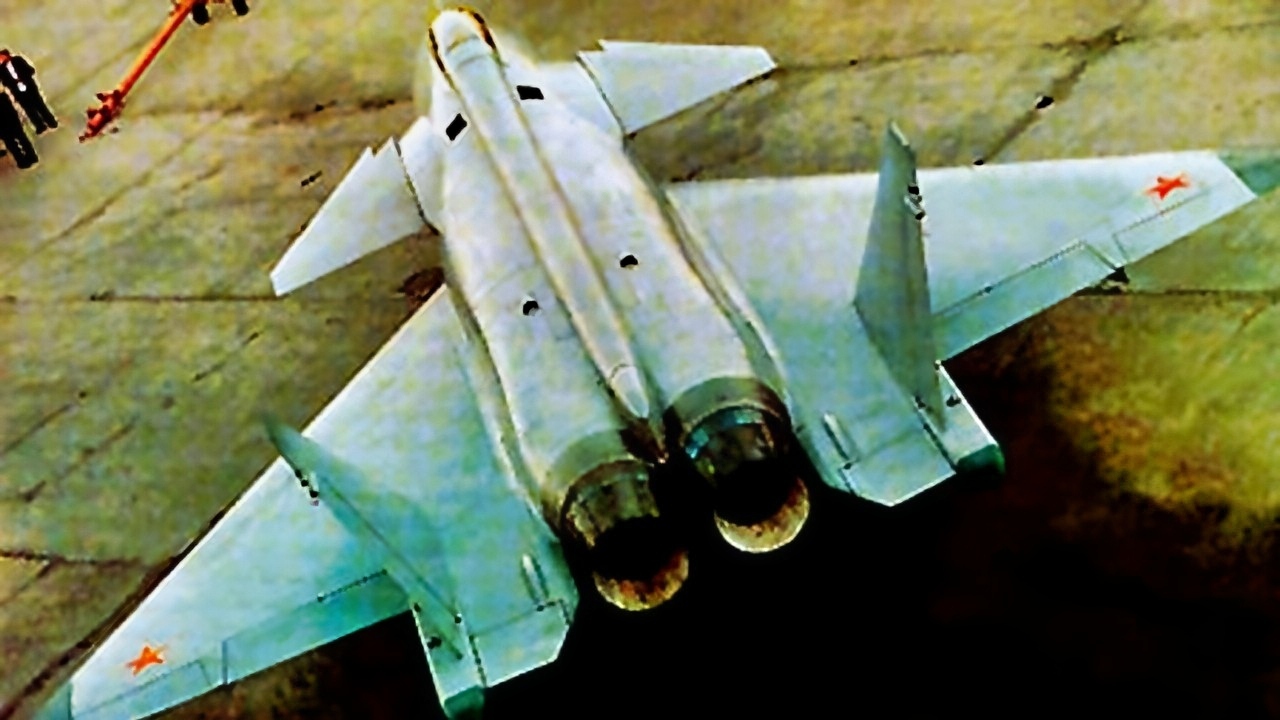
Russia’s MiG 1.44 was developed by Mikoyan in the 1980s and 1990s as the Soviet Union’s answer to the U.S. Air Force’s Advanced Tactical Fighter program — the project that produced the F-22 Raptor — combining large delta wings, forward canards, super-cruise, and reduced radar signature into a credible fifth-generation rival. The aircraft made its first flight on February 29, 2000, climbing to 3,300 feet over the LII Gromov Flight Research Institute near Moscow at 270 to 325 knots and circling the airfield twice with its landing gear down for 18 minutes — and never flew again. The collapse of Russian defense funding ended the program, though Russian state media TASS has since suggested its canard configuration may have influenced China’s J-20 stealth fighter.
Russia’s MiG 1.44 Stealth Fighter Failure:

MiG 1.44 Fighter. Image Credit: Creative Commons.
One of the Soviet Union’s initial forays into fifth-generation technology was motivated by knowledge of the United States own advanced aerospace projects. Though Soviet Su-27 and MiG-29 aircraft were among the leading fourth-generation aircraft, their supremacy was gradually overtaken by newer, more advanced aerospace projects. One of the United States Air Force’s Advanced Tactical Fighter programs, which ultimately yielded the F-22 Raptor stealth fighter, is thought to have caused not inconsiderable consternation in the Soviet Union.
Cognizant of near-term aerospace advancements — and threatened by the prospect of being outclassed by the United States — the Soviet defense ministry sought an aircraft that would credibly go head-to-head with some of the most potent fighters in the West, such as the American Teen Series aircraft, while also evading adversary radar undetected.
Ambitious Design
The resultant aircraft, designated the MiG 1.44, combined several ideas that were predominant in Soviet aerospace design in the 1980s and 1990s: large delta wings with forward canards on the fuselage.
These design choices would give the MiG 1.44 a very high degree of agility and, when combined with a relaxed stability design controlled by a digital fly-by-wire system, make it very maneuverable.
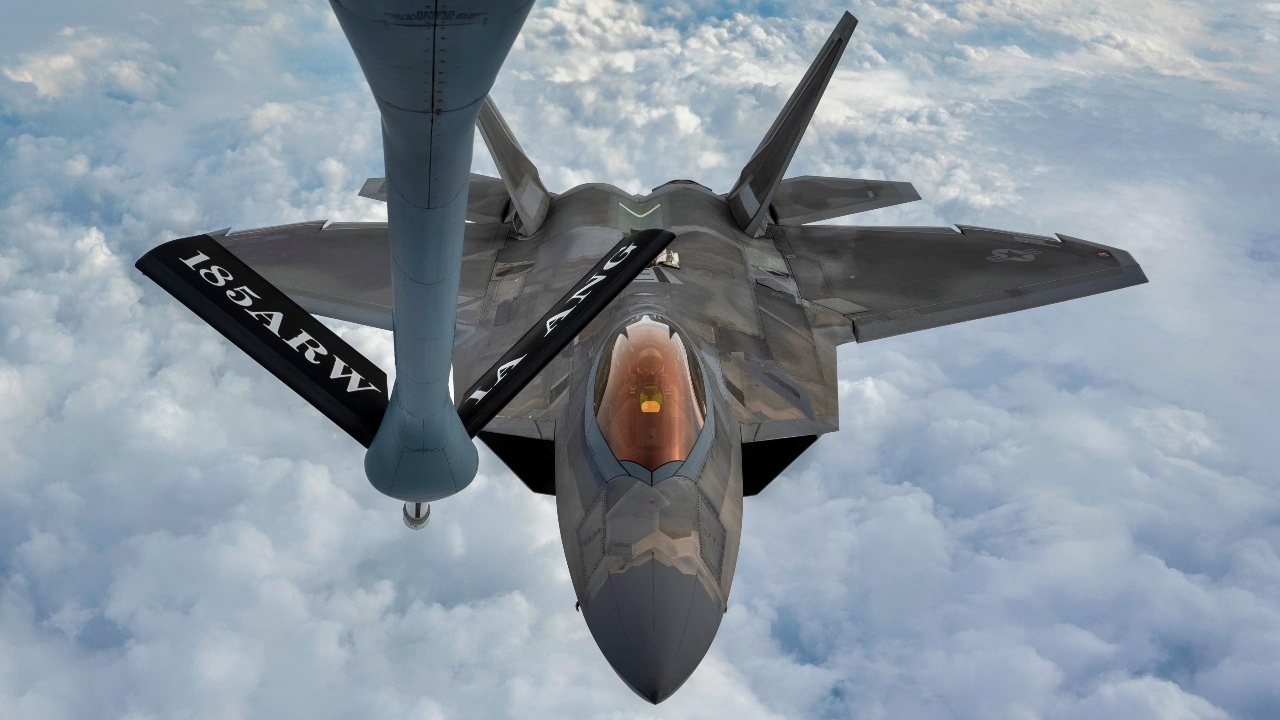
A U.S. Air Force F-22 Raptor approaches the boom of a KC-135 Stratotanker during a refueling mission over the Florida Panhandle, Dec. 14, 2022. Aerial refueling allows pilots to stay airborne for longer periods of time, increasing the mission capabilities individual aircraft can support. (U.S. Air Force photo by Tech. Sgt. Betty R. Chevalier)

(Sept. 16, 2023) – The U.S. Air Force F-22 Raptor Demonstration Team performs during the 2023 NAS Oceana Air Show. The NAS Oceana Air Show is a chance for the Navy to give back to the community, showcasing Naval aviation to visitors from across the country and around the world. (U.S. Navy photo by Mass Communication Specialist 2nd Class Megan Wollam)

U.S. Air Force Capt. Nick “Laz” Le Tourneau, F-22 Raptor Aerial Demonstration Team commander, performs an aerial maneuver during the Hyundai Air and Sea show at Miami, Florida, May 25, 2025. The F-22 Aerial Demonstration Team highlights cutting-edge airpower, precision, skill, all while reinforcing public confidence in the Air Force’s ability to protect and defend. (U.S. Air Force photo by Staff Sgt. Lauren Cobin)
Unlike extremely “clean” stealth aircraft like the F-22 Raptor, the MiG 1.44 incorporated features that were not necessarily in line with a purely stealth design. Canards, partially exposed engine compressor blades, and the aircraft’s relatively complex geometry all increased radar cross-section, a measure of radar detectability.
It may have been the case that Mikoyan engineers hoped that elements of electronic warfare and extreme maneuverability would partially offset a less-stealthy design. Still, some measures were taken that would reduce the jet’s stealth signature.
The internal carriage of weapons, as well as composite materials in the airframe, was thought to have been considered.
One-off Experiment
“After numerous false starts, the RSK MiG 1.44 fifth-generation fighter technology demonstrator made its first flight on 29 February. The flight, from the LII Gromov Flight Research Institute at Zhukovsky, near Moscow, lasted 18 minutes,” Flight International, an aviation magazine, wrote around the turn of the century.
“The MiG 1.44 climbed to 3,300ft (1,000m) and twice circled Zhukovsky with the undercarriage down at a speed of 270-325kt (500-600km/h) before landing. The first flight was planned for March 1999.”
The magazine made an important distinction, however, explaining that “while the MiG 1.44 is not considered a prototype for the Russian air force’s next-generation fighter, RSK believes the program is crucial for the development of Russian fighters. Key 1.44 technologies are super-cruise, reduced infrared, radar, and visual signatures and thrust vectoring for control at high angles of attack.”
In the end, the jet would not take to the skies again, though it may have aided the development of other programs, including one of China’s initial forays into stealth: its fifth-generation J-20 jet, an air superiority fighter.
Much of a Muchness?
One Russian source, TASS, a wire service, noted that the J-20 and the MiG 1.44 share certain design elements. “Among the fifth-generation stealth fighters already in service and under development, the Chinese J-20 is the largest. The aircraft is also noticeably distinguished by its unique aerodynamic design, the so-called canard (defined by the presence of a horizontal tail located in front of the main wing).”
“This is exactly the scheme that was used in the development of the Russian prototype of the fifth-generation fighter MiG 1.44, which never took off.”
Though TASS’s statement may come across as rather speculative — and, in any case, difficult to definitively clarify — there is no denying that the two aircraft do have a few traits seemingly in common.
This may, admittedly, be thanks to similar design principles shared by all stealth aircraft, rather than a direct influence of one project on the other.
One-off Design
Though the MiG 1.44 held some promise as a research aircraft and could indeed have aided other, future aircraft if the design matured, it was not to be.
Following the rather abrupt collapse of the Soviet Union and subsequent budgetary drawbacks, particularly in defense, precious few rubles were left over for advanced aerospace projects — especially at a time when world peace felt closer than it ever had been.
“We all have been waiting for this flight for so long, but it went through as an everyday event. The machine behaved well, but its handling qualities make it clear that it is a fundamentally new aircraft. So all the work lies ahead,” Flight International wrote in 2000, quoting Vladimir Gorbunov, one of Mikoyan’s test pilots.
Had the program not been crimped by a lack of funds, the resulting, more mature aircraft would no doubt have been remarkable.
About the Author: Caleb Larson
Caleb Larson is an American multiformat journalist based in Berlin, Germany. His work covers the intersection of conflict and society, focusing on American foreign policy and European security. He has reported from Germany, Russia, and the United States. Most recently, he covered the war in Ukraine, reporting extensively on the shifting battle lines in Donbas and writing about the war’s civilian and humanitarian toll. Previously, he worked as a Defense Reporter for POLITICO Europe. You can follow his latest work on X.


George
May 9, 2026 at 6:26 am
We know that US is the best in everything👍, we know that. For that you have problem in Iran war because you are the best in all. All other are far away from US with everything. No comment
Rob Ots
May 9, 2026 at 2:10 pm
I mean, America wasted 67 billion on 150 F-22 Raptors so it’s not like we did any better.
Donatello
May 10, 2026 at 1:32 am
Just like Su-47, 1.44 was just a random side project that eventually saw the light only to show a progress and get some cash from the government.
No big hopes, no big money spent.
Please learn the subject better next time.
Sean
May 10, 2026 at 1:42 pm
It reminds me of the aircraft from the movie “Firefox”
Vladimir
May 10, 2026 at 1:55 pm
Russians stupid, Americans clever. Except everyone in the world can see in Iran how clever Americans and their president are. Except you are done with manufacturing F22s because your president was clever enough to put Chinese under sanctions and make them stop exporting you rare earths you need for manufacturing F22s. Say goodbye to your former superpower status, just like you did in basketball when your “dream team” was humiliated by: Argentina 3 times, Lithuania 3 times, Serbia 2 times, Spain, Germany, Greece, France, Nigeria and Puerto Rico. Iran is the first, let’s see who will humiliate you next.
Peter J Ford
May 15, 2026 at 12:21 pm
That Mig 1.44 looks more like a Jumbo-size Typhoon than a stealthy aircraft.