


Former U.S. Secretary of Defense Donald Rumsfeld testified to Congress that approximately $2.3 trillion in Pentagon receipts was “missing” from the defense budget the day before the September 11, 2001, attacks. The Pentagon has failed every annual audit for 7 consecutive years since 2018. A Government Accountability Office (GAO) report from May 2025 determined that the “Pentagon will likely fail audits through 2028.”
The Pentagon Has a Money Problem
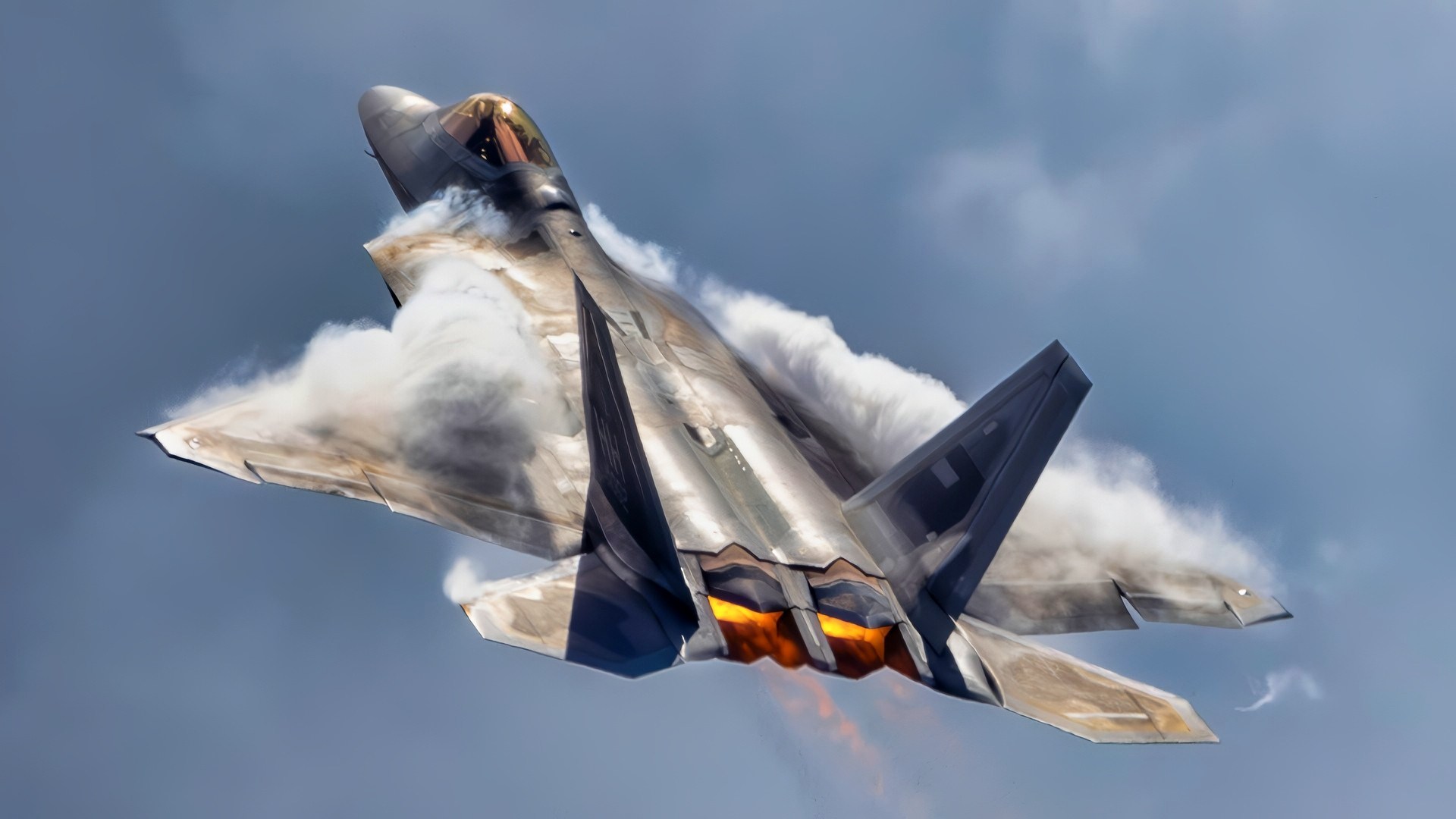
An F-22 Raptor performs an aerial demonstration at Marine Corps Air Station Kaneohe Bay, Hawaii, Aug. 8, 2025. The rapid change in angle of attack causes visible vapor to form around the aircraft, giving spectators a clear view of the jet’s aerodynamic performance. This demonstration highlights the unique thrust-vectoring capabilities of the F-22, allowing it to achieve extreme agility unmatched by other fighter aircraft. (U.S. Air Force photo by Staff Sgt. Lauren Cobin)
America finds itself in the middle of another major conflict, this time with the Islamic Republic of Iran. A nation that spends more on its national defense than the next ten countries combined appears to be struggling to define what victory over Iran is. Meanwhile, the Trump administration has inexplicably asked for a new defense budget of $1.5 trillion.
That’s the highest defense budget request in the history of the Department of Defense.
Even with all the money sloshing around the Pentagon, the US cannot seem to either win the wars it fights or even stay far enough ahead of rivals, notably the People’s Republic of China (PRC), which spends far less on its military than the United States does.
It gets bleaker, though.
The Pentagon cannot pass an Audit.
Given the Defense Department’s regular taxpayer funding, there have been several attempts to audit the Pentagon.
The Pentagon has failed every single one of its annual audits in seven consecutive years. A Government Accountability Office (GAO) report from May 2025 determined that the “Pentagon will likely fail audits through 2028.”
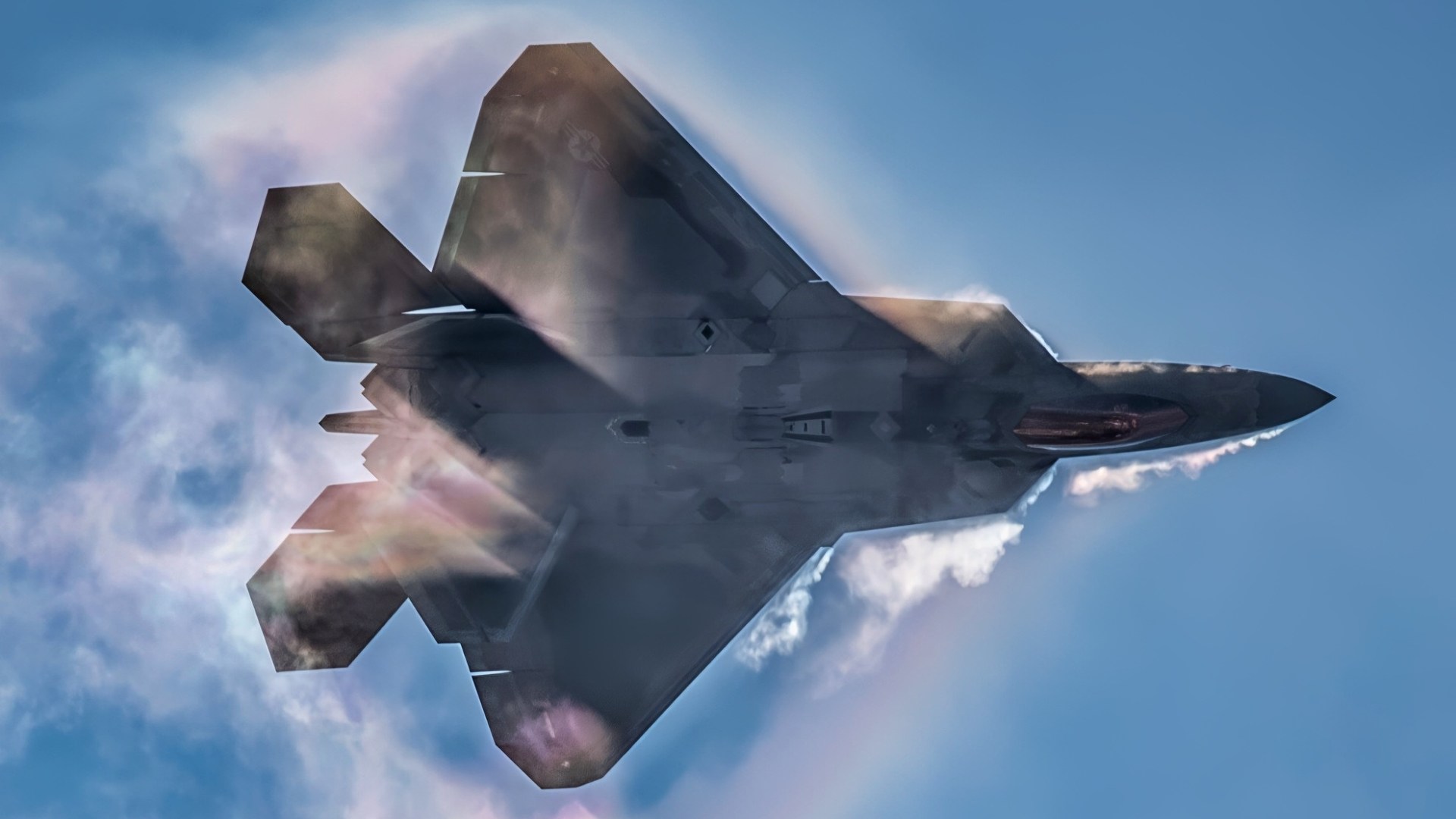
U.S. Air Force Maj. Josh ‘Cabo’ Gunderson, F-22 Raptor Demonstration Team commander, performs during an air show in Fort Worth, Texas, Oct. 17, 2020. The F-22’s raw power and thrust vectoring technology gives the aircraft super maneuverability in the air-to-air battlespace. (U.S. Air Force photo by 1st Lt. Sam Eckholm)
That’s astonishing, even for a massive government bureaucracy.
Interestingly, not even the budget busters of Elon Musk’s “Department of Government Efficiency” (DOGE) could ultimately fix their cost-saving ire at the greatest target of them all: the Pentagon.
A $4 Trillion Bureaucratic Black Hole
Just think about the size of the Pentagon.
Not only is its annual budget larger than that of some small countries’ entire economies, but the Defense Department also manages more than $4 trillion in assets. Many defenders of the Pentagon argue that the assets are so large and the Defense Department so expansive that tracking massive inventories globally is a complex task.
Failing an audit, according to these voices, does not inherently mean the Pentagon is abusing the generous sums of money that taxpayers lavish upon the bureaucracy every year.
Meanwhile, defenders of the Pentagon’s accounting practices insist that legacy IT and accounting systems are partly to blame for the Defense Department’s perennial failure to pass an audit. These older systems reportedly cannot communicate with one another or share critical data, compounding the challenges of maintaining accuracy in DoD accounting practices.

M1 Abrams Tank. Image Credit: Creative Commons.
Yet specific departments in the Pentagon — notably the United States Marine Corps and the Defense Threat Reduction Agency (DTRA) — have consistently passed all audits conducted by their respective organizations. Something is amiss. And it isn’t whatever gobbledy-gook excuse the defense community wants to give We, The People, for their profligate spending of our money.
The Contractor Empire
Then there’s the added problem of the army of contractors the Pentagon supports. Ever since the Reagan administration, ironically, to save taxpayer money, the Pentagon has increasingly relied on independent contractors to do the work that government employees once did.
An entire cottage industry of defense contracting has arisen in Washington, D.C., stemming from the decades-long shift in Pentagon practices that initially called for contractors. But these contractors, being so variegated and spread throughout the elephantine Pentagon bureaucracy, supposedly lack a uniform documentation and accounting system, which complicates auditors’ ability to maintain accurate data on Pentagon expenditures.
But all this sounds like excuses.
The Pentagon’s Missing Trillions
There’s something deeper here. Something much darker, frankly. Because it isn’t just the seven audits in a row since 2018 that the Defense Department has failed, the United States Armed Forces’ performance metrics do not, unfortunately, warrant continuing to pour gobs of tax dollars into the DoD. Not until the Pentagon standardizes accounting practices and restores accountability.

A U.S. Army M1A2 SEPv2 Abrams assigned to Alpha Company, 1st Battalion, 67th Armor Regiment, 3rd Brigade Combat Team, 1st Armored Division prepares to move off the live fire range after completing the day portion of Table VI Tank Gunnery conducted at McGregor Range, New Mexico, Sept. 29, 2023. Gunnery Table VI evaluates crews on engaging stationary and moving targets while utilizing all weapons systems in offensive and defensive positions, ensuring our crews are trained and ready for any mission. (U.S. Army photo by Spc. David Poleski)
Just think back to the day before the 9/11 attacks.
Then-Secretary of Defense Donald Rumsfeld, who entered the George W. Bush administration with a desire to streamline the bureaucracy at the Pentagon, testified to Congress that there was, per his team’s analysis, $2.3 trillion in receipts that were “missing” from the defense budget. At that public hearing, Rumsfeld even argued for modest cuts to the defense budget.
A day later, the 9/11 attacks occurred, and Rumsfeld’s missing $2.3 trillion in receipts got buried beneath an avalanche of even more free-flowing tax dollars into, shall we say, the leaky pipes of the Pentagon’s bureaucratic machine.
Washington’s Self-Licking Ice Cream Cone
How is it that before 9/11, the highest concentration of wealth in the United States was in Silicon Valley, but after 9/11, the highest concentration of wealth was in the Washington, D.C.-Northern Virginia-Southern Maryland axis?
Hey, the country was at war against international terrorism! Why would anyone want to ask those questions back then? What are you, a Bin Laden lover or something?
Washington, D.C., became a self-licking ice cream cone for the defense establishment. Indeed, it became a giant self-licking ice cream cone for the entire city. Everyone there conducted themselves with the idea that war was their highest aim (at least the continuation of global tensions).
Peace became a four-letter word while the hucksters in the defense contracting community and the bureaucrats in the Pentagon do all they can to ensure their continued wealth.
America Pays More for Less
Not only has the United States not won a conflict since at least 1991 (though you might say that it hasn’t won since 1945), but the Pentagon, despite its massive funding, has not produced a reliable warship or warplane since the end of the Cold War.
So, we’re spending the most we’ve ever spent on defense at a time when there isn’t a single green chute to be found (other than the endless streams of money flowing into the Pentagon) in the defense establishment.
All this is occurring at a time when the United States is carrying a debt load of $39 trillion and counting. The interest on this year’s debt amounts to $1.2 trillion. To say this is unsustainable is an understatement.
Break the Defense Cartel
One way to lower the defense budget and make it more efficient would be to allow small startups to compete more widely for lucrative government contracts. Small sthaveups have been allowed in certain areas.
Still, the big defense contractors continue to box out the little guys (or buy them out), ensuring that competition does not stand, keeping defense product prices relatively high.
Even that, though, is not enough to stop the proverbial bleeding.
The inefficiencies and corruption at the scale they’re at inside the Pentagon are simply insurmountable with anything other than the combination of drastic reform, the breaking up of the big defense contractors, the overall reduction in defense spending, and the refusal of US politicians to so quickly reach for the military option whenever international crises arise.
Until these fundamental reforms occur in short order, spending will continue, inefficiencies will grow, and the US military will continue to lose its combat effectiveness. In contrast, the cost of maintaining that ineffective military increases.
About the Author: Brandon J. Weichert
Brandon J. Weichert is the Senior National Security Editor at 19FortyFive.com. Recently, Weichert became the editor of the “NatSec Guy” section at Emerald. TV. He was previously the senior national security editor at The National Interest. Weichert hosts The National Security Hour on iHeartRadio, where he discusses national security policy every Wednesday at 8 p.m. Eastern. He hosts a companion show on Rumble entitled “National Security Talk.” Weichert consults regularly with various government institutions and private organizations on geopolitical issues. His writings have appeared in numerous publications, among them Popular Mechanics, National Review, MSN, and The American Spectator. And his books include Winning Space: How America Remains a Superpower, Biohacked: China’s Race to Control Life, and The Shadow War: Iran’s Quest for Supremacy. Weichert’s newest book, A Disaster of Our Own Making: How the West Lost Ukraine, is available for purchase at any bookstore. Follow him via Twitter/X @WeTheBrandon. The opinions in this article are the author’s own.


