

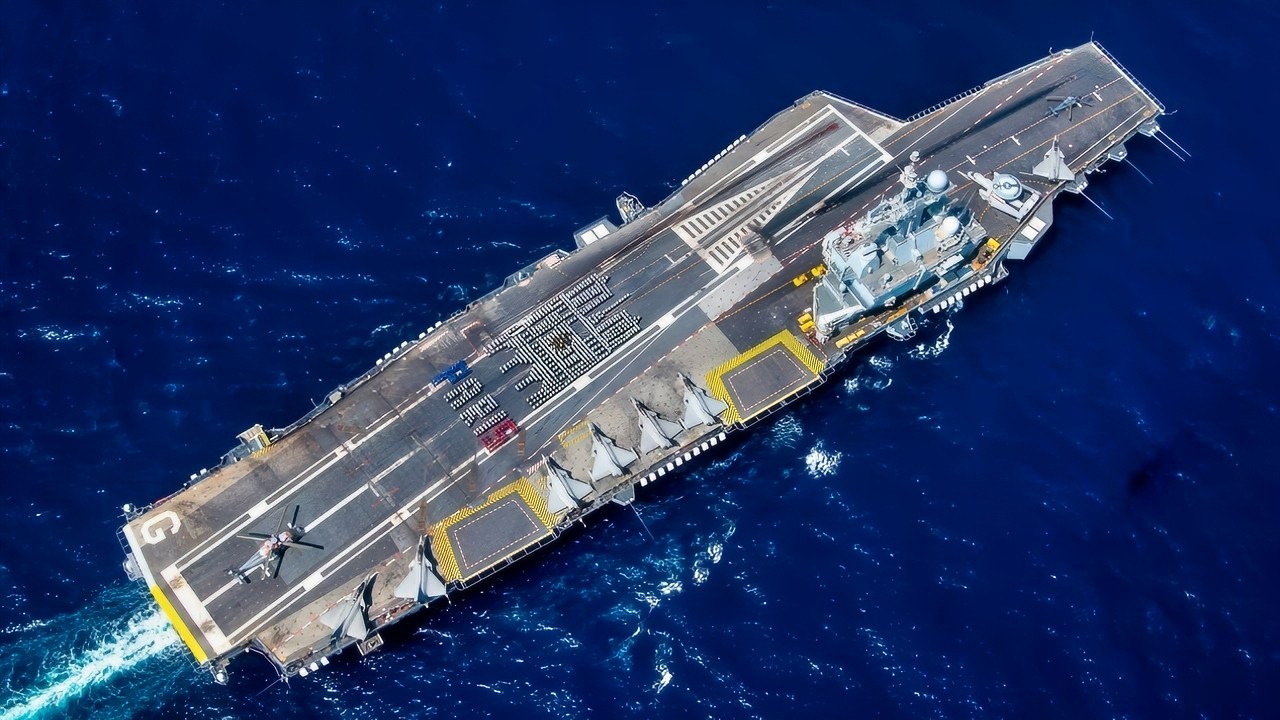
France’s nuclear-powered aircraft carrier Charles de Gaulle is steaming through the Red Sea right now, anchoring a French-led coalition trying to reopen the Strait of Hormuz in the middle of the Iran war. She is the only nuclear-powered carrier operating outside the U.S. Navy — and one of just two non-American carriers of her kind on the planet.
She is also 25 years old, has been disabled by mechanical failures four times, and is scheduled to retire when her €10.25 billion successor, France Libre, commissions in 2038.
France’s Charles de Gaulle: The Only Non-American Nuclear Aircraft Carrier — And Why France Built Her Anyway

190424-M-BP588-1005 U.S. 5TH FLEET AREA OF OPERATIONS (April 24, 2019) A U.S. Marine MV-22 Osprey assigned to the 22nd Marine Expeditionary Unit sits on the flight deck of France’s Marine Nationale aircraft carrier FS Charles De Gaulle (R 91). This was the second time that Ospreys have landed aboard the French vessel. Marines and Sailors assigned to the 22nd MEU and Kearsarge Amphibious Ready Group are currently deployed to the U.S. 5th Fleet area of operations in support of naval operations to ensure maritime stability and security in the Central region, connecting the Mediterranean and the Pacific through the western Indian Ocean and three strategic choke points. (U.S. Marine Corps photo by Maj. Joshua Smith/Released)
The Charles de Gaulle (R91) is one of two nuclear-powered fixed-wing aircraft carriers operating outside the United States Navy — the only one in the West besides the American supercarriers, and one of just two in service worldwide alongside China’s developing nuclear carrier. She is currently steaming through the Red Sea toward the Strait of Hormuz, anchoring a French-led naval coalition attempting to reopen the world’s most critical shipping chokepoint in the middle of the Iran war.
She is also 25 years old, has been disabled four times by mechanical and structural problems, is currently France’s only fixed-wing carrier, and is scheduled to retire in the late 2030s when her successor — the nuclear-powered France Libre — enters service. The question hanging over the French defense establishment is the same question hanging over every other carrier-operating navy: in an era of long-range anti-ship missiles, anti-access networks, and cheap drones, does France actually need an aircraft carrier?
The History: Why France Built A Nuclear Carrier
The French requirement for a nuclear-powered aircraft carrier was identified in the mid-1970s as a replacement for the conventionally powered Clemenceau-class carriers Foch and Clemenceau, which had served as the French Navy’s fixed-wing strike platforms since 1961 and 1963, respectively.
The Clemenceaus were limited in operational endurance, dependent on fuel oilers, and increasingly out of step with the growing weight and complexity of carrier aircraft.
France had a unique advantage at the time. The country had developed indigenous nuclear propulsion through its ballistic missile submarine program — the Le Redoutable-class entered service in 1971 — and through the Rubis-class attack submarines that followed in 1983.
The reactors developed for those boats could, in theory, be scaled up to power a surface ship of carrier displacement. The argument within the French Defense Ministry was that a nuclear-powered carrier would deliver three structural advantages over a conventional design: indefinite range without tanker support, sustained sprint speeds without burning aviation fuel reserves, and elimination of the logistics tail that conventional carriers require for diesel resupply at sea.
The original plan called for two nuclear carriers. The first was provisionally named Bretagne in 1986. The second, Provence, was scheduled for follow-on construction. Both names were dropped. President François Mitterrand renamed the lead ship, Richelieu, in 1986. Prime Minister Jacques Chirac renamed her again on May 18, 1987 — Charles de Gaulle, after the wartime Free French leader and postwar founder of the Fifth Republic.
The second carrier never materialized. The 2013 French Defense White Paper formally canceled the PA2 program, leaving France with a single fixed-wing carrier and the structural problem single-carrier navies face: when the carrier is in refit, the navy has none.
Design And Technology
Construction began at the DCN Brest shipyard on November 24, 1987, with full hull assembly starting in April 1989. The launching ceremony took place on May 7, 1994 — making her, at 42,000 tons full load, the largest warship Western Europe had launched since HMS Ark Royal in 1950.
The carrier measures 261.5 meters in length, displaces 42,500 tons after the 2008 refit, and carries a crew of approximately 1,760 plus an embarked air wing detachment. Propulsion comes from two K15 pressurized water nuclear reactors — the same reactor family that powers French ballistic missile submarines — each producing 150 megawatts thermal, driving two Alstom steam turbines for a total of 82,000 shaft horsepower and a design speed of 27 knots.
The flight deck operates under a CATOBAR configuration: catapult-assisted takeoff with arrested recovery. Two 75-meter steam catapults — derived from American C-13 designs licensed by Northrop Grumman — handle launches. The flight deck angle is 8.5 degrees. The deck was extended by 4.4 meters during 1999 sea trials after testing revealed the original geometry could not safely operate the E-2C Hawkeye early-warning aircraft, a fix that cost roughly 5 million francs and triggered significant negative French press coverage.

July 19, 2008) A French F-2 Dassault Rafale fighter prepares to launch during combined French and American carrier qualifications aboard the aircraft carrier USS Theodore Roosevelt (CVN 71). This event marks the first integrated U.S. and French carrier qualifications aboard a U.S. aircraft carrier. The Theodore Roosevelt Carrier Strike Group is participating in Joint Task Force Exercise “Operation Brimstone” off the Atlantic coast until the end of July. (U.S. Navy photo by Mass Communication Specialist 3rd Class Christopher Hall/Released)
Defensive armament includes four eight-cell Sylver A43 launchers carrying MBDA Aster 15 surface-to-air missiles, two six-cell Sadral launchers for Mistral short-range missiles, and a mix of 20mm Narwhal remote-operated guns and legacy Giat 20F2 autocannons. The carrier carries no fixed-wing strike weapons of her own — her offensive capability is entirely embarked: up to 40 aircraft, typically including 24 to 30 Rafale M fighters, two to three E-2C Hawkeye AEW aircraft, and a rotor wing of NFH Caïman Marine, AS565 Panther, AS365F Dauphin Pedro, and EC725 Caracal helicopters.
Construction Was Tough
The construction record was not clean. Funding was repeatedly cut during budget pressure cycles, work was suspended four separate times — 1990, 1991, 1993, and 1995 — and total program cost ran past €3 billion. Sea trials revealed propulsion system issues, electrical generation problems, and the deck-length shortfall. The most damaging incident came on November 9-10, 2000, when the port propeller broke during sea trials in the Western Atlantic en route to Norfolk, Virginia.
The supplier, Atlantic Industrie, was blamed for poor-quality construction. The French Defense Minister ordered an investigation into quality management. Shortly afterward, a fire destroyed the supplier’s archives. The carrier returned to sea using the older spare propellers from Clemenceau, limiting her to 25 knots until new propellers were installed during the 2007 refueling.
She was finally commissioned on May 18, 2001 — five years behind the original schedule.
Operational History of the Charles de Gaulle Carrier
The Charles de Gaulle’s first operational deployment came in December 2001, when she sailed for the Arabian Sea to support Operation Enduring Freedom. Her embarked Super Étendard strike fighters and E-2C Hawkeyes flew combat missions over Afghanistan throughout the deployment. The carrier returned to Toulon in July 2002.
The mid-2000s deployment cycle included exercises with American, British, and Italian carrier groups in the Mediterranean and the Indian Ocean. The first major refit ran from September 2007 through December 2008 — refueling the two K15 reactors, installing new propellers capable of reaching the contractual 27 knots, upgrading aircraft maintenance spaces to handle the Rafale F3 standard, and increasing satellite communications bandwidth tenfold.
The carrier’s worst public operational embarrassment came on October 14, 2010, when a four-month deployment to combat piracy off Somalia was cut to a single day after an electrical fault in the propulsion system forced her to return to Toulon.
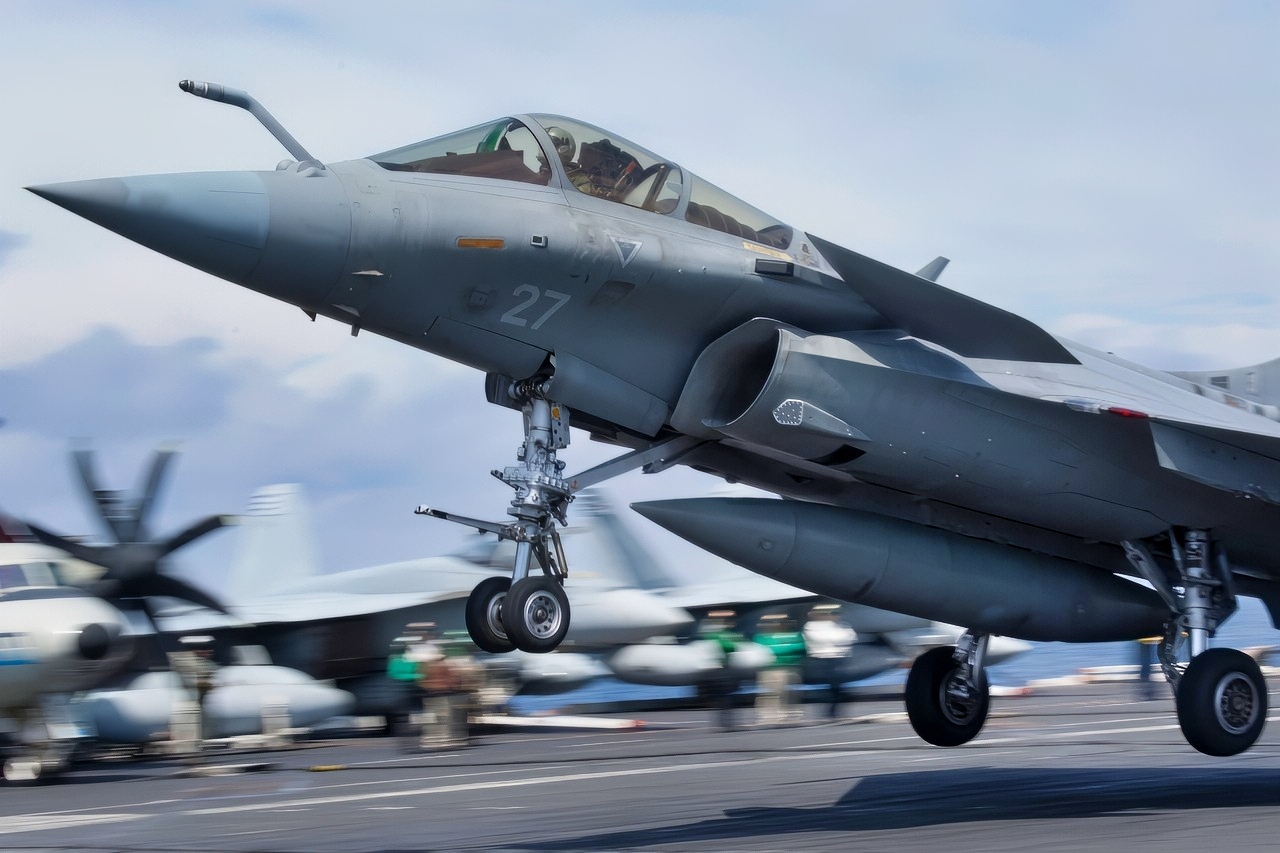
(July 3, 2018) A French Dassault Rafale M Fighter touches down on the flight deck aboard the Nimitz-class aircraft carrier USS Harry S. Truman (CVN 75). Harry S. Truman is currently deployed as part of an ongoing rotation of U.S. forces supporting maritime security operations in international waters around the globe. (U.S. Navy photo by Mass Communication Specialist 3rd Class Rebekah A. Watkins/Released)
The 18-month midlife refit from February 2017 through September 2018 was the largest single overhaul in the ship’s history. Reactor refueling. Combat system modernization. New radars, including the SMART-S Mk2 surface search radar. Updated electronic warfare suite. By the end of the refit, the carrier was certified to operate the Rafale M F3-R standard armed with the ASMP-A air-launched nuclear missile and the SCALP-EG cruise missile — making Charles de Gaulle the only French naval platform capable of delivering both conventional precision strike at theater range and nuclear strike at strategic range.
The 2020 deployment was disrupted by the pandemic outbreak among the 1,760-person crew during Mediterranean operations, requiring the carrier to return early to Toulon. Subsequent deployments through 2022 and 2023 included Mediterranean operations supporting NATO posture during the Russia-Ukraine war and Indo-Pacific transits demonstrating French strategic autonomy doctrine.
Combat History
The carrier has been involved in active combat operations across multiple campaigns.
Operation Enduring Freedom in 2001-2002 was the first major combat deployment, with Super Étendard and E-2C aircraft flying missions over Afghanistan from the Arabian Sea. Operation Harmattan in 2011 saw the carrier providing air support during the Libya intervention, with Rafale M fighters conducting strike missions against Gaddafi regime targets. Operations against ISIS in Iraq and Syria from 2015 through 2018 used Charles de Gaulle as a forward strike platform for the French contribution to Operation Chammal.
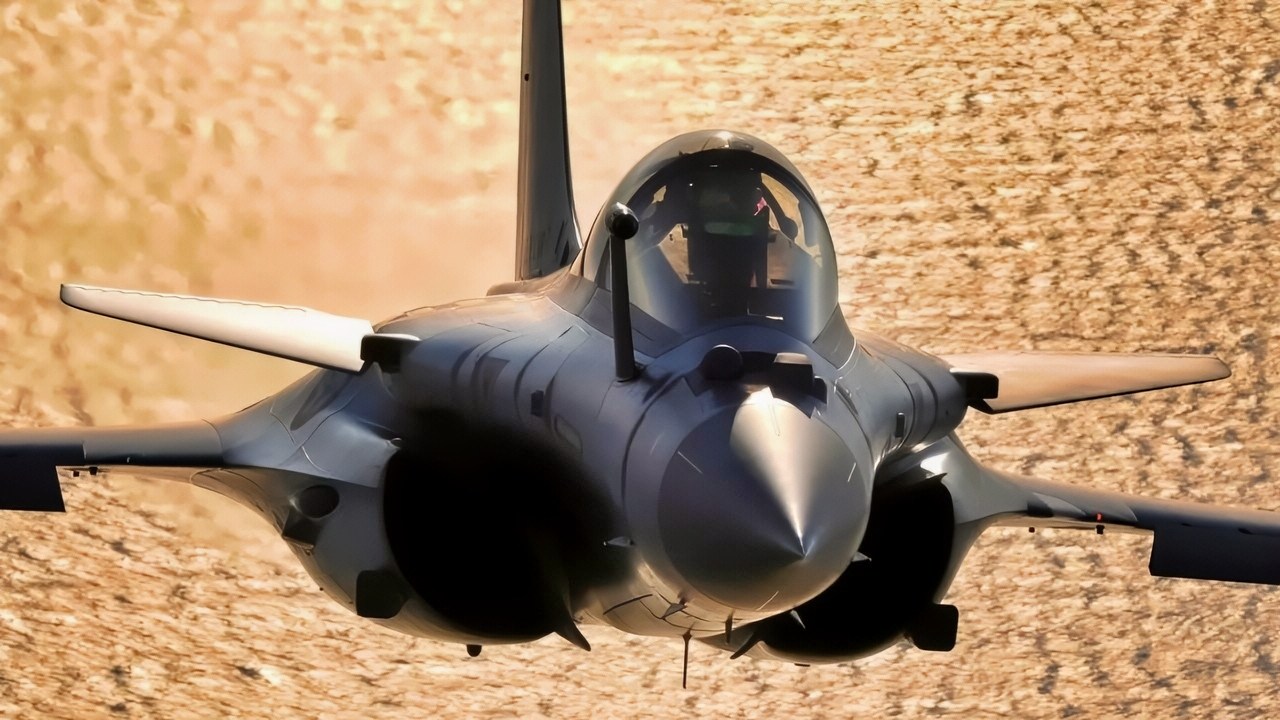
Dassault Rafale Fighter. Image Credit: Rafale.
The current Iran war deployment is the most operationally consequential in the carrier’s history.
President Emmanuel Macron ordered the carrier strike group to the Eastern Mediterranean on March 3, 2026, pulling the formation out of NATO exercises in the Baltic after Iranian drones struck the British Royal Air Force base at Akrotiri in Cyprus on March 1. The carrier transit covered approximately 7,000 kilometers in six days. Macron boarded the ship off Cyprus on March 9. The French government described the broader naval mobilization — Charles de Gaulle plus eight frigates and two Mistral-class helicopter carriers — as “unprecedented.”
The carrier strike group composition deployed for the operation, per public USNI News reporting, includes the Horizon-class air-defense destroyer Chevalier Paul, a FREMM multi-mission frigate, a fleet oiler, a nuclear attack submarine whose identity has not been publicly disclosed, plus the Spanish frigate Cristóbal Colón and the Dutch frigate Evertsen operating in escort.
In early May 2026, after the suspension of the U.S.-led Operation Project Freedom escort mission in the Strait of Hormuz, Charles de Gaulle moved from the Mediterranean into the Red Sea to anchor a French-British coalition that France has been building since April. The carrier is currently positioned to support a defensive coalition operation to restore commercial shipping through the strait if and when conditions allow. Per NBC News reporting on the current deployment, French armed forces spokesman Colonel Guillaume Vernet stated that the Hormuz coalition will not begin operations until “the threat to shipping must come down, and the maritime industry must be reassured enough to use the strait.”
The Replacement Carrier
The Charles de Gaulle is scheduled to retire in 2038. Her successor is France Libre — the porte-avions de nouvelle génération formally approved by Macron in December 2025 and named in March 2026 after the wartime Free French government-in-exile that de Gaulle himself led.
France Libre will be substantially larger than her predecessor — 310 meters long, 78,000 tons displacement, nearly double the current carrier. She will carry American-designed Electromagnetic Aircraft Launch Systems and Advanced Arresting Gear from General Atomics instead of steam catapults, plus two new TechnicAtome K22 nuclear reactors producing 220 megawatts each — a substantial increase over the K15 reactors aboard Charles de Gaulle.
The cost is €10.25 billion. Hull assembly is scheduled to begin at Chantiers de l’Atlantique in 2032, with transfer to Toulon in mid-2035 for outfitting and nuclear fueling. Sea trials in 2036. Commissioning in 2038. By that point, Charles de Gaulle will be 37 years old.
A French defense assessment scheduled later this decade will determine whether Charles de Gaulle can safely operate past her 2038 retirement horizon if France Libre slips behind schedule. If not, France faces a multi-year carrier gap — the same single-carrier problem that has plagued the country since the 2013 cancellation of the second carrier never solved.
Does France Actually Need Aircraft Carriers?
Here is the question the Iran war has put into sharp focus.
The argument for the carrier is doctrinal. France has built its strategic autonomy posture around the capability to project sovereign French airpower into any region within reach of an aircraft carrier without requiring host-nation basing rights, American tanker support, or coalition permission. The Charles de Gaulle is the physical embodiment of that doctrine. She has done exactly what France built her to do — supporting combat operations against the Taliban, Gaddafi, ISIS, and now defending allied air bases and commercial shipping in the Eastern Mediterranean and Red Sea during the Iran war.
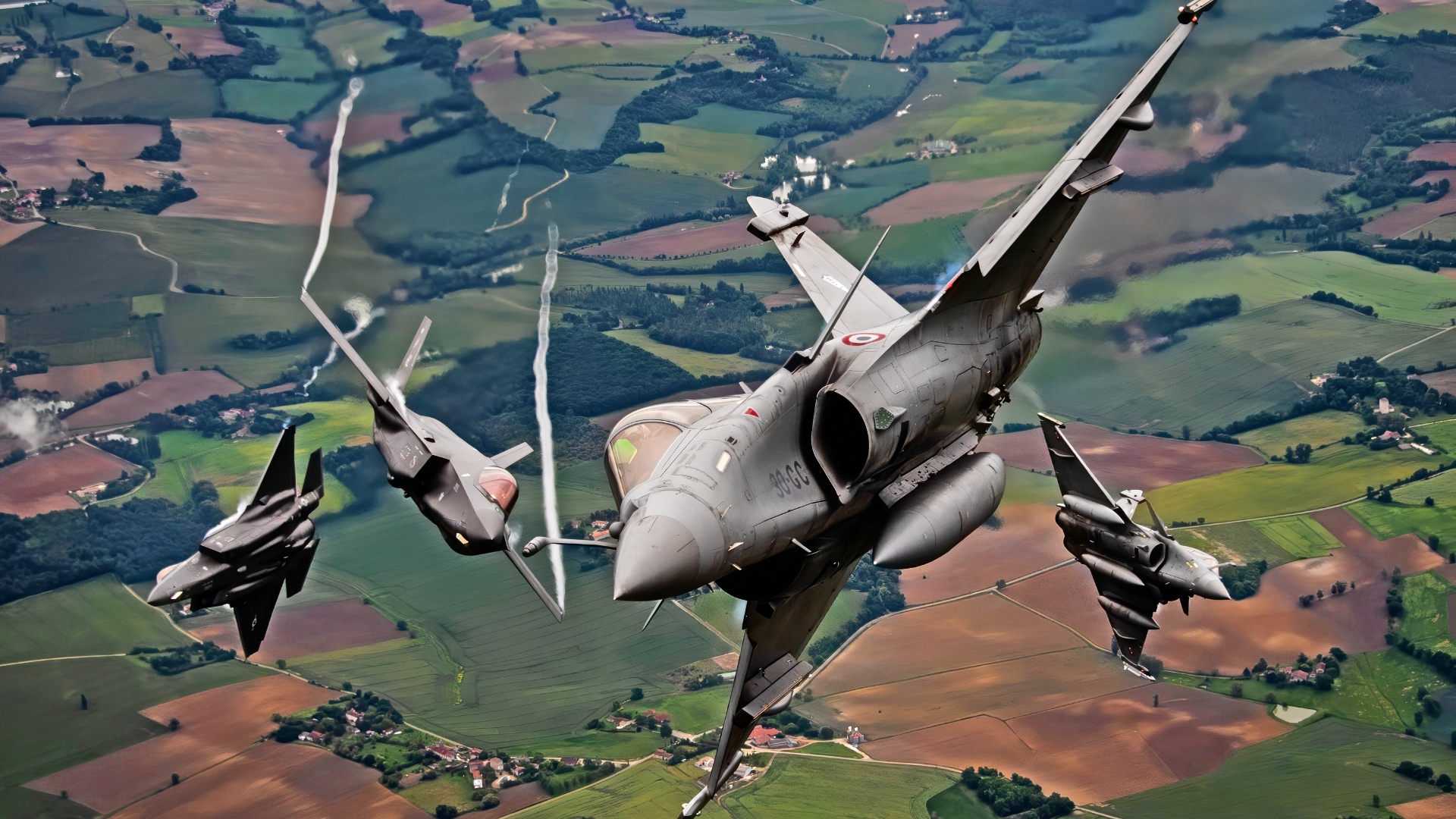
Two U.S. Air Force F-35A Lightning IIs assigned to the 4th Fighter Squadron, Hill Air Force Base, Utah, and two Dassault Rafales assigned to the 1/4 Gascogne Fighter Squadron, 113 Saint-Dizier-Robinson air base, France, break formation during flight May 18, 2021 over France. The flight was apart of the Atlantic Trident 21 exercise which is a joint, multinational exercise involving service members from the U.S., France and the U.K., and is aimed at enhancing fourth and fifth generation integration, combat readiness and fighting capabilities, through conducting complex air operations in a contested multinational joint force environment. (U.S. Air Force photo by Staff Sgt. Alexander Cook)
The argument against the carrier is asymmetric. Iranian anti-ship missile capability, Russian-supplied long-range systems, Houthi drone swarms, and the broader proliferation of low-cost precision strike weapons have made carrier operations progressively more expensive and more dangerous in contested theaters. As Defense News reported on the analyst debate around the current deployment, French and European defense analysts are openly questioning whether the deployment risk justifies the strategic signaling value when the same strike capability could in principle be delivered by Rafales operating from Al Dhafra in the UAE, by SCALP missiles launched from frigates, or by ASMP-A nuclear strike packages delivered from land bases.
The counter-argument is that no other platform delivers the full package the carrier provides. Carrier-based Rafales can be repositioned in days to any region with access to international waters. Land-based fighters require a host-nation agreement and infrastructure. Frigate-launched cruise missiles cannot deliver sustained airpower, only single-shot strikes. The carrier is the only French platform that can independently project a meaningful sortie rate against a peer adversary anywhere in the world.
France is committed to keeping that capability through the Libre carrier program.
MORE – ‘She Can Shoot Down an F-22’: China’s J-20 Stealth Fighter Has Arrived
MORE – China’s J-35A Stealth Fighter Has a Message for the U.S. Air Force
About the Author: Harry J. Kazianis
Harry J. Kazianis (@Grecianformula) was the former Senior Director of National Security Affairs at the Center for the National Interest (CFTNI), a foreign policy think tank founded by Richard Nixon based in Washington, DC. Harry has over a decade of experience in think tanks and national security publishing. His ideas have been published in the NY Times, The Washington Post, The Wall Street Journal, CNN, and many other outlets worldwide. He has held positions at CSIS, the Heritage Foundation, the University of Nottingham, and several other institutions related to national security research and studies. He is the former Executive Editor of the National Interest and the Diplomat. He holds a Master’s degree focusing on international affairs from Harvard University. Kazianis is Editor-In-Chief of 19FortyFive.
CORRECTION: We have fixed the word ‘history’ as it was spelled incorrectly. Clearly, we needed more coffee when we posted.


Charles Ufarlei
May 18, 2026 at 4:51 pm
“Hisotry”. I checked but could not find that word in either my English or French dictionary. Is this an attempt at Frenglish? 😀
Mike
May 19, 2026 at 12:12 am
Nice history lesson,but what’s the message that the French have for the US or is that just for click bait?
Hachem
May 19, 2026 at 6:46 am
But what is the message??
Dan Dunn
May 19, 2026 at 7:49 am
So what is the message to America? I mean besides France has a carrier that is barely deployable
At least it isn’t leaking radiation all over the place anymore
Bobby
May 19, 2026 at 11:38 am
The message the French aircraft carrier has for the US navy is we surrender.
Scott Groth
May 19, 2026 at 1:30 pm
The “Message”- was obviously inserted in the title, so that ‘left leaning’ dems would want to glean the article for any anti-Trump rhetoric they could misconstrue on social media.
Otherwise, who in their right mind would want to read about:
” Frances nuclear powered air craft carrier – trying to save face after fearing commitment to
protect world from Iran’s lunatical nuclear threats.” 😎
Nik
May 19, 2026 at 3:17 pm
I think the message was “sorry were so bloody late to help keep the Iranians from getting deployable nukes, our Aircraft carrier was stuck in reverse”.
Robert
May 19, 2026 at 10:51 pm
The message is that if the US gettigs to close to the Frence aircraft carrier. The US would have to tow it back for more repairs.
Antagonist
May 20, 2026 at 1:04 am
They’re not surrendering again?
Sydney Pointier
May 20, 2026 at 6:02 am
We can surrender or bugger off?
Hypothetical Aussie
May 20, 2026 at 6:23 am
Dont make Australians commit to another war to save your French arses. Better to save your cities. Start with Paris. Only then then waste money on aircraft carriers…
AN AMERICAN
May 20, 2026 at 7:27 am
just like the French to show up decades late, I’ll equiped and short staffed . When they run out of wine they return to port and claim a victory when they haven’t fought since 1945 because the french resistance and french women did all the work. A french Aircraft carrier really ??? Lol lol lol
Tim H
May 20, 2026 at 7:51 am
What is the message? That France’s aircraft carrier is a piece of shit? Or that your just another lying leftist media(propaganda) person, putting out click bait misinformation, cuz your sold out or can’t control your TDS.You are a sorry excuse for a journalist.Maybe take up cleaning toilets.
Noone Knowsme
May 20, 2026 at 9:21 am
The message that they have for America is that “we’re sorry we dropped all those rifles on the ground without even one shot being fired. From now on we will toss them in the ocean where nobody will find them and make fun of us”
Message understood. Steam ahead proudly in your leaking radioactive vessel, France.
Jerry Dee
May 20, 2026 at 1:33 pm
Could you make the story longer? Answ the simple question put forth, What’s the message to US?
Jack MeHoff
May 20, 2026 at 6:42 pm
No message, just baloney article to fill in a gap left in the 24 hr news cycle.
Justin
May 20, 2026 at 9:59 pm
The message….
Please let us show yoy how to surrender a air craft carrier🤣
RG
May 21, 2026 at 6:30 am
So why is it okay for France, America,Israel and multiple other countries to have nuclear power but not Iran?
ANSWER: It’s not! Wrong for one, wrong for all. And anyone who supports the idea that “Is okay for me but not for you” is a threat to world safety.
Random A-
May 21, 2026 at 8:35 am
So what was the .
Message to the U.S ?,ph nothing it was just stupid click bait by a hack writer giving a standard history lesson no one asked for ? Find another carrier path
Jesus Delgado
May 23, 2026 at 8:21 pm
Obviously the mesage is… Mr Trump, can we ask thee for some fuel?